The Sesame Flower
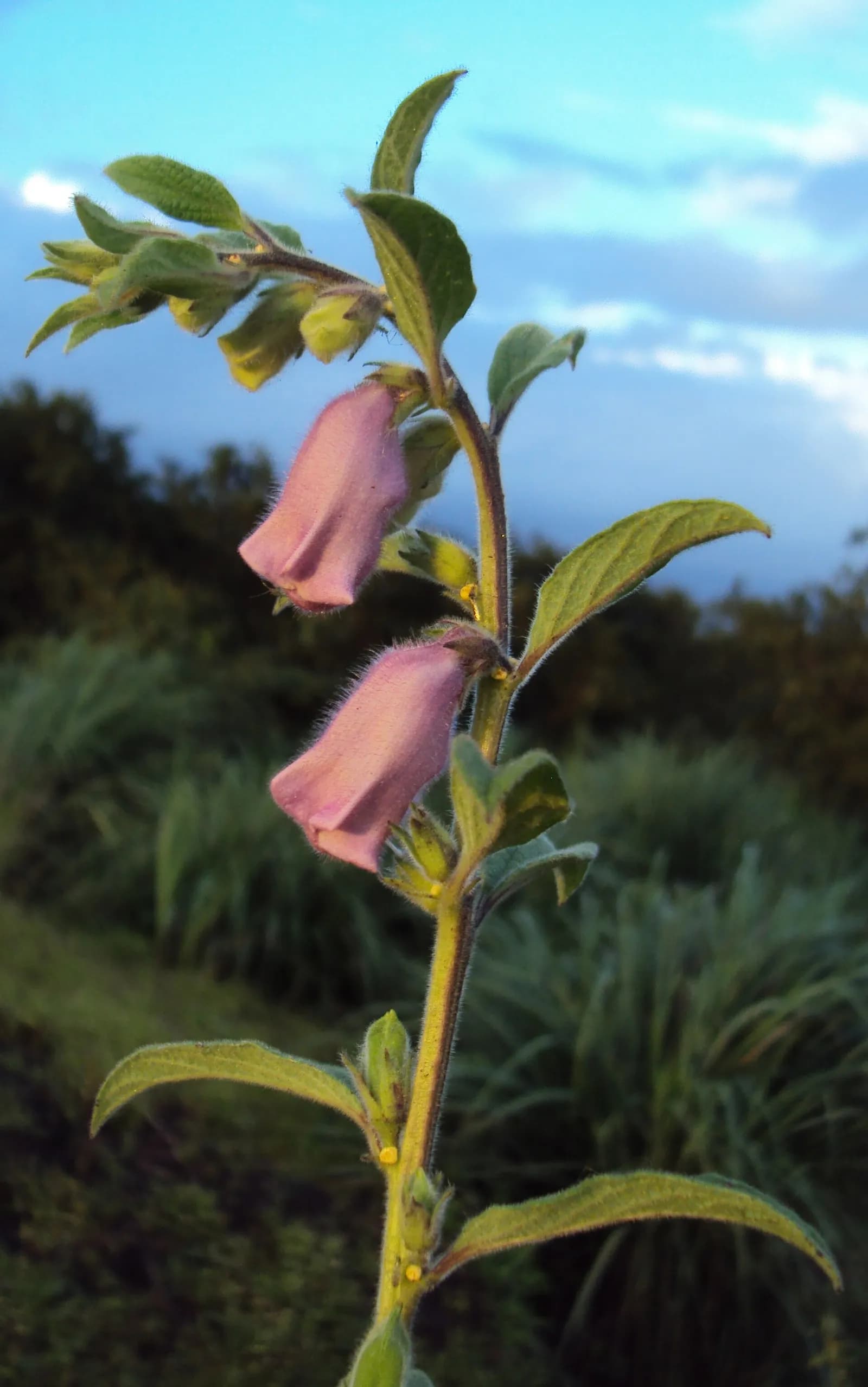
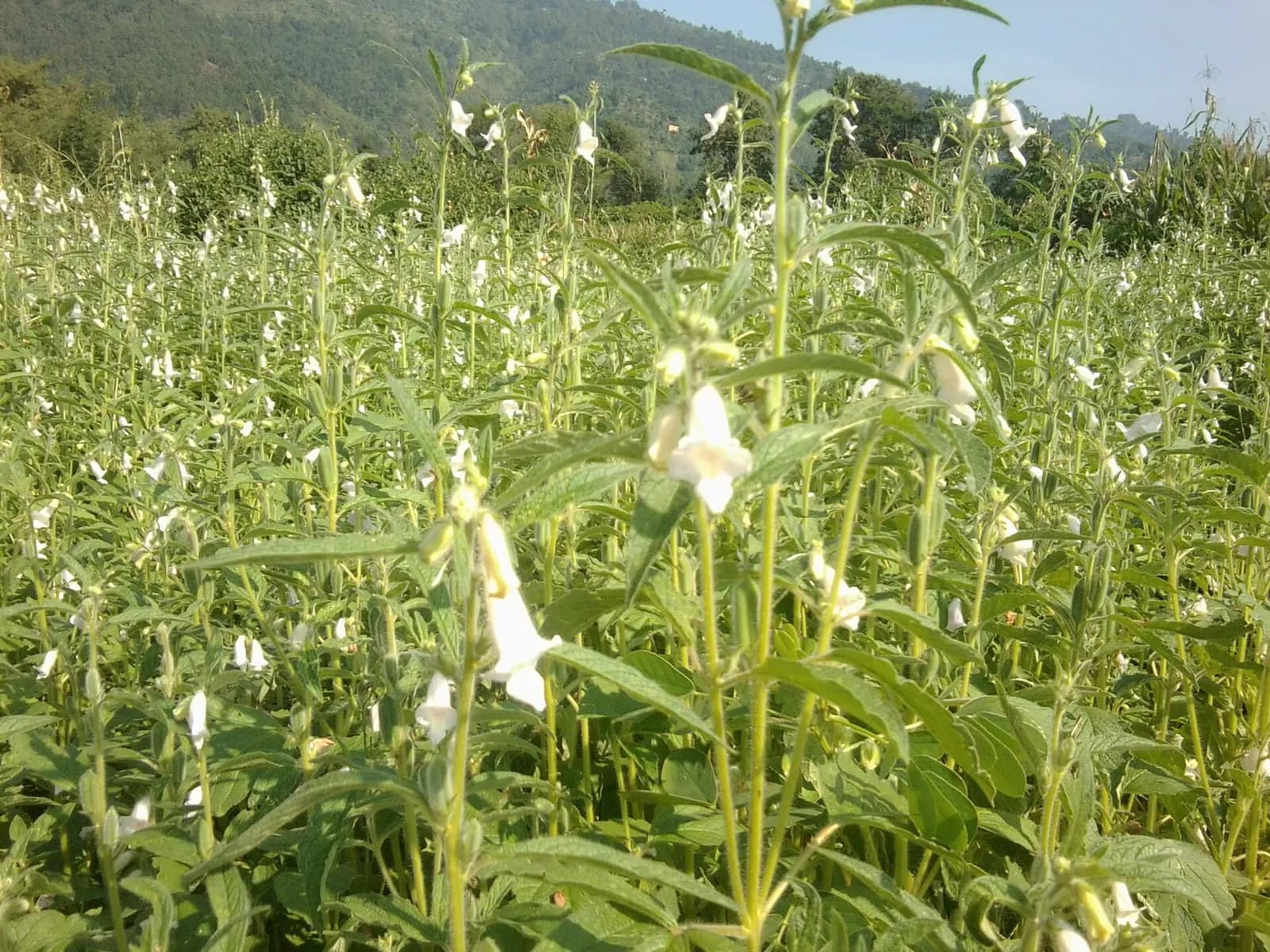
The small tubular flower of the sesame is one of those easily overlooked: whitish, with a pink or lilac cast, it hangs in the leaf axils, its corolla turned downward. But the poets of Vraja liken to it the nose of Radha. And the nose is the quiver of the god of love: narrow, turned downward, full of flower arrows. They fly out in the guise of Her smiles and strike the heart of Krishna without fail.
The Nose of Radha
When the poets of Vraja set about describing the beauty of Radha, they do not invent the images anew but give out a flower to each of Her features. The beginning was made by Srila Jayadeva Gosvami in the Gita-Govinda: there Krishna, making peace with the angry Radha, goes over Her face flower by flower.
bandhūka-dyuti-bāndhavo ’yam adharaḥ snigdho madhūka-cchavir
gaṇḍaś caṇḍi cakāsti nīla-nalina-śrī-mocane locanam
nāsābhyeti tila-prasūna-padavīṁ kundābha-danti priye
prāyas tvan-mukha-sevayā vijayate viśvaṁ sa puṣpāyudhaḥ
“Your lips, fiery One, are friends with the glow of the bandhuka, Your cool cheeks have taken the sheen of the madhuka flower, Your eyes have outshone the blue lotus, Your nose has become like the sesame flower, and Your teeth shine like the kunda jasmine. It seems that the flower-archer Kamadeva, having served Your face with his five arrows, has thereby conquered the whole universe.”
The Quiver of the God of Love
Here the whole face is taken apart into flowers: the lips are the bandhuka, the cheeks the madhuka, the eyes the blue lotus, the teeth the kunda, and between them the nose is the sesame flower. And at once it is said what the list is for: the five features of the face are the five arrows of Kamadeva. Bhaktivedanta Narayana Gosvami takes them one by one in his commentary, and to the sesame nose falls the “melting arrow” (dravana-bana), from which the hardness of the heart melts away1. From this line the sesame flower entered the poetry of Vraja – not as a plant but as a name for one feature of a face.
This comparison, though, Srila Jayadeva Gosvami did not invent but took up: it is older and had already settled into the dictionary. Monier-Williams, explaining the word tila, notes at once: “its blossom is compared to the nose”. And for the compound tila-pushpa, literally “sesame flower”, the second meaning given is “the nose”2. The poets of Vraja received the image ready-made.
Srila Krishnadasa Kaviraja Gosvami in the Govinda-lilamrita went further. If the nose is a sesame flower, narrow and turned downward, then what is it like? A quiver. And the whole description of Radha turns into a scene of the hunt:
amuṣyāḥ śrī-nāsā-tila-kusuma-tūṇo rati-pater
adho-vaktraṁ pūrṇaḥ kusuma-viśikhaiś citra-mṛgayoḥ
mukha-dvārā tasmāt smita-caya-miṣāt te nipatitāḥ
śaravyatvaṁ yeṣām alabhata hareś citta-hariṇaḥ
“Her nose is a sesame flower, the quiver of the god of love, turned downward and filled to the brim with the flower arrows of a wondrous hunter. Through the mouth, in the guise of smiles, these arrows fly out – and overtake the deer, the heart of Krishna.”
The Hunt for the Heart of Krishna
The image gathers into one the nose, the smile and its effect. The quiver hangs point downward, as a nose should; the arrows – Her smiles – pour out of the quiver’s “throat”, that is, from the mouth; and the hunter has but one target, the heart of Krishna, which darts about like a frightened deer.
Others took up the image. Srila Jiva Gosvami in the Gopala-champu, drawing the youthful beauty just beginning to open in Radha, sees the sesame flower – Her growing nose – shining tenderly, and below it the bimba fruit of Her lips hanging on a scarlet thread3. Srila Prabodhananda Sarasvati in the Vrindavana-mahimamrita puts a golden pearl ring on this flower-nose and calls it “the wondrous golden double quiver of Kamadeva”4. And Srila Rupa Gosvami in the Ujjvala-nilamani, a book on the poetics of love, quotes both the verse of Jayadeva and the verse of Krishnadasa Kaviraja as model descriptions of a heroine’s nose.
The Arrow of Kamadeva and the Nose of Krishna
Through the sesame flower the god of love enters the verses. The principal list of his five flower arrows is given by the Sanat-kumāra-saṁhitā, and it is quoted by Srila Vishvanatha Chakravarti Thakura in his Mantrārtha-dīpikā: the mango bud, the ashoka, the mallika, the madhavi and the bakula. The Gita-Govinda, for its part, reads the five by the features of Radha’s face: the lips, the cheeks, the eyes, the nose and the teeth, and the sesame nose among them is the “melting arrow”. The sense of this reading is the reverse of the usual one: Kama conquers the universe not by his own strength but because he has borrowed the weapon from the face of Radha. It is not that Radha is beautiful “like” the arrows of Kama, but that Kama is all-powerful only because he begs the arrows from Her.
The same flower describes the nose of Krishna Himself. When in the Govinda-lilamrita the turn comes to Him, Srila Krishnadasa Kaviraja Gosvami takes the same flower, but of another colour. In the golden Radha the nose is a pale sesame flower; in the dark-skinned Krishna it is the same flower, but of sapphire, turned downward, and He Himself is like one of the blue arrows of Kama5. One image in two colours binds the faces of the Divine Couple.
In the same chapter, a little earlier, he goes over what the moon lacks to pass for the face of Krishna: bandhuka lips, mirror cheeks, kunda teeth, bird eyes, a half-moon brow, Kama’s bow for eyebrows, a swarm of bees for hair, and a nose – a sesame flower. Then, he says, the best of poets might perhaps risk the comparison6.
Chaitanya Mahaprabhu
The flower came in useful for describing the form of Sri Chaitanya Mahaprabhu as well. In the Chaitanya-charitamrita, listing the marks of His golden beauty, Srila Krishnadasa Kaviraja Gosvami does not compare the nose with the sesame but sets it above the flower:
ājānulambita-bhuja kamala-locana
tila-phula-jini-nāsā, sudhāṁśu-vadana
“Arms reaching to the knees, lotus eyes, a nose that conquers the sesame flower, and a face like the moon.”
The phrase “conquering the sesame flower” (tila-phula-jini-nasa) is the same rasika device as in the earlier verses: the flower is named for comparison and at once turns out to be the lesser. In the form of Gaura, Radha and Krishna bring the old comparison with them, and once again it falls short.
Worship and Sesame Seeds
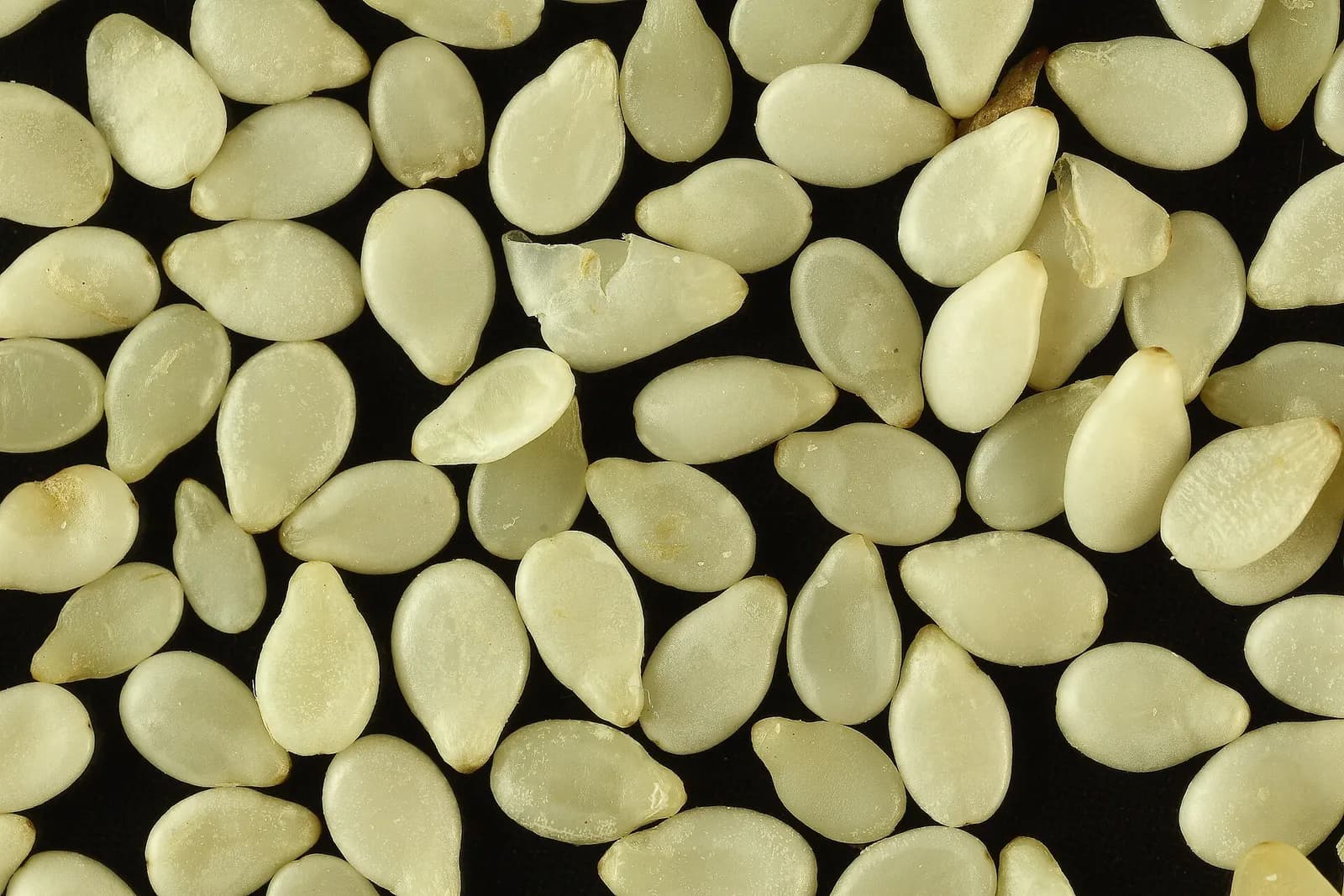
Outside poetry the sesame is valued not for its flower but for its seed. Srila Sanatana Gosvami in the Hari-bhakti-vilasa, gathering the flowers pleasing to Sri Govinda, enters the sesame in the list too, beside the malati, the kunda, the karnikara, the champaka, the ashoka and the bakula. But far more often it is the seed of the sesame itself (tila) that appears in the books on service. Of water, flowers, sesame seeds and rice the arghya is composed – the offering made when the Lord is greeted; with sesame, water and sandal the tarpana is performed in remembrance of the forefathers; on sesame oil a lamp is lit. The Hari-bhakti-vilasa even equates the merit of a daily gift of sesame with the worship of a shalagrama-shila7. An explanation of such honour is given by Monier-Williams’s dictionary: expounding tila, he cites the belief that the sesame was born from the drops of Vishnu’s sweat8.
Ayurveda
Ayurveda values in the sesame above all the seed and the oil. In taste (rasa) the sesame is sweet, in quality (guna) oily and heavy, in potency (virya) warming, and after digestion (vipaka) sweet again; it softens vata, and in excess inflames pitta and kapha. Sesame oil (taila) is held the best for anointing the body and the base of medicinal preparations for disorders of vata. It is not for nothing that the word taila itself, “oil”, grew out of tila, “sesame”: oil is sesame oil above all. Black sesame is placed above the rest. (The properties are after the Bhavaprakasha-nighantu; the talk is of the seed and the oil, not of the flower.)
Botany
Botanists know the sesame as Sesamum indicum of the family Pedaliaceae – an annual of 30 to 110 cm, from single-stemmed to branching; some cultivars stretch almost twice as high, to 185 cm. The flower is small, 1.5–3 cm, tubular, from white and pale pink to lilac and light purple, and in some cultivars lilac stripes or a dark edge run along the lower lip; it sits in the leaf axils, turned downward. It was this shape that suggested to the poets the image of the nose as a quiver. The sesame flowers after the sowing, and in India it is sown at several times: with the rains, before winter, and under irrigation in February. Hence the flora of Karnataka counts it as flowering all year round, while the flora of Gujarat sets the window at August–October. Then ripen the oblong capsules of 1.5–5 cm with a multitude of seeds – from white and cream to brown and black. It is for these seeds that the sesame is grown all over India; in Hindi it is called til, the white one – safed til.
Sources
We build Vrajapedia together – with stories, verses, photographs and parikrama experience. If you know something more, tell us and it will appear on this page.