Tulasi
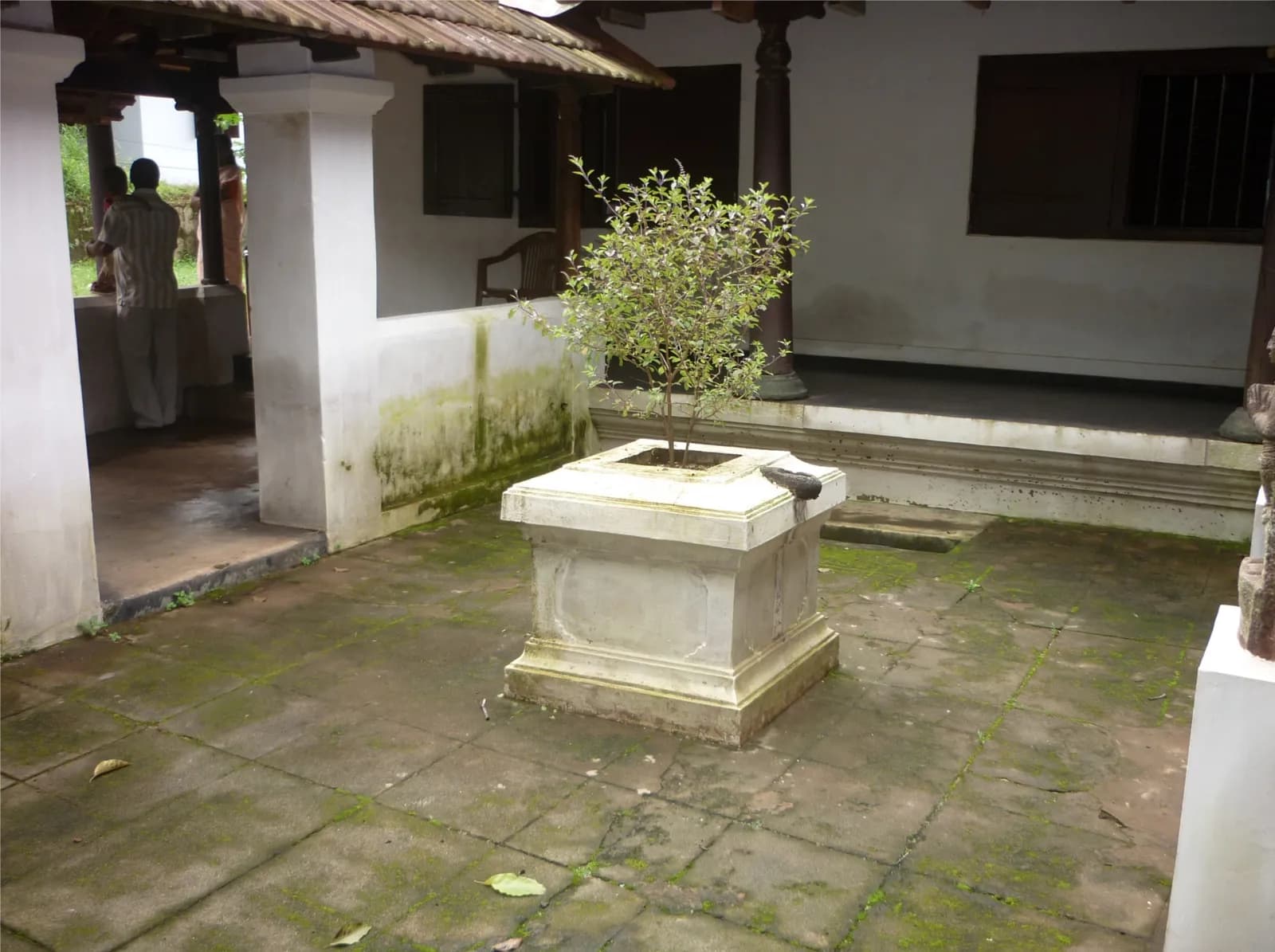
A modest little bush on a clay altar by a Vaishnava’s house – and the very one whom Krishna loves more than golden flowers studded with gems. Tulasi is not merely a plant of Vrindavana but its mistress: the forest is named after her, Vishnu Himself planted her here, and no offering to Him is made without her leaf. When the gopis lost Krishna on the night of the rasa-lila, they went round the whole forest asking after Him, but Tulasi they asked as a friend: she alone had been with Him, in the garland on His chest.
Tulasi in Vrindavana
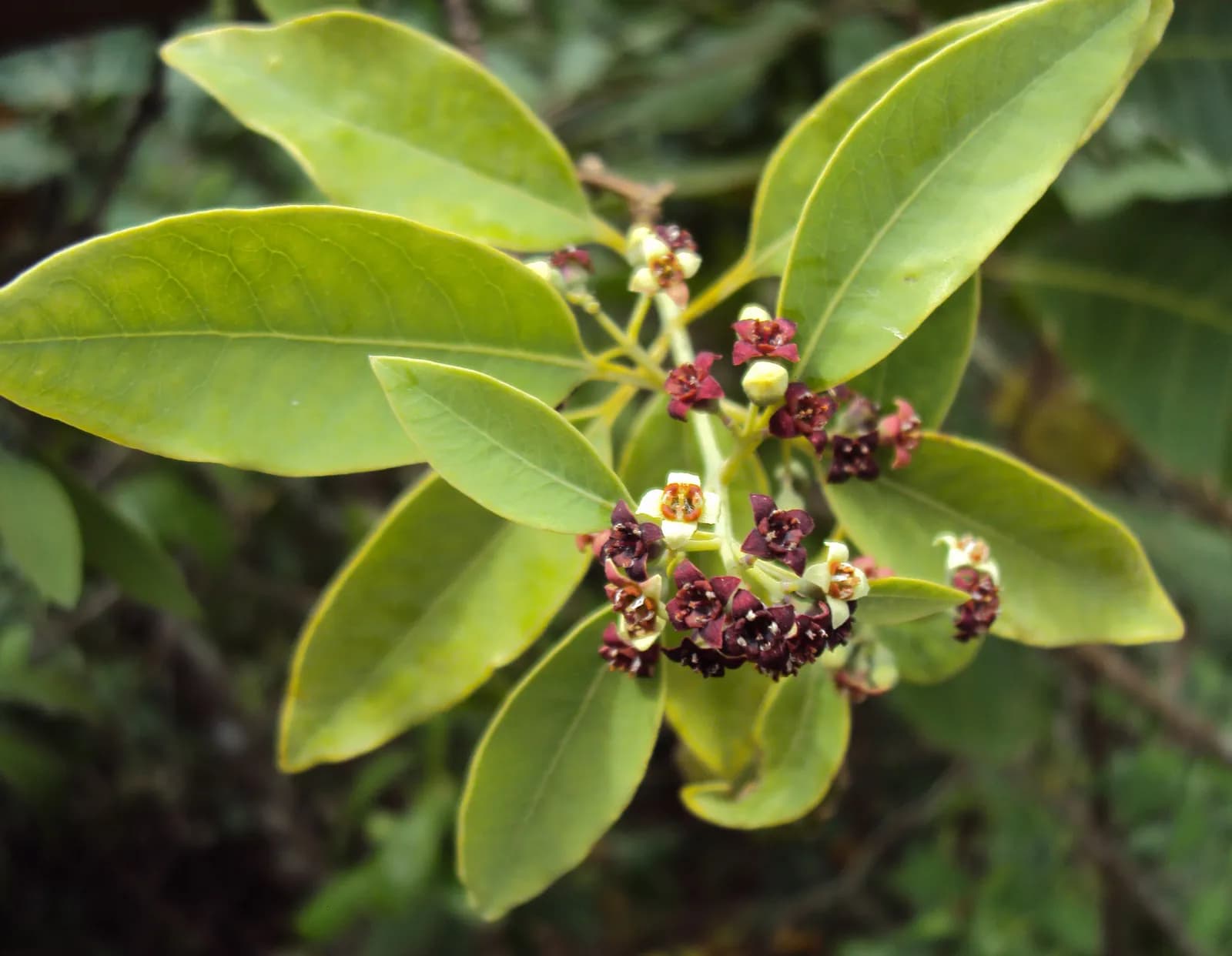
On the night of the rasa-lila Krishna suddenly disappeared, and the gopis, maddened by separation, rushed to look for Him all over the forest. They asked after Him of the trees, of the creepers, of the does – of everything they met on the way. But from the trees they got no answer: those stood silent, and the gopis decided that the trees were “of the masculine gender”, and therefore on Krishna’s side and would not give Him away. Then they came to Tulasi – as to a friend, as to one who must have seen Him.
kaccit tulasi kalyāṇi
govinda-caraṇa-priye
saha tvāli-kulair bibhrad
dṛṣṭas te 'ti-priyo 'cyutaḥ
“O most gracious tulasi, to whom the feet of Govinda are so dear, have you not seen Him, the infallible one, carrying you on His body and surrounded by a swarm of bees?”
A Fragrance the Bees Can Tell
Why to her in particular? Srila Vishvanatha Chakravarti Thakura in his commentary says out what the gopis left between the words: “We are unfortunate, because we are separated from Krishna. You alone are fortunate.” The reason for her good fortune is named at once – govinda-charana-priye, “she to whom the feet of Govinda are dear”. And then an almost jealous surmise: Krishna went away carrying her on His body, and did not drive off even the thousands of bees that circle around her fragrance. So, the gopis conclude, He left us only because we have no such perfume. In one address there is both tenderness and envy: of all whom Krishna loves, it is this unremarkable little bush that has come closest to His feet. And the name says the same: the Shabda-sagara dictionary derives tulasī from tulā, “comparison”, and the root ṣo, “to destroy”: she for whom no equal can be found.
With her fragrance there is a strangeness. Srila Vishvanatha Chakravarti observes: tulasi, for all her virtues, is not usually counted among the especially fragrant plants. But early in the morning she gives off a transcendental fragrance, inaccessible to an ordinary nose and perceptible only to liberated souls and to the bees allowed to circle around the Lord’s garlands. Of these bees there is another verse in the same canto:
darśanīya-tilako vana-mālā-
divya-gandha-tulasī-madhu-mattaiḥ
ali-kulair alaghu gītām abhīṣṭam
ādriyan yarhi sandhita-veṇuḥ
“Maddened by the divine, honey-like fragrance of the tulasi flowers of Krishna’s garland, the swarms of bees sing their loud songs for Him, and the most beautiful of all living beings, in approval and in gratitude for their singing, takes out His flute and begins to play on it.”
Planted by Vishnu Himself
But where did Tulasi come from in Vrindavana at all? Srila Jiva Gosvami in the Gopala-champu quotes a verse from the Skanda Purana in which Krishna, through the mouth of His servant, tells where she came from: she did not grow of herself but was planted and tended by the Lord Himself:
gavāṁ hitāya tulasī
gopīnāṁ rati-hetave
vṛndāvane tvaṁ vapitā
sevitā viṣṇunā svayam
“O Tulasi, for the good of the cows and for the love-play of the gopis you were planted in Vrindavana and tended by Vishnu Himself – so that Gokula might flourish and Kamsa be overthrown.”
Part of the Dhama Itself
For the cows, for the gopis, for the flourishing of Gokula – that is why Vishnu planted and watered this little bush with His own hands. Srila Prabodhananda Sarasvati in the Vrindavana-mahimamrita sees the whole forest so: Vrindavana “shines with countless divinely fragrant tulasi trees, dear to Krishna” – they are not decoration here but part of the dhama itself. By one tradition the very name of the forest came from her: the daughter of King Siradhvaja, named Tulasi, came here to perform tapasya in order to obtain the Lord as her husband – and the forest came to be called by her name.
Tulasi in Vrindavana has another, hidden form as well. In the pastimes that go on round the clock, among the maidservants of Radha there is a manjari named Tulasi. In the Krishna-bhavanamrita of Srila Vishvanatha Chakravarti she puts on Radha’s neck a garland of madhavi, and in the Nava-Vraja-mahima of Sivarama Swami, Radha, before entering Nanda’s kitchen in the morning, hands Tulasi Her wrap, Her rings and Her ornaments. In the Govinda-lilamrita of Srila Krishnadasa Kaviraja, Tulasi together with her friend Kasturi carries a garland of betel from Radha to Krishna – a quiet messenger between Them. So one name is borne both by the little bush on the altar and by the young maidservant who weaves its manjaris into garlands for her Mistress.
Worship
Tulasi is the only plant that is worshipped as a deity: she is circumambulated, bowed to, sung before. The reason is simple: without her leaf a Vaishnava will offer Krishna nothing at all. The Gautamiya Tantra, which Srila Sanatana Gosvami quotes in the Hari-bhakti-vilasa, says of it thus:
tulasī-dala-mātreṇa
jalasya culukena vā
vikrīṇīte svam ātmānaṁ
bhaktebhyo bhakta-vatsalaḥ
“The Lord, to whom His devotees are dear, gives Himself away entirely into the power of one who offers Him with love a single leaf of tulasi and a handful of water.”
One Leaf and Nine Services
Here one hears the words of Krishna Himself in the Bhagavad-gita: patram pushpam phalam toyam – “a leaf, a flower, a fruit or water, offered with love, I accept”1. Tradition reads “a leaf” here as a leaf of tulasi: one dark little leaf laid on top, and the offering is accepted. In the books on service the same thing is repeated again and again: a manjari of tulasi on Krishna’s head is dearer than millions of gold coins given in charity; a thousand blue lotuses offered for a hundred years running will not equal one of her leaves.
The service of Tulasi is set out in nine simple acts, and this list is given alike by Srila Rupa Gosvami in the Bhakti-rasamrita-sindhu and by the Garga-samhita2: to see her, to touch her, to remember her, to glorify her, to bow to her, to hear about her, to plant her, to water her and to worship her. Nothing complicated – and yet the Garga-samhita promises for it the fruits of piety accumulated over thousands of millions of yugas.
In the Garga-samhita the wise Chandranana instructs Radha Herself: “The service of Tulasi gives the greatest piety and good fortune – it grants the association of Sri Krishna.” If even the queen of Vrindavana is advised tulasi-seva as the way to Krishna, what is to be said of us. Hence too the Vaishnava custom of wearing round the neck the tulasi-kanthi-mala – beads turned from her woody stem: the Hari-bhakti-vilasa calls one who wears sanctified tulasi beads the best of Vaishnavas. And every morning the devotees sing her a short prayer in which Tulasi and Vrinda are one3.
The Goddess and the Manjari
Behind this little bush stands a goddess. The Gaudiya tradition identifies Tulasi with Vrinda-devi – the keeper of the forests of Vraja, the one who prepares the groves for the pastimes of Radha and Krishna. The Vaishnavas honour her with the title Maharani, “great queen”, on a par with the Yamuna; in one of the prayers she is addressed exactly so: tulasi maharani, vrinde maharani. The morning tulasi-arati begins with a request to Vrinda-devi for permission to serve the Divine Couple – because it is she who opens the way into her forests.
And the manjari who weaves flowers into Radha’s garlands has a third name as well. By the Gaudiya tradition Tulasi-manjari is the siddha form of Raghunatha dasa Gosvami, who in the inner pastimes is also called Rati-manjari. So behind one name there stand three: the plant, the keeper of the dhama and the eternal maidservant of Radha.
Chaitanya Mahaprabhu
The same thought – serve Tulasi and you will come to Krishna – stands in the well-known story of a conversion from the days of Mahaprabhu. Haridasa Thakura, settling in a forest hut, planted a tulasi bush by his threshold and every day repeated three hundred thousand names of the Lord before it. When a local prostitute came to seduce him and, failing, kept coming again and again, Haridasa gave her the same simple prescription: “Repeat the name unceasingly and serve Tulasi – water her and pray to her, and soon you will find shelter at Krishna’s feet.” The woman began to bow to the tulasi, to circle round her, to listen to the holy name – and was changed utterly, showing the signs of love of God.
And the Gaura-lila too began, according to the Chaitanya-charitamrita, with a leaf of tulasi: Advaita Acharya, grieving over the fallen world, took a vow to bring Krishna down to the earth – and day after day worshipped the Lord, offering Him only water of the Ganges and leaves of tulasi. That proved enough to summon the Supreme.
Beyond Vraja
The glory of Tulasi is not confined to Vrindavana. In the Third Canto of the Bhagavatam the four Kumaras, entering Vaikuntha, see something remarkable: even the flowers of paradise there do not envy her but honour her:
mandāra-kunda-kurabotpala-campakārṇa-
punnāga-nāga-bakulāmbuja-pārijātāḥ
gandhe 'rcite tulasikābharaṇena tasyā
yasmiṁs tapaḥ sumanaso bahu mānayanti
“Although the mandaras, kundas, kurabakas, utpalas, champakas, arnas, punnagas, nagakeshavas, bakulas, lilies and parijatas put forth their flowers, which give off a transcendental fragrance, they are always mindful of the austerities performed by tulasi, for they see that the Lord shows her an evident preference, adorning Himself with garlands of her leaves.”
The Austerity That Heaven Honours
The mandara and the parijata are heavenly trees, each with its own famed fragrance; and yet what they honour is not their own scent but the austerity of tulasi. Srila Vishvanatha Chakravarti goes further: even the residents of Vaikuntha, seeing this, begin to dream of being born on the earth of Bharata in order to perform such an austerity – and so the land where tulasi grows is in some way higher than Vaikuntha itself.
Where does this power of hers come from? The Skanda Purana traces it to the beginning of time: in the churning of the ocean of milk, for the good of all living beings, Vishnu created tulasi – a plant in which the essence of all healing herbs is gathered. And the story of how the goddess Vrinda, the chaste wife of the demon Jalandhara, by the mercy of Vishnu became in her next life his beloved Tulasi, lives in the Kartika-mahatmya of the Padma Purana.
Ayurveda
That “essence of all healing herbs” of which the Skanda Purana speaks, Ayurveda sets out in the dry language of properties. In taste (rasa) she is pungent and bitter, katu and tikta; in quality (guna) light, dry and penetrating; in potency (virya) hot, ushna; the after-taste (vipaka) is pungent as well, katu. She pacifies vata and kapha but excites pitta. In the Raja-nighantu (10.148–149) she has some thirty names – Surasa, Surabhi, Vishnu-vallabha, Pavitra and others; she is described too by the Bhavaprakasha-nighantu and by the classical Charaka- and Sushruta-samhitas.
Tulasi is used above all for diseases of the breath: cough, asthma, bronchitis. She goes as well against fever and headache, to kindle the digestive fire, as a remedy for infections and for anxiety. The leaves, the seeds, the root and the woody stem, from which beads are turned, are all used.
Botany
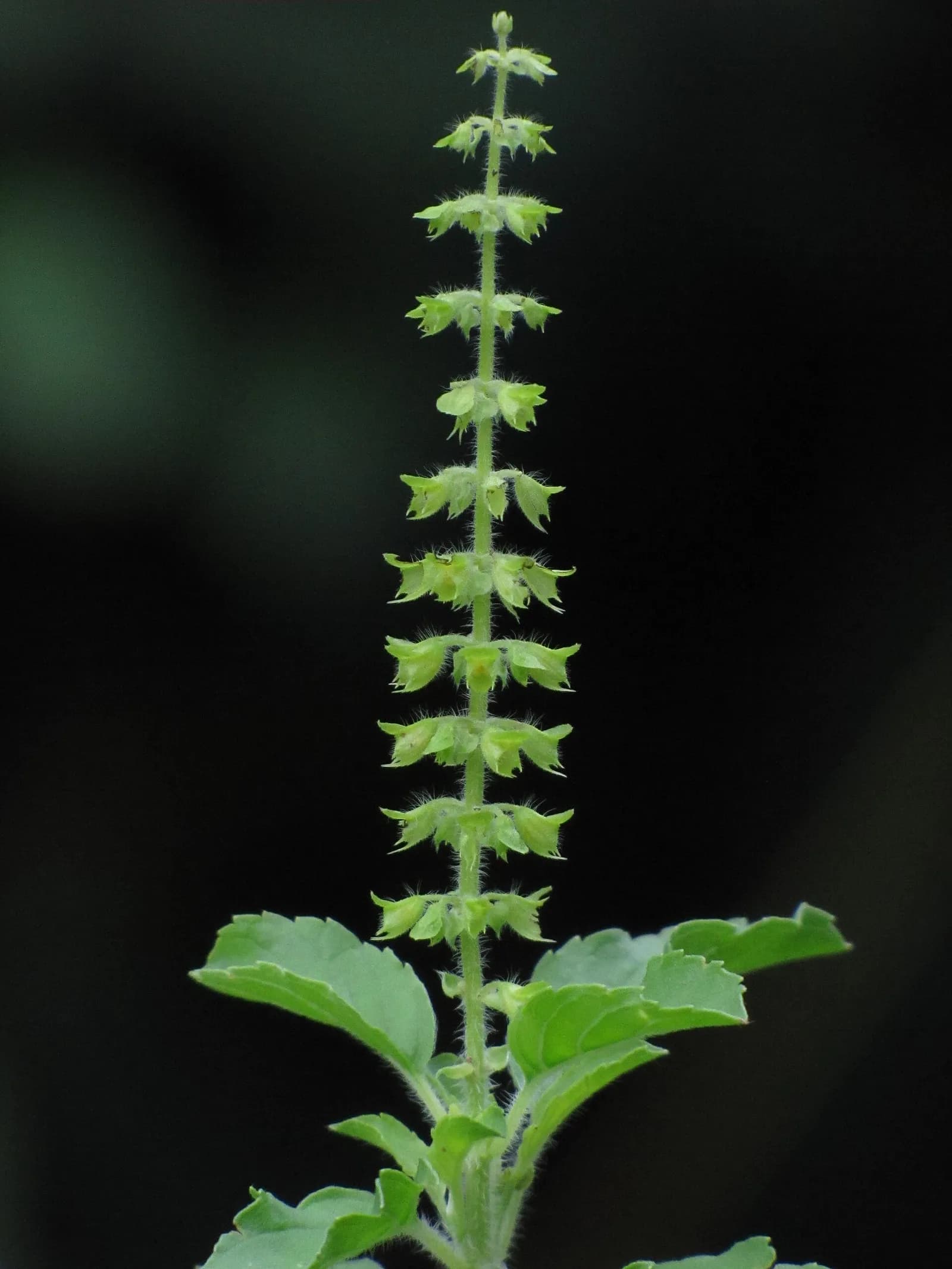
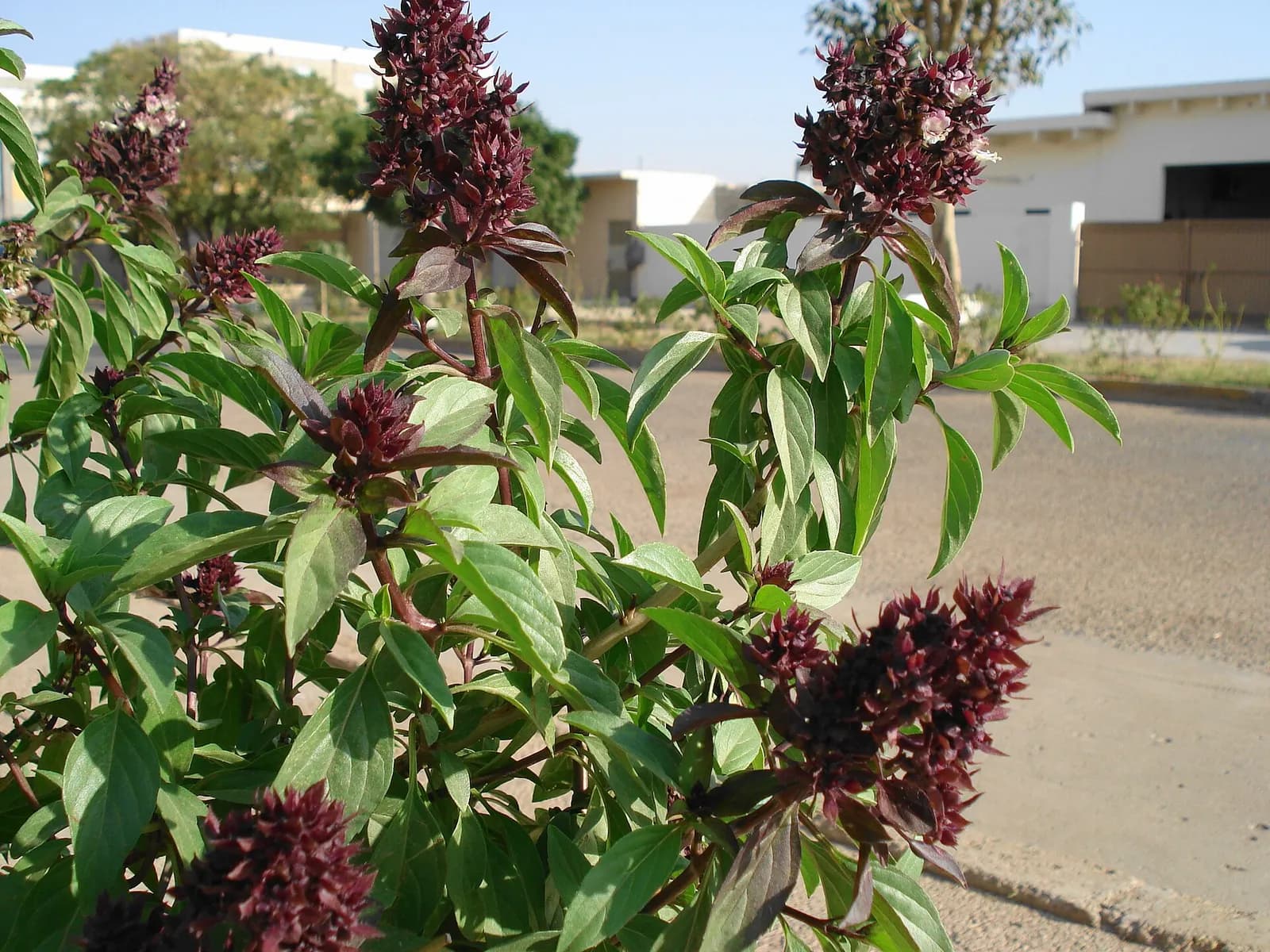
Botanists know Tulasi as Ocimum tenuiflorum – the name Linnaeus gave her back in 1753, in his Species Plantarum. In books about her another one stands more often, Ocimum sanctum: the same plant, only its second name spread wider than the first. The family is Lamiaceae. It is indeed a basil: her nearest kin is the garden Ocimum basilicum, and further off in the family, mint and sage. The plant is erect and much-branched, 30–100 cm tall, woody at the base of the stem – which is why the handbooks call it now a herb, now an undershrub. It is downy all over, from stem to leaf; the scent comes from the essential oil in the leaves: rub a leaf and the scent comes. The leaves are almost round, up to five centimetres, with an entire or toothed margin; they grow in pairs, and each pair is turned across the next. The flowers are small, up to four millimetres, white or lilac; the whole spike may be lilac as well. Two forms are distinguished: the green one (Rama- or Sri-tulasi) and the dark one, with a purple cast to the leaf (Krishna- or Shyama-tulasi) – both these names mean “dark”. She grows all over India, from sea level up to two thousand metres.
Sources
We build Vrajapedia together – with stories, verses, photographs and parikrama experience. If you know something more, tell us and it will appear on this page.