Suvarna-champaka
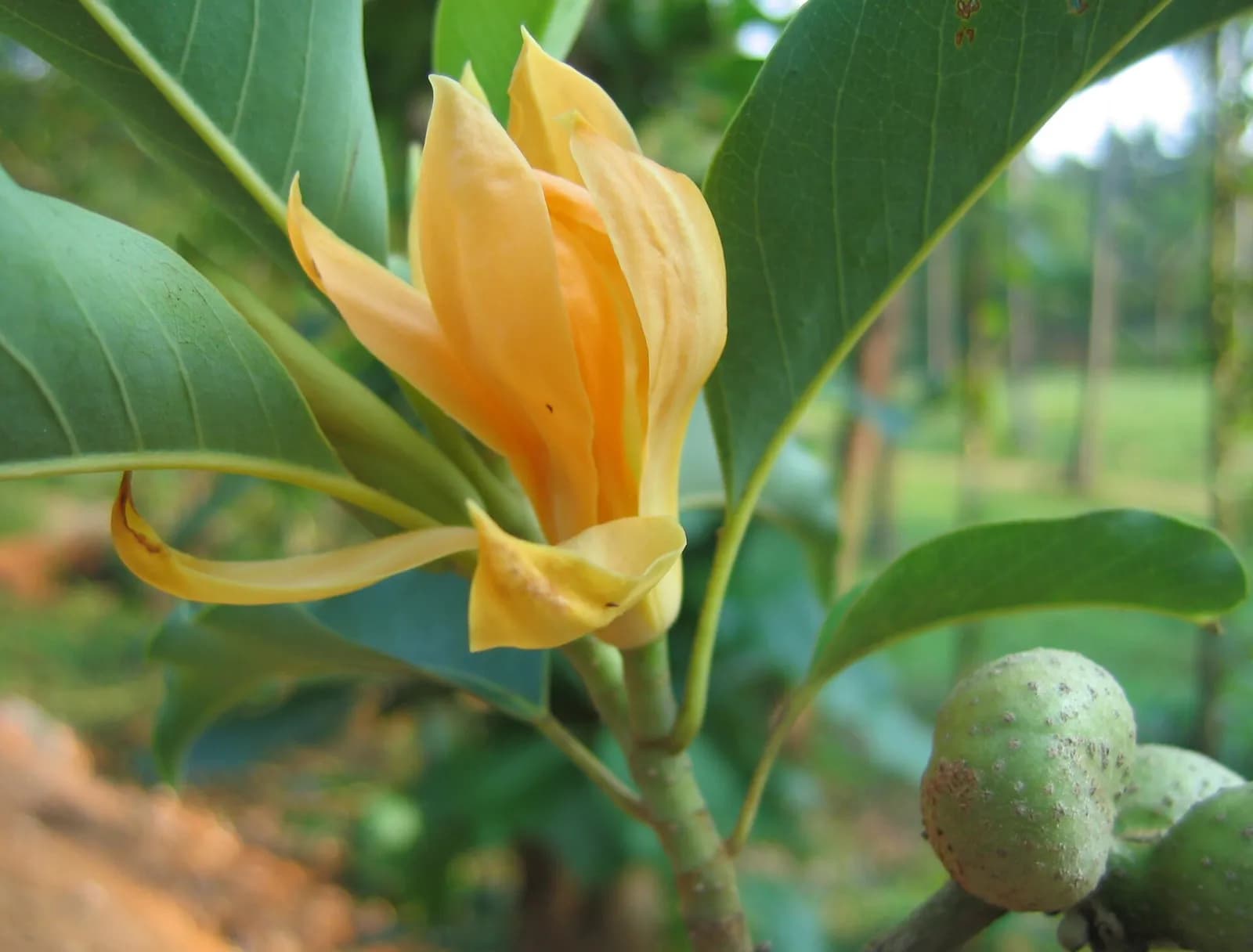
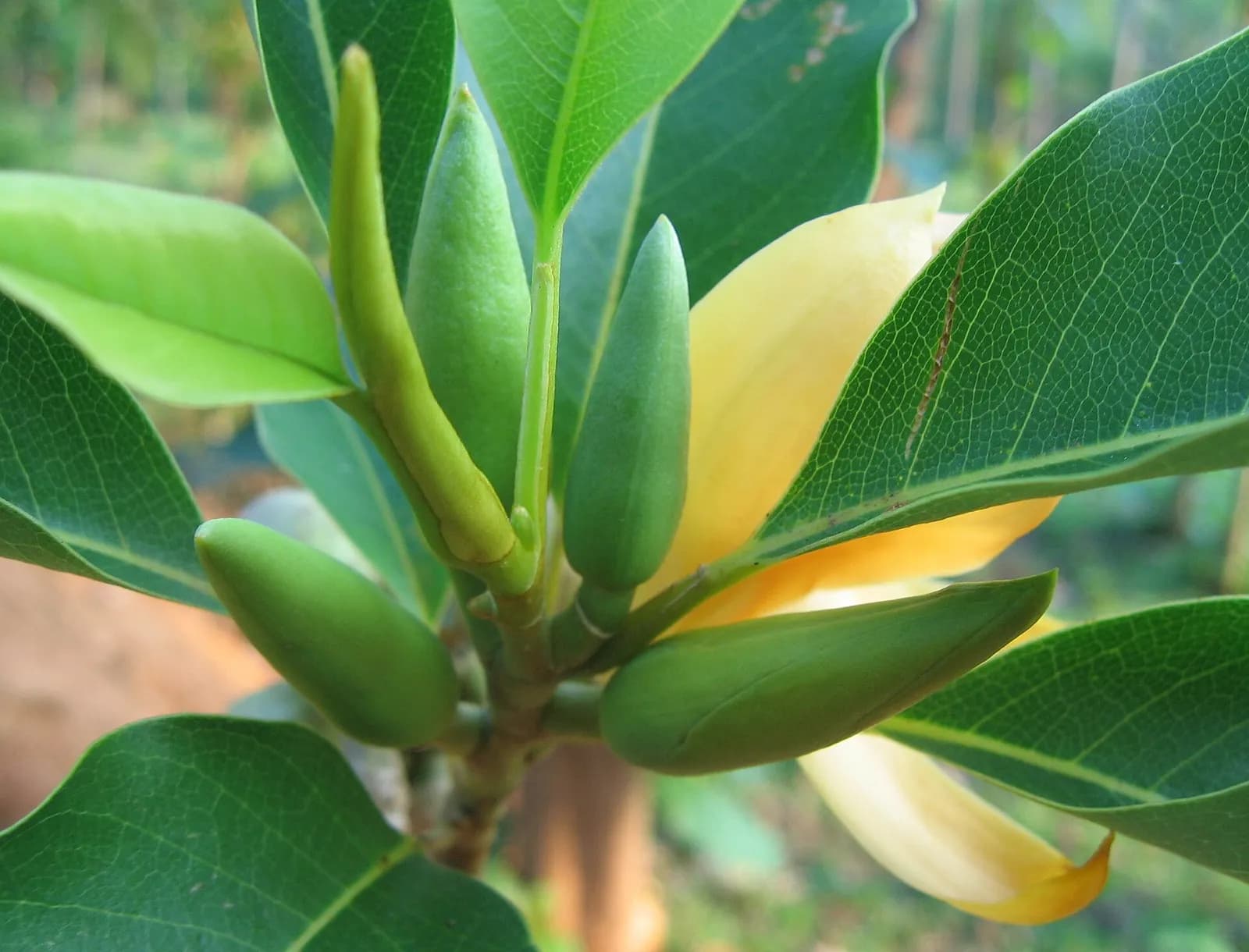
Suvarna-champaka means “the golden champaka”: the name is given for the colour. A fresh flower burns with a warm, living gold, and that gold the poets gave to Radha: Her body shines like a champaka flower, and from that light the whole forest turns golden. And beside Her, dark as a thundercloud, the tamal: Krishna. That is how the pair is read: the golden champaka and the blue lotus, the dark tree and the golden creeper that winds about it. And at once a word about the confusion. In India today “champa” is the name of the plumeria – low trees with thick bare branches and white fragrant flowers, which now stand everywhere. They were brought from America and have nothing to do with the shastras. The champaka of the verses is another tree, a tall forest magnolia with narrow golden flowers.
Contents
- 01The Golden Flower of Radharani
- 02Two Colours Seek Each Other
- 03The Champaka and the Tamal
- 04The Tree and the Creeper
- 05Krishna in Champaka Flowers
- 06Garlands, Earrings, a Crown
- 07The Golden Bowers of Radha-kunda
- 08The Gopis Ask the Champaka
- 09Five Trees – Five Arrows
- 10Worship
- 11Chaitanya Mahaprabhu
- 12Beyond Vraja
- 13Ayurveda
- 14Botany
- 15Sources
- 01The Golden Flower of Radharani
- 02Two Colours Seek Each Other
- 03The Champaka and the Tamal
- 04The Tree and the Creeper
- 05Krishna in Champaka Flowers
- 06Garlands, Earrings, a Crown
- 07The Golden Bowers of Radha-kunda
- 08The Gopis Ask the Champaka
- 09Five Trees – Five Arrows
- 10Worship
- 11Chaitanya Mahaprabhu
- 12Beyond Vraja
- 13Ayurveda
- 14Botany
- 15Sources
The Golden Flower of Radharani
The gold of the champaka is not an ornament of Radha but Her very colour: the body of Radha is that gold. Srila Prabodhananda Sarasvati said of it thus:
nava-campaka-gaura-kāntibhiḥ
kṛta-vṛndāvana-hema-rūpatām
bhaja kām api viśva-mohinīṁ
madhura-prema-rasādhi-devatām
“Worship the mistress of sweet prema who enchants the whole world – Sri Radha, who with the radiance of Her body, the radiance of a fresh golden champaka, turns the whole of Vrindavana into gold.”
Two Colours Seek Each Other
Call Radha a golden champaka, and Krishna, the blue lotus, at once stands beside Her. The two colours seek each other. Srila Prabodhananda returns to this pair in the Vrindavana-mahimamrita again and again: he prays for the day when the Couple, “whose radiance puts to shame the golden champaka and the blue lotus”, will appear to him in the forest bowers by the Yamuna1. The same in the verse of meditation on Radha by Srila Vishvanatha Chakravarti: Her beauty puts to shame at once the lightning, the champaka, gold and kunkuma.
Most often these two flowers meet in his own Krishna-bhavanamrita. In a bower before dawn the jewelled lamps make Krishna a blue lotus and Radha a golden champaka. When She puts the hair back from Her face, Her fingers are like champaka buds. And on the swing Their bodies, “like a single blue lotus and a single golden champaka”, merge into one, and the fragrance reaches the heavens.
The Champaka and the Tamal
In the verses the champaka is called a creeper again and again: champaka-valli, champaka-lata. In fact it is a tall tree. But the image needs a creeper, one that winds about a support and does not live without it – and so they write. The darkest tree of Vrindavana is the tamal, of Krishna’s colour. Hence the image: the golden champaka wound about the dark tamal is Radha embracing Krishna.
In the Gopala-champu of Srila Jiva Gosvami a whole scene comes out of this. Radha is in separation and cannot meet Krishna. She writes a short message on a champaka creeper, and Vrinda shows it to Krishna:
vṛndāvane tamālas tvam
ahaṁ campaka-vallikā
agayor nau mithaḥ saṅgo
vṛndayaiva na cānyathā
“In Vrindavana You are the tamal tree, and I am the champaka creeper. We are both unmoving – and only Vrinda can bring us together, in no other way.”
The Tree and the Creeper
The tree and the creeper cannot come together by themselves – they are brought together by Vrinda-devi, the arranger of the forest pastimes. That is what Radha asks for.
In the Madhava-mahotsava Srila Jiva Gosvami leads the reader through the chambers of the bowers, and the sixth is “the chamber splendid with champaka creepers embracing tamala trees; thinking that it holds the complexions of you both, this creeper house is drenched in tears”2. The sakhis in the Gopala-champu observe: to look at, Radha is “a golden champaka that plays at placing herself below Krishna the tamal”, yet by Her love She brings Krishna under Her sway. And the forest gives away their secret: on the tamals there are traces of kunkuma, and “on all the champaka creepers the leaves are scratched by nails”.
Krishna in Champaka Flowers
Not Radha alone. Krishna too is never parted from this flower: garlands and earrings of champaka are His favourite ornament. The stanza of Purushottamadeva in the Padyavali draws Him exactly so:
adhare vinihitaṁ vaṁśaṁ
campaka-kusumena kalpitottaṁsam
vinatam dadhānaṁ aṁsaṁ
vāmaṁ satataṁ namāmi jita-kaṁsam
“With a garland of champaka flowers on His gently sloping shoulders He raises the flute to His lips. Eternally I bow before Krishna, the conqueror of Kamsa.”
Garlands, Earrings, a Crown
Srila Rupa Gosvami in the Stava-mala sings of the child of Yashoda “in shining champaka earrings”, and of the grown Krishna with a champaka garland that “sways in His pastimes” through the bowers of Govardhana. In the Govinda-lilamrita of Srila Krishnadasa Kaviraja Gosvami, Vrinda-devi brings Krishna two champaka flowers to adorn His ears, and, catching sight of Radha coming, He takes them off and gives them to Her. In Srila Jayadeva Gosvami the fourteenth canto of the Gita-Govinda is named after this adornment – “Hari-ramita-champaka-shekhara”, “Hari crowned with champaka”.
This gold has another side as well. The sakhis in Srila Rupa Gosvami’s play Vidagdha-Madhava are adorning Radha, Vrinda shows a tender yellow bud, and Krishna answers: it is “like the golden shakti of Kamadeva, which troubles the hearts of proud maidens”3. In Radha this colour is pure sweetness, while in the god of love it is a weapon.
The Golden Bowers of Radha-kunda
Describing the groves around Radha-kunda, Srila Krishnadasa Kaviraja Gosvami sets the champaka where everything turns golden. On the southern bank of the pond the swing of the Couple is hung from two champakas. The western bower is called Hemambuja, “the Golden Lotus”: it is roofed with champakas, and the gold is within it and without. And the Hema-kunja, the “golden bower” to the south of the pond, turns everything around it to gold, like the land of Kanchana-bhumi.
Every kunja has its mistress and its maidservant. The suvarna-champaka grows in the kunja of Vishakha, and it is tended by Vilasa-manjari – a young maidservant of Radha in the eternal lila; tradition identifies her with Srila Jiva Gosvami.
The Gopis Ask the Champaka
In the Srimad-Bhagavatam the champaka appears at a moment of separation. In the midst of the rasa-lila Krishna suddenly disappears, and the gopis, maddened, look for Him all over the forest, addressing the trees as living beings:
Five Trees – Five Arrows
Srila Vishvanatha Chakravarti Thakura remarks: the trees are not chosen at random. They “serve their guests the bees, offering them nectar”, therefore they are kind of heart, therefore they will tell. He explains what followed as well: the wind swayed the treetops, the gopis took it for a shaking of the head and ran on.
Vallabhacharya and Narayana Bhatta Gosvami read this list differently: those five trees that the gopis call upon are the five arrows of the god of love, with whose fragrance he strikes hearts. The nagakesara stands in the verse under the short name naga. The principal list of the arrows is given by the Sanat-kumāra-saṁhitā, and it is quoted by Srila Vishvanatha Chakravarti Thakura in his Mantrārtha-dīpikā: the mango bud, the ashoka, the mallika, the madhavi and the bakula, one flower to each letter of the kāma-bīja.
Worship
The flowers of the champaka go to Krishna in worship as well. Srila Sanatana Gosvami gathered in the Hari-bhakti-vilasa many promises from the Puranas for such an offering. From the Skanda Purana: to offer a champaka to Janardana is the same as offering Him a blue lotus; and whoever honours Hari with champaka flowers in the rainy season returns no more to the round of births. The champaka stands too in the lists of Govinda’s favourite flowers, beside the bhu-champaka, the “earth champaka”: which, despite its name, is no kin of the tree but a herb of the ginger family. It is not for nothing that the champaka itself blossoms in exactly that rainy time of which the verse speaks.
Chaitanya Mahaprabhu
The gold of the champaka reached the Gaura-lila as well. The colour of the body of Sri Chaitanya Mahaprabhu is conveyed by Srila Krishnadasa Kaviraja Gosvami in a single word: champaka-gaura, “golden as the champaka”. And he puts that word where the Lord meets Sanatana Gosvami for the first time:
taṁ sanātanam upāgatam akṣṇor
dṛṣṭa-mātram atimātra-dayārdraḥ
āliliṅga parighāyata-dorbhyāṁ
sānukampam atha campaka-gauraḥ
“As soon as Sanatana came before Him, the Lord, whose colour is that of a golden champaka flower, stretched out His arms, broad as clubs, and with great love embraced him.”
In that one word is the whole of Gauranga: outwardly the gold of Radha, within Krishna. And in Gaudadesha the champaka is recalled by the grave of Chand Kazi, the magistrate whom Mahaprabhu converted by His sankirtana. It is still shown near Mayapur under a champaka tree and called “the samadhi of Chand Kazi”.
Beyond Vraja
The champaka blossoms outside Vrindavana as well. In the Srimad-Bhagavatam it adorns, together with the kadamba, the ashoka and the bakula, the lake Bindu-sarovara, where the sage Kardama performed his austerities. And the four Kumaras, entering the spiritual kingdom, see the champaka among the most fragrant flowers, beside the mandara, the kunda, the punnaga, the nagakesara and the parijata. And all of them, for all their fragrance, honour the austerity of the modest tulasi: the Lord shows her an evident preference, adorning Himself with a garland of her leaves.
Ayurveda
In Ayurveda the champaka is bitter, pungent and astringent in taste (rasa: tikta, katu, kashaya), light and dry in quality, cooling in potency (virya – shita), with a pungent after-taste (vipaka). It pacifies kapha above all. The flowers, the bark of the trunk and the bark of the root are used: they are put into remedies for skin diseases, digestive disorders and fever, and are valued as a cleanser of toxins. But the champaka is famous not for medicine – for fragrance.
Botany
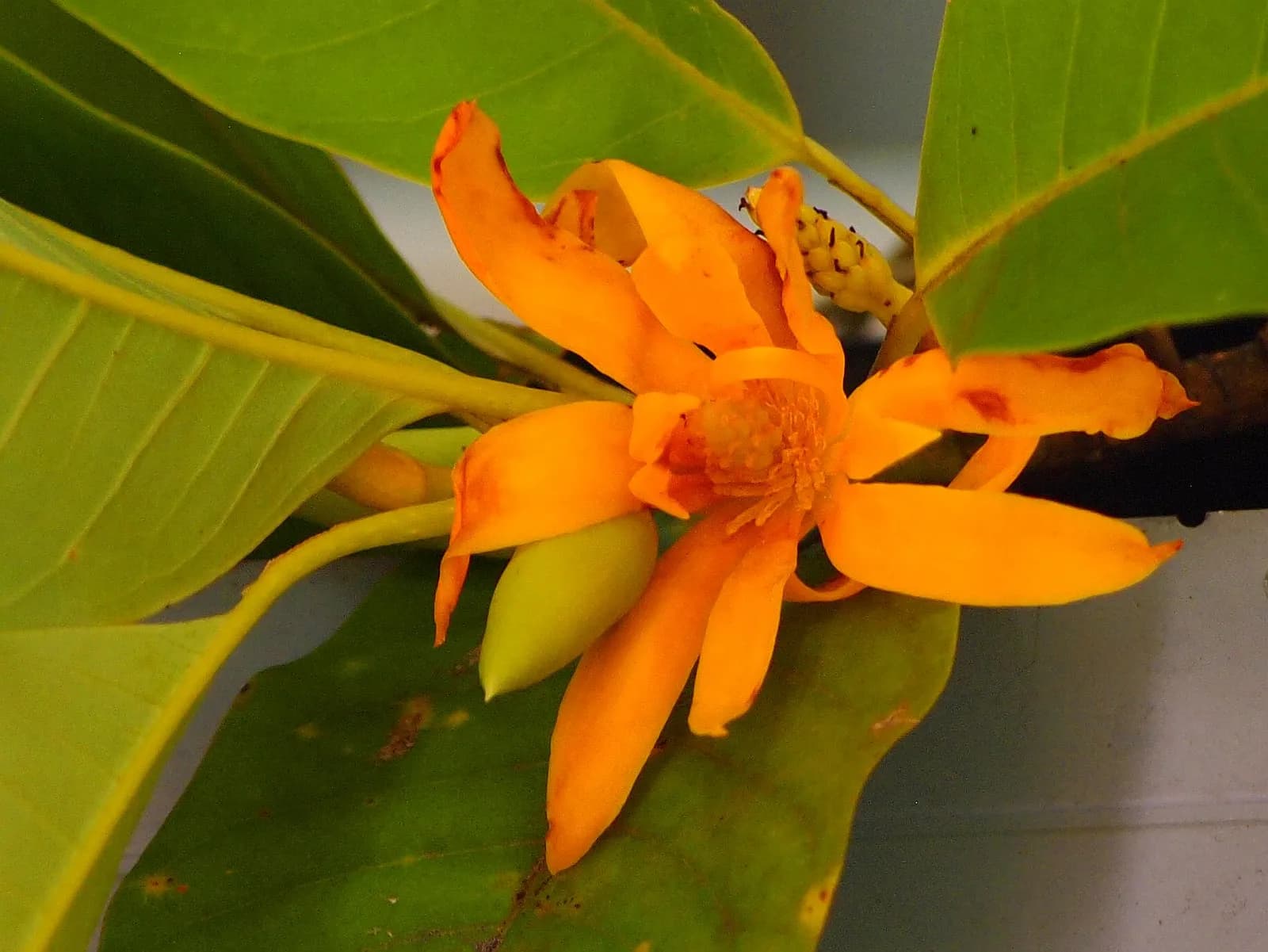
The suvarna-champaka is Magnolia champaca (formerly Michelia champaca) of the magnolia family, a tree up to fifty metres tall, with a trunk almost two metres thick. The flower is striking: fifteen to twenty petals, each two to four centimetres long and barely half a centimetre wide. It is for their colour that the tree is called “the golden champa” (son champa). The flowers smell strong and sweet, and the champaka blossoms in the wettest time, in June and July. Its range is wide: the Himalayas and Tibet, the north-east and the south of India, southern China, the whole of South-East Asia from Myanmar and Thailand to Java and Borneo. In the mountains it rises to one thousand three hundred metres. From its flowers the famous attar has been made for centuries – that very scent which in the poetry of Vraja accompanies Radha.
And one last thing. The “champa” which everyone in India knows today is not this tree. That is the name of the plumeria (Plumeria), the frangipani: low trees with thick bare branches and white or pink flowers, which now stand everywhere – by temples, in gardens, along the roads. Its homeland is tropical America, and it reached India only after the discovery of the New World, so it cannot be in any shastra. The champaka of the verse of Vraja is always the magnolia, a tall forest tree with narrow golden flowers.
Sources
We build Vrajapedia together – with stories, verses, photographs and parikrama experience. If you know something more, tell us and it will appear on this page.