Tal
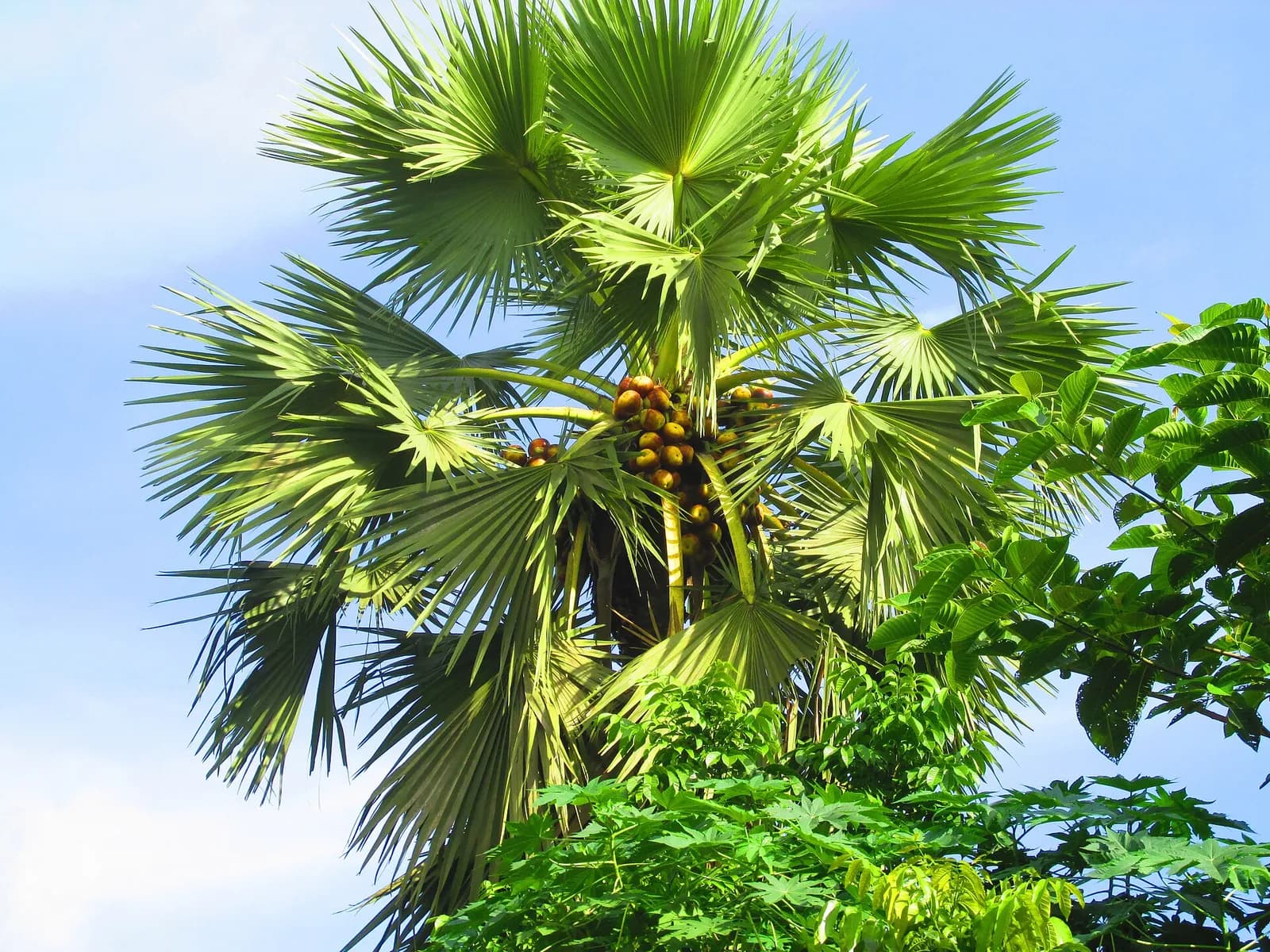
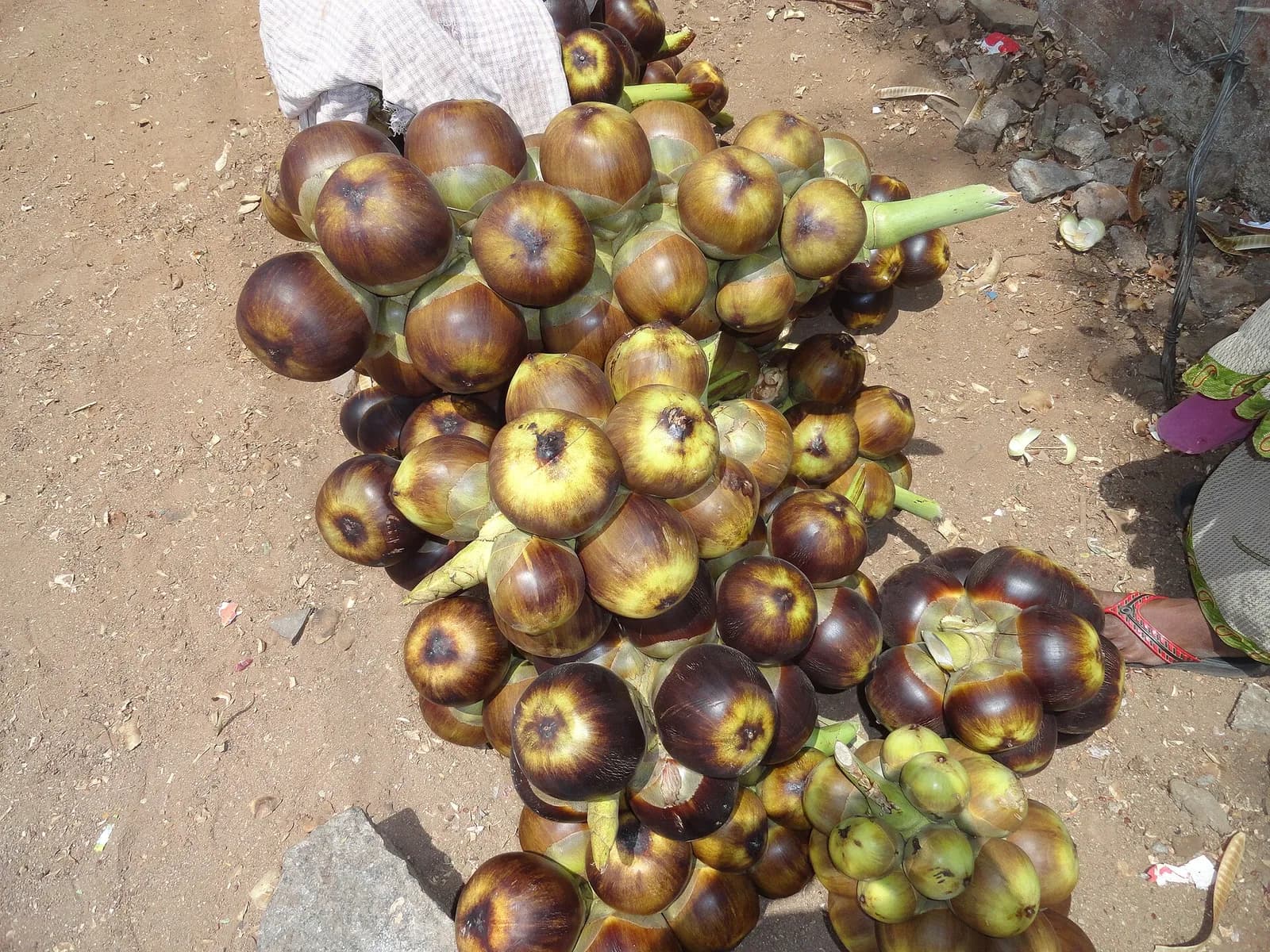
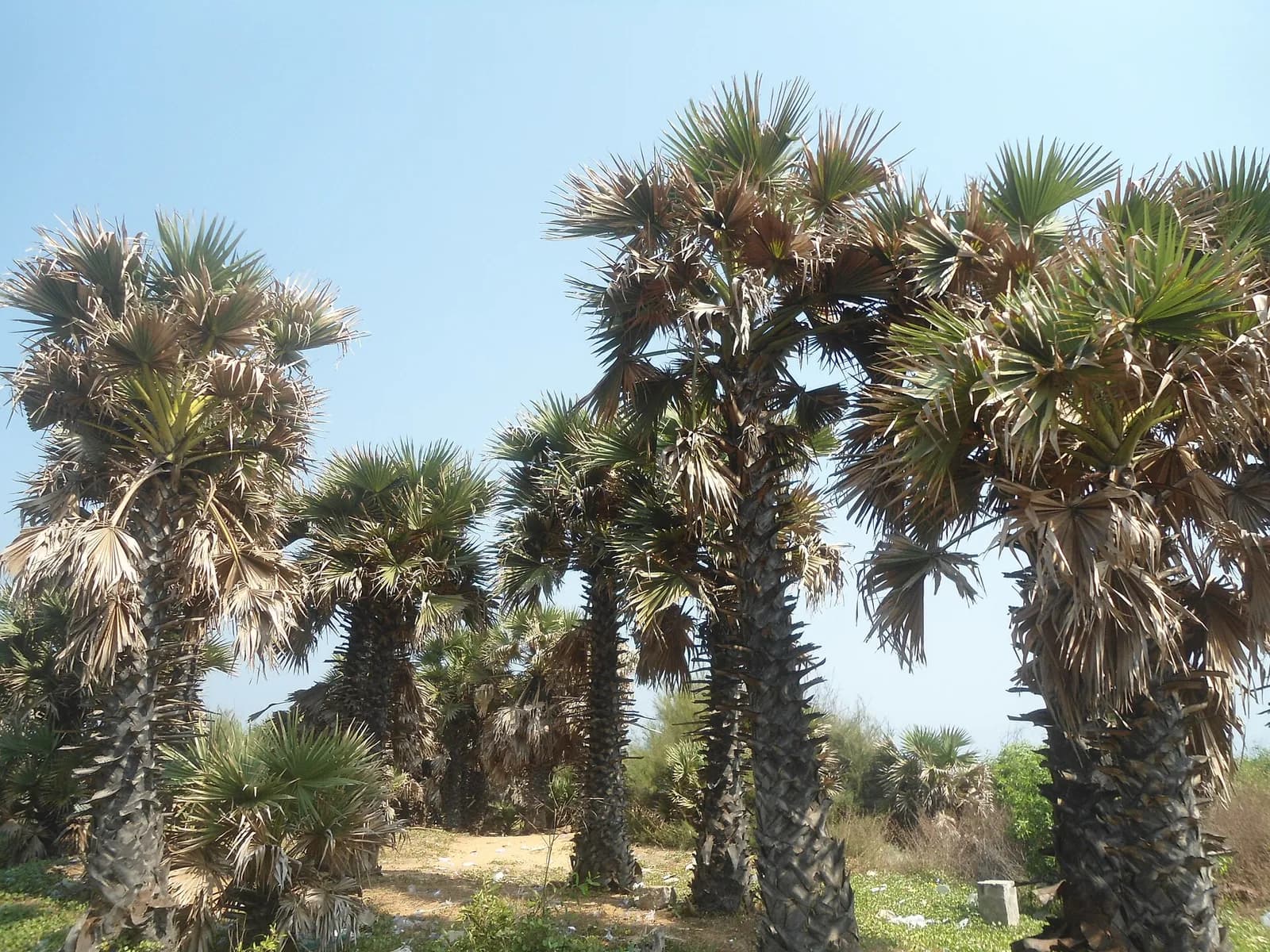
The tal is a tree like a column: a bare trunk of thirty metres without a single branch, and only at the top a fan of stiff leaves and clusters of heavy dark fruits. A whole forest of such palms west of Mathura gave its name to the second of the twelve forests of Vraja – Talavana, “the palm forest”. Here the ripe fruits of the tal smelled so that the scent carried for a mile, and the cowherd boys could not wait to get at them; and here Balarama, seizing the ass-demon by the hooves, hurled him onto the very top of a palm – the “king of grasses”. And the palm is a tree long associated with Balarama: its sign stands on His banner and is imprinted on His foot.
The Tree in Vraja
Talavana is the second of the twelve forests of Vraja, and it is named after this tree. Srila Jiva Gosvami, in his commentary on the Gopala-tapani Upanishad, listing the forests around Mathura, calls Talavana a forest “filled with tala trees”1, – and it was these trees that became the cause of the lila. The forest lay west of Mathura, about one yojana away2, not far from Govardhana – and was closed tight to people: it was guarded by the demon Dhenuka in the form of an ass, together with all his asinine kin.
Once in the rainy season, when the fruits of the palms swell and fall of themselves, the cowherd boys caught their scent, brought on the wind from far off. Shridama, Subala, Stokakrishna and the others did not dare enter the forbidden forest and turned to the two brothers:
rāma rāma mahā-bāho kṛṣṇa duṣṭa-nibarhaṇa
ito 'vidūre su-mahad vanaṁ tālāli-saṅkulam
“[The cowherd boys said:] O Rama, O mighty-armed Rama! O Krishna, destroyer of the wicked! Not far from here there is a huge forest where a multitude of palms grows.”
The Boys’ Request and the Brothers’ Feat
Then they say the main thing: the fruits there fall and already lie on the ground, but they are guarded by the wicked Dhenuka3.
The commentators observe: the boys asked not out of greed but out of love – they wanted to see the prowess of their friends, and the request only kindled in the brothers the heroic mood (vira-rasa)4. Srila Vishvanatha Chakravarti catches a play in the very word: tala-ali means both “rows of palms” and “bees on the tala” – and since bees are black, the word also hints at the sweetness of these fruits.
The brothers laughed and went. Balarama entered first and with both arms began to shake the trees with the strength of a maddened elephant, bringing the fruits down to the ground5. At the crash of the falling fruits the ass Dhenuka came racing up and struck Balarama in the chest with his hind hooves. What happened next the Bhagavatam tells thus:
sa taṁ gṛhītvā prapador
bhrāmayitvaika-pāṇinā
cikṣepa tṛṇa-rājāgre
bhrāmaṇa-tyakta-jīvitam
“Lord Balarama caught Dhenuka by the hooves, whirled him around with one hand and hurled him onto the top of a palm. From the furious whirling the demon gave up his life.”
“The King of Grasses”
In the verse itself the tree is called trinaraja, “the king of grasses”. That name belongs not to the palmyra alone: the dictionaries give “the king of grasses” to the coconut too, and to the bamboo, and to the sugarcane – but Srila Sridhara Swami and Srila Vishvanatha Chakravarti gloss it in this verse in the same way: trinaraja is the tala. Srila Sanatana Gosvami adds that the word was chosen to stress the height of the tree – in the next verse it is already called maha-tala, the gigantic palm. The demon’s body shook the treetop, that one felled the neighbouring palm, that one the next, and the whole forest heaved as under a strong wind. The brothers then flung the rest of the ass-demons onto the palms as well. And it all ended as the boys had asked:
hatvā rāsabha-daiteyaṁ tad-bandhūṁś ca balānvitaḥ
cakre tāla-vanaṁ kṣemaṁ paripakva-phalānvitam
“Together with Lord Balarama Krishna killed the ass-demon and all his kinsmen and friends. In this way He made the forest of Talavana, whose palms are laden with ripe fruits, a safe place.”
Now one could enter the forest without fear and eat its fruits to the full.
Worship
The place of the feat became a holy site. In the Mathura-mahatmya Srila Rupa Gosvami, gathering the testimonies of the Puranas, sets Talavana second in the pilgrim circuit of the twelve forests and quotes a verse from the Skanda Purana in which the whole glory of the forest is drawn out of the name of the tree:
aho tāla-vanaṁ puṇyaṁ yatra tālair hato 'surāḥ
hitāya yādavānāṁ ca ātma-krīḍānakāya ca
“Oh, holy is Talavana, where by palms a demon was killed – for the good of the Yadavas and for the Lord’s own play!”
The neighbouring verse says the same: “The second excellent forest is called Talavana; whoever bathes there is born having fulfilled his duty”6. So Talavana became a tirtha – a place of pilgrimage, where the bathing itself purifies. And the pilgrim, going round the twelve forests of Vraja, remembers at these palms how Balarama gave the forest back its fruits.
The Tal in the Poetry of Vraja
The poets returned to this scene more than once: in it the tender request of the boys stands beside the formidable prowess of the brothers. Srila Rupa Gosvami in the Stava-mala paints the smile that slipped across Krishna’s face at their words, and explains it so: “today these fruits are not tasty, but tasty will be the rasa of battle!”7 – and he calls Krishna Himself “a fire for the host of ass-demons”. Srila Sanatana Gosvami in the Krishna-lila-stava makes of the feat the very address to the Lord:
uttāla-tāla-rājī-bhid rāsabhāsura-nāśana
gopa-vṛnda-stavānandin puṇya-śravaṇa-kīrtana
“O crusher of the ranks of tall palms! O slayer of the ass-demon! O You who delight in the praise of the cowherd boys, O You whom to hear and to glorify is holy!”
The Mark of the Palm and the Second Sense of the Name
Most closely of all the lila became bound to Balarama Himself. In Srila Rupa Gosvami’s Lalita-madhava Nava-vrinda, looking at Him, marvels: You are the protector of the dhenu (the cows), yet You killed Dhenu-ka; and though the sole of Your foot bears the mark of a palm, You broke the tall palms of Talavana with delight8. The mark of the palm (tala) on the foot and on the banner is an ancient emblem of Balarama, “who bears the palm on His standard”. The name is not accidental: the Sanskrit dictionaries call the palm dhvaja-druma, “the banner tree”, because from its tall straight trunks the shafts of standards were made. So the tree whose imprint He bears on His foot became also the tree that He felled in play.
The name of the tree has a second meaning as well. Tala in Sanskrit also means a musical measure, a clap of the hands, the ring of cymbals; and so in descriptions of the rasa-lila this word again and again means the rhythm of the dance, not the tree. And among the forest trees of Vrindavana the tala stands in its due place in the lists of Srila Rupa Gosvami and Srila Vishvanatha Chakravarti – a tall column between the mango and the sarala, beside the nyagrodha, the tamal and the kadamba.
Beyond Vraja
The palm is met with in descriptions of the heavenly gardens as well. On the slopes of Kailasa, the abode of Shiva, the Bhagavatam lists the tala among the trees – and Vamshidhara at once explains in his commentary: tala means trinaraja, “the king of grasses”9. In the garden Ritumat, in the valley of Mount Trikuta (where the elephant-king Gajendra was gathering lotuses before his fight with the crocodile), tala palms again grow in the common row with the madhuka, the shala, the tamala, the arjuna and the asana: all these are marks of a lush and fruitful garden of the gods. In Vraja the tala has its own lila, while in the other books it remains simply a tall and generous tree.
Ayurveda
In Ayurveda the tal is a sweet and cooling tree. In taste its fruit and sap are madhura (sweet), in quality heavy and unctuous (guru, snigdha), in potency shita (cooling), with a sweet after-taste; and so it pacifies vata and pitta, though the ripe fruit in excess may inflame pitta and kapha. The fruit, the flower, the root and the sap are used – the famous palm “neera”. Charaka and Sushruta place the tal in the sweet group (madhura-varga), while the nighantus of Bhavaprakasha and Kaiyadeva name it a remedy for painful urination (mutrakrichchhra), retention of urine, bleedings (raktapitta), enlargement of the spleen and cholera-like conditions; the ash of the palm inflorescence is given for excess acidity. The Sanskrit names of the tree say the same: trinaraja and tararaja (“the king of grasses” and “the king of trees”), gajabhakshya (“elephant fodder”), dirgha-padapa (“the long tree”). By its height, its fruit and its generosity it is remembered.
Botany
The tal is Borassus flabellifer, the palmyra or toddy palm, of the palm family (Arecaceae). Its homeland is South and South-East Asia, India among them. The bare column of the trunk rises some thirty metres and only at the very top bears a crown of huge fan leaves one to three metres wide, cut into six or eight dozen stiff segments; the leaf-stalks are set along the edges with hard spines. The palmyra is dioecious: the male and female flowers are on separate trees, gathered into hanging thread-like inflorescences. The fruit is large: at first three-sided, when ripe rounded, fifteen to twenty centimetres across and up to two and a half kilograms in weight, black outside and often fragrant; inside a young fruit are three jelly-like translucent kernels with sweet flesh, which in India is eaten in the heat to this day. It was these fruits, falling heavily in the rainy season, that called to the cowherd boys of Talavana.
Sources
We build Vrajapedia together – with stories, verses, photographs and parikrama experience. If you know something more, tell us and it will appear on this page.