Vat (the Banyan)
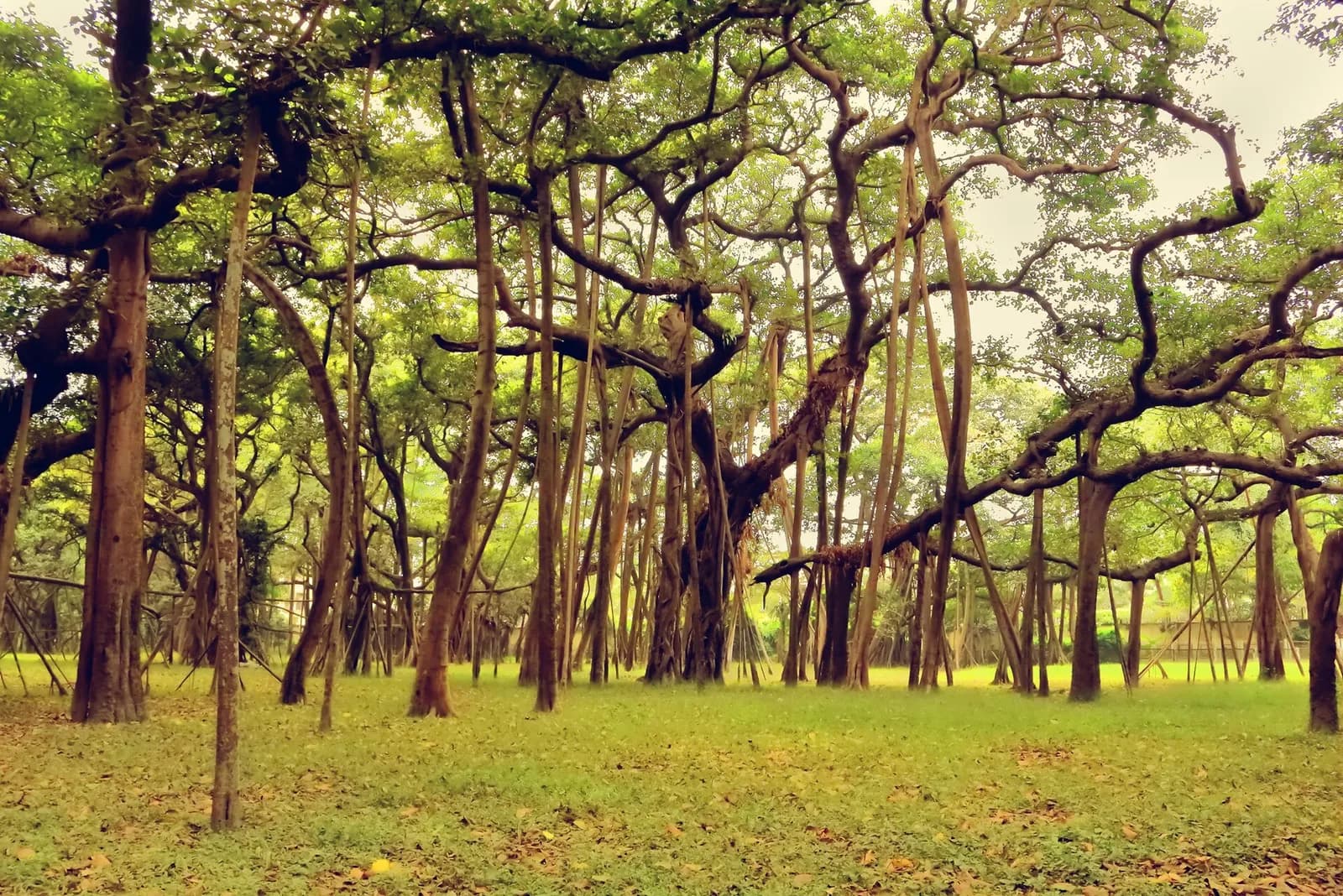
A tree that becomes a grove. The banyan does not take its stand on height – it grows outward and downward: aerial roots hang from the branches, root into the ground as new trunks, and in time a single tree covers a whole clearing. In Vrindavana the first among such banyans is Bhandira, the giant on the bank of the Yamuna, under which Krishna played with the cowherd boys in the summer season and after which a whole forest is named. And in the shastras the banyan has a quite different fame: when the waters of the deluge swallow the universe, the infant Krishna lies on its leaf curled into a cup.
The Tree in Vrindavana
The giant of Vrindavana is a banyan by the name of Bhandira. The Bhagavatam brings us to it with a scene of the cowherd childhood. The boys are pasturing the cows and playing at “who carries whom”: the loser carries the winner on his shoulders. And the whole band, carrying one another, follows Krishna to a huge banyan.
vahanto vāhyamānāś ca cārayantaś ca go-dhanam
bhāṇḍīrakaṁ nāma vaṭaṁ jagmuḥ kṛṣṇa-purogamāḥ
“Thus, carrying one another and at the same time watching over the cows, the boys followed Krishna, and He brought them to the huge banyan Bhandiraka.”
The banyan is called here by its own name, vata, and Srila Sanatana Gosvami adds at once: it is a banyan in name only, while in essence it is a kalpa-vriksha, a wish-fulfilling tree. And what did it look like? The commentators, following Sanatana, quote a description from the Hari-vamsha – and it draws not a tree but a whole mountain:
prītyā kuṇḍalitaḥ kulena marutāṁ ruddhaḥ śikhaṇḍotkarair
ādhipatyam ivānyeṣāṁ tasya deśasya śākhinām
kurvāṇaṁ śubha-karmāṇaṁ nirāvarṣam anātapam
nyagrodhaṁ parvatāgrābhaṁ bhāṇḍīraṁ nāma nāmataḥ
“Covered with dense foliage, it was like a cloud come down to the earth… That tree, like a king over all the trees growing round about, protected all its dwellers from the pouring rains and the scorching sun. Such was that nyagrodha tree named Bhandira, like the peak of a huge mountain.”
A yojana in height and in breadth, dark as a cloud in the sky, Bhandira stands in the very middle of the forest and, together with Govardhana, is counted the “king” of the land of Vrindavana. Srila Jiva Gosvami in the Gopala-champu goes further: the giant banyan is a whole house of Krishna, with rooms beyond counting; its long branches stretch across the Yamuna and, strewn with flowers, turn in places into a couch, while the creepers that wind about the trunk sway along with them. Here, under the banyan-palace, Krishna plays with the gopis.
Pralamba and the Forest Fire
It is at Bhandira too that one of the fearsome lilas of childhood is played out. Into that very game of “who carries whom” the demon Pralamba slipped in disguised as a cowherd boy – he had planned to carry off Krishna and Balarama. Krishna, understanding everything, cheerfully took him into the game and arranged it so that the demon fell to Balarama as a “mount”: the losing Pralamba took Balarama on his shoulders and rushed away, and Balarama with one blow of His fist smashed his head1. All this at the root of Bhandira, fanned by cool winds, as Srila Rupa Gosvami sings in the Stava-mala.
At the same banyan another disaster comes to an end. When once the cows and the cowherd boys were surrounded by a forest fire, Krishna told His friends to shut their eyes, drew the fire into Himself – and when they opened their eyes, they saw that they were standing by their own banyan2. Srila Sanatana Gosvami bows to Krishna in the Krishna-lila-stava with these very words: “O You who drank the terrible forest fire, You brought the cows and the cowherd boys back to the tree Bhandira.” Twice the danger ends at this tree, and twice Krishna brings His own back to it.
Bhandira in the Poetry of Vraja
With the poets of Vraja Bhandira grows into an image of its own: a giant set above all the trees of the neighbourhood. Srila Rupa Gosvami put the praise of it into the mouth of Krishna Himself:
bibhrāṇaḥ śata-koṭi-maṇḍita-mahā-śākhā-bhujoddaṇḍatāṁ
kālindī-taṭa-maṇḍale viṭapinām ākhaṇḍalatvaṁ yayau
“The tree Bhandira bends joyfully before us in the wind, and its leaves outshine all the peacock feathers. With hundreds of millions of huge branch-arms it has become the king of all the trees on the bank of the Yamuna.”
And this king of trees is not only a playground for boys. In rasika poetry Bhandiravana becomes a place of secret trysts. In Srila Raghunatha dasa Gosvami a maidservant-manjari dreams of this: Radha sits with Her friends on flower cushions deep in the forest of Bhandira, while beside them a wondrous portrait of Her beloved is being painted3. And Srila Vishvanatha Chakravarti Thakura, in his gloss on the Ujjvala-nilamani, gathers under the shade of the bata-raja, the king-banyan, both the dances of the cowherd girls and the cunning intrigues of the go-betweens. And when Krishna leaves for Mathura, He is reproached by the same tree. The gopis in separation ask why He takes His ease “in the house of the black serpent that has risen out of the land of Bhandira”4. The house here is the banyan itself, and the black serpent is He: the word bhogi means both “serpent” and “enjoyer”.
The Glory of the Dhama and Worship
Bhandiravana is one of the twelve forests of Vraja and one of the five that stand on the eastern bank of the Yamuna, together with Bhadravana, Bilvavana, Lohavana and Mahavana. Srila Rupa Gosvami in the Mathura-mahatmya, referring to the Adi-varaha Purana, says of it thus:
ekādaśaṁ tu bhāṇḍīram yogināṁ priyam uttamam
tasya darśana-mātreṇa naro garbhaṁ na gacchati
“The eleventh forest is Bhandira, most beloved of the yogis; merely by beholding it a man enters the womb no more.”
The same book promises: having seen Vasudeva in Bhandira, a man is not born again; having bathed there and been cleansed of all sins, he goes to the world of Indra. The promises are given to the forest, and the forest was named after the tree. Srila Sanatana Gosvami remarks that this banyan is “famous in the world” (loke prasiddha), and Srila Rupa Gosvami writes in the Dana-keli-kaumudi: “Bhandira is a huge banyan in Vraja, which stands there to this day; the forest where it grows is named after it.” Much later Sri Chaitanya Mahaprabhu came here too: going round the forests of Vraja, He visited Bhandiravana, and after it Bhadravana, Lohavana and Mahavana.
Other Banyans of Vraja
Bhandira is not the only sacred banyan of the dhama. On the bank of the Yamuna in Vrindavana stands Vamshi-vata – the banyan under which Krishna began to play the flute, calling the cowherd girls to the rasa-lila. With this image Srila Krishnadasa Kaviraja Gosvami opens the Chaitanya-charitamrita as well:
śrīmān rāsa-rasārambhī vaṁśīvaṭa-taṭa-sthitaḥ
karṣan veṇu-svanair gopīr gopī-nāthaḥ śriye 'stu naḥ
“Sri Srila Gopinatha, who has revealed to the world the divine sweetness of the rasa dance, stands on the bank at Vamshivata and with the sounds of His celebrated flute calls the cowherd girls. May they all bestow their blessings upon us.”
Srila Jiva Gosvami explains that Vamshi-vata too is “a certain banyan, famous in the world”; it stands in Vrindavana, and it is also the rasa-sthali, the place of the night dance. And other celebrated vatas are scattered over Vraja: Akshaya-vata in Kokilavana, Advaita-vata and Shringar-vata in Vrindavana. Finally, the banyan stands in the row of the sacred figs, beside the pipal and the udumbara; which trees belong to that row and how many they are, the books count differently.
Beyond Vraja
The banyan has a second fame as well, a universal one. At the very end of the Bhagavatam the sage Markandeya, the only one left alive in the waters of the universal deluge, wanders for millions of years over the boundless ocean. And then, on a patch of dry land, he sees a young banyan, and on its branch the impossible:
prāg-uttarasyāṁ śākhāyāṁ tasyāpi dadṛśe śiśum
śayānaṁ parṇa-puṭake grasantaṁ prabhayā tamaḥ
“On the north-eastern side of that tree he saw a branch on which, in the hollow of a banyan leaf, an infant lay. A radiance came from Him that dispelled all the darkness around.”
This infant is the Lord Himself; the folds on His belly, the following verses say, are like a banyan leaf, and He, playing, takes the toe of His foot into His mouth. The image of vata-patra-shayi, the baby Mukunda “reclining on a banyan leaf”, is well known to Vaishnava iconography: the whole world is folded into an infant rocking on a little leaf above the boundless water.
Outside Vraja the banyan is honoured no less. It is the national tree of India; it is revered as a symbol of long life and indestructibility, and it is not for nothing that the “akshaya-vata”, the “imperishable banyan”, stands in the holy places of pilgrimage. Temples are often built by old banyans. The tradition of Vraja connects the banyan with Lord Shiva: Srila Sanatana Gosvami, indicating where Bhandira is to be sought, places it to the north-west of the local temple of Shiva.
Ayurveda
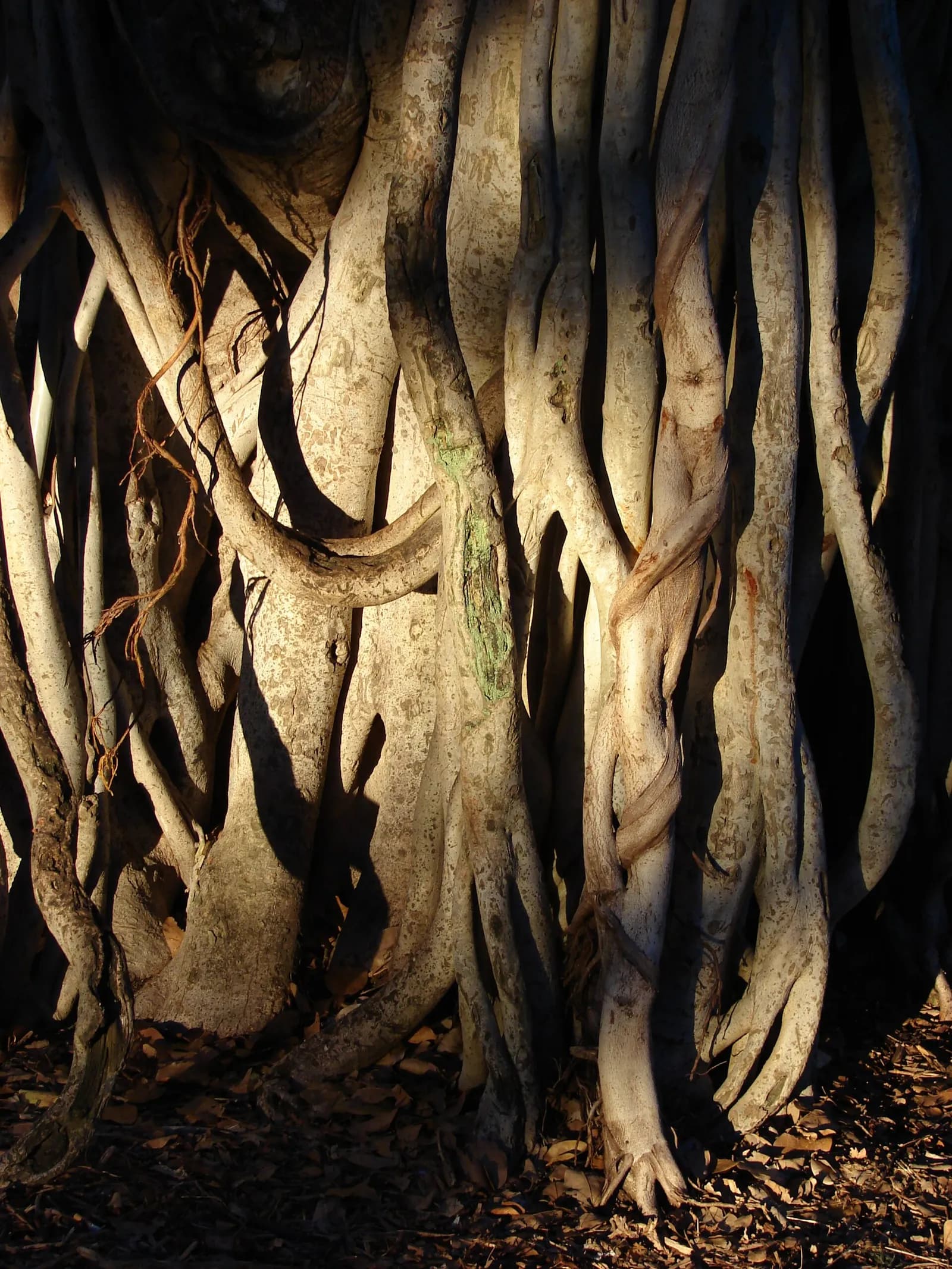
Ayurveda knows the banyan under the name nyagrodha and counts it among the milky trees – the kshira-vrikshas, those that give off a white sap at a break. Sushruta places the banyan at the head of the group nyagrodhadi, named after it, while Charaka counts it among the astringents (kashaya-skandha) and among the remedies that restrain the urine (mutra-sangrahaniya). The taste of the bark is astringent (rasa: kashaya), the qualities heavy and dry (guru, ruksha), the potency cooling (virya: shita), the after-taste pungent (vipaka: katu); and so the banyan pacifies kapha and pitta. That is why it is given for diarrhoea (atisara), for bleeding, for the healing of wounds and for the care of the skin; the bark is used for cleaning the teeth as well. The very name nyagrodha, “growing downward”, points to the chief mark of the tree: the aerial roots that reach from the branches to the ground.
Botany
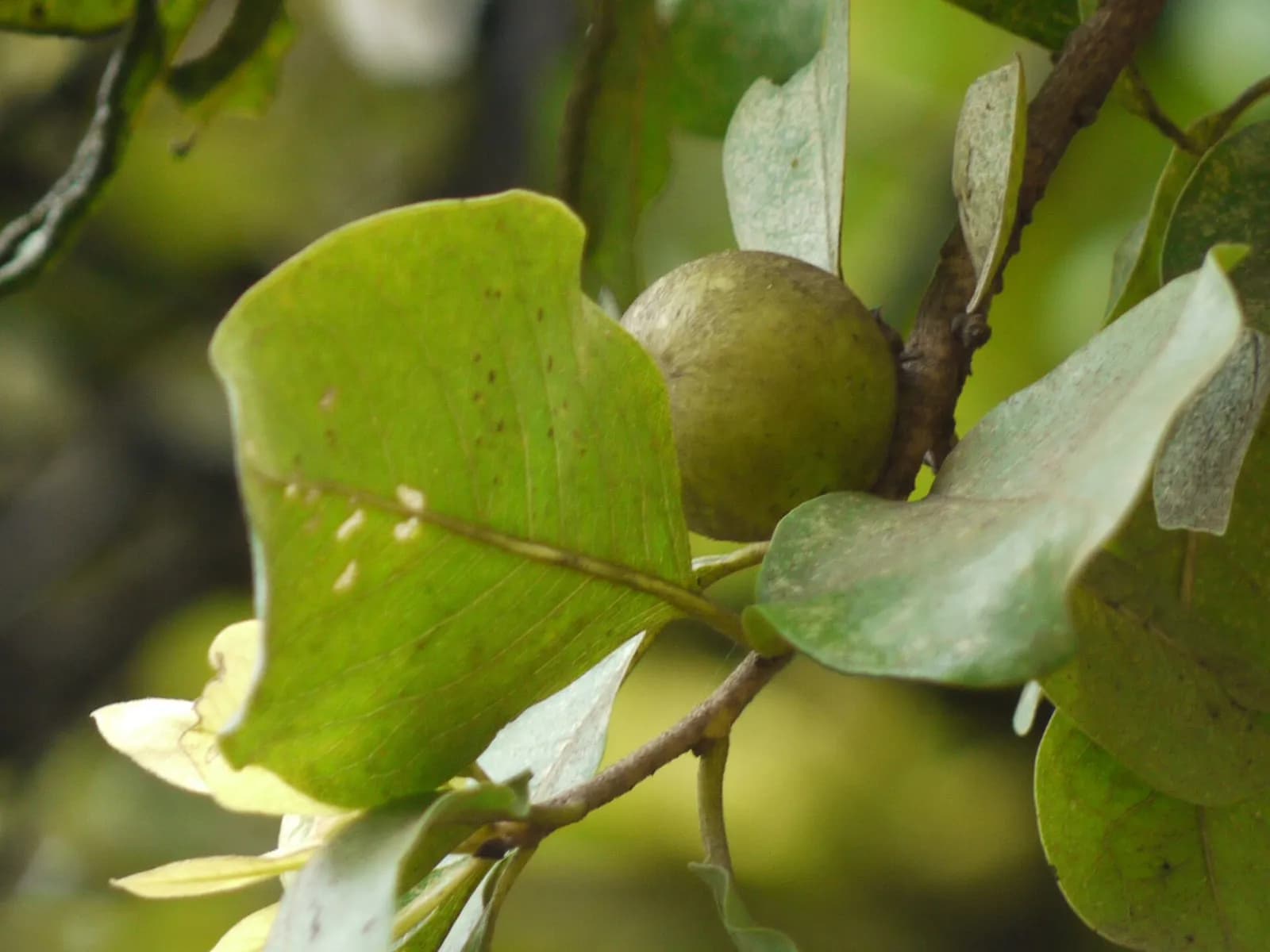
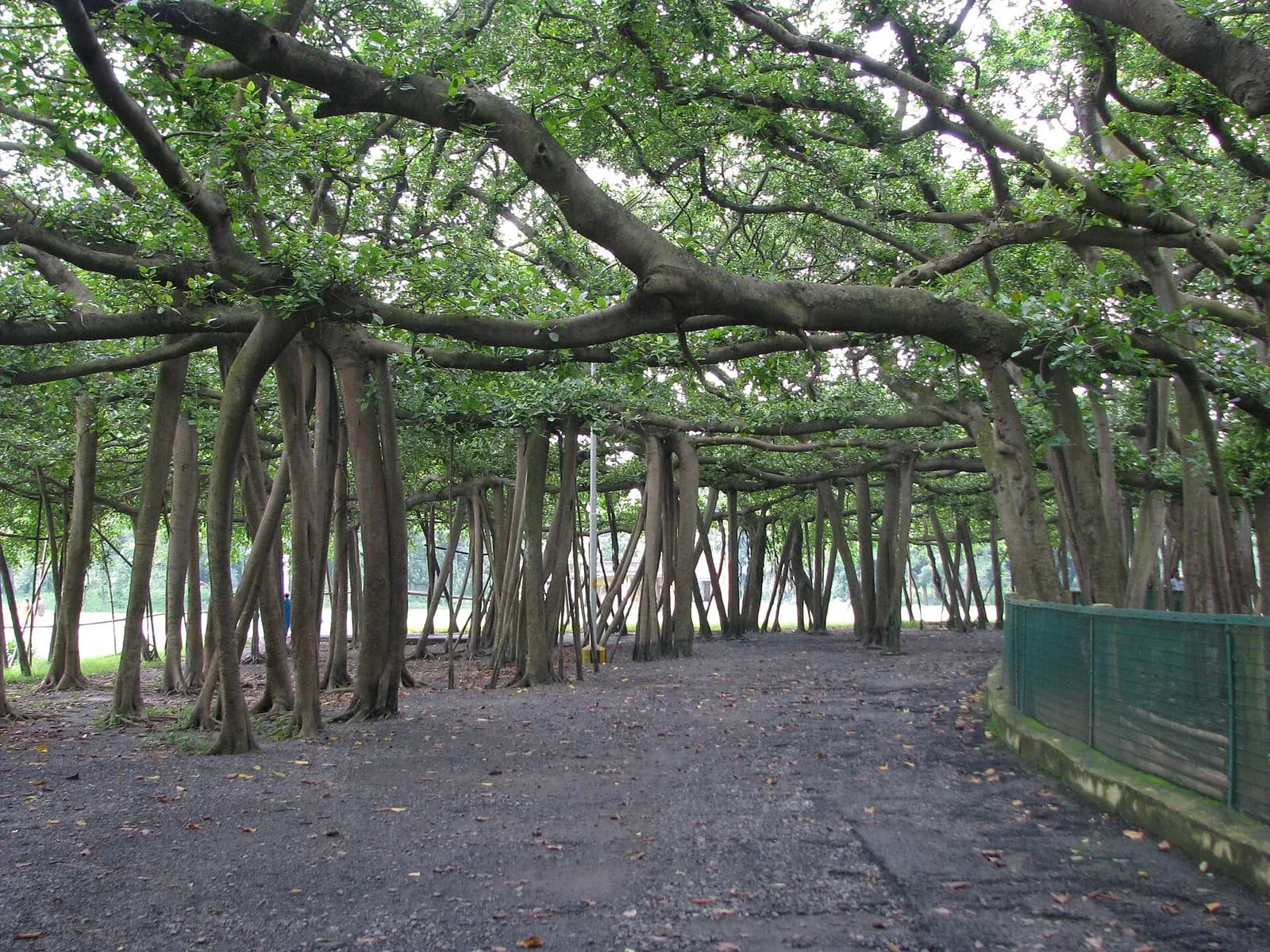
The banyan is Ficus benghalensis of the mulberry family (Moraceae), the national tree of India. In height it does not stand out: up to 30 metres, on a level with the pipal and the udumbara. All its peculiarity is in breadth: the crown is held not by branches but by prop roots, and it can grow without end – crowns of more than 180 metres across are known. The flowers are not to be seen from outside: they are hidden inside the hollow figs. The tree is evergreen and native to the Indian subcontinent.
What this means in practice is shown by the Great Banyan in the Kolkata botanical garden. Its main trunk rotted and was cut out back in 1925, and the tree is alive: a crown 486 metres in circumference is held by 3,772 prop roots, and it covers almost two hectares. They say of it that from a distance it is not a tree but a dense forest. And even it is not the record-holder: the crown of Thimmamma Marrimanu in Andhra Pradesh is entered in the Guinness Book of Records as the largest in the world.
And how long a banyan lives, no one knew until recently: tropical trees have no clear annual rings, and the age of the famous banyans was taken from legends and old chronicles. Until radiocarbon was brought in: the banyan at Munger in Bihar was dated by the core of its trunk – and came out at no less than 700 years.
From under this wide shade came the European name of the tree as well. The Gujarati vaniyo, from the Sanskrit vanija, “merchant”, the English heard as banian: under the crowns of such trees Indian traders set up their bazaar, and in the 1630s the name of the merchants passed to the tree itself.
Sources
We build Vrajapedia together – with stories, verses, photographs and parikrama experience. If you know something more, tell us and it will appear on this page.