Sita Ashoka
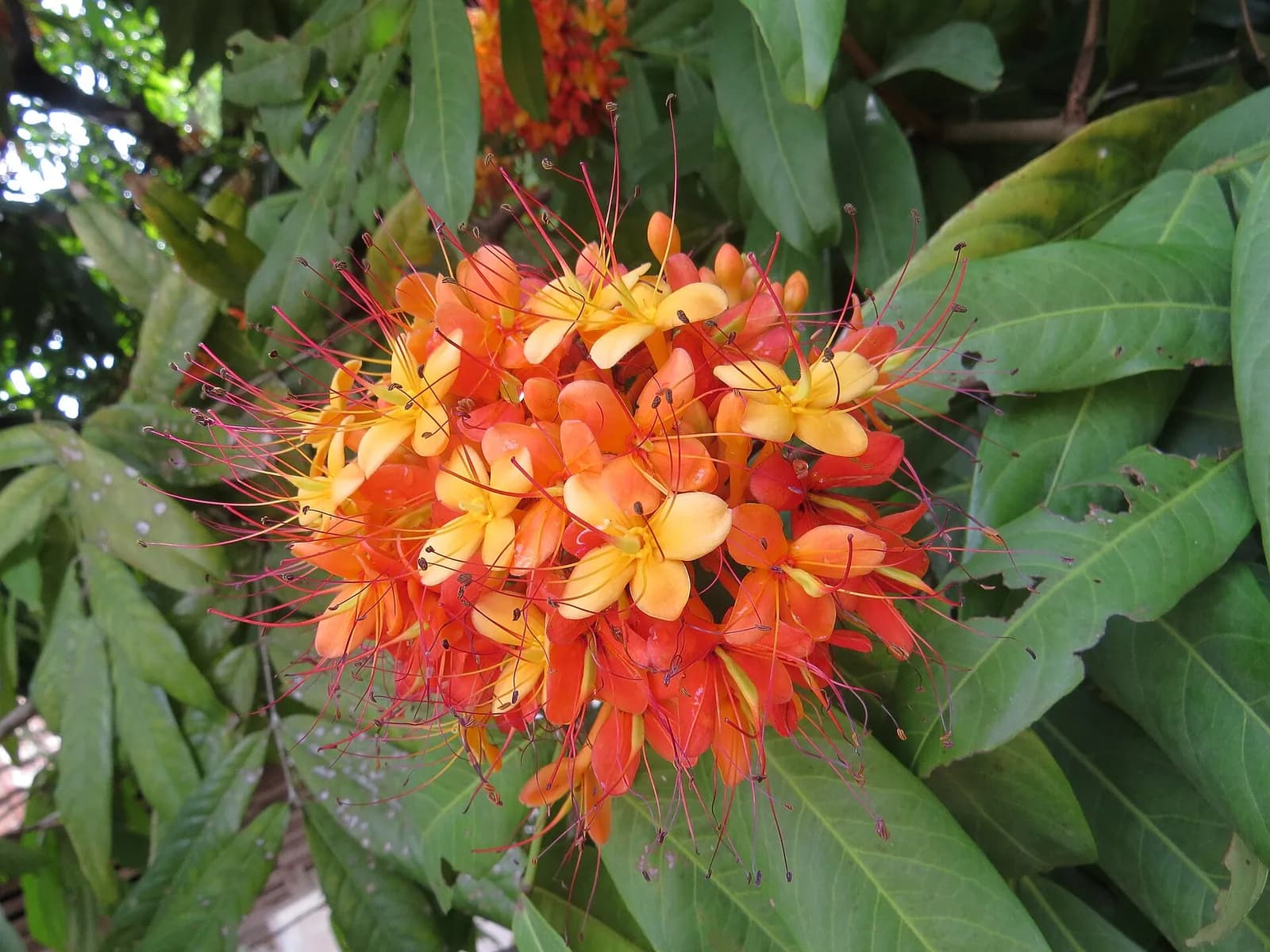
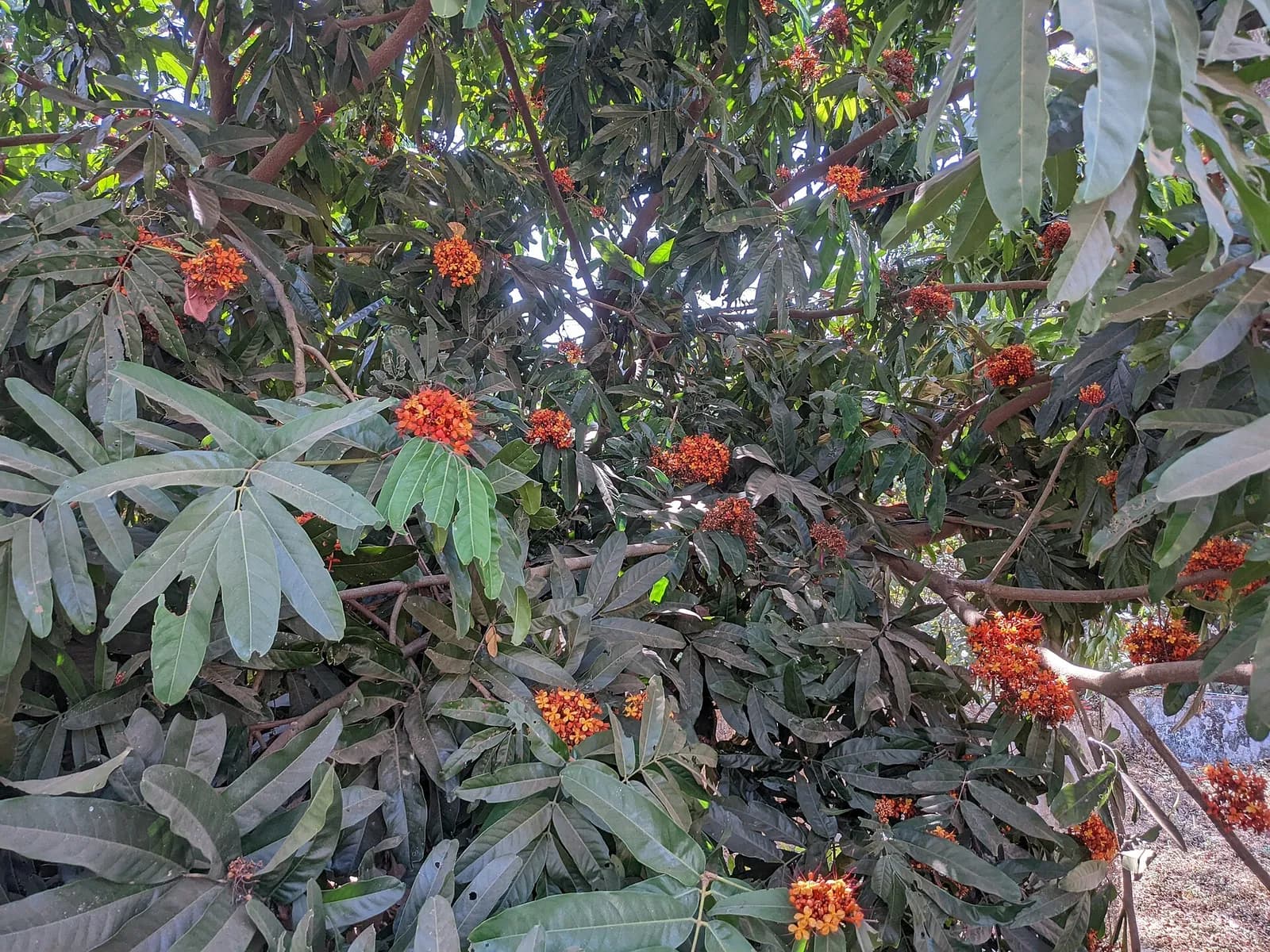
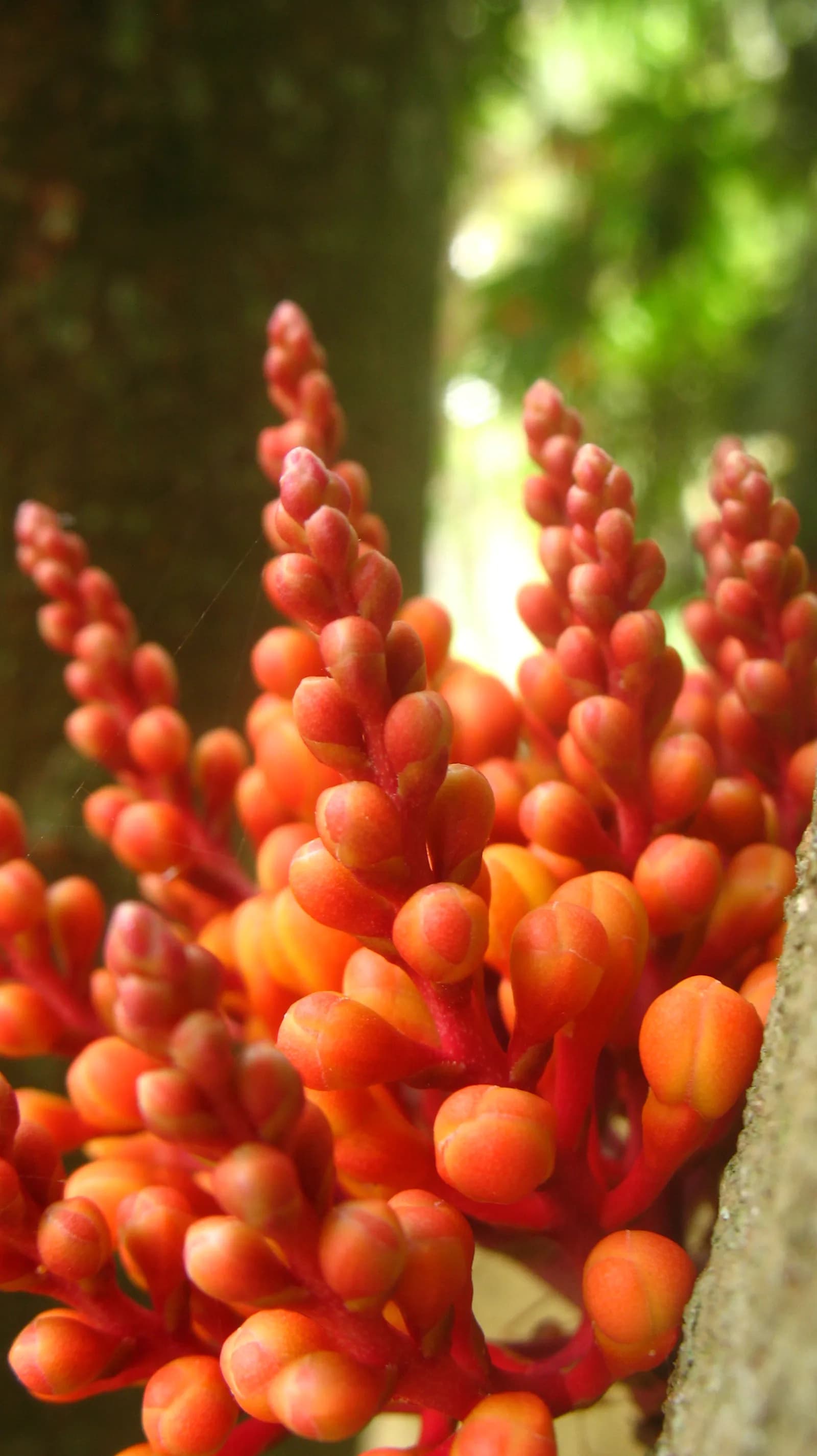
It is called “the tree without sorrow” – the name itself, ashoka, means “that in which no sorrow remains”. A small evergreen tree: its clusters flare first yellow, then orange and at last deep crimson, while the young leaves hang down in soft red tassels. In Vraja, Radha with Her own hands lays its clusters on Krishna’s ears, the gopis call it by name as they search for Krishna in the night forest, and the commentators of the Bhagavatam build a whole play of words on that name: one look at the ashoka takes away the sorrow of separation. And only beyond Vraja does the same tree turn its shadow side – it was in a grove of ashokas that Sita languished in Ravana’s captivity, and from her the tree takes its name.
The Tree in Vrindavana
In the twenty-third chapter of the Tenth Canto of the Bhagavatam the wives of the brahmanas, whose husbands were absorbed in dry ritual, abandon the sacrifice and, against the will of their husbands, brothers and sons, hurry to Krishna with food. And they find Him – in a garden on the bank of the Yamuna, among fresh ashoka shoots:
yamunopavane 'śoka-
nava-pallava-maṇḍite
vicarantaṁ vṛtaṁ gopaiḥ
sāgrajaṁ dadṛśuḥ striyaḥ
“In a garden by the Yamuna, adorned with fresh ashoka shoots, they saw Him – strolling in the circle of the cowherd boys and His elder brother Balarama.”
The Play of the Name
Why, of all the trees of the garden, is the ashoka the one named? Here opens the play for whose sake Srila Sanatana Gosvami and Srila Jiva Gosvami linger over this verse. Ashoka is parsed as a-śoka – “that from which no sorrow remains”: the moment the brahmanas’ wives, worn out by separation, saw these trees, their sorrow melted away. The “sorrowless” tree met those who had come to be rid of sorrow, and lived up to its name1.
Seven chapters later the ashoka sounds again. Having lost Krishna in the midst of the rasa-lila, the gopis, maddened by separation, rush through the night forest and call out to the trees one after another – the ashoka stands in the very second of their appeals:
The Grove of Trysts
Vraja then repeats this scene in its own way. In the Ananda-Vrindavana-champu Srila Kavikarnapura draws the very nature of the holy land out of the tree’s name: since Vrindavana is free of all sorrow, it is also full of ashoka trees. And in his own scene of searching, written in the wake of that chapter, he again places the ashoka among those the gopis appeal to: “O red ashoka! Destroy our sorrow and tell us where Krishna has gone.” The name of the tree makes this plea almost a pun – the sorrowless one is begged to drive sorrow away.
The ashoka carries an old poetic belief as well, one that Vraja takes up gladly: this tree blossoms out of season if a beautiful girl touches it with her foot. In Srila Rupa Gosvami’s Lalita-madhava Krishna sees an ashoka that has bloomed out of season and thinks to Himself: was it Chandravali who brushed it with her foot? In the Vidagdha-madhava of the same poet He guesses by the same sign where Radha is hiding: why else would the tree bloom out of time and hum with the bees that have flocked to it2?
In the Ananda-Vrindavana-champu the same sign is read by the gopis who follow the traces of the Divine Couple. The ashoka and the bakula bloomed out of season from Radha’s tears of love and the touch of Her foot; at the root of the ashoka a red mark of alta remained, and the bees, abandoning the flowering bakula, crowd where Her tears wetted the earth.
That is why ashoka groves in Vraja are favourite bowers of trysts. In the Govinda-lilamrita of Srila Krishnadasa Kaviraja Gosvami the bower of Lalita with the telling name Vasanta-sukha-da, “giver of the joy of spring”, is covered from top to bottom with ashoka trees and creepers in white, pink, green, yellow and dark blue clusters, and around it, like the petals of a lotus, stand eight small bowers whose core is again the same tall flowering ashokas. In Srila Jayadeva Gosvami the tryst is appointed on a bed of fresh ashoka leaves in a flowering thicket, and in the anthology Padyavali a friend even warns: do not go into an ashoka grove alone, and do not listen there, in a secluded place, to the sound of the flute3.
Its flowers adorn the Divine Couple Themselves. Red ashoka clusters are laid on Krishna’s turban and on His dark curls as earrings of buds; in the Padyavali a gopi, not recognising Him, asks about Him: “Who is this, with earrings of ashoka buds, His body like a black touchstone, who has conquered me with a single sound of the flute?” It happens the other way round as well: Radha Herself adorns Krishna.
atha dara-phullam aśoka-latā-
stavaka-yugaṁ vṛṣabhānu-sutā
svayam avacitya hareḥ śravasoś
capala-kareṇa dadhau sumukhī
“The daughter of Vrishabhanu plucked two barely opened clusters of ashoka and with trembling hands laid them on Krishna’s ears.”
The White-shining Ashoka
Of one ashoka in Vraja few people know. North of Brahma-kunda, by the lake of Kaliya, there stands, in the words of the Brahma-kunda-mahatmya, an ashoka tree with a white radiance: at the very noon of the twelfth day of the bright half of the month of Vaishakha it blossoms for the joy of the pure devotees – and no one knows of it but them. This verse is repeated both by Srila Jiva Gosvami in the Gopala-champu and the Krishna-sandarbha, and by Srila Rupa Gosvami in the Mathura-mahatmya4.
Worship
Ashoka flowers go directly into the service of the Lord as well, and the books on service value them highly – again for that same property of removing sorrow. Srila Sanatana Gosvami gathered the sayings of the Puranas about this in the Hari-bhakti-vilasa:
“Worshipping Lord Hari, who removes fear and sorrow from the hearts of His devotees, with beautiful ashoka flowers, a person gains the right to enter His supreme abode. …And whoever honours the Lord of the universe with bakula and ashoka flowers will dwell in the abode of Hari for as long as the sun and the moon rise.”
The ashoka is bound up with a spring rite as well – the Damanaka-mahotsava, which the same book prescribes for the ekadashi of the bright half of the month of Chaitra. Having finished the morning duties, one goes to a garden of fragrant damanaka and worships the god of love in the form of an ashoka tree, offering rice, sandal and other gifts. And the prayer here is again built on the name of the tree: “O ashoka, obeisances to you; you destroy the sorrow of Kama’s wife – take away my suffering too, and grant me eternal joy”5. When it is over, a shoot of damanaka is plucked – it is carried off for the worship of Krishna.
The Arrow of the God of Love
Through the ashoka, spring enters the verse of Vraja together with the god of love. The Sanat-kumāra-saṁhitā lays out the five flower arrows of Kamadeva by the letters of the kāma-bīja: the mango bud, the ashoka, mallika, madhavi and bakula, one flower to a letter6. The ashoka stands second in that quiver. And its arrow strikes without fail: in Srila Jayadeva Gosvami the ashoka creeper blossoming out of season is, for Radha in separation, “like a spear that pierces my eyes”. The last word, all the same, belongs to Krishna: the true god of love in Vraja is He, and the arrows of Kama only serve Him.
Chaitanya Mahaprabhu
The ashoka reached the days of Sri Chaitanya Mahaprabhu as well – and again through its name. On the full moon of the month of Vaishakha, walking at night in the garden of Jagannatha-vallabha in Jagannatha Puri, Mahaprabhu entered the mood of the gopis and began, as they did, to go round tree after tree, creeper after creeper:
prati-vṛkṣa-vallī aiche bhramite bhramite
aśokera tale kṛṣṇe dekhena ācambite
“Thus, wandering from tree to tree, from creeper to creeper, He came under an ashoka tree and suddenly saw Lord Krishna.”
The place is not chosen by chance: the sorrow of separation that drove Mahaprabhu through the night garden breaks off in a vision of Krishna precisely under the “sorrowless” tree – that same ashoka which in all the books of Vraja stands where sorrow ends.
The Other Side of the Name
Far from Vraja the same tree turns another side. Where the talk is of Rama, the ashoka enters the verse no longer as a grove of trysts but as a place of captivity. In the tenth chapter of the Ninth Canto of the Bhagavatam Srila Vishvanatha Chakravarti, retelling the Ramayana, brings Ramachandra to his abducted wife:
“Ramachandra saw Sita sitting in a hut under a shimshapa tree in a forest of ashoka trees, wasted away and worn out by the sorrow of separation from Rama.”
The Name of Sita
In this Ashoka-vana on Lanka Sita spent the months of her captivity. Hence the tree’s present name – Sita-ashoka: a name that promises “the absence of sorrow” has been bound for ever to the most sorrowful of separations.
The same blood-crimson colour surfaces in Vraja too, but in a single dark scene: in Srila Kavikarnapura, Pralambasura, struck down by Balarama, falls to the ground all in blood, like the sun setting behind Mount Vindhya covered with scarlet ashoka flowers. And in the heavenly gardens, on Trikuta where Gajendra plays, and in the garden of the sage Kardama, the ashoka blooms simply as one of the trees of paradise.
Ayurveda
In Ayurveda the ashoka (Saraca asoca) is first of all a “woman’s tree”. The taste of its bark (rasa) is astringent and bitter, its energy (virya) cooling, and the taste after digestion (vipaka) pungent; it pacifies pitta and kapha. Its chief fame is as a uterine tonic: a decoction of the bark is used for heavy bleeding and disorders of the female cycle (raktapradara, menorrhagia), and on this same bark one of the best-known Ayurvedic preparations, Ashokarishta, is built. The flowers are used as well: their pulp, in folk practice, stops dysentery. So in medicine too the tree keeps its name – it takes the ailment away and leaves no sorrow behind.
Botany
The Sita-ashoka is a small evergreen tree of the legume family (Fabaceae), up to ten metres tall, with smooth grey-brown bark and a dense crown that gives thick shade. The leaves are dark green, glossy, up to 30 cm long, of four to six pairs of leaflets with a slightly wavy margin; the young shoots are soft, reddish and drooping. The flower is small, with a long tube that opens into four oval lobes: this genus has no petals at all – it is the calyx that is coloured; the flowers are gathered in dense fragrant clusters and change colour with age – from yellow in the young ones to orange and deep crimson in the mature. The tree blooms all year round, with a peak in January–February. Its homeland is the Indian subcontinent from the Himalayas and Assam to Sri Lanka and Myanmar; to Java, Sumatra, Malaya and the Andamans the ashoka was introduced. It is often confused with the tall “false ashoka” (Polyalthia longifolia), which is planted along roads: that tree belongs to another family, the Annonaceae, and in the books of Vraja it does not appear at all. The ashoka of the shastras is always the saraca, a low tree with fiery clusters.
Sources
We build Vrajapedia together – with stories, verses, photographs and parikrama experience. If you know something more, tell us and it will appear on this page.