Pomegranate
The pomegranate is a fruiting shrub with bright red flowers and heavy, blushing fruit that ripens in the kunjas of Vrindavan beside mango and kadamba. Its seeds are fed to tame parrots, and with its ripe fruit Krishna treats His friends at forest feasts. But the poets of Vraja saw more in it than that: for them the pomegranate became a mirror of Radha’s beauty — and the comparison went so far that it entered one of Her names.
rasāla-tāla-bilvāni badarāmalakāni ca
nārikelāni panasa-drākṣā-kadalakāni ca
nāgaraṅgāni pīlūni karīrāṇy aparāṇy api
kharjūra-dāḍimādīni pakvāni rasavanti ca
“He served rasālas, palm fruits, and bilva fruits, and badaras and āmalakas, and coconuts, jackfruit, grapes, and bananas. He served oranges, pīlus, karīras, and other ripe, tasty fruits, like dates and pomegranates.”
Groves, and the Pomegranate’s Address
He explains at once that only in the forest of Vrindavan can all these fruits be found ripe at one and the same hour — everywhere else each comes in its own season. And the pomegranate grows here not as a lone bush but in whole groves: in the Garga-samhita, in the forest of Kundavan, pomegranate thickets stand next to those of mango, orange and grape1.
It has an address of its own as well. In the descriptions of the kunjas of Radha’s eight principal friends, the pomegranate is entered under the kunja of Tungavidya, where Lavanga Manjari tends it: in the pastimes of Lord Chaitanya she comes as Srila Sanatana Goswami.
Most often, though, the pomegranate appears in Krishna’s pastimes together with parrots. Radha and Krishna keep tame parrots and mynas, the black talking birds, and both have one and the same delicacy: the ruby seeds of the pomegranate. Srila Krishnadasa Kaviraja Goswami draws such a scene in Govinda-lilamrita: Vrinda Devi brings grapes and pomegranate seeds, and Radha and Krishna feed their birds from their own hands, tenderly2.
The Pomegranate in the Poetry of Vraja
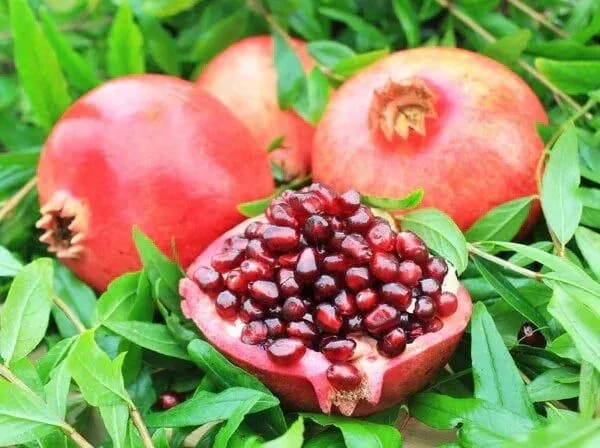
Break open a ripe pomegranate and inside is a close-packed row of scarlet seeds, even and glossy — teeth exactly. The likeness was noticed long ago: one of the Sanskrit names of the pomegranate is danta-bija, “tooth-seeded”. And here is Krishna, catching a familiar fragrance in the forest and wondering aloud: Radha, “whose teeth are as lovely as pomegranate seeds”, must be gathering flowers somewhere near, at the foot of Govardhan3. The image took hold, and the poets set about completing it: if the seeds are teeth, then the scarlet flower is the lips, and two heavy round fruits on a branch are the breasts.
Srila Rupa Goswami brings all three together in a single verse of his play Vidagdha-madhava. Krishna is adorning Radha in a forest bower when He suddenly points out to Her a pomegranate tree trembling in the wind:
pariṇata-vara-bīja-spardhi-dantoru-bhāsaḥ
kusumam upahasantyās tanvi danta-cchadena
phala-vijayi-kucayas tvad-bhayād dāḍimīyaṁ
mṛdula-pavana-dola-dambhataḥ kampate 'dya
“Beloved, look! Its ripe seeds are outshone by the splendour of Your teeth, its flowers are mocked by Your lips, and its fruit is defeated by Your breasts — and so this pomegranate tree, on the pretext of swaying in the gentle breeze, now trembles in fear of You.”
The tree really is swaying in the wind — but Krishna passes that trembling off as the fright of the one who has lost.
The Parrot and Radha’s Name
In another scene of Vidagdha-madhava, Krishna watches a tame parrot beside a scarlet fruit and addresses Radha Herself as a pomegranate tree: “O pomegranate, this parrot, his heart struck by your red beauty, keeps wondering whether your fruit is ripe or not — and so he holds back”4. Srila Vishvanatha Chakravarti Thakur explains the second meaning: Krishna is asking whether the fruits of love on Radha’s tree have ripened. Srila Krishnadasa Kaviraja Goswami goes further still: in his telling the parrot takes Her breast for a pomegranate, settles beside it, and pecks Her lip, having mistaken it for a ripe bimba fruit.
So the modest fruiting shrub reached the very name of Radha: in his hymn of Her one hundred and eight names, Srila Raghunatha dasa Goswami calls Her “the one whose teeth, shining like ripe pomegranate seeds, draw Krishna — the parrot who carries away sins”5.
Worship
The pomegranate has its place in temple service too. The Hari-bhakti-vilasa of Srila Sanatana Goswami and Srila Gopala Bhatta Goswami names it among the ripe fruits offered to Lord Vishnu with love — along with mangoes, coconuts and bananas6.
Beyond Vraja
In the Srimad Bhagavatam the pomegranate is named among the trees of Ritumat, the heavenly garden on Mount Trikuta — the very garden where Gajendra, the king of the elephants, was gathering lotuses before he met his deliverer. That garden, in Shukadeva’s words, was full of trees that flowered and bore fruit in every season: mandara and parijata, mango and champaka — and pomegranates among them.
Ayurveda
In Ayurveda the pomegranate — dadima — is valued for a rare combination of tastes: it is sweet, sour and astringent all at once. It is the astringent quality (grahi) that makes it the first remedy for a disordered gut. The sweet pomegranate is held to balance all three doshas — an uncommon quality, so it is given to the weakened and the convalescent alike; the sour varieties, for their part, quiet vata and kapha, but aggravate pitta. The pomegranate is counted among the remedies for the heart (hridya), for thirst and for fever. Its properties are set out by the classical compendia — the Bhavaprakasha-nighantu, the Raja-nighantu and the Kaiyadeva-nighantu — while the Madhava-chikitsa prescribes the pomegranate for fever and for diarrhoea.
Botany
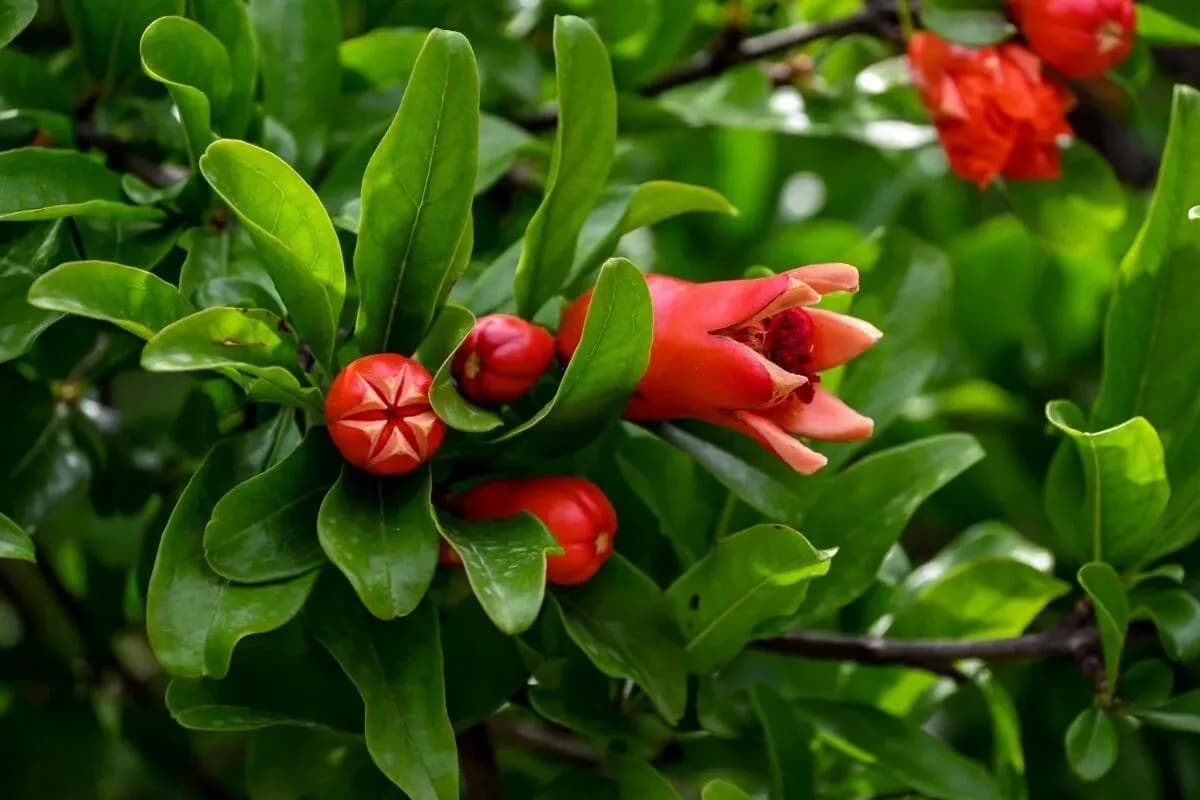
Punica granatum is a shrub or small tree of up to five metres, usually multi-stemmed, with thorny twigs; the plant is long-lived. The leaves are narrow, oblong and glossy, set opposite one another. The flowers are tubular and bell-shaped, bright red (occasionally white or yellowish), with crimped petals. The fruit is a leathery “capsule” in which hundreds of seeds lie among spongy partitions.
The Latin name came to the pomegranate from the Romans: they called the fruit malum Punicum, the “Punic apple”. And from their pomum granatum, “apple with seeds”, comes the English pomegranate. The tree’s homeland stretches from Transcaucasia and Iran to Afghanistan and Pakistan; it came to India long ago, but come it did. Pomegranates have been cultivated for some five thousand years, and today the tree grows all across India, Vraja included.
The pomegranate in flower
Sources
We build Vrajapedia together – with stories, verses, photographs and parikrama experience. If you know something more, tell us and it will appear on this page.