Gulala-kunda
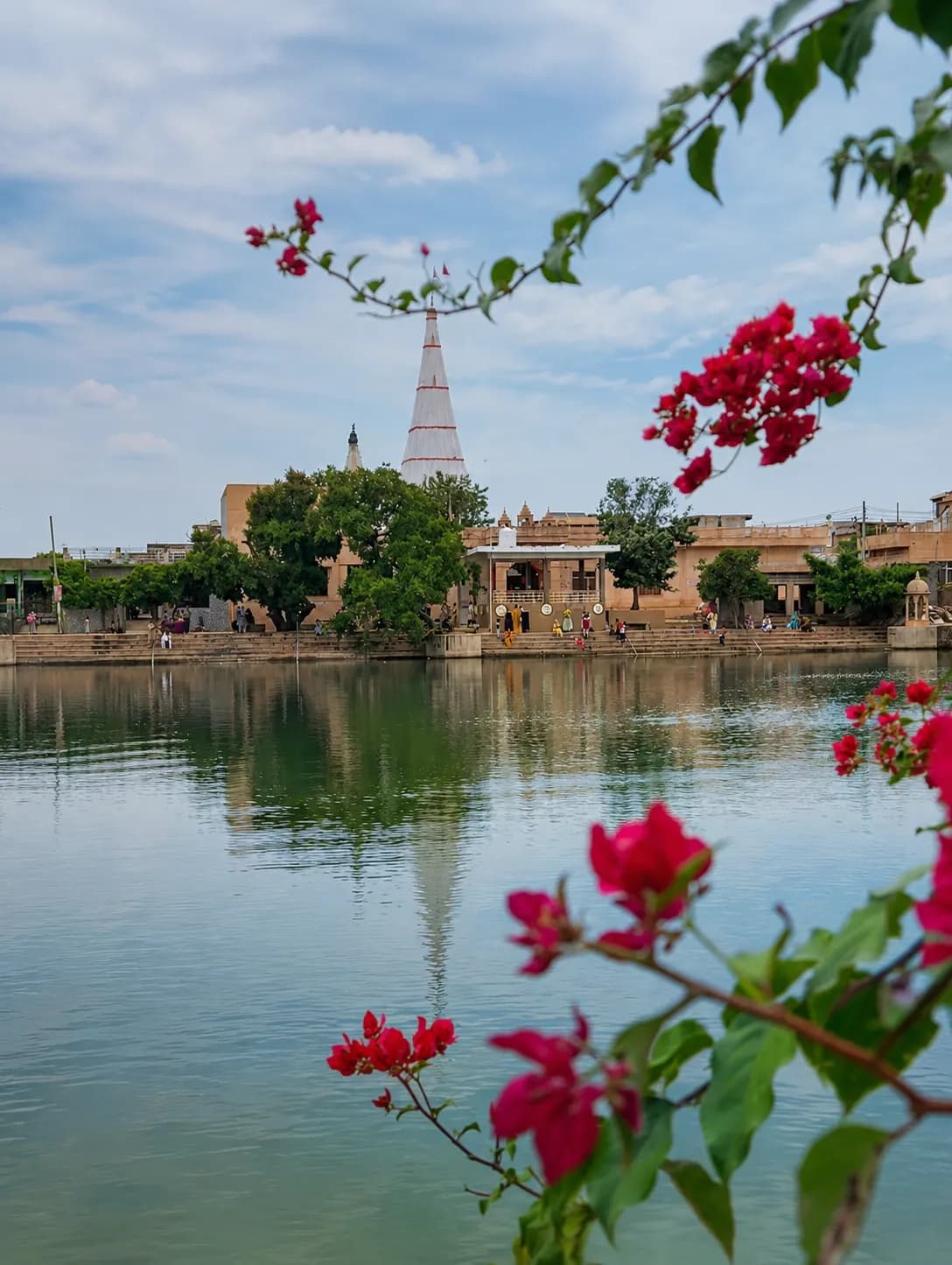
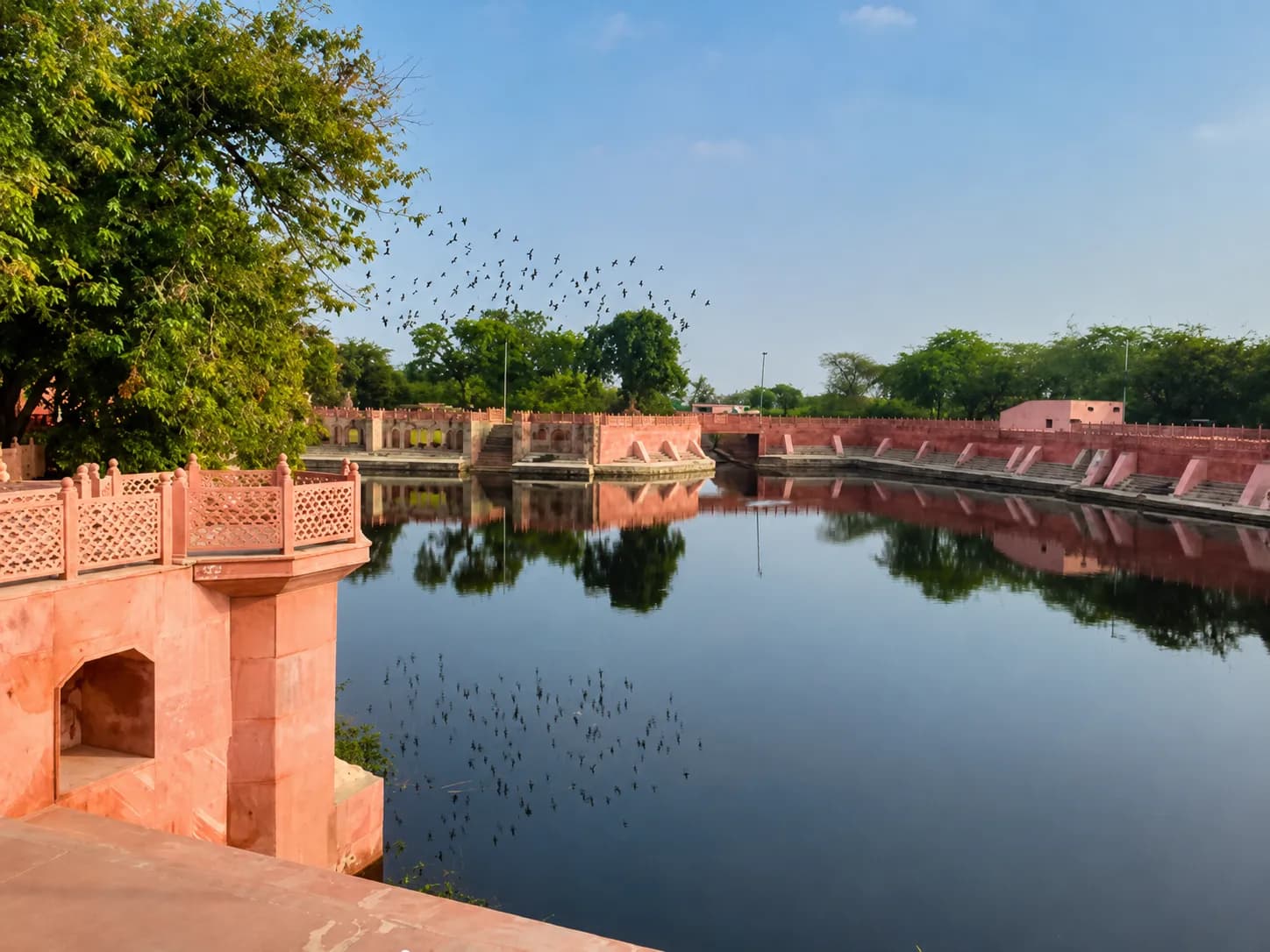
A small lake on the western side of Govardhan, to the left of the road from Jatipura to Gantholi. Here Radha, Krishna and the gopis came to wash off the colours after playing Holi. Hence the name: gulāl is the red powder with which all over India people shower one another at the festival of colours. It is said that every spring the water in the kunda turns red of itself.
First Came the Lake, Then the Lila
Usually in Vraja a lake remains after a lila – as its trace. With Gulala-kunda it happened the other way round: the lake was here first, and it was the lake that determined where Holi would be played.
Sivarama Swami names the reason. The village of Gantholi suited Holi perfectly: a secluded place, no extra eyes, and above all – it has a lake in which one can wash after the play. Colours are not easily got rid of: gulal stains the hair, settles on the eyelashes, works into the clothes. To play all day in an open field and then go home in such a state is a doubtful undertaking. And here the water is at hand.
The choice of place is explained in another way as well: there is a tradition that Holi began at Varshana, but Krishna divided His attention among all the gopis equally; Radha and Her friends were saddened and went off to play here, in a secluded place.
So the kunda in this story is part of the festival: the battle of colours raged in the village nearby, and here they came at the end.
A fine bright red powder for Holi. It is thrown by the handful, moulded into balls and mixed with water for the pichkari squirts. From it comes “gulali”, reddish: such became the colour of the water in the kunda.
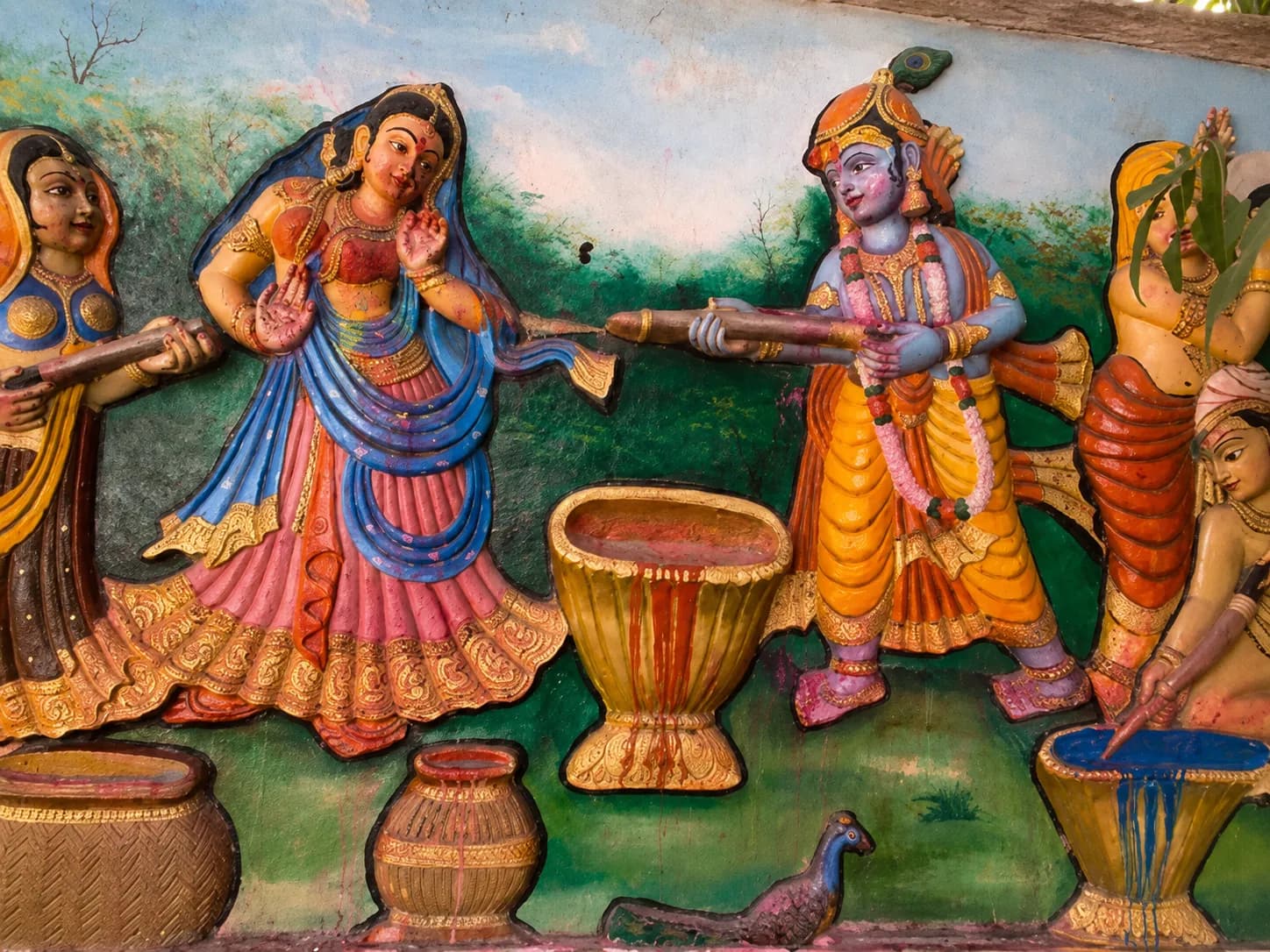
The cowherd boys and girls hurled balls of pink powder at one another: some burst on reaching their target, others burst in the air, and the colour settled on the trees, the vines and the grass, on faces, hands and clothes. Madhumangala would run out to the front line and taunt the girls, dancing around them; when the gopis attacked with balls and water squirts, he retreated to hide behind his friends’ backs. Some threw colours, some played instruments, some sang. Peacocks and cuckoos circled above the battlefield and adorned the music with their voices.
And when the merriment had subsided, Krishna sent the boys home and went with the gopis to the water. They washed the gulal from their bodies, changed into fresh clothes and ornaments – and the water of the kunda turned red.
Why the Water Turns Red Every Spring
The red water is spoken of not only in the past tense: it is said that it turns red towards the full moon of Phalguna – on the day of the appearance of Shri Chaitanya Mahaprabhu.
The earliest record is in Srila Narahari Chakravarti’s Bhakti-ratnakara. Raghava Pandita leads Shrinivasa Acharya and Narottama dasa through Vraja, tells them where the village got its name, and at the end adds matter-of-factly, as of something commonly known: this red colour people see in the spring in the water of Gulala-kunda.
Sivarama Swami writes of the same:
The redness of the water is explained in different ways. Narayana Gosvami writes that the colour was washed off bodies and clothes, Sivarama Swami – off bodies only. In the Pushti-marga tradition (as retold by brajrasik.org) the Divine Couple were showered with colour so abundantly that the sky itself was dyed, and the powder settled into the water during the festival itself. And the Bhakti-ratnakara does not go into causes – it only records the observation.
The same picture is found in the Garga-samhita, where the Holi of Radha and Krishna is described without naming the place:
ābīrāruṇa-cūrṇānāṁ muṣṭibhis tā itas tataḥ
kurvatyaś cāruṇaṁ bhūmiṁ dig-antaṁ cāmbaraṁ tathā
“Throwing red powder in all directions, they coloured the sky, the earth and all the quarters red.”
Kunda of Colour, Kunda of Henna, Kunda of Lac
Gulala-kunda is not alone in its neighbourhood.
In the route of Bhaktivedanta Narayana Gosvami they come one after another: Javaka-kunda, Gulala-kunda, Gantholi, Behej. And the now abandoned Mainhadi-kunda, according to Padmalochana dasa, lies half a kilometre from the town of Govardhan: once Radhika washed her hands, painted with henna, in it, and the water turned yellow.
There is almost no material on the two outer kundas (both are mentioned in passing and once each), but in this part of Govardhan the water remembers colour.
The Knot, Gopala and Mahaprabhu
The two chief stories of these places unfolded not by the water but in the neighbouring village; here is only what ties them to the kunda, and they are told in the article on Gantholi.
The name of the village comes from the word gāṅṭha, “knot”: at the height of that same Holi play Radha and Krishna sat down to rest, and their friends crept up from behind and tied the ends of Their garments together.
sakhī duṅha vastre gāṅṭhi dila saṅgopane
“A sakhi stealthily tied the garments of the Two in a knot.”
The sources differ both on who tied the knot and on how it all ended; the details are in the article on the village.
And the second story is of how the Deity of Gopala was brought to Gantholi from the summit of Govardhan, saving Him from a rumour of a raid by soldiers, and how Shri Chaitanya Mahaprabhu, who would not agree to set foot on the hill, received His darshan here for three days. The name of the village is given in the Chaitanya-charitamrita itself:
śuniyā grāmera loka cintita ha-ila
prathame gopāla lañā gāṅṭhuli-grāme khuila
“Hearing this, all the villagers were alarmed. First of all they took Gopala and carried Him to the village of Ganthuli.”
The verse that Mahaprabhu spoke on seeing Gopala is given by Sivarama Swami – these are the lines of Srila Rupa Gosvami:
vāmas tāmarasākṣasya bhuja-daṇḍaḥ sa pātu vaḥ
krīḍā-kandukatāṁ yena nīto govardhano giriḥ
“May that left arm of the lotus-eyed Krishna protect you, by which the hill of Govardhan was turned into a ball for play.”
Gulala-kunda Today
The kunda lies away from the main parikrama path, on the great 38-kilometre arc, and most pilgrims pass it by. It is most convenient to turn off through the lane by Rudra-kunda: some ten minutes by car.
Along the same road, nearer to the town of Govardhan, stands a garden with two ancient trees – Jnana and Ajnana. Sivarama Swami relates that these were the names of two maidservants of Radha who accompanied Her to a tryst. Krishna did not know them and grew shy, which angered Radha and embarrassed the girls themselves – and they turned into trees so as not to hinder the meeting of the Divine Couple. Gopala loved this garden so much that when His temple was being built on the summit of the hill, He told the pujari to cut a window in the room so that the garden could be seen.
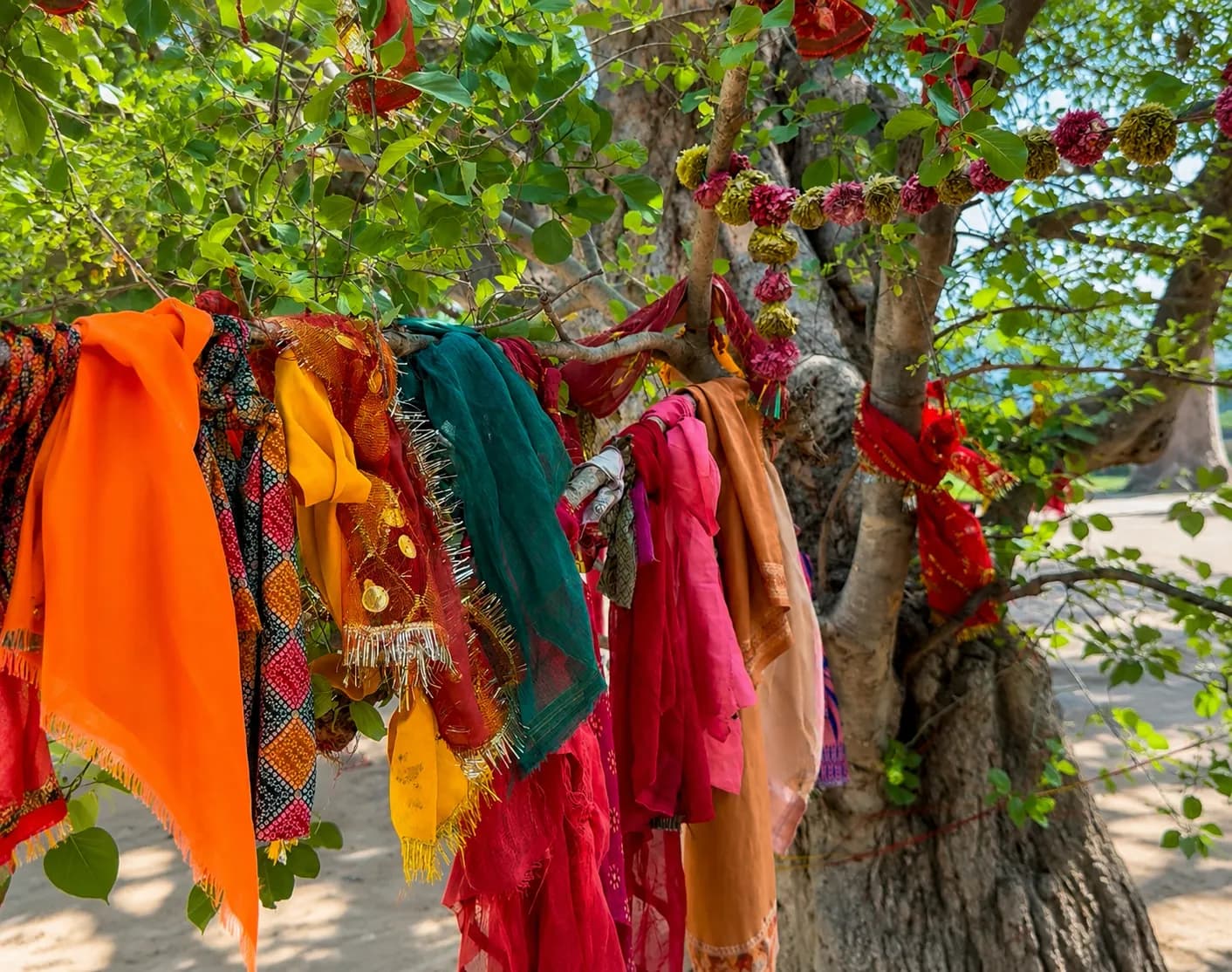
This is a quiet place. The entrance is a gate of pink sandstone; in the courtyard there is a large shady tree and a stone relief with Radha and Krishna playing Holi. On the bank stands a temple of Shiva (the local Gulal-kund Mahadeva) and a heap of Giriraja shilas with tulasi planted around them. Nearby is a small temple with the Deities of Radha Krishna and the baithak of Shri Vallabhacharya.
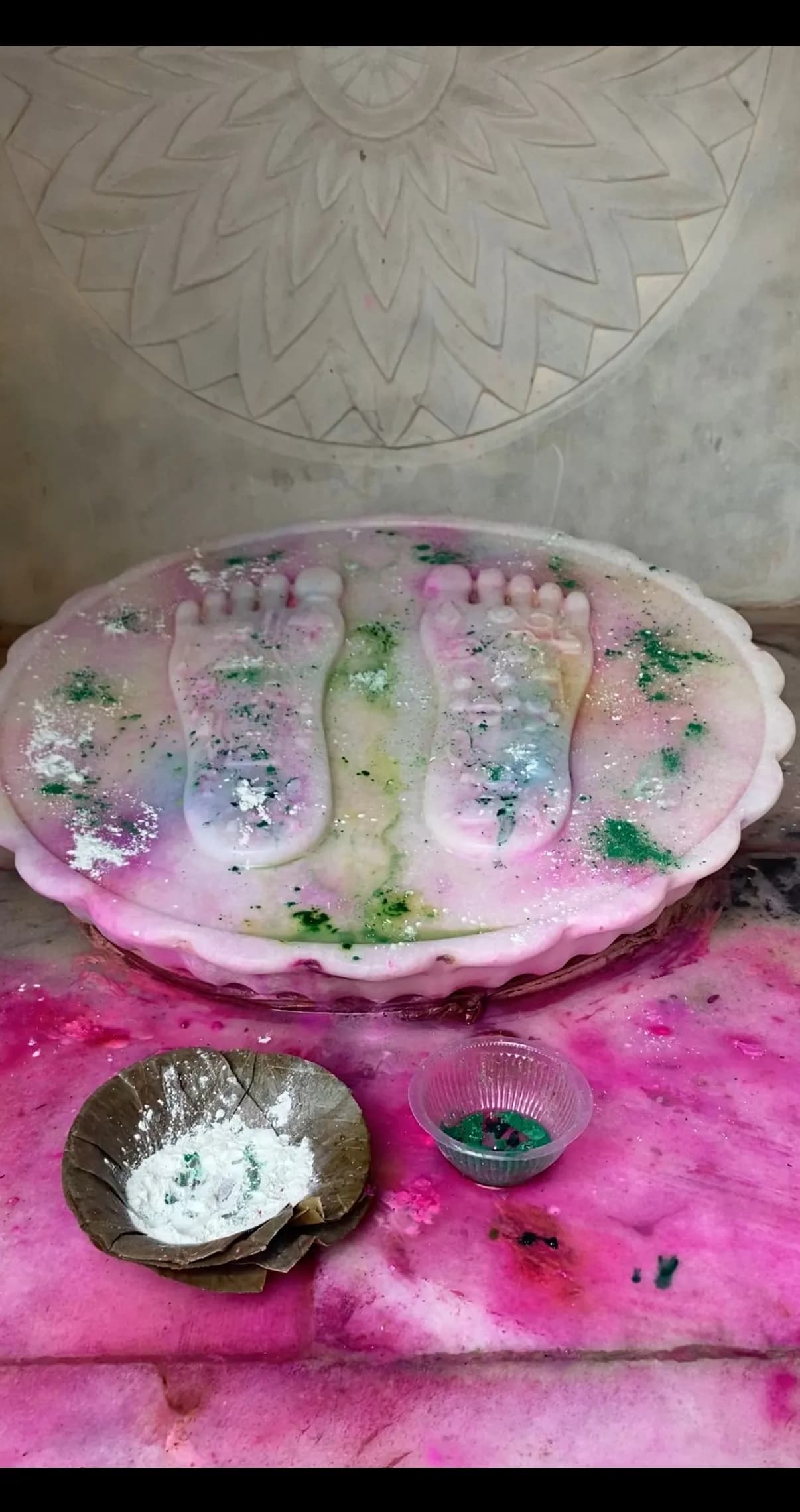
The kunda is full of water, especially in the rainy season, and everything around is clean and well kept; the village women gather to sing bhajans, and green parrots call to one another in the branches. Here too a charan-paduka is installed, the footprints of Shri Chaitanya Mahaprabhu, and beside them a verse from the Chaitanya-charitamrita saying that He was here.
The courtyard before the kunda is covered in pink stains all the year round, and these are not the traces of a Holi gone by: Vaishnavas of the Pushti-marga come here day after day and apply the colours as prasad. Of Gulala-kunda it is said that Holi is played here all twelve months. The kunda itself has remained a favourite motif in sanjhi – the art of Vraja in which patterns are laid out with coloured powder and petals.
The kunda has a song of its own as well: Shri Raghavdas-ji, the son of the ashta-sakhi poet Shri Chaturbhujadas-ji, received in meditation the darshan of this lila and composed verses about the longing to see the place “where Lord Hari plays with the gopis”.
Sources
We build Vrajapedia together – with stories, verses, photographs and parikrama experience. If you know something more, tell us and it will appear on this page.