Shesha-shai
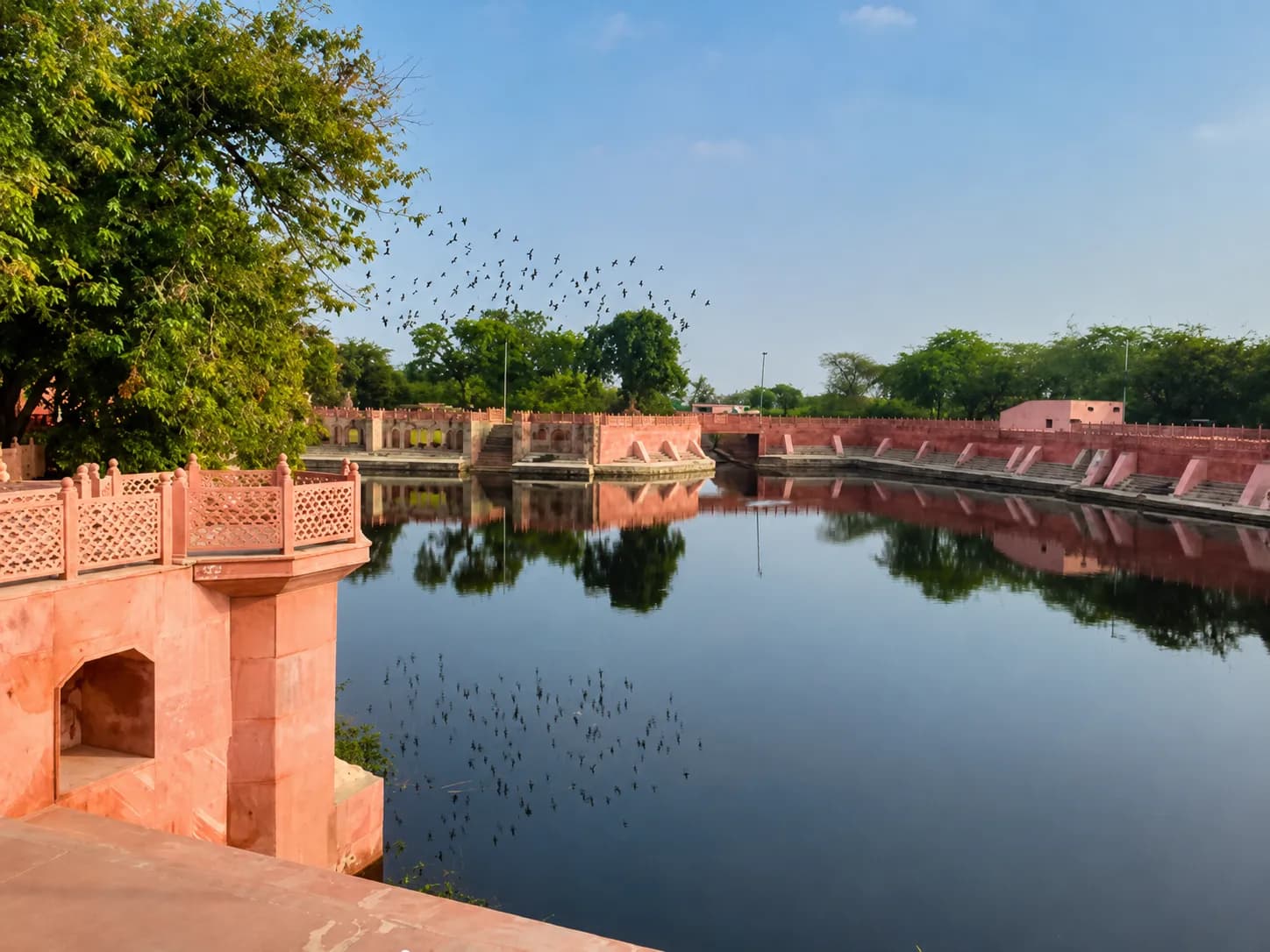
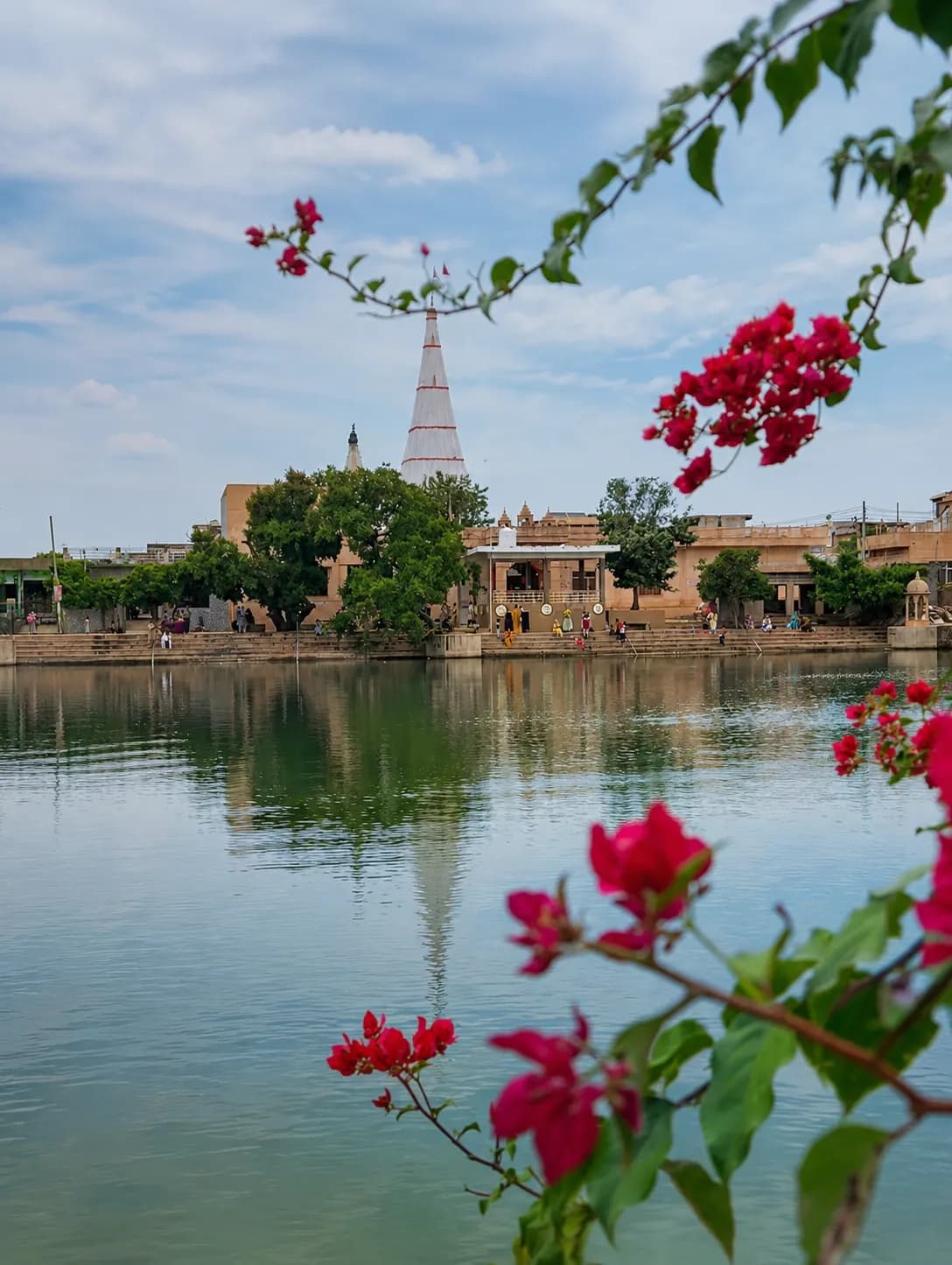
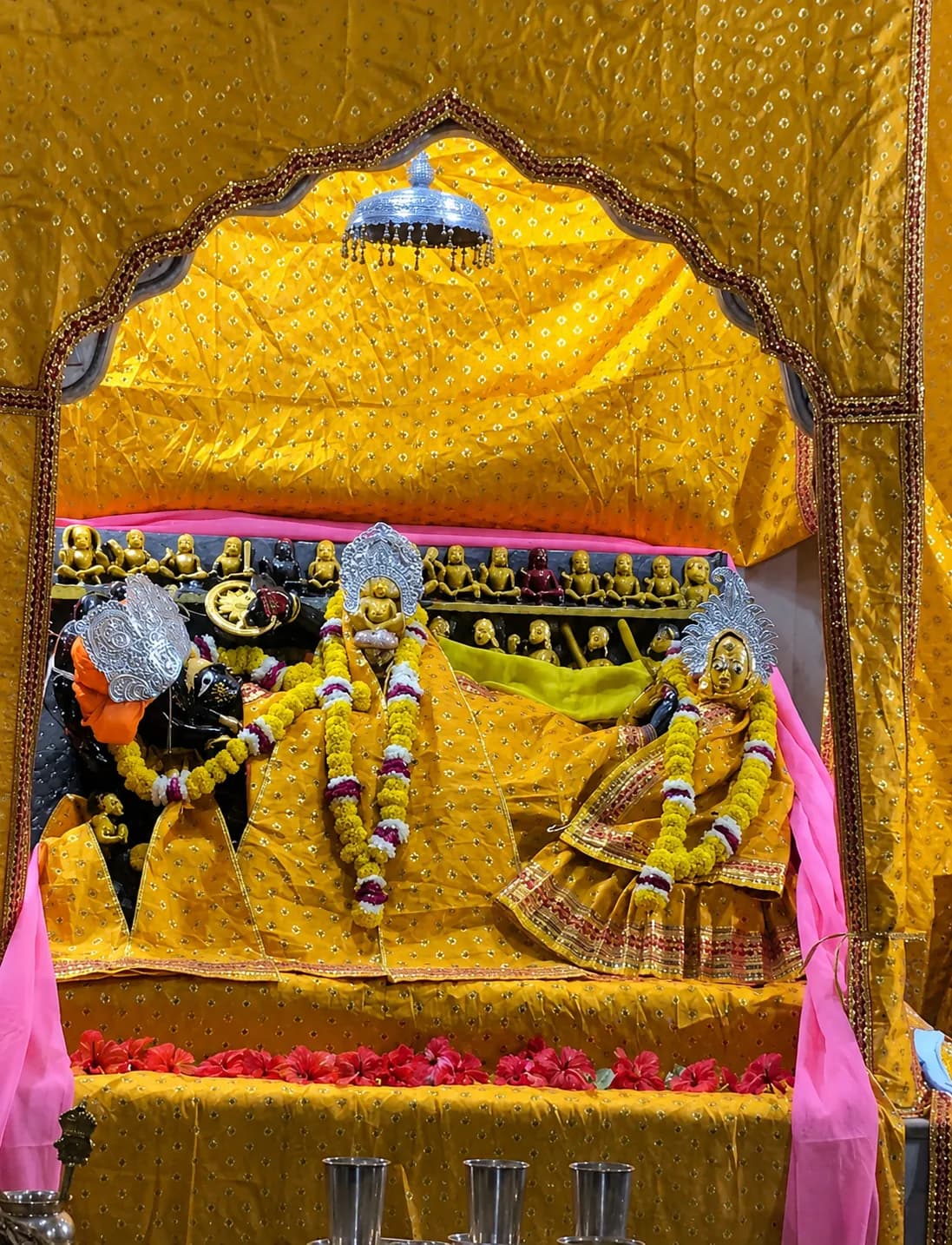
Shesha-shai is the place of one wondrous lila on the northern border of Vraja, on the route of the Vraja-mandala parikrama between Kotvan and Kosi. Here are the kunda Kshira-sagara, the “ocean of milk”, and a temple where Krishna reclines on the serpent Ananta in the form of Vishnu, while Radha, in the mood of Lakshmi, massages His feet.
Radha’s Request
Once Krishna was playing in this secluded forest with Radha and her friends; in conversation the talk turned to Vishnu, who eternally rests on the thousand-headed serpent Ananta in the midst of the ocean of milk. Radha wished to see that form with Her own eyes. “O Hari,” She said, “I have heard that You are Ramachandra, and Vishnu, and the other incarnations. If You find Me worthy, show Me the form You assume, reclining on Shesha-Naga in the ocean of milk.”
How the Kshira-sagara came to be the sources relate differently. Sivarama Swami writes that the delighted Krishna played on His flute – and in answer His cows flooded the earth with unending streams of milk, so that a lake spread out at once. In the retelling of Rajashekhara dasa, Krishna manifested this kunda directly from His mind. Both retellings agree on one thing: in the midst of the milky expanse the serpent Shesha appeared with a thousand heads strung with jewels, and his mouths sang the glories of the Lord.
Then Radha and Krishna walked hand in hand along the body of the serpent – and before the eyes of Her friends they were transformed. Krishna became the four-armed Vishnu with conch, club, disc and lotus, and Radha a four-armed Lakshmi. Krishna leaned back on the hoods of Shesha, stretched out at full length and laid His feet in Radha’s lap. Massaging His feet, She wished to press them to Her breast but did not dare: She thought that Her firm breast would hurt those feet, tender as lotuses. And so She froze, not daring to touch. The gopi friends looked on in amazement.
It is precisely this scene that Srila Raghunatha dasa Gosvami recalls in the Vraja-vilasa-stava, asking of Shesha-shai the chance to live for ever in Vraja:
yasya śrīmac-caraṇa-kamale komale komalāpi
śrī-rādhoccair nija-sukha-kṛte sannayantī kucāgre
bhītāpy ārād atha nahi dadhāty asya kārkaśya-doṣāt
sa śrī-goṣṭhe prathayatu sadā śeṣa-śāyī sthitiṁ naḥ
Shri Radha, Herself tender, wished for Her own happiness to press to Her breast the tender lotus feet of Shesha-shai Shri Krishna, but changed Her mind, fearing that Her breast was too firm for His feet. May Shesha-shai then grant me for ever a shelter in the enchanting meadows of Vraja.
Sivarama Swami, referring to Srila Rupa Gosvami, makes a distinction: the Sheshashayi-Vishnu whom Krishna manifests in Vraja and the Sheshashayi-Vishnu who proceeds from Narayana are not one and the same. The first is higher: when He manifests, the second is present within Him. The relation between them is the same as between Krishna Himself and His expansion Narayana. It is not that Krishna here imitates Vishnu – the ocean of milk itself and the Bhagavan resting upon it take their beginning in this cowherd play.
Glorified in the Shastras
Under this name the place is to be found in the stavas and in the pilgrim guides, not in the Puranas. The Bhakti-ratnakara leads the pilgrim through Shesha-shai and retells the lila in almost the same words as the Vraja-vilasa-stava:
Here, at Shesha-shai, is the Kshira-samudra, where Krishna for His amusement reclined on the serpent couch of Ananta. The bliss He felt when Shri Radhika served His feet is beyond description.
The name of the forest wanders from source to source: in one place it is Sheshashayi-vana, in another Sheshashayana-vana. The Adi-varaha Purana counts Sheshashayi among the upavanas, the lesser forests of Vraja-mandala. In the old “map” in which Vraja is presented as the body of Krishna, Shesha-shai together with the neighbouring Paramananda-vana forms the nostrils.
The History of the Place
Who installed the Deity here is not known for certain. The local brahmanas say that it was manifested by Vajranabha – the great-grandson of Krishna, who restored the holy places of Vraja after the Lord’s departure. There are no records to confirm this. It is also said that the Deity was discovered by Srila Narayana Bhatta Gosvami, but the dates do not agree: Shri Chaitanya Mahaprabhu saw Sheshashayi-Vishnu here during His Vraja parikrama in 1515, while Narayana Bhatta came to Vrindavan only in 1545 – which means it stood here long before him.
Of this darshan the Bhakti-ratnakara tells in detail: seeing the beauty of the Deity, Lord Chaitanya was wholly overcome with love; those who saw His radiance and His tears decided that before them was no ordinary man but Sheshashayi-Bhagavan Himself in the guise of a sannyasi. Rajashekhara dasa adds: looking at Lakshmi massaging the feet of Vishnu, Mahaprabhu spoke the verse of the gopis from the Srimad-Bhagavatam.
yat te sujāta-caraṇāmburuhaṁ staneṣu
bhītāḥ śanaiḥ priya dadhīmahi karkaśeṣu
tenāṭavīm aṭasi tad vyathate na kiṁ svit
kūrpādibhir bhramati dhīr bhavad-āyuṣāṁ naḥ
O dear beloved! Your lotus feet are so tender that we place them on our breasts with the greatest care, fearing to cause You pain. In You is our whole life. And so it troubles us that the pebbles on the forest path along which You walk may hurt Your tender feet.
Later, by tradition, Shri Vallabhacharya came here too: beside the temple his seat, the bethaka, is preserved.
Shesha-shai Today
The temple stands to this day. Within is the Deity of Sheshashayi-Vishnu: the four-armed Narayana on Shesha-Naga, with Lakshmi at His feet; the local people call Him Podhanatha. Beside the temple is the kunda Kshira-sagara, honoured as non-different from that very ocean of milk; it has a second name as well, Maha-dadhi-kunda. Here too are a kadamba grove and the jhulana-sthali, the place of Krishna's swing-riding with the gopis. A kilometre and a half to the south lies Nandanavana – a small wood to which, as they tell, for bhajan Nanda Maharaja often came.
With this same place is connected an episode from the life of Srila Prabhupada. In 1932 he, then still an uninitiated householder, Abhay Charan De, was walking with a group of pilgrims of Srila Bhaktisiddhanta Sarasvati Thakura. At Kosi, on the last night of the parikrama, it was announced: one could either stay to hear the spiritual master or go for the darshan of Sheshashayi-Vishnu. Almost everyone went to the temple – only Abhay Charan and a dozen senior sannyasis remained. “I thought: what is there for me to see at this Sheshashayi?” he recalled afterwards. “Better let me hear what Srila Bhaktisiddhanta Sarasvati will say.” Later, when they were introduced to one another in Allahabad, Sarasvati Thakura remarked: “He likes to hear. He does not go away. I have marked him. I shall accept him as a disciple.”
Sources
We build Vrajapedia together – with stories, verses, photographs and parikrama experience. If you know something more, tell us and it will appear on this page.