Peeli Kaner
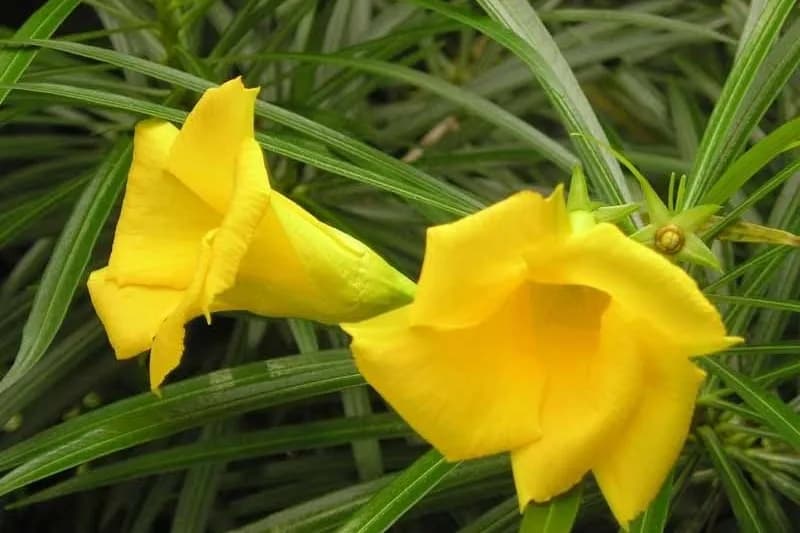
Peeli kaner, the “yellow kaner”, is the double of the karavira: its flowers are neither white nor red but a warm gold, wound into tight funnel-bells. After them comes a drupe whose stone is worn as a charm for luck — the “lucky nut”. Beautiful, poisonous, and a stranger: this oleander sailed to India from Mexico, and the ancient texts of Vraja do not know it. It has no Vrindavan pastime of its own, but its name sets it in the shadow of the karavira, and the colour of its flower is read in its own way by the tradition of worship.
Name and Place
The yellow oleander comes from tropical America, from Mexico; it reached India already as an ornamental and settled into gardens and roadsides. Neither under the name pita-karavira nor under any other is it to be found in the shastras: in the age when those texts were taking shape, the tree was growing across the ocean.
The place it holds in Vrindavan it took through a name — and a borrowed one at that. Kaner in Hindi is the karavira, Nerium oleander; the word itself grew out of the Sanskrit karavira. The yellow newcomer was given the same name with a qualifier: peeli kaner, “yellow kaner”. The same dogbane family, the same poisonous beauty, the same funnel-shaped flowers. And so it ended up in the shadow of its elder relative: in Vraja the karavira is both offered to the Lord and kept under a wary eye. That reputation the yellow double received along with the name — it has none of its own.
The Yellow Flower in Worship
Peeli kaner comes to the service of Krishna not through pastime but through colour. Setting out in the Hari-bhakti-vilasa which flowers the Lord is to be honoured with, Srila Sanatana Goswami gives a short rule: the colour of the offering answers with a different fruit.
śvetaiḥ puṣpaiḥ samabhyarcya naro mokṣam avāpnuyāt ||
kāmān avāpnuyāl loke pītair devaṁ samarcayan |
śatrūṇām abhicāreṣu tathā kṛṣṇaiḥ prapūjayet ||
“A man who worships the Lord with white flowers attains liberation. He who honours Him with yellow (pita) flowers gains the fulfilment of his desires in this world; and with dark flowers worship those who seek to overcome their enemies.”
What the Rule of Colour Says
The white flower here leads to moksha, liberation; the yellow to kama, the fulfilment of an earthly wish. Which means that the golden flower of the kaner, even offered with love, speaks of a request rather than of renunciation. This is neither a prohibition nor a commendation but a caveat about colour — and the yellow oleander falls under it entirely.
And in India today the bright yellow flowers of the kaner really are carried to puja — a young custom, but a living one. So the stranger plant, unknown to the poets of Vrindavan, comes to rest at the Lord’s feet after all.
Not a Medicine
The classical Ayurvedic characteristics — rasa, virya, vipaka — peeli kaner does not have: the nighantus do not describe a late arrival from overseas. Folk usage yields little more: the whole plant, from root to seed, contains cardiac glycosides, so it is taken only externally and with caution, while the “lucky nut” is worn as an amulet far more often than it is used.
Botany
Peeli kaner is Cascabela thevetia (formerly Thevetia peruviana), an evergreen shrub or small tree of the dogbane family. It stands three to six metres, with narrow glossy leaves up to 25 cm set round the shoot in threes, and funnel-shaped bell flowers of a warm gold (less often white or orange). The fruit is a fleshy drupe that blackens from green as it ripens; inside is a hard stone with two to four flat seeds, and it is this that is called the “lucky nut”. From the true kaner, the karavira, it is told apart by the yellow colour and by the bell shape of the corolla, but the poisonousness and the general look the two oleanders hold in common.
Photographs of peeli kaner
Sources
We build Vrajapedia together – with stories, verses, photographs and parikrama experience. If you know something more, tell us and it will appear on this page.