Kusha
There is a grass in India that is not picked in passing: it is cut with a prayer, twisted into rings and mats, and hardly a rite is performed without it. The kusha, a stiff grass with a sharp leaf-tip, was born from the body of the Lord Himself: in the form of the Boar He shook Himself, and the hairs that fell took root as this grass. That is why Krishna names the kusha among His opulences. And in Vraja the forest of Talavana is carpeted with it, with it the place of a rite is sprinkled and purified, and it is this grass, twisted into a ring, that the dark-hued Cowherd puts on His finger when He plays the part of a young brahmana.
The Grass Born from the Body of the Lord
Why an unremarkable grass became a holy thing, the Srimad-Bhagavatam tells. The Lord took the form of the giant Boar, Varaha, to raise the drowned Earth from the bottom of the ocean, and coming out of the waters He shook Himself – and hairs fell from His body. On that spot rose the capital of Svayambhuva Manu, the city of Barhishmati, named, as Srila Vishvanatha Chakravarti explains, after that same grass: barhis is one of the names of the kusha, and so the sacrificial bedding made of it is called. And the hairs themselves took root as two evergreen grasses:
kuśāḥ kāśās ta evāsan śaśvad-dharita-varcasaḥ
ṛṣayo yaiḥ parābhāvya yajña-ghnān yajñam ījire
“The city of Barhishmati was so called because the Lord's hair dropped there from His body when He manifested Himself as Lord Boar. As He shook His body, this very hair fell and turned into blades of evergreen kusha grass and kasha, by means of which the sages worshipped Lord Vishnu after defeating the demons who had interfered with the performance of their sacrifices.”
One of the names of Krishna keeps the same thought. Explaining the Gita-Govinda, Srila Bhaktivedanta Narayana Gosvami recalls: the name Keshava is derived, among other ways, from the word kesha, “hair” – for it was the hair fallen from Lord Varaha that became the kusha grass, without which a Vedic sacrifice is unthinkable1.
And since this grass is from the body of the Lord, He does not pass it over in the list of His opulences, where He names the best in every kind of thing. In His conversation with Uddhava He sets the kusha beside the ruby among jewels and ghee among oblations:
ratnānāṁ padma-rāgo ’smi padma-kośaḥ su-peśasām
kuśo ’smi darbha-jātīnāṁ gavyam ājyaṁ haviḥṣv aham
“Among jewels I am the ruby, and among beautiful things I am the lotus cup. Among all types of grass I am the sacred kusha, and of oblations I am ghee and other ingredients obtained from the cow.”
Kusha in Vraja
The kusha grows all over Vraja. When the shastras describe the forest of Talavana, the very one where Balarama crushed the ass-demon Dhenuka, they paint its ground as level, soft, black and “thickly overgrown with darbha grass, without stones or rubble”2.
In Vraja things are made of kusha as well. In the Gopala-champu Srila Jiva Gosvami tells how the cowherds, moving to Vrindavan and taking the herds across the river, bound together reeds – kasha, kusha and shara – with bamboo into a floating roadway as wide as a highroad. And when Krishna and Balarama enter the ashrama of their teacher as true brahmacharis, on their fingers are rings of kusha, pavitra, the mark of one initiated into a rite.
And once a bunch of kusha helped Krishna make His way to Radha. Her jealous mother-in-law Jatila, wishing to guard her daughter-in-law, calls a brahmana into the house to perform worship of the sun god. And that priest turns out to be Krishna in disguise: a young brahmachari in white, with a book and a bunch of darbha grass in His hand.
dhīra-tāra-nayanaḥ sita-vāsā darbha-sambalita-pustaka-pāṇiḥ
sāma-gāna-madhura-svara-kaṇṭho mūrtimān sa ihaiṣa tadoce
“With a deep, calm gaze, in white garments, with a book and darbha grass in His hands, with a voice as sweet as the singing of the Sama-veda – He, [piety] itself embodied, spoke…”
Then the play begins. The rite requires that the priest and the one for whom it is performed should touch. “I do not touch women,” says the supposed brahmana, “so touch Me with kusha grass and recite the mantra”3. So under the guise of ritual strictness He receives a touch from Radha, while the helpers meanwhile sprinkle the “priest” with water from the tips of that same kusha.
Worship
What in the lilas only flashes by is set out in detail in the instructions on worship. The Hari-bhakti-vilasa of Srila Sanatana Gosvami and Srila Gopala Bhatta Gosvami gives the kusha a place of its own. A seat for sadhana and puja, it teaches after the Narada-pancharatra, must not be made of bamboo, stone, wood or common grass – those bring misfortune; whereas a mat of kusha “carries illness away”4. With it, twisted into a besom, the arena of sacrifice is swept; with water from its tips the sacrificial pit, the kunda, is sprinkled and purified; the tips of kusha (kushagra) are put into the arghya, the water for bathing the Lord's feet; and from three stalks folded together a special knot is tied, the kurcha, which is called just that – “the knot of Brahma”.
There is a place in the same book where the kusha yields. The leaves for offering to the Lord the Hari-bhakti-vilasa arranges as a ladder: from the apamarga and the bhringaraja upward through the shami, the durva and the kusha – to the amalaki, to the leaf of the bilva and, above all of them, to the tulasi. The grass without which hardly a rite is begun is not at the top of this row.
Beyond Vraja
Beyond Vraja the kusha is above all the grass of yogis and sages. Instructing Arjuna in yoga, Krishna first of all tells him to make a seat of precisely this grass:
śucau deśe pratiṣṭhāpya sthiram āsanam ātmanaḥ
nāty-ucchritaṁ nāti-nīcaṁ cailājina-kuśottaram
“To practise yoga, one should go to a secluded place and should lay kusha grass on the ground and then cover it with a deerskin and a soft cloth. The seat should be neither too high nor too low and should be situated in a sacred place.”
On just such a mat Maharaja Parikshit passed the last week of his life, listening to the Srimad-Bhagavatam on the bank of the Ganga – the commentary on the verse about Krishna's opulences quoted above recalls this too. And in the hands of Balarama the same grass once became a weapon: on His pilgrimage He strikes down the haughty Romaharshana with a single blade of kusha, merely touching him with its tip.
There is a tale of quite another kind about this grass as well. When Sita, the daughter of the Earth, went back into the earth at the end of her life, her son caught at his mother's hair – and the strands left in his hand turned into kusha grass; after it the prince was named Kusha.
Ayurveda
In Ayurveda the kusha is a grass of coolness. Sushruta puts it into the trinapanchamula, “the five grass roots”: kusha, kasha, nala, darbha and shara go together as a mild diuretic and a cooling remedy in fever and diseases of the urinary tract.
Curiously, the kusha and the darbha stand separately in that five, although in ritual they are two names of one grass: the name darbha the lexicons give to a neighbouring grass as well, the imperata. The kusha is taken as an astringent too – for diarrhoea and bleeding – and its root goes into the paste which, according to the Kashyapa-samhita, is applied for snakebite.
Botany
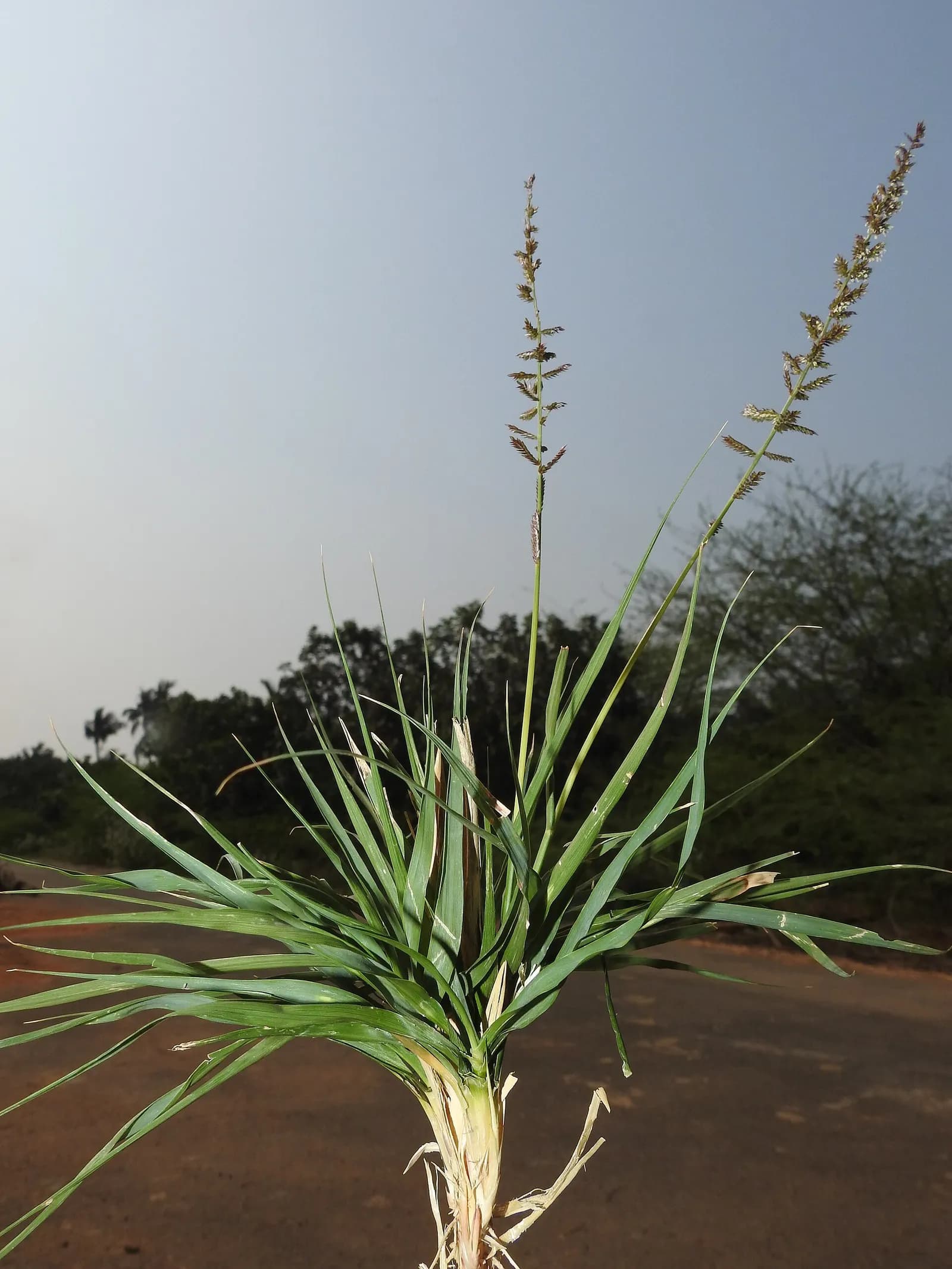
The kusha is Desmostachya bipinnata. From a thick creeping rhizome it rises in straight stems; its leaf is long and narrow, with cutting edges and a prickly tip. The inflorescence is gathered from spikes some fourteen centimetres long: they may be crowded together or set apart. The kusha grows in a broad belt from the Sahara to Tanzania, across the Indian subcontinent and Indochina, and occurs in the Himalayas as well; it settles readily on salt flats and dry wastes, and in the fields it has the name of a stubborn weed. In different parts of India it is called differently – dabh in Hindi, kush in Bengali – but most often by one of the two ancient names: darbha or kusha.
Kusha: the stand, the spike, the clump
Sources
We build Vrajapedia together – with stories, verses, photographs and parikrama experience. If you know something more, tell us and it will appear on this page.