Aparajita
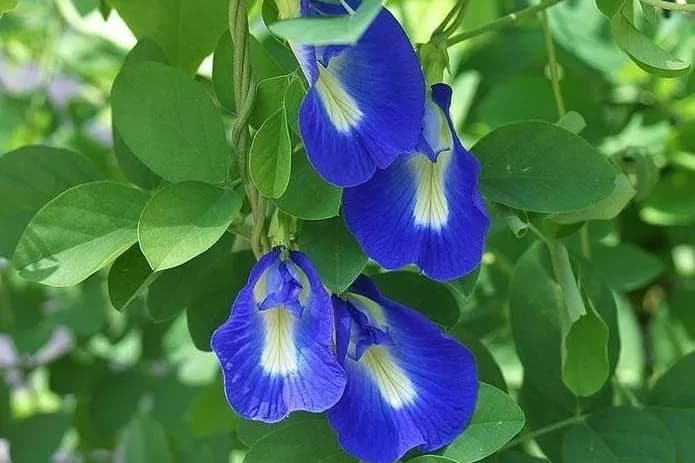
This creeper twines over the fences and bushes of Vraja, and it is known by its color. The Sanskrit tradition gave it the name vishnukranta, “she whom Vishnu stepped over,” while the poets of Vrindavan saw in its blue the very hue in which Krishna’s body glows. Yet its flower can also be white, and its whole story in Vraja rests on these two colors: one the poets gave to Krishna, the other to Balarama.
The Creeper in the Kunja
The aparajita is an unassuming creeper: it clings to bushes, hangs from fences, and weaves its blue into the overall green of the kunja. In the Govinda-lilamrita, describing the grove where the Divine Couple rests, Srila Krishnadasa Kaviraja Gosvami lists its creepers one by one, and the aparajita – under the name vishnukranta – stands there alongside gunja and bimba:
śrī-vāsantī-saptalā-svarṇa-yūthī
jātī-yūthī-mallikā-mudgarādyaiḥ |
viṣṇukrāntā-kṛṣṇalā-bhīru-bimbā
kubjāsphotādyaiś ca vallī-samūhaiḥ ||
“…full of creepers – vasanti, saptala, svarna-yuthi, jati, yuthi, mallika, and mudgara, as well as vishnukranta, krishnala, bhiru, bimba, kubja, and asphota…”
The Service of the Blue Flower
A verse earlier it is said that all these creepers are kalpa-valli, desire-fulfilling creepers. The aparajita has a service of its own as well. When Srila Jiva Gosvami in the Gopala-champu portrays Govardhan Hill as a gracious host receiving the Lord with every rite of hospitality, the water for washing His feet, padya, flows down the hill in waterfalls, and in these streams – among shyamaka grass, durva, and lotuses – float vishnukranta flowers1. The blue flower thus becomes part of what Govardhan himself offers at Krishna’s feet.
Blue and White: Two Colors, Two Brothers
The aparajita blooms in two ways: some creepers bear a deep blue flower, others a pure white one. Srila Jiva Gosvami drew on this for the scene of the name-giving ceremony. The sage Garga comes secretly to Gokula to name the two boys; and when Rohini with Balarama and Yashoda with Krishna sit down before him, the poet sees them thus:
sitāsitaikaika-puṣpa viṣṇukrāntādvaya-prabhe |
te rohiṇī-yaśodākhye tanayābhyāṁ virejatuḥ ||
“With their sons, mothers Rohini and Yashoda shone like two vishnukranta vines, each bearing a single blossom: one white, the other dark.”
The white flower is fair-complexioned Balarama on Rohini’s lap; the dark one, Krishna on Yashoda’s lap: one vine, two hues.
The poets give that same dark flower to Radha’s eyes as well. Elsewhere in the Govinda-lilamrita, Her eyebrows are likened to vishnukranta vines curving and spreading wide, and Her eyes to dark flowers blossoming on those vines:
bhruvau tiraḥ-prasāriṇyau viṣṇukrāntā-late dhruvam |
asyāḥ kṛṣṇe yayor bhātaḥ kusume netrayor miṣāt ||
“Her eyebrows are creeping vishnukranta vines, and the dark flowers that shine upon them are Her eyes.”
The Sanskrit commentary on this passage offers a brief gloss: vishnukranta means aparajita.
Unconquerable: The Origin of the Name
Aparajita means “unconquerable, undefeated.” Tradition applies the same word both to the Lord and to His energy: in the Bhakti-rasamrita-sindhu Krishna is called aparājita-mānī, “proud of being unconquerable,” while the Hari-bhakti-vilasa advises keeping the name of Lord Aparajita in mind when going into battle. There is also a Rudra named Aparajita among the eleven Rudras (forms of Shiva). Yet no dictionary explains why the vine came to bear this name: in what way it is unconquerable, we do not know.
The second name is clearer. Kranta comes from the root kram, “to step, to stride”; the same root gives us vikrama, “a stride,” and Trivikrama, “he who took three strides” — the name of Vamana, who measured out all the worlds in three steps. Thus vishnukranta means “she over whom Vishnu strode.” What linked this image to a vine creeping along the ground, the dictionaries likewise do not say, yet tradition holds the herb itself to be auspicious: in the same Hari-bhakti-vilasa, vishnukranta appears in a list of herbs, like durva, that a Vaishnava does well to keep at hand.
Ayurveda
In the medical tradition, aparajita is known by many names — vishnukranta, asphota, girikarni, shveta. It is also called shankhapushpi, but that name is shared by several different herbs, and in Ayurvedic compendia it more often refers to another plant. Its rasa (taste) is pungent, bitter, and astringent; its guna (qualities) are light and dry; its virya (potency) is cooling; its vipaka (post-digestive effect) is pungent. The plant is considered to balance all three doshas. Its chief renown is as a medhya, a remedy for the mind and memory: aparajita is counted among the intellect-strengthening herbs and is used for memory disorders and for the eyes, throat, and skin. The Charaka Samhita places it in the shiro-virechanopaga gana — herbs that aid cleansing of the head through the nose — while the Bhavaprakasha Nighantu assigns it to the guduchyadi gana. The parts used are the root bark, roots, and seeds.
Botany
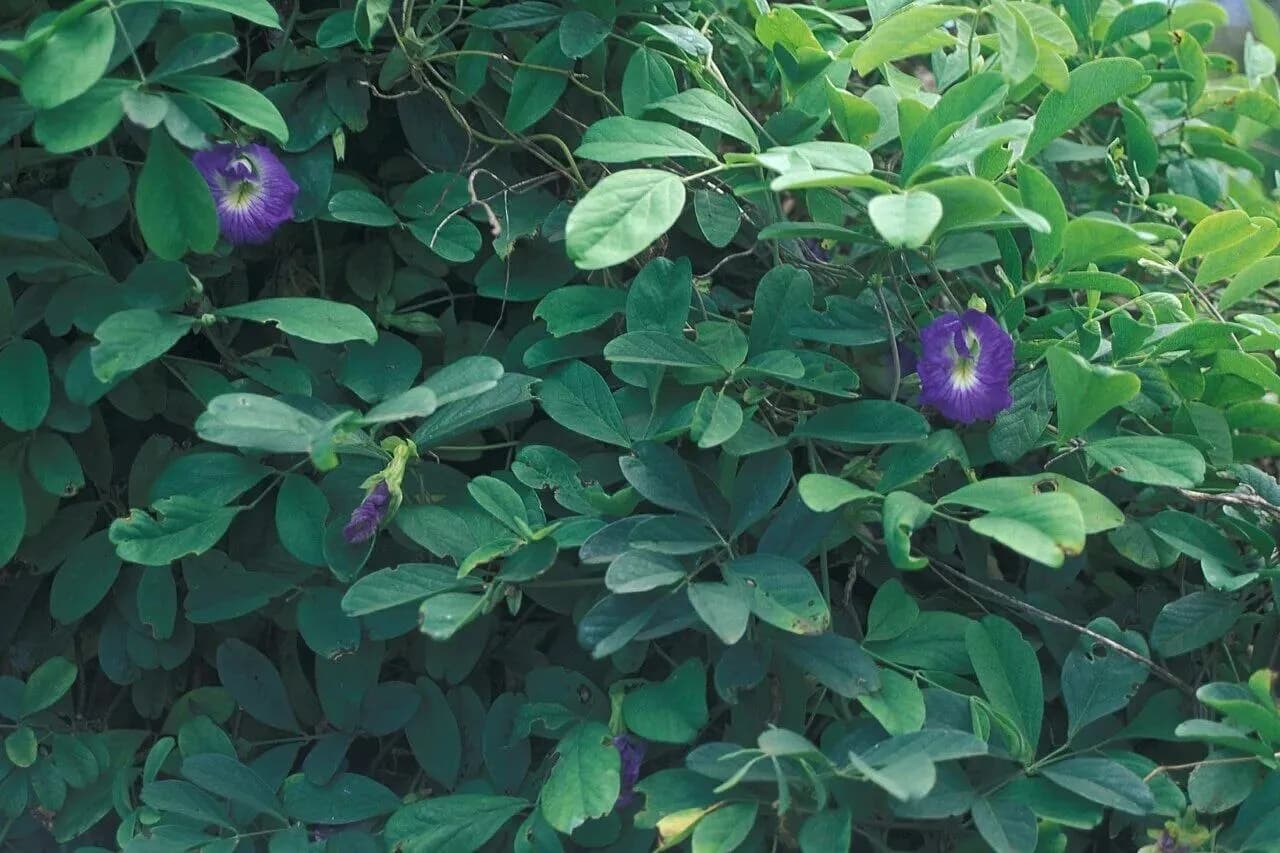
Aparajita is Clitoria ternatea of the family Fabaceae (pea family, relatives of peas and beans), a slender twining climber: its woody base overwinters, while the shoots grow back each year and climb about three meters up a support. The leaf is pinnate; the flower is large, four centimeters by three, and set upside down: in peas and beans the largest petal, the standard, stands at the top while the narrow keel is tucked below — in aparajita it is the other way around. The flower’s shape earned the plant its English name, Butterfly Pea; after flowering, the vine bears flat legume pods with seeds. Aparajita is native to Africa and Southeast Asia, but throughout India it is grown by houses and fences — both for the blue of its flowers and for the equally blue infusion brewed from them.
Aparajita in bloom
Sources
We build Vrajapedia together – with stories, verses, photographs and parikrama experience. If you know something more, tell us and it will appear on this page.