Uddhava-kunda
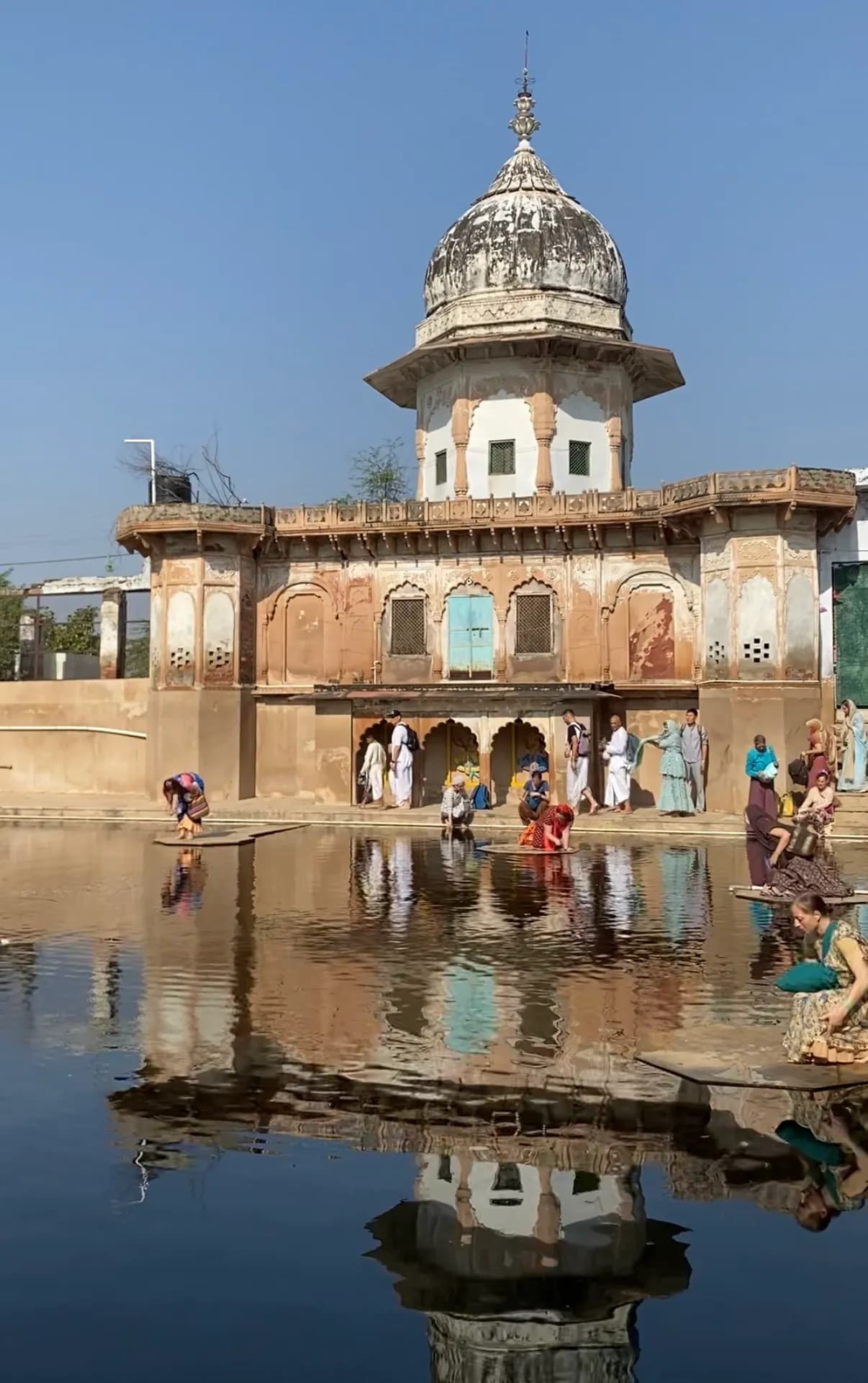
A small kunda on the road of the Govardhana parikrama, to the right of the road, not far from Kusuma-sarovara. It is named after Uddhava – the cousin, minister and closest friend of Krishna. After his journey to Vraja he prayed to be born here as a blade of grass, so that the dust from the feet of the gopis might fall upon him. According to the Bhagavata-mahatmya of the Skanda Purana, it was here too that he appeared to the queens of Dvaraka and recited Srimad-Bhagavatam to them for a month.
Why the Kunda Bears Uddhava’s Name
When Krishna left Vraja for Mathura and then for Dvaraka, the only one He could send to Vraja was Uddhava – there was no one else to entrust this journey to. Nanda and Yashoda had to be consoled and a message delivered to the gopis. But Krishna had a second purpose as well: He wanted Uddhava to understand, at least a little, what their love was.
So that the people of Vraja would not doubt the messenger, Krishna gave him His own yellow pitambara and a fresh vaijayanti garland – the one that was made for Him every day. Uddhava arrived on a golden chariot. The gopis, catching sight of it from afar, took fright: “Is it Akrura again?” – and then they made out the garland and the clothes and were reassured: “He looks like Krishna and he is dressed like Krishna.” At that moment Uddhava wished the earth would swallow him. “Beside the gopis I have not a drop of devotion to Krishna,” he thought, and without going up to them he turned first towards the house of Nanda.
He found the house abandoned. Disorder, the hearth and the pots under a layer of dust and cobwebs. In a corner, on a bed, mother Yashoda lay motionless. Uddhava stayed in Vraja for ten months, and all that time, in the words of Srila Raghunatha dasa Gosvami, he “again and again brought the people of Vraja back to life with stories of Krishna”.
He left that place a different man. Everything he had known about devotion before Vraja ceased to seem devotion to him.
āsām aho caraṇa-reṇu-juṣām ahaṁ syāṁ
vṛndāvane kim api gulma-latauṣadhīnām
yā dustyajaṁ sva-janam ārya-pathaṁ ca hitvā
bhejur mukunda-padavīṁ śrutibhir vimṛgyām
“The gopis of Vrindavana have given up the association of their husbands, sons and other family members, who are very difficult to give up, and have forsaken the path of chastity to take shelter of the lotus feet of Mukunda, Krishna, whom one should seek out by Vedic knowledge. Oh, let me be fortunate enough to be one of the bushes, creepers or herbs in Vrindavana, because the gopis trample them and bless them with the dust of their lotus feet.”
The commentators draw attention to the order of the words. Uddhava does not ask to be a tree: trees are tall, and the dust from the feet does not reach them. He lists gulma, lata, oshadhi – bushes, creepers and herbs, each one lower than the one before. Most of all he wishes to become grass. Srila Jiva Gosvami and Srila Sanatana Gosvami see in this gradation an echo of his humility.
Srila Sanatana Gosvami distinguishes this prayer from the similar prayer of Brahma. Brahma with his four heads cannot remain in Vraja for long and asks for the dust from the feet of anyone at all among the people of Vraja. Uddhava lived in Vraja for a long time and asks for the mood of service from the gopis in particular.
Uddhava’s Appearance to the Queens of Dvaraka
Krishna left this world, and His great-grandson Vajranabha, at the direction of the sage Shandilya, set about restoring Vraja: he founded villages, dug lakes and wells, installed Shiva-lingas. Maharaja Parikshit sent him architects, engineers, craftsmen, painters and masons from his capital Indraprastha. Vraja came back to life – but the queens of Dvaraka, who had been brought here, went on burning with separation from their husband.
One day the queens came to the bank of the Yamuna and saw that the river was full of joy. This astonished them: “You are as much a wife of Krishna as we are, yet the pain of separation has not touched you. Why?” The Yamuna answered: “I am a maidservant of Radharani, and therefore separation from Krishna is unknown to me. And you in truth are never parted from Him, only you do not know it.” And then she advised them: go to Sakhi-sthali by Giriraja Govardhana, to the lake overgrown with flowers, and hold a great festival of sankirtana there – the congregational singing of the holy names. At the height of the festival, she said, Uddhava will appear.
The primary source of this account is the Bhagavata-mahatmya of the Skanda Purana. The place is named in it thus:
govardhana-giri-nikaṭe
sakhī-sthale tad-rajaḥ-kāmaḥ
tatratyāṅkura-vallī-rūpeṇ-
āste sa uddhavo nūnam
“At the place of the sakhis, near the hill of Govardhana, Uddhava verily abides in the form of shoots and creepers, longing to obtain the dust touched by the gopis.”
The Festival at Kusuma-sarovara
The next shloka explains why a festival in particular would work: Krishna blessed Uddhava so that he himself would appear as an utsava – a festival of His glory. That is why the Yamuna tells them to go to the surroundings of Kusuma-sarovara and to take Vajra with them. In Sivarama Swami’s telling Kalindi-devi puts it more simply: “Uddhava is especially fond of hari-kirtan. If we loudly sing the holy names of our beloved Krishna, he will surely appear.”
Parikshit ordered karatalas, drums, flutes and vinas to be brought. The queens, all of them skilled in singing and dancing, took up the instruments. Before the beginning the two kings agreed that Vajranabha would stand guard himself, so that no outsider should disturb the festival.
In Sivarama Swami’s description, in the queens’ kirtan everything was forgotten except the Holy Name: gone were Parikshit’s horses, his armies, his family, his kingdom, his rule over the earth. Parikshit opened his eyes and saw the queens standing like golden dolls turned towards the grove by Kusuma-sarovara – motionless, only their lips moving: “Krishna, Krishna.” And then a solitary figure rose, “as mist rises from a lake”. The body dark as the Yamuna and cool as her waters; arms strong as thunderbolts; a chest broad as a doorway; eyes soft as lotus petals.
tataḥ paśyatsu sarveṣu
tṛṇa-gulma-latā-cayāt
ājagāmoddhavaḥ sragvī
śyāmaḥ pītāmbarāvṛtaḥ
“And then, before the eyes of all, Uddhava came forth from the thickets of grass, bushes and creepers. He wore a garland of flowers, his body was dark blue, and he was clothed in yellow raiment.”
A Month of Srimad-Bhagavatam
The queens spread their shawls on the ground and sat down in semicircles. Uddhava and Parikshit settled in the shade of a flowering bakula. Parikshit spoke first: “The fortune fell to you of being near the Lord even when He was preparing to leave this world. Tell us, of whom did He think last, and what was His final wish?”
Vajranabha handed the kingdom over to his only son Pratibhu and at last sat down to listen together with the queens. The telling lasted a month. The listeners did not merely understand what they heard – they saw it: when Uddhava described the creation and destruction of the world, those events unfolded before them; when he spoke of Krishna’s incarnations, the pastimes appeared to the whole assembly; when he came to the pastimes of Vrindavana, they all seemed to enter into them.
atha vṛndāvane māsaṁ
govardhana-samīpataḥ
śrīmad-bhāgavatāsvādas
tūddhavena pravartitaḥ
“Thus for a month Uddhava conducted the relishing of Srimad-Bhagavatam in the forest of Vrindavana, near Govardhana.”
It all ended with the listeners disappearing. The Skanda Purana says: all who heard the Bhagavatam from Uddhava became hidden from the eyes of ordinary people, but to those whose eyes are anointed with love they are visible in Krishna’s pastimes in Vraja.
And Uddhava, as Sivarama Swami writes, “looked over the beautiful Pushpavana, the calm Kusuma-sarovara and the devoted hill of Govardhana; this was the home he had asked Krishna for, and he loved it”.
The Glory of the Grass and Shrubs of Vraja
A whole theme begins with Uddhava’s prayer: the low growth of Vraja is not vegetation but the companions of Krishna. Srila Raghunatha dasa Gosvami unfolds it thus:
yat kiñcit tṛṇa gulma-kīkaṭa-mukhaṁ goṣṭhe samastaṁ hi tat
sarvānanda-mayaṁ mukunda-dayitaṁ līlānukūlaṁ param
śāstrair eva muhur muhuḥ sphuṭam idaṁ niṣṭaṅkitaṁ yācñayā
brahmāder api sa-spṛheṇa tad idaṁ sarvaṁ mayā vandyate
“With great longing I glorify the blissful grass, bushes, worms and insects of Vraja, whose lot Brahma, Uddhava and others desire, whose glory is again and again clearly established by shastras such as Srimad-Bhagavatam, who are very dear to Mukunda and who assist Krishna in His pastimes.”
Srila Prabodhananda Sarasvati turns the same thought differently. He glorifies the forest of Radha: there Uddhava, who used to massage the lotus feet of the Lord and who lacked nothing, still wished to become a blade of grass.
The History of the Place
The kunda was dug by Vajranabha in memory of Uddhava, who lives in these parts as grass and once appeared here in person. In Sivarama Swami’s description this was not a single reservoir but a complex: a kunda, a temple and Deities. The Deity of Uddhava, according to Madhurya-dhama, was installed by him as well; Rajashekhara dasa conveys this more cautiously – “some say”.
Uddhava abides in two places at once: in Badarikashrama and here, at the foot of Govardhana. The primary source distinguishes these forms: in Badari Uddhava is present manifestly and teaches the world, while Vraja-bhumi was given to him as the land of his perfection – and therefore here he is unseen.
phala-bhūmir vraja-bhūmir
dattā tasmai puraiva sa-rahasyam
phalam iha tirohitam sat
tad ihedānīṁ sa uddhavo ’lakṣyaḥ
“But even earlier Krishna granted him Vraja-bhumi with all her secrets as the land of his perfection. And since that perfection is hidden here, Uddhava abides here unseen to this day.”
The thickets in which he lives have thinned out in recent years. Kadambavana, the forest of kadambas, stretches from the edge of Sutalavana all the way to Uddhava-kunda. The neighbouring Sakhi-sthali was once a large kadamba-khandi – a grove of which little is left.
Uddhava-kunda Today
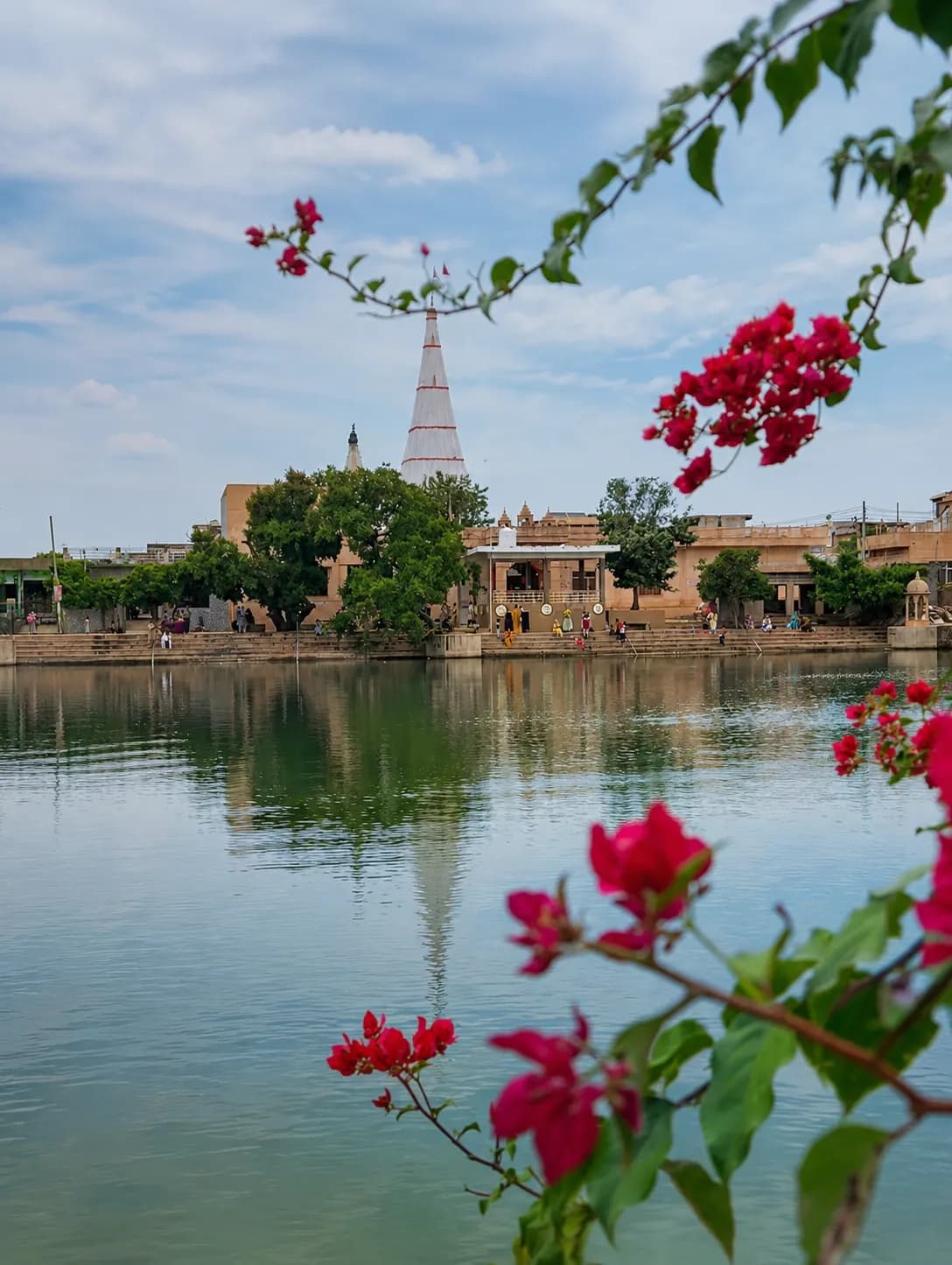
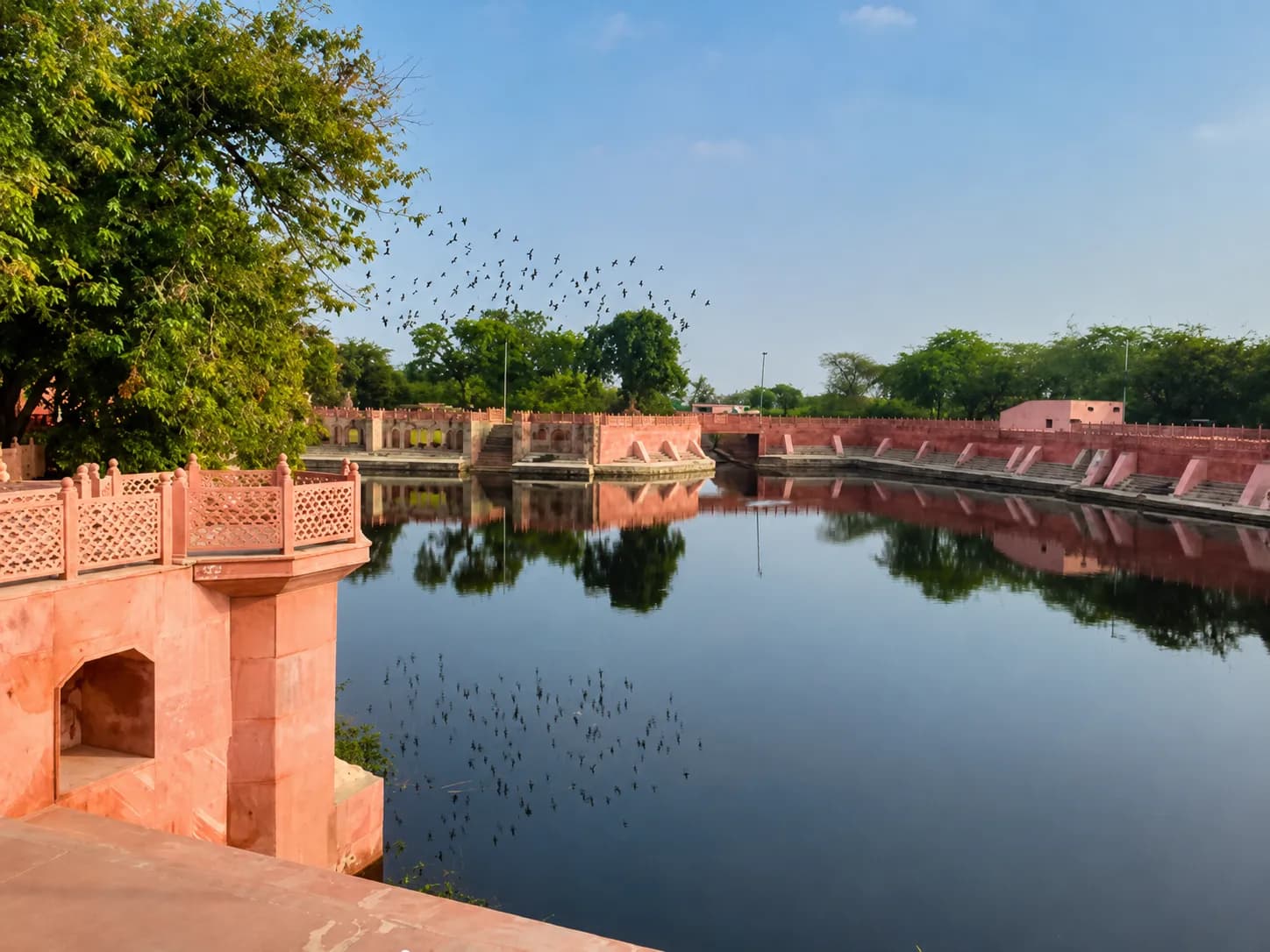
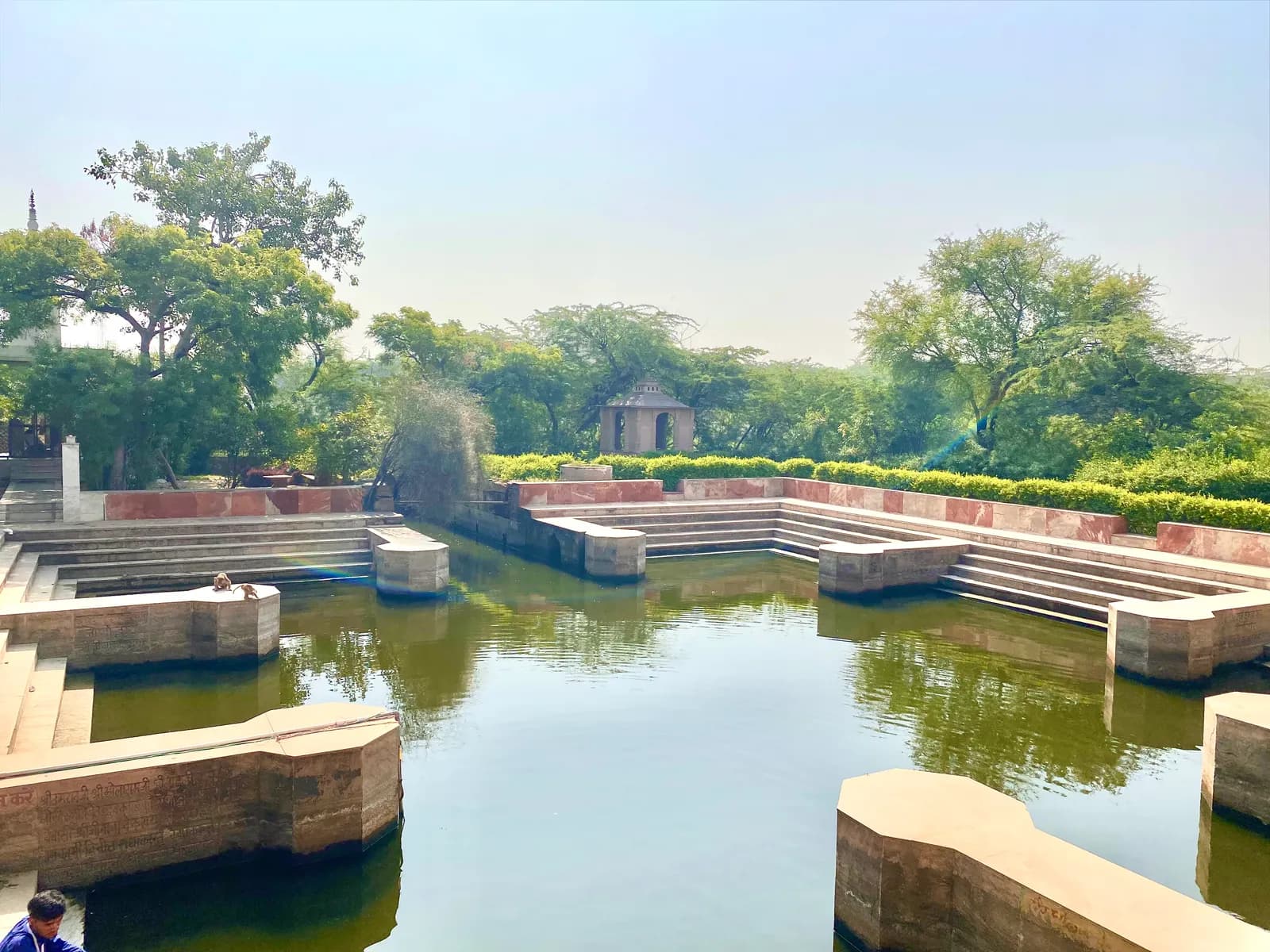
The kunda is not large, but there is always plenty of water in it, and it is kept in order. Beside it is the temple of Uddhava.
A separate point of the same complex is Uddhava-baithak, the sitting place of Uddhava on the bank of Kusuma-sarovara, near which there is a temple with a Deity of Uddhava. The sources draw the boundary between the kunda and the baithak differently, so that on the ground this is more a cluster of two or three points than a single object. The descriptions differ as well in how the kunda lies in relation to Kusuma-sarovara: some place it directly behind the lake and exactly to the west of it, others – on the other side of the Govardhana ridge, so that from the kunda one goes to the lake across the hill.
It is said that whoever bathes here will become humbler than a blade of grass and more tolerant than a tree. And whoever offers respects to Uddhava and reads Srimad-Bhagavatam here will attain the abode of Krishna.
On the path the kunda stands immediately after Sakhi-sthali, and further on the road goes to Radha-kunda:
The Other Uddhava-kunda near Nandagrama
There are two Uddhava-kundas in Vraja. The second lies near Nandagrama, beside Uddhava-kyari – a garden in the kadamba kunja of Vishakha-sakhi, where Uddhava delivered Krishna’s message to the gopis. The place there is remote, away from the parikrama of Nandagrama, and only the name connects it with the kunda by Kusuma-sarovara.
Sources
We build Vrajapedia together – with stories, verses, photographs and parikrama experience. If you know something more, tell us and it will appear on this page.