Description

Bhaktivedanta Narayana Gosvami
From the book “Sri Vraja-maṇḍala-parikramā”:
Around 5,200 years ago, at the end of the last Dvāpara–yuga, the Supreme Lord Śrī Kṛṣṇacandra appeared as the son of Śrī Vasudeva and Devakī in the prison house of the brutal King Kaṁsa. Seeing the child’s divine and wondrous four–armed form, the colour of a dark rain cloud, Vasudeva and Devakī began glorifying Him. In His four hands He held a conch shell, a disc, a club and a lotus flower; on His chest was the mark of Śrīvatsa; and the Kaustubha jewel hung round His neck. In response to Vasudeva and Devakī’s prayers, the Supreme Lord assumed the form of a newborn baby boy, and somehow urged Vasudeva to take Him in his arms and carry Him to Nanda–bhavana, the home of Nanda Mahārāja, in Gokula–Mahāvana. So that Vasudeva could escape with the divine baby, his hand cuffs and foot–shackles fell open, the guards fell into a deep sleep, and the great iron doors of the prison swung open of their own accord. Although the night was stormy and the Yamunā was filled with roaring waves, the way cleared before Vasudeva and he safely reached Gokula.
That night, in Nanda–bhavana, Yaśodā had given birth to two–armed Śyāmasundara, and a few moments later to a baby girl, Yogamāyā. Because of her heavy labour, Yaśodā had fallen unconscious. When Vasudeva entered the house with his baby, that two–armed Śyāmasundara assimilated Vasudeva’s son within Himself, but Vasudeva could not understand what had happened. He picked up the baby girl in his arms and silently returned to Kaṁsa’s prison. The prison doors closed automatically behind him, and his and Devakī’s shackles slipped back in place. When Kaṁsa received word that a child had been born to Vasudeva and Devakī, he stormed into the prison, sword in hand, and snatched the baby girl from the arms of his sister, Devakī. Swinging the baby by the legs he tried to dash her against the surface of a stone, but she rose into the sky and turned into the eight–armed goddess Durgā. After rebuking Kaṁsa she disappeared.
Śrī Vajranābha, Śrī Kṛṣṇa’s great–grandson, established an extensive temple at Śrī Kṛṣṇa’s birthplace. Over the centuries, religious kings of India successively built temples at the same location. When Śrī Caitanya Mahāprabhu arrived in Vraja there was a grand temple here. Seeing Mahāprabhu’s sweet dancing born from transcendental ecstatic love, and hearing His sweet kīrtana, hundreds of thousands of people assembled here, and became overwhelmed with ecstasy.
When Śrī Caitanya Mahāprabhu came to this place, He saved Subuddhi Rāya, a king of Bengal, by stopping him from committing suicide. He then made him into a great devotee of the Lord. Subuddhi Rāya had been ostracised from his caste by an extremist Muslim ruler in Bengal. Though Subuddhi Rāya wanted to become a Hindu again, the dogma of the priestly castes decreed that there was no path by which he could re–enter Hinduism before his death. When Śrī Caitanya Mahāprabhu, the ocean of mercy, met Subuddhi Rāya, He asked him to utter the holy name of Śrī Kṛṣṇa just once in order to become completely purified. Subuddhi Rāya followed Mahāprabhu’s instruction, and performed harināma-saṅkīrtana and served the Vaiṣṇavas at this place for the rest of his days.
Śrīman Mahāprabhu arrived in Vraja during the rule of the Mughal emperor Humāyūṁ. The Muslims later destroyed the temple that was here at that time. In AD 1610, the king of Orchā, Mahārāja Vīrasinghdeva, constructed a grand temple for Ādikeśava at the cost of thirty–three hundred thousand rupees, but in AD 1669 the intolerant and fanatic ruler Aurangzeb destroyed it, and built a mosque in its place. The priests of Śrī Ādikeśava hid the ancient deity in Rājadhāna, a village seventeen miles from the present city of Īṭāvā, in the district of Kānpura. Today, this same deity resides in a small temple in Rājadhāna, and a pratibhū-vigraha18continues to be worshipped in the Ādikeśava Temple in Mallapurā, behind the present Janma–sthāna. This Ādikeśava deity is unique in that His body is decorated with the symbols of the twenty–four incarnations of Bhagavān. Vaiṣṇavas visit this temple because they consider this the deity of Śrī Ādikeśava.
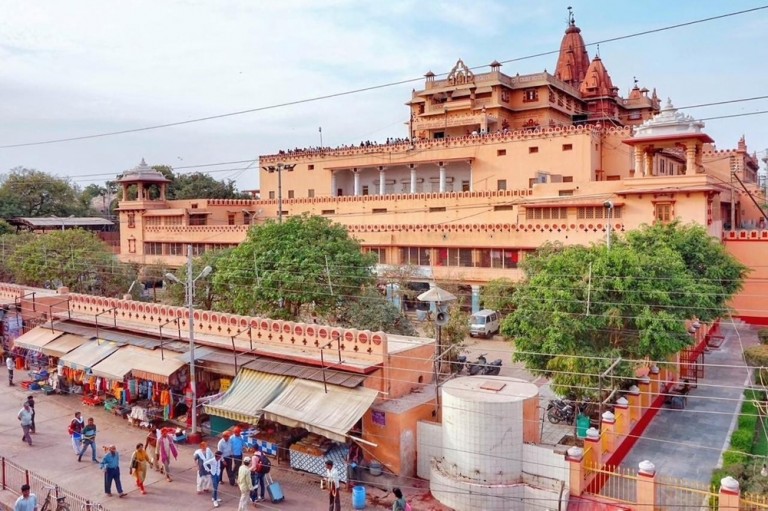
A magnificent temple has now been constructed at the birth– place of Śrī Kṛṣṇa at Keśava–kaṭara, with funds raised by Śrī Madana–mohana Mālavīya. He did this on the direction of the late Śrī Hanumān Prasāda Poddāra of Gītā Press in Gorakhapur, and with the contribution of Śrī Ḍālmiyā and other wealthy persons.
The birthplace of Śrī Kṛṣṇa is within the Mallapurā area of Mathurā. Cāṇura and the other wrestlers (mallas) of Mahārāja Kaṁsa lived here. There is a wide pond near here named Potrā– kuṇḍa, which was originally within the walls of Kaṁsa’s gigantic prison. Śrī Vasudeva and Devakī would bathe here, and it is said that Devakī’s clothes were washed here after the delivery of her sons. The pond was formerly called Pavitrā–kuṇḍa (pavitrā meaning “pure”), but in the course of time, it became known as Potrā–kuṇḍa.
Rajashekhara Dasa
From the book “Chaurasi-kosa Vraja Mandala Parikrama”:
This is said to be the exact spot where the prison cell of King Kamsa was located and thus the actual place where Lord Krishna was born. The word ‘prachin’ means ‘old’ or ‘original’ and ‘janmasthana’ means ‘birthplace’. The Prachin-janmasthana is also known as ‘Kamsa Kara-garh’, which means “Kamsa’s prison cell’. The Prachin-janmasthana is situated in the area of Mathura known as Mallapura where the wrestlers employed by Kamsa, including Chanura and Mushtika, used to live. The wrestlers, who were part of the royal bodyguard, were given the responsibility to guard Vasudeva and Devaki during the period of their imprisonment. The word ‘malla’ means ‘wrestler’ and ‘Mallapura’ means the ‘residence of the wrestlers’, which further confirms that the Prachin-janmasthan at Mallapura is the actual site of Kamsa’s prison. There is a small temple at the Prachin-janmasthana where the Deities of Vasudeva and Devaki along with baby Krishna can be seen. Local scholars and the people of Mathura have recognized this Prachin-Janmasthana as being the original birthplace of Lord Krishna since time immemorial.
The Chaitanya-charitamrita says that Lord Chaitanya also visited Krishna’s birthplace before going for darshana of Lord Keshava Deva. The Bhakti-ratnakara also mentions that Raghava Pandita, Shrinivasa Acharya and Narottama Dasa also visited the room where Krishna was born during their parikrama of Mathura. Raghava Pandita Goswami informed his two companions, “This is the room of Devaki and Vasudeva where Krishna, the Supreme Lord, took His birth. According to the Skanda Purana, a person who fasts; chants japa and then takes darshana of this birthplace of Krishna is freed from all sins and is liberated. The Padma Purana says, “Anyone who once enters the janma-griha [birthplace] of Keshava during the month of Kartika achieves the eternal Absolute Truth, Lord Shri Krishna.”
It is interesting to note that the site presently advertised as the Shri Krishna Janmasthana, located at the rear of the new Keshava Mandira did not exist at the time of Lord Chaitanya or the period when Raghava Pandita, Shrinivasa Acharya and Narottama Dasa visited Mathura. It is quite evident that both Lord Chaitanya and Raghava Pandit and his companions visited the birth site of Lord Krishna which was in a separate location to that of the Keshava Mandira. Historical records show that from around the year 1951, when the land containing the ruins of the ancient Keshava Mandira was acquired by the Keshava Mandira Trust for building a new temple, a room in an old basement that was an extension of the Shahi Eidgarh mosque was advertised as being the actual site of the Janmasthana where Krishna was born. Previous to this, the Prachin-Janmasthana was the only place recognized by everyone as Krishna’s birthplace. Gaudiya Vaishnava scholars have concluded that the new ‘Janmasthana site’ located next to the recently-built Keshava Mandira may be acknowledged as a smriti-sthala, which means a shrine of remembrance, while the Prachin-janmasthana should be recognized as the actual site of Lord Krishna’s birth.
Photo (1)