Description

Bhaktivedanta Narayana Gosvami
From the book “Sri Vraja-maṇḍala-parikramā”:
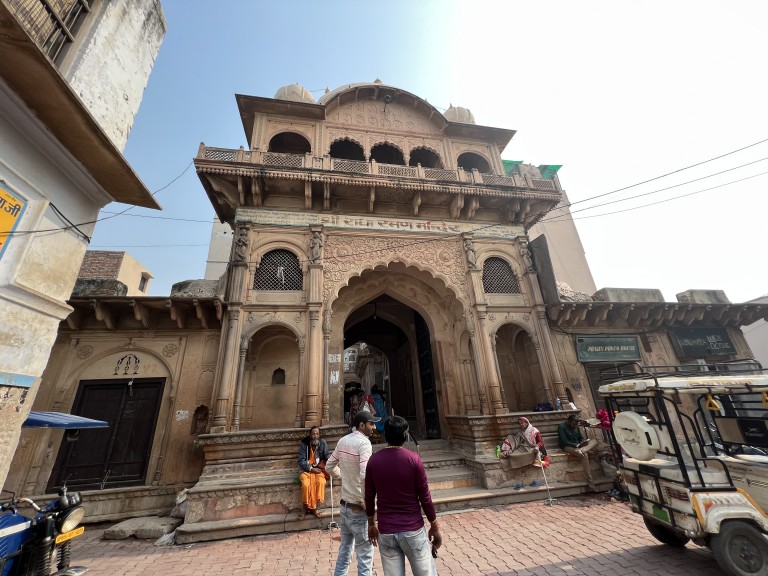
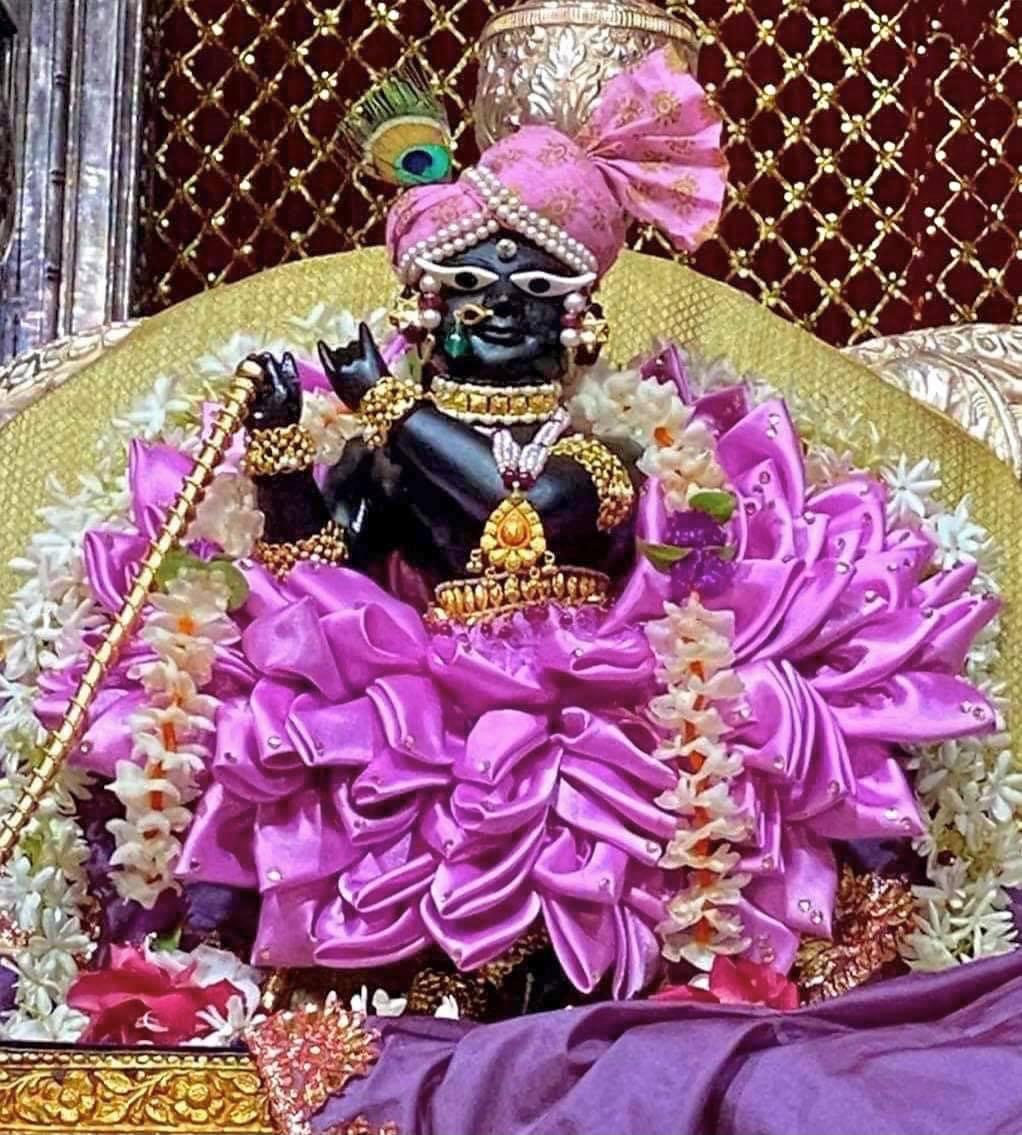
Śrī Rādhā-Ramaṇa is the deity of Śrī Gopāla Bhaṭṭa Gosvāmī, the recipient of Śrīman Mahāprabhu’s mercy. Śrī Bhaṭṭa Gosvāmī initially served and worshipped a śālagrāma-śilā. Once, he intensely desired to decorate his śālagrāma, to seat Him on a swing and sway Him back and forth, and to serve Him in many ways like a deity. “If only He had arms and legs like a deity‚” he thought.
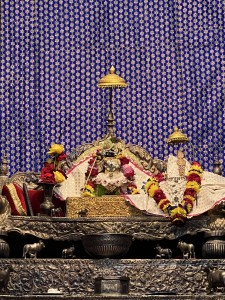
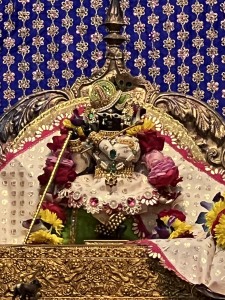
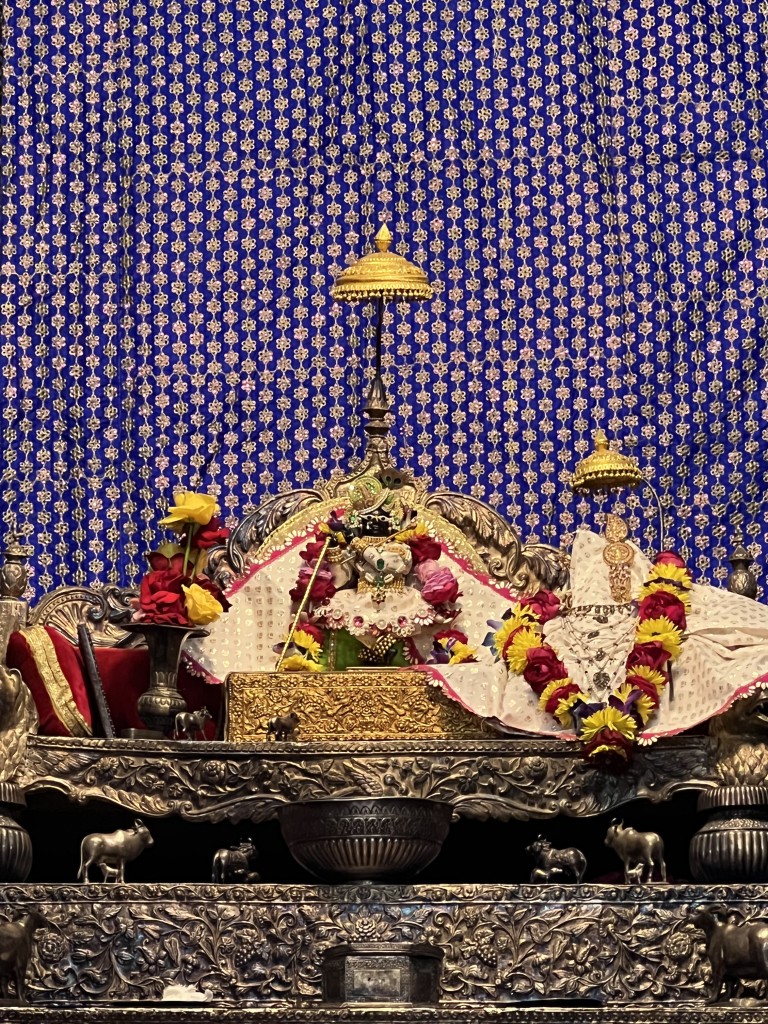
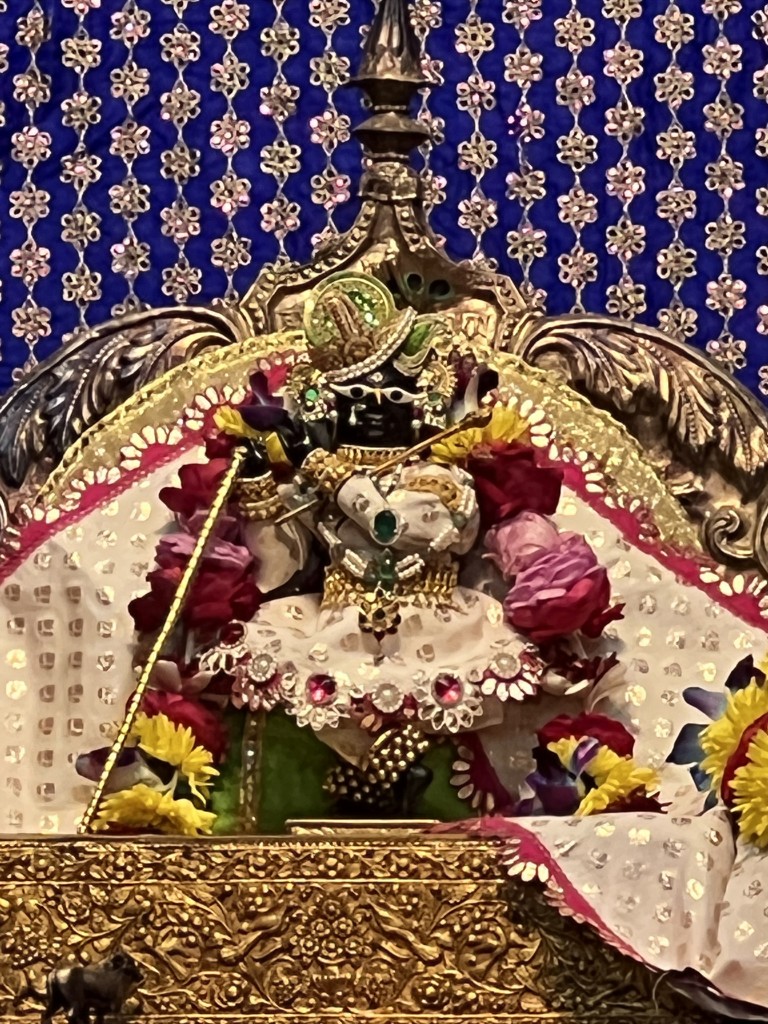
Prabhu is very kind to His devotees. To fulfil the desire of this bhakta, He transformed Himself that very night into the attractive threefold-bending form of Śrī Rādhā-Ramaṇa. Śrī Bhaṭṭa Gosvāmī decorated Him with many ornaments, swung Him on a swing and offered food preparations with great affection. If one has darśana of Śrī Rādhā-Ramaṇa’s back, one will see that it resembles a śālagrāma-śilā. Although the deity is only twelve finger-widths tall, He is very attractive. Śrī Rādhā-Ramaṇa’s lotus face is like Śrī Govinda’s, His chest is like Śrī Gopīnātha’s, and His lotus feet are like Śrī Madana-mohana’s. By taking His darśana, one receives the benefit of taking darśana of these three deities.
According to the book Sevā-p rāk aṭ ya, R ādhā-R amaṇa manifested from the śālagrāma-śilā in saṁvat 1599 (1543 AD). His abhiṣeka took place on Pūrṇimā in the month of Vaiśākha (April–May) that same year. There is no deity of Śrī Rādhā with Rādhā-Ramaṇa, but a gomatī-cakra is worshipped on the altar to His left. According to an injunction in Śrī Hari-bhakti-vilāsa, a gomatī-cakra is to be worshipped along with a śālagrāma-śilā.
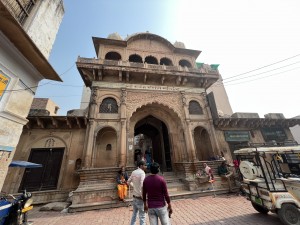
Adjacent to the temple of Śrī Rādhā-Ramaṇa, to the south, is the samādhi of Śrī Gopāla Bhaṭṭa Gosvāmī and the place where Rādhā-Ramaṇa appeared. Unlike other deities, Śrī Rādhā-Ramaṇa never left Vṛndāvana.
Rajashekhara Dasa
From the book “Chaurasi-kosa Vraja Mandala Parikrama”:
This is one of the ‘Seven Goswami Temples’ and was established by Gopala Bhatta Goswami, one of the famous Six Goswamis of Vrindavana. The Deity of Radharamana suddenly self-manifested one day from a shalagrama-shila just for the pleasure of Gopala Bhatta. All shalagrama-shilas are considered to be a natural manifestation of Lord Vishnu and are therefore immediately worshipable and do not need to be installed. The shalagrama-shila is a sacred black stone that is worshiped specifically by brahmanas and must be worshiped in all Vedic sacrifices as the yajna-pati, or principle enjoyer of the sacrifice. The shalagram-shila is also an essential part of Deity worship being the principle recipient of the seva-puja, and no worship is considered complete without the shaligrama-shila being worshiped as the seva-pati.
The story regarding the amazing shalagrama-shila of Gopala Bhatta is as follows. After spending a number of years studying and writing in the company of the Goswamis of Vrindavana, Gopala Bhatta decided to make the arduous journey to the holy place known as Muktinatha in the Himalayas, where there is a famous shrine of Lord Vishnu. One day while taking his bath in the sacred Kali Gandaki River that flows in the region of Muktinatha, Gopala Bhatta scooped water with his kamandalu and was about to pour it over his head, when he found that a number of black stones known as shalagrama-shilas had somehow or other entered his kamandalu, perhaps due to the strong currents in the river. After putting them back into the Gandaki, he again scooped water with his kamandalu and found that the shilas had once again entered his kamandalu. Surprised at this, he again put them back into the river, but when this happened for a third time, he realized it was the plan of the Lord and decided to keep all the shilas that had entered his kamandalu, he carefully tied them in a cloth and kept it suspended around his neck for safety. The Kali Gandaki River, which starts high-up in the Himalayan Mountains in what is now Nepal, is the only river in the world where these sacred shalagrama-shilas can be found.
When Gopala Bhatta eventually returned to Vrindavana, he performed his bhajana in a corner of Nidhuvana where he also began worshiping the shalagrama-shilas he had obtained from the Kali Gandaki River. At night, Gopala Bhatta would place all the shalagrama-shilas in a cloth bag and hang them in a nearby tree while he took rest. One day while worshiping the shalagrama-shilas, he began lamenting that he did not have an archa-vigraha or Deity of Lord Krishna like the other Goswamis, which he could dress with beautiful clothing, ornaments, crowns, and other Deity paraphernalia. The following day was Narasingha-chaturdashi, the appearance day of Lord Narasinghadeva, the half-man half-lion incarnation of Vishnu who appeared from a rock pillar. Early the next morning when Gopala Bhatta went to worship his shalagrama-shilas, to his utter amazement he found that one of the shilas had opened up and transformed into a beautiful Deity of Krishna, standing in the tri-bhanga-rupa, or the three-fold bending form and playing a flute. On hearing the news of the miracle, the other Goswamis immediately came to congratulate Gopala Bhatta on his amazingly good fortune and to see for themselves the exquisite beauty of the self-manifested Deity, which stood about ten inches high. The Goswamis gave the Deity the name ‘Radharamana’ which means ‘one who gives pleasure to Radha’. When the Deity is being dressed in the morning, or during abhisheka ceremonies, one can clearly see half of the shalagrama-shila from which the Deity appeared, still attached to Deities back.
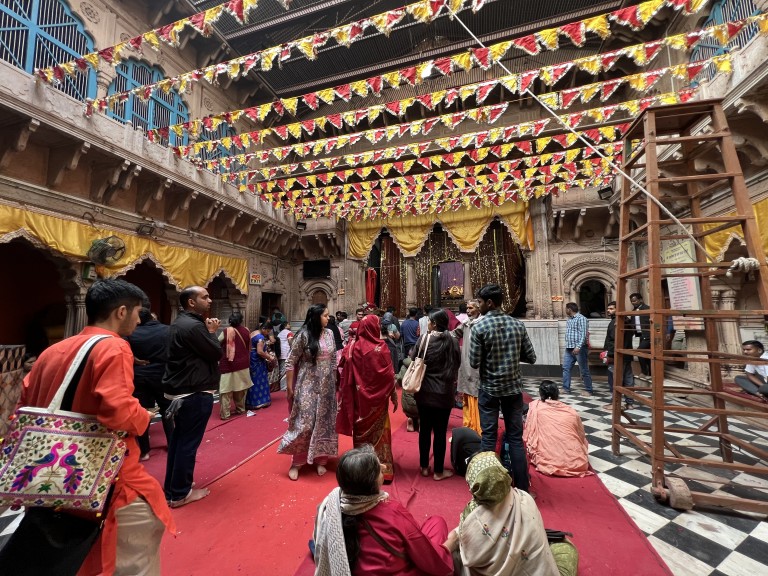
It is said that the Deity’s lotus face resembles that of Govindaji, His chest is like that of Gopinathaji, and His lotus feet are identical to those of Madana-Mohana, thus it is said that by having darshana of Radharamana one also recieves darshana of the three presiding Deities of Vrindavana, namely: Govindaji, Gopinathaji, and Madana-Mohana. There is no Deity of Radharani in this temple because the Deity of Radharamana is worshiped as a saligram-shila and therefore in accordance with Hari-bhakti-vilasa, a gomati-chakra (sacred stone from the river Gomati) is being worshiped simultaneously. From the Vaishnava perspective Radharani is eternally present with Krishna although She may be in Her unmanifested (aprakata) feature. However, the crown (mukuta) of Radharani is kept on the altar signifying Her presence. The actual spot where the Deity self-manifested from the shaligrama-shila can be seen in a courtyard just next to Gopala Bhatta’s Samadhi Mandira. An off-shoot of the original tree where Gopala Bhatta used to hang his shaligrama-shilas in a bag at night can also be seen. According to the historical treatise Seva-prakatya, the abhisheka and installation of the Radharamana took place on Vaishakha-purnima in the year 1543. As the Deity of Radharamana is very small and a temple had not been established at that time, the Deity remained hidden in Vrindavana during the attack on the holy city by the forces of Emperor Aurangzeb in 1690. The present temple of Radharamana that is seen today was opened in 1826.
Gopala Bhatta Goswami Samadhi
Shrila Gopala Bhatta Goswami entered samadhi in the year 1585, and his sacred body was entombed at this spot where he performed his bhajana and worshiped his Deity named Radharamana. Gopala Bhatta was born in the year 1503 on trayadashi during the lunar month of Pausha (Krishna-paksha). He first met Lord Chaitanya during his childhood at Shrirangam (Rangapatnam) in Tamil Nadu, during the Lord’s tour of South India in 1511. When Lord Chaitanya arrived at Shrirangam, He met Gopala Bhatta’s father whose name was Venkata Bhatta, in the famous temple of Seshashayi Vishnu, also known as the Ranganatha Mandira. After seeing the transcendental beauty of Lord Ranganatha, Lord Chaitanya chanted the holy names and danced in ecstasy before the Deity. Venkata Bhatta, who was a sevak in the temple, also joined Lord Chaitanya, and chanted and danced along with the Lord in an ecstatic mood. After the kirtana ended, Venkata Bhatta invited Lord Chaitanya to his residence for prashadam, and also requested Him to spend the entire rainy season at his home in Shrirangam. During the four months of the monsoon season, when it rains very heavily, especially in South India, sannyasis and other traveling mendicants generally remain in one place, therefore Lord Chaitanya very happily accepted Venkata Bhatta’s proposal.
Venkata Bhatta was a pure Vaishnava of the Shri sampradaya and was a priest at the temple of Rangaji. Every day during Lord Chaitanya’s stay at his residence he would discuss the transcendental topics of Krishna-katha with Him. While the Lord was staying at Venkata Bhatta’s house, the young Gopala Bhatta had the opportunity to hear all the transcendental topics as well as render service to Lord Chaitanya, including honoring the remnants of Mahaprabhu’s prashadam. Lord Chaitanya, who could recognize the devotional qualities of the young Gopala Bhatta, told him not to marry and in the future, and when he was old enough, he should go and stay in Vrindavana. Lord Chaitanya also met Gopala Bhatta’s uncle, Prabhodananda Saraswati, who was one of the greatest scholars of the Shri sampradaya, and was also the initiating spiritual master of Gopala Bhatta. Probhodananda was also responsible for the education of Gopala and trained him in Sanskrit grammar, philosophy, rhetoric, poetry, and all the important aspects of Vedic culture. Under the expert guidance of Prabhodananda Saraswati, Gopala Bhatta’s scholarship was unparalleled. While Lord Chaitanya stayed at Shrirangam, Prabhodananda Saraswati also had the opportunity to discuss philosophy with Lord Chaitanya and was so impressed with the Lord’s precepts and teachings, that he left the Shri sampradaya and became an ardent follower of the Gaudiya Vaishnava sampradaya, and eventually went to live in Vrindavana where he spent the remainder of his life.
After the death of his parents, Gopala Bhatta left for Vrindavana to take shelter of Rupa and Sanatana Goswamis. Lord Caitanya had already informed the two Goswamis that Gopala Bhatta would one day join them, and they immediately accepted him as their younger god-brother. When Lord Chaitanya heard that Gopala Bhatta had arrived in Vrindavan, he was extremely pleased and sent some of His personal belongings to Gopala Bhatta as gifts, including His sitting place (choki), and His loin-cloth (kaupin). There is also a cloth wrapper (chadar) that is also said to have been sent as a gift by Lord Chaitanya.
It is believed that Gopala Bhatta, who was an expert in the subject of Deity worship, made significant contributions to Sanatana Goswami’s celebrated book, the Hari-bhakti-vilasa which he also helped to edit. The Hari-bhakti-vilasa delineates the principles of devotional service as well as the authorized Vedic system of Deity worship. Gopala Bhatta is also credited for helping to originate the six theses for Jiva Goswami’s famous Sat Sandharbha. Gopala Bhatta’s most celebrated disciple was the celebrated Shrinivasa Acharya. In the Gaura-ganoddesha-dipika, Shri Kavi Karnapura Goswami says, “In my opinion, that person who in Vrindavana was Ananga Manjari is now Gopal Bhatta Goswami, some authorities, however, have given their opinion that he was Guna Manjari.”
Photo (4)