Description

Bhaktivedanta Narayana Gosvami
From the book “Sri Vraja-maṇḍala-parikramā”:
Close to the famous Vaṁśīvaṭa, on the bank of the Yamunā, Śrī Paramānanda Bhaṭṭācarya and Madhu Paṇḍita used to worship Śrī Rādhā-Kṛṣṇa Yugala with extreme renunciation. Once, the current of the Yamunā cut into her bank and a very beautiful deity of Śrī Gopīnātha was revealed from under the sand. In the morning, when the devotee Paramānanda came to the Yamunā to bathe, he found this exceptional deity who stole his heart. He entrusted the service of Śrī Gopīnātha to Śrī Madhu Paṇḍita. First, Śrī Gopīnātha resided near Vaṁśīvaṭa, but later on a magnificent new temple was constructed elsewhere and His service and worship continued there.
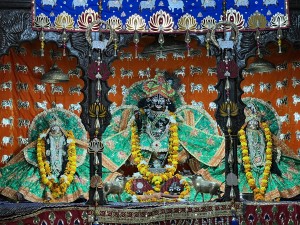
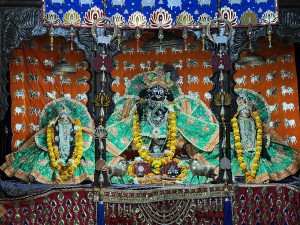
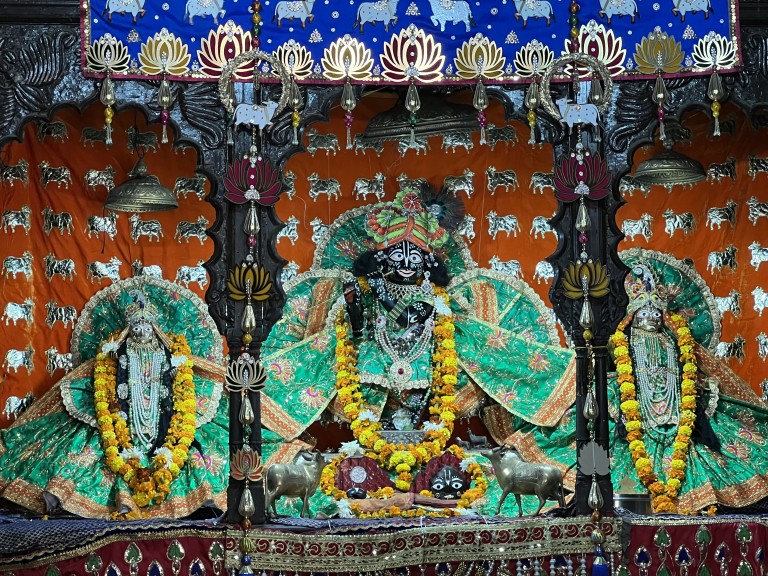
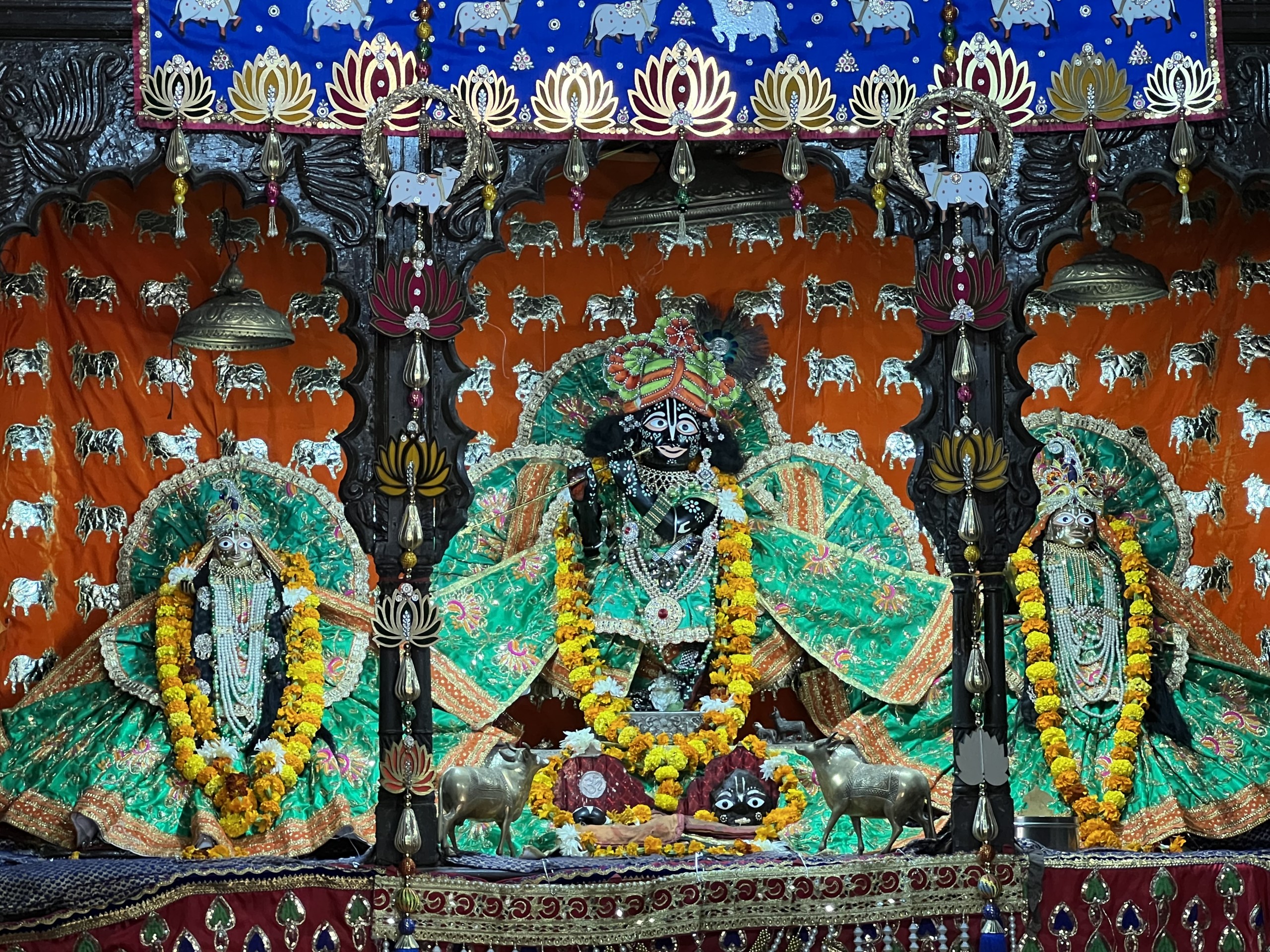
Once, Nityānanda Prabhu’s wife Jāhnavā Ṭhākurāṇī came to Vṛndāvana. As she was having darśana of Śrī Rādhā-Gopīnātha, she thought that the deity of Rādhikā was too small and that‚ if Rādhikā had been a little taller, the Couple would look much more beautiful. Jāhnavā Ṭhākurāṇī returned to her residence after beholding the evening ceremony. That night, in a dream, Śrī Gopīnātha asked Jāhnavā to arrange for a taller deity of Rādhikā. She received similar instructions from Śrīmatī Rādhikā, and had a deity of Her made that was a more appropriate size for the deity of Gopīnātha. The book Bhakta-māla describes that at the time of Jāhnavā Ṭhākurānī’s disappearance, she revealed her own deity and established herself in it. She instructed the priests to install the deity of her in the chamber of Śrī Gopīnātha. When this deity arrived at the temple of Gopīnātha in Vṛndāvana, the priests hesitated to install her along side Śrī Gopinātha. At that time, Gopīnāthajī Himself instructed the priests, “Do not hesitate. This is My beloved Anaṅga Mañjarī. Place her on My left and Rādhikā on My right.” And so it came to be that Jāhnavā stands on Śrī Gopīnātha’s left side and Rādhikā stands on His right.
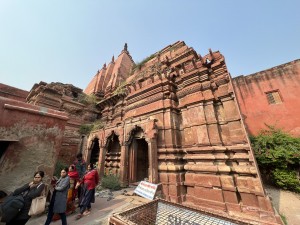
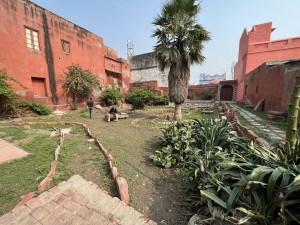
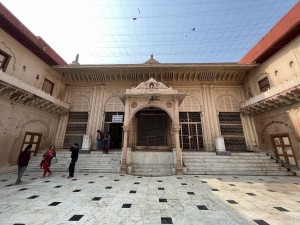
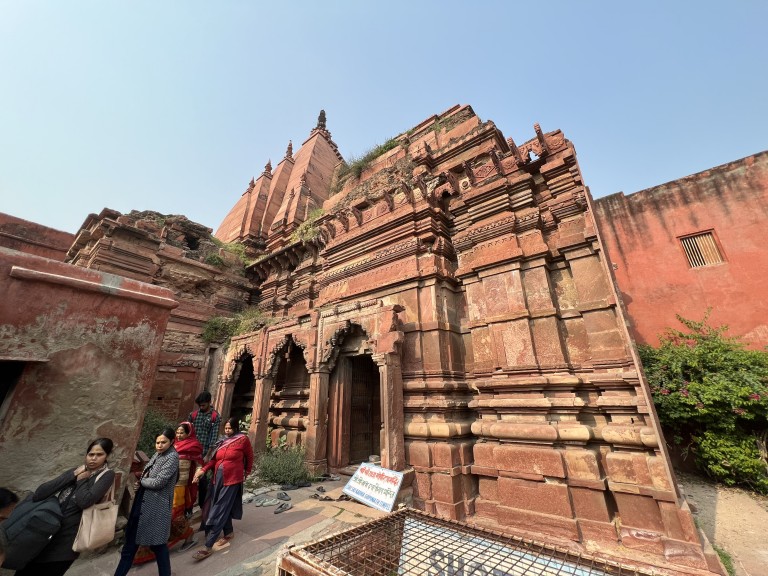
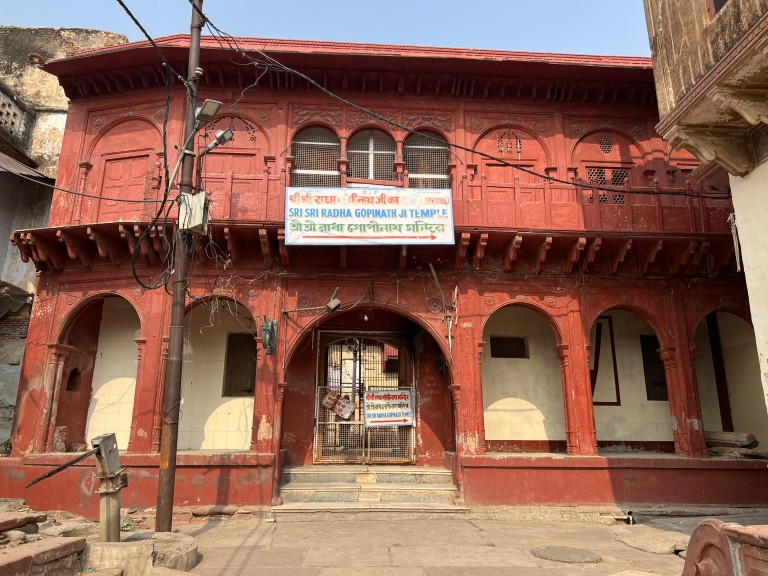
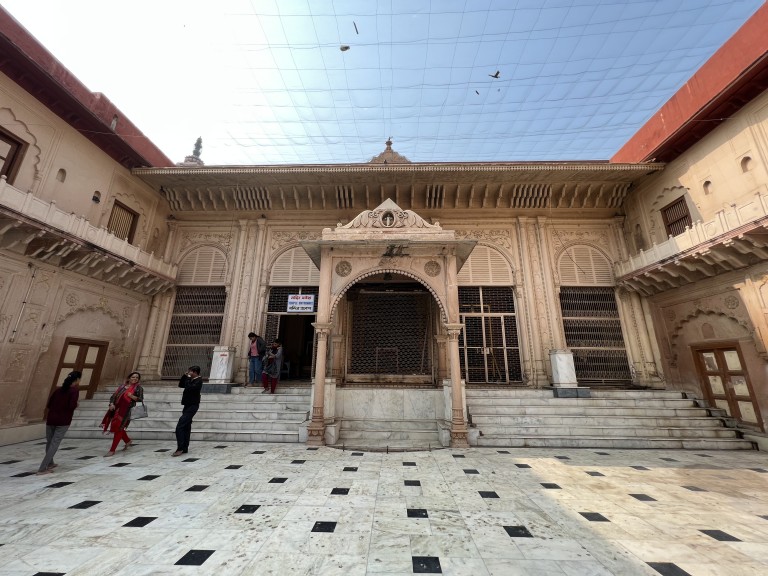
During the oppression of Aurangzeb, the original deities of Gopīnāthajī, Rādhikā and Jāhnavā also proceeded to Jaipura together with other deities. The pratibhū-vigrahas now preside in the temple built by Nandakumāra Vasu. Jāhnavā Ṭhākurānī is seated on the left side of Gopīnātha, and Lalitā Sakhī and a small deity of Rādhikā are seated on His right. The deity of Mahāprabhu Śrī Gaurasundara is in a separate chamber. In 1632 AD, the original temple was built by Rāya Singh, the son of the king of Bīkānera, Mahārāja Kalyāṇamala of the Rāṭhaur dynasty. Aurangzeb destroyed this temple. The pratibhū-vigrahas were established in 1748 AD, and the new temple was built in 1819 AD. Near the new temple to the east is the samādhi of Madhu Paṇḍita.
Rajashekhara Dasa
From the book “Chaurasi-kosa Vraja Mandala Parikrama”:
The temple of Radha Gopinatha is one of the ‘Seven Goswami Temples of Vrindavana’ and was established by Shrila Madhu Pandita Goswami, a prominent disciple of Gadadhara Pandita and an important follower of Lord Chaitanya Mahaprabhu. Although he was not directly one of the Six Goswamis, he is counted as one of the important Gaudiya Goswamis of Vrindavana. When Madhu Pandita Goswami came to Vrindavana he began searching everywhere for the Deity of Lord Gopinatha that had been lost since many years. Lord Gopinath was one of the three presiding Deities of Vrindavana, along with Govindaji and Madana-Mahana, originally established by Vajranabha Maharaja. However, even after searching for the Deity every day, Madhu Pandita could not find Lord Gopinatha and feeling great sorrow, he eventually gave up eating food altogether and would sit at Vamsi Vata while shedding a constant stream of tears in separation from the Deity. However, Madhu Pandita’s ardent desire to serve the Lord Gopinatha would soon be fulfilled.
That year during the monsoon season there was a great flood in Vrindavana and the River Yamuna overflowed her banks. It is said that the great force of the flood waters swept away the famous banyan tree that stood at Vamsi Vata. After the monsoon rains had abated and the flood waters had receded, Paramananda Bhattacharya, a disciple of Gadadhara Pandita and a close companion and god-brother of Madhu Pandita, took a branch from the old banyana tree in order to plant it in the same spot where the old banyana tree had once stood. On his arrival at Vamsi Vata, Paramananda suddenly noticed the Deity of Lord Gopinatha lying half-buried in the ground near the place where the great banyan tree had been uprooted. Paramananda immediately called Madhu Pandita and after retrieving the Deity from the earth, they moved the Deity to the bhajana-kutira of Madhu Pandita near to where the Gopinatha temple now stands. Madhu Pandita then began the worship of Lord Gopinatha, which continued until his dying day.
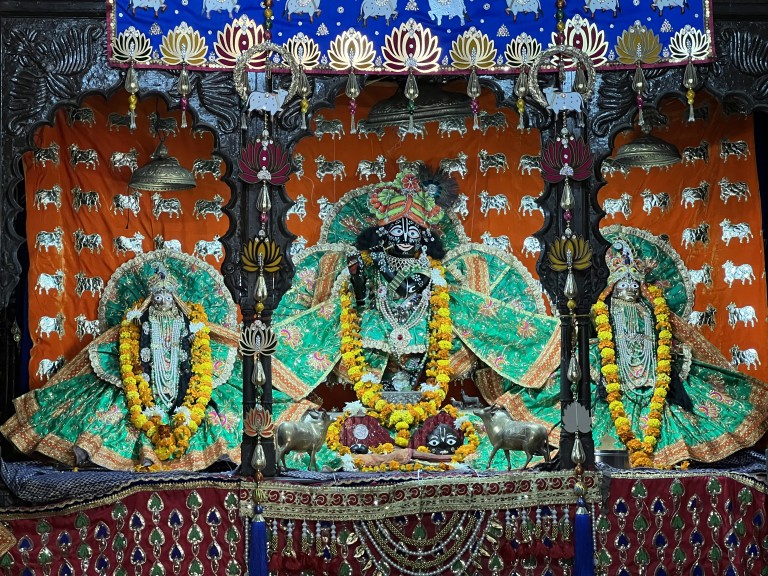
The Gopinatha Mandira is the only temple where one can see the Deity of Ananga-manjari on the altar. Ananga-manjari is Radharani’s younger sister and she can be seen standing on Lord Gopinatha’s left-hand side, with Radharani standing on Gopinatha’s right-hand side. This arrangement is most unusual because Radharani always stands on the left-hand side of Krishna in all other temples. (if viewed from the darshana mandapa then Ananga Manjari is standing on the right and Radharani is on the left). There is a very interesting story that explains this most unusual occurrence. Soon after the installation of the Deity of Radharani at the Govindaji Mandira, a Deity of Radharani was installed in all the other Gaudiya temples in Vrindavana including Madana-Mohana and Gopinathaji. When Lord Nityananda’s wife, Jahnava Mata, visited Vrindavana on pilgrimage in the year 1582, she felt that the Deity of Radharani being worshiped on the altar with Lord Gopinatha was far too small, therefore when she returned to Bengal she asked one of her disciples to carve a new Deity of Radharani especially for the Gopinatha temple. This new Deity was then sent to Vrindavana and immediately installed next to Lord Gopinatha. When all the devotees in Vrindavana saw the new Deity of Radharani, they felt that it looked just like Jahnava Mata. This happened because the devotee who carved the Deity, being a disciple of Jahnava Mata, had modeled it on the beautiful features of Jahnava Mata herself.
After consulting with all the senior Vaishnavas, it was decided that the Deity was actually Ananga-manjari, Radharani’s younger sister, who in Chaitanya-lila appeared as Jahnava Mata, Lord Nityananda’s consort. Because the Deity resembling Ananga-manjari had already been installed at the left-hand of Lord Gopinatha, it was felt that it must have been prearranged by Lord Gopinatha Himself, and should therefore not be moved. The smaller Deity of Radharani was then placed on Lord Gopinatha’s right-hand where She remains even today. All the devotees felt that due to Ananga-manjari’s deep desire to serve Lord Gopinatha; out of compassion and love for Her younger sister, Radharani had elevated her to Her own position at the left-hand of Lord Gopinatha. Later in the year 1632, a grand temple was constructed next to Madhu Pandita’s bhajana-kutira where he worshiped the Deity of Lord Gopinatha. The temple construction was undertaken by the noted Rajput king named Raja Saganji, one of the Shekawat royal princes of Rajasthana.
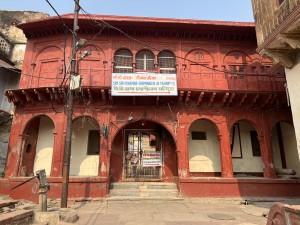
In the year 1670, the Deity of Lord Gopinatha was moved to Jaipur due to the attack on Vrindavana by the tyrant Aurangzeb whose soldiers desecrated the important Gaudiya Goswami temples including Govindaji, Gopinathaji and Madana-Mohana. Sometime later a new temple of Gopinatha was constructed next to the original one and the pratibhu-murti of Lord Gopinatha, Radharani and Ananga Manjari were installed there. These pratibhu-murtis are still being worshiped in the new temple and Ananga Manjari can still be seen standing on the left of Lord Gopinatha with Radharani standing on the right. This same arrangement occurs in all the various Gopinatha temples in Vraja including the two Gopinatha temples at Radha-kunda, as well as in Jaipura where the original Deity of Lord Gopinatha is presently being worshiped.
The Deity of Lord Gopinatha along with the Deities of Madana-Mohana and Govindaji, originally established by Vajranabha in Vrindavana, represent the three eternal duties, or in other words the constitutional position of all living entities trapped in the material world under the shackles of maya. The word prayojana refers to the ultimate goal of life, which is to develop love for the Supreme Personality of Godhead and Lord Gopinatha is the Deity who helps us to establish this loving relationship. Lord Gopinatha, who is also known as Gopijanabhallava – the attracter of the gopis, is the Deity who fulfills all our desires and attracts us to return back to Godhead. Therefore, Lord Gopinatha also represents the ultimate goal of devotional service, which is spontaneous attraction in pure love of Godhead.
Madhu Pandita Goswami Samadhi
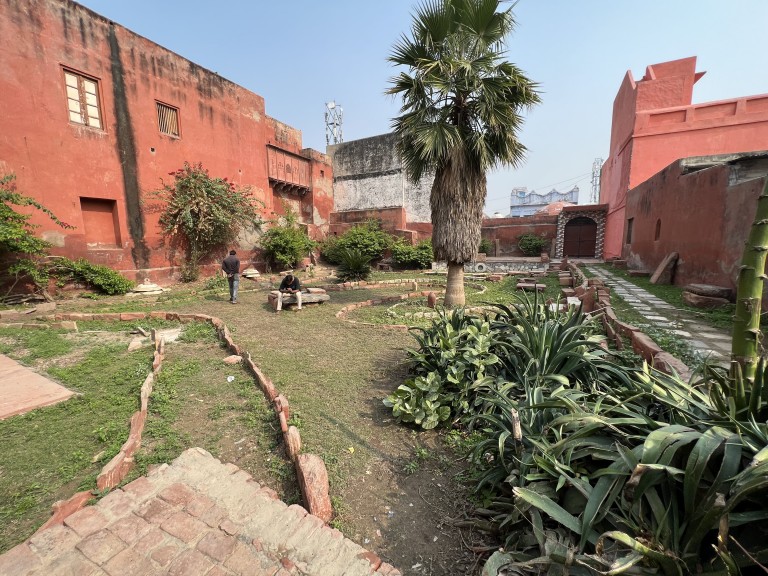
The Samadhi Mandira of Shrila Madhu Pandita Goswami can be seen located near to the eastern gate of the old Gopinatha Mandira on the spot where it is believed his bhajana-kutira once stood and where he used to worship the Deity of Lord Gopinatha. Shrila Madhu Pandita Goswami was a prominent disciple of Gadadhara Pandita and one of Lord Chaitanya’s important associates. Although Madhu Pandita was not directly one of the Six Goswamis, he was one of the most prominent Gaudiya Goswamis living in Vrindavana during the period. He is credited with discovering the Deity of Lord Gopinatha and establishing His worship as well as being the inspiration behind the construction of the Gopinatha Mandira. Due to the significance of the Gopinatha Deity having been originally established by Vajranabha five thousand years earlier, the Gopinatha Mandira became celebrated as one of the ‘Seven Goswami Temples of Vrindavana’. It is said that in Vrindavana-lila Shrila Madhu Pandita Goswami is the gopi named Mandali in the yuta, or group of younger gopis under the leadership of the ashta-sakhi Champakalata.
Photo (9)