Description

Bhaktivedanta Narayana Gosvami
From the book “Sri Vraja-maṇḍala-parikramā”:
Mahārāja Vajranābha installed the three deities of Śrī Govinda, Śrī Gopīnātha and Śrī Madana-mohana in Śrī Dhāma Vṛndāvana. In time, due to the oppression of the barbarians, the priests hid these deities in various places and fled. Vṛndāvana turned into a dense forest. It has already been described how Śrī Govindadeva re-appeared after many years by the endeavours of Śrī Rūpa Gosvāmī. Now, we will briefly describe how Śrī Sanātana Gosvāmī manifested Śrī Madana-mohana.
Sometimes in the morning, Śrī Sanātana Gosvāmī walked the sixteen miles from Vṛndāvana to Govardhana to perform the fourteen-mile long parikramā of Govardhana. From there, he would walk another sixteen miles to Mathurā to collect alms (mādhukarī) and then again walk back to his bhajana-kuṭī in Vṛndāvana. One day, he came to the house of a Caube brāhmaṇa in Mathurā for alms. What did he see there? In the house of the Caube, two beautiful boys were playing the game gullī-ḍaṇḍā. Madana, the restless, fidgety boy with a dark-bluish complexion defeated the son of the Caube. Madana climbed upon the shoulders of the defeated boy and enjoyed a ‘horse ride’. But when the Caube’s son defeated Madana the second time they played, and it was his turn to enjoy a ride on Madana’s shoulders, Madana ran into the temple room. Seeing this, the son of the Caube angrily abused and pursued Him. He wanted to enter the temple, but the priest scolded him and chased him away. Pointing his forefinger at Madana, who had turned into the deity, the son of the Caube said, “You just wait, I will see You tomorrow.”
This scene amazed Śrī Sanātana Gosvāmī. The next day, he arrived a little earlier, at breakfast time, desiring to again have darśana. Although she had not yet taken bath, the Caubāin was making khichrī for both boys, who were sitting waiting for their breakfast. Maiyā was brushing her teeth with one end of a stick and was stirring the khichrī with the other end. When she had finished cooking, she served the boys the hot khichrī in bowls, cooling it down by blowing on it with her mouth. The boys were relishing this khichrī with great love.
Sanātana Gosvāmī could not tolerate her improper conduct. “Maiyā, it is not proper to cook khichrī without taking bath, to stir it with the stick you use to brush your teeth, and then to serve this contaminated breakfast to the boys.”
The Caubāin realized her mistake, and replied, “Bābā, from tomorrow, I will be clean when I cook and serve the boys their breakfast.”
Śrī Sanātana Gosvāmī wanted to see some more pastimes of the deity of Śrī Madana-mohana, so on the third day he went there again. Breakfast was delayed that day because Maiyā was taking bath. She then had to clean the pots. The hungry boys were demanding breakfast. Maiyā pacified them, and after completing her morning chores, she started cooking khichrī. The two boys were pulling on her cloth and insisting on eating at once. Sanātana Gosvāmī was unable to tolerate this. He approached her and said, “Maiyā, there is no need for you to be clean by bathing. If this Madana is pleased with your unclean and impure breakfast, then you should do as such. I have committed an offence at your feet. From tomorrow, you should do whatever you think is proper to satisfy them.”
Just as Sanātana Gosvāmī was about to leave, the boy Madana came out of the temple room and said, “Bābā, I will come with you.”
But Śrī Sanātana Gosvāmī replied, “I am a completely renounced person. I have neither a place to live, nor any arrangement to cook palatable food. If even Yaśodā-maiyā could not completely satisfy You, how can I take care of You?” The child Madana nonetheless insisted on coming with him. Sanātana Gosvāmī said, “If You really want to come, then You will have to follow me on foot. I cannot carry You on my shoulders.”
The boy said, “I will walk behind you, but do not turn around along the way to look at Me. You can look at Me only at your bhajana-kuṭī.”
When Sanātana Gosvāmī had reached his bhajana-kuṭī, he turned around and saw the boy Madana smile and change into His deity form. Sanātana Gosvāmī constructed an altar by putting a board on top of a few stones and seated Him there. Every day, he would cook some balls of dough without salt on live coals, and offer them to the deity. One day, as Sanātana Gosvāmī was making his offering, Madana-mohanajī asked him for some salt. Sanātana Gosvāmī would happily have given salt if only he had some, but there was no salt in his hut. Madana-mohanajī told him, “I am not able to swallow this dry dough-ball.” Upon hearing this, Sanātana Gosvāmī began to repent.
At that time, Kṛṣṇadāsa Kapūra, a rich merchant from the Multāna province, happened to be travelling along the Yamunā carrying valuable articles for trade in large boats. As the boats approached Sanātana Gosvāmī’s bhajana-kuṭī, they got stuck in the sand. Despite several efforts, the boats could not be released from the sand. The merchant came ashore and saw the extremely beautiful deity of Śrī Madana-mohana in front of the hut. Sitting down on the invitation of Sanātana Gosvāmī, the merchant began to weep and lament to him about his situation. In his mind, he firmly vowed, “As soon as my boats are freed from the sand, I will construct a beautiful temple for Śrī Madana-mohana with the profits I make from this journey. I will also make proper arrangements for His service and offerings.” The moment he resolved this, his boats were dislodged by themselves and started drifting again. He made an enormous profit from his trade and, on the inspiration of Śrī Sanātana Gosvāmī, had a huge temple constructed for Śrī Madana-mohana. However, Śrī Sanātana Gosvāmī entrusted all the arrangements of service, worship, offering and so forth to the priests and again began performing mādhukarī in Vraja. In this way, he maintained his life by living under a different tree every night and performing rigid sādhana-bhajana.
After the disappearance of Śrī Sanātana Gosvāmī from this material world, Aurangzeb, who was inimical to the Hindus, desecrated this temple in 1670 AD, destroying the dome and other parts. Before he did this, Madana-mohanajī and other deities of Vṛndāvana had already been moved to Jaipura. Nowadays, Madana- mohanajī resides in Karaulī. In 1748 AD, a pratibhū-vigraha of Madana-mohana was established here. Then, in 1819 AD, Śrī Nandalāla Vasu constructed the present temple.
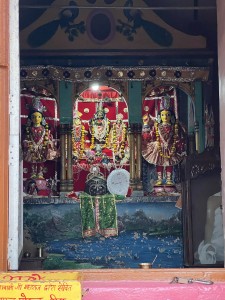
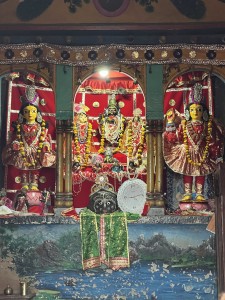
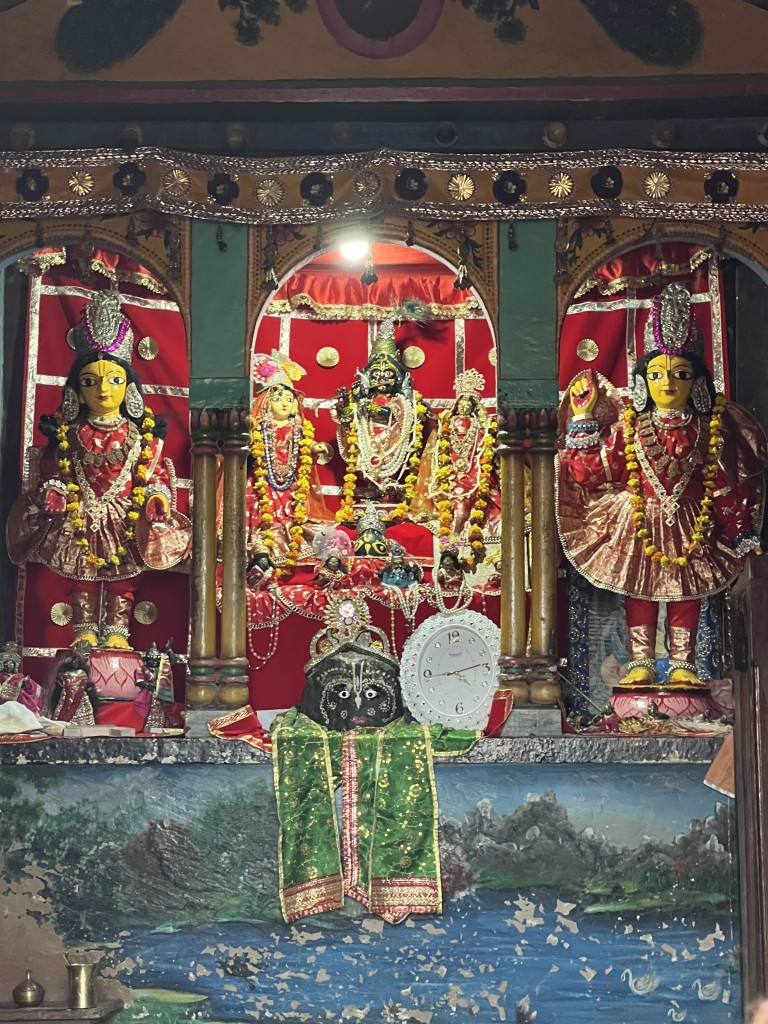
The ancient hand-written books, Sevā-prākaṭya and Iṣṭalābha, mention that Sanātana Gosvāmī obtained Śrī Madana-Gopāla from Paraśurāma Caube of Mahāvana in saṁvat 1590 (1534 AD) and re-established the deity’s service and worship in the same year on Śuklā-dvitīyā (the second day of the bright moon) of Māgha (January–February). He entrusted the duties of the service and worship to Kṛṣṇadāsa Brahmacārī. At that time, there was no deity of Śrī Rādhikā with Śrī Madana-mohana. Śrī Puroṣottama Jānā, the father of King Pratāparudra of Orissa, arranged with great faith to send two deities of Rādhā from Purī-dhāma to Vṛndāvana. Śrī Madana-mohana informed the priest in his dream, “The taller of the two deities from Purī is Lalitājī, and the shorter is Rādhājī. You should place the deity of Rādhikā on My left side and the deity of Lalitā on My right side.” It is mentioned in Bhakti-ratnākara that Śrī Sanātana Gosvāmī built a temple for Śrī Caitanya Mahāprabhu in the southern part of Śrī Madana- mohana’s temple, but Śrī Caitanya Mahāprabhu did not come to Vṛndāvana a second time.
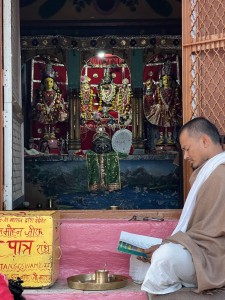
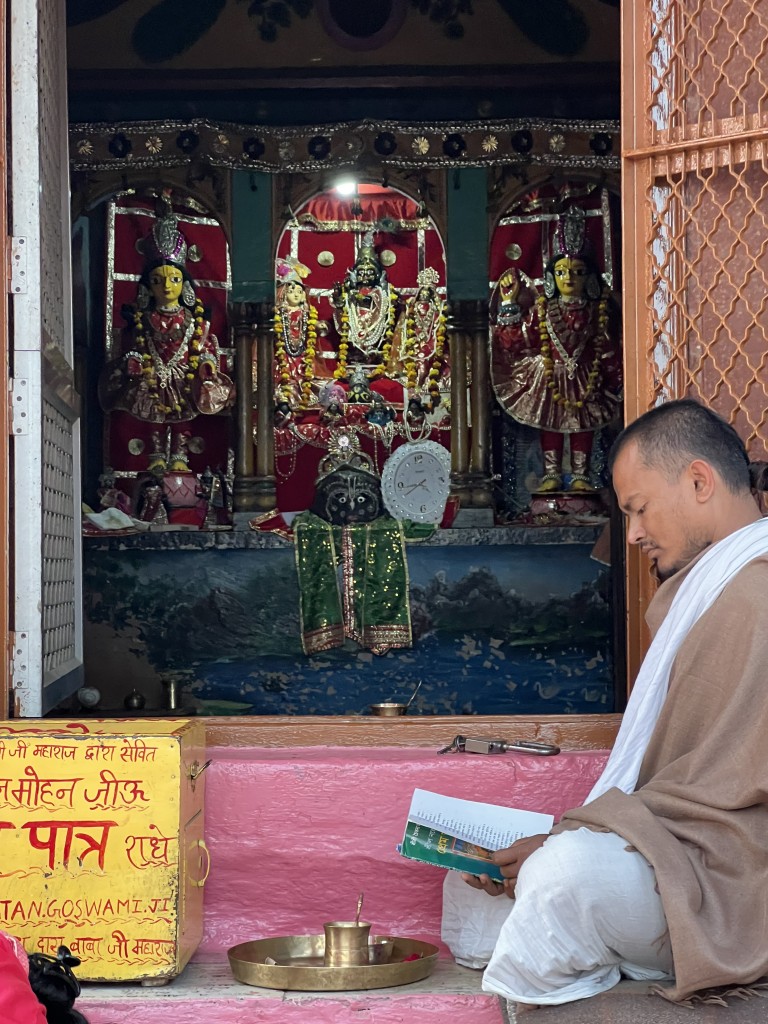
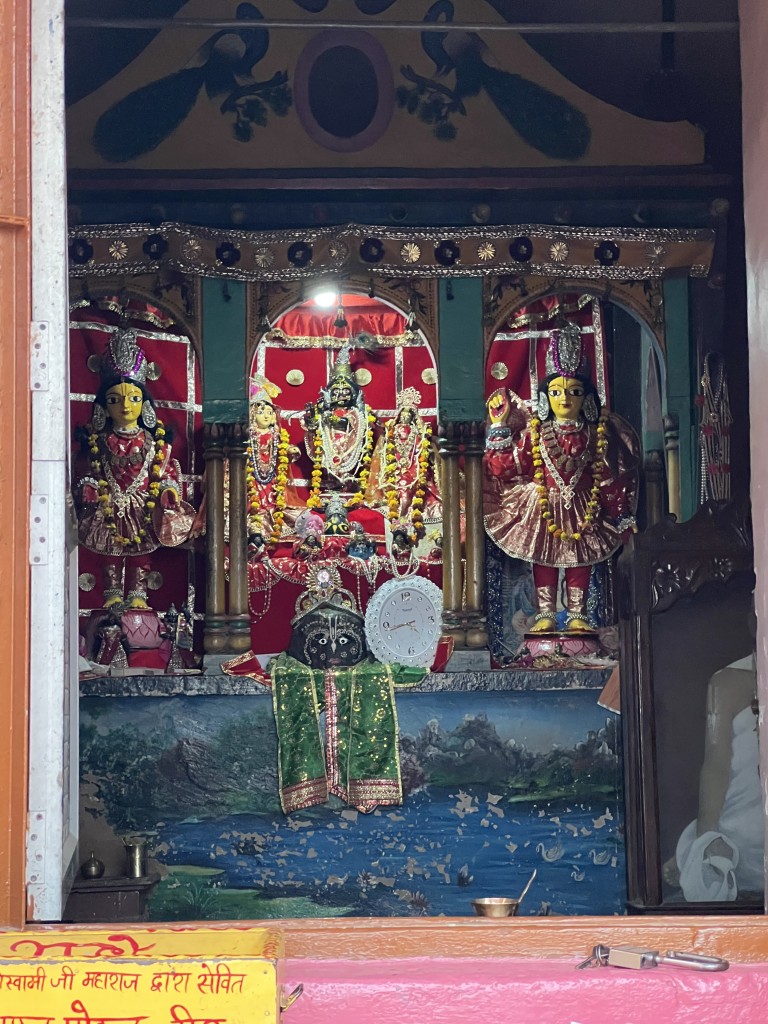
In the new temple, Rādhikā stands on Śrī Madana-mohana’s left side and Lalitā stands on His right side. A śalāgrāma-śilā is also there, and Śrī Jagannātha presides in a separate room (prakoṣṭha). Places of darśana near the old temple are Śrī Sanātana Gosvāmī’s bhajana-kuṭī, samādhi and the grantha-samādhi.
Rajashekhara Dasa
From the book “Chaurasi-kosa Vraja Mandala Parikrama”:
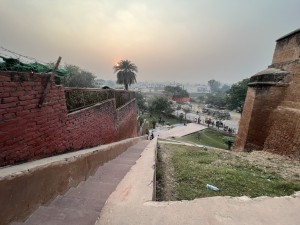
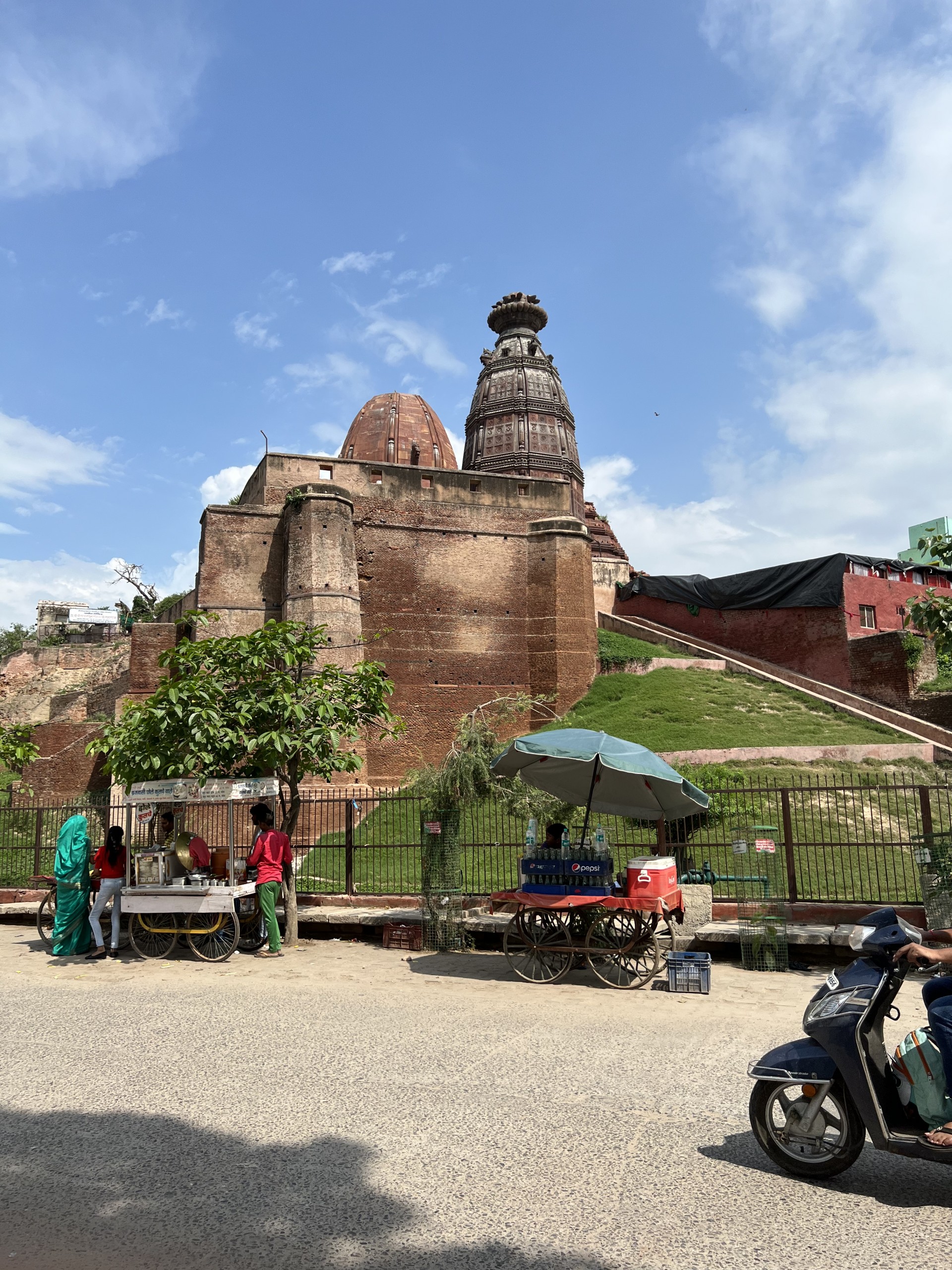
The famous temple of Lord Madana-Mohana was established by Shrila Sanatana Goswami and it is the first of the ‘Seven Goswami Temples’ that is visited during the parikrama of Vrindavana. The temple was built on the spot where the celebrated Deity of Madana-Mohana was being worshiped by Shrila Sanatana Goswami on top of the small hill known as Dwadashaditya-tila. The name ‘Madana-Mohana’ means ‘He who attracts even Cupid’, the god of love – whose name is also Madana. The temple of Madana-Mohana was the first temple built in Vrindavana since the time of Vajranabha Maharaja five thousand years earlier. King Vajranabha, who was Lord Krishna’s great grandson, established a number of important temples in Vrindavana, such as: Madana-Mohana, Govindaji, and Gopinathaji, but during the course of time these temples disappeared and the Deities were lost.
In the year 1670, just prior to the attack on Vrindavana by the soldiers of the Mughal tyrant Emperor Aurangzeb, the Deity of Lord Madana-Mohana, along with the other important Gaudiya Goswami Deities including Govindaji and Gopinathaji, were secretly taken out of Vrindavana and hidden at Radha-kunda. During the attack by Aurangzeb’s soldiers, Vrindavana’s most important temples including Madana-Mohana, Govindaji, and Gopinathaji, were desecrated and Aurangzeb’s soldiers dismantled the shikara (turret) of these temples. When it became safe, the three Deities were then taken from Radha-kunda to Kamyavana, and then finally to Jaipura in Rajasthan, where the Deity of Madana-Mohana was worshiped for many years. Sometime later, when a princess of the Jaipura royal family married a prince from the kingdom of Karauli near Bharatpura, it is said the princess, unable to bear the separation of Lord Madana-Mohana, took the Deity with her and established His worship in Karauli, where the Deity remains even to this day.
Madana-Mohana was the first Deity installed in Vrindavana and all Gaudiya Vaishnavas are advised to worship this Deity in order to reestablish their long-lost relationship with the Supreme Lord. In the beginning stages of sadhana-bhakti, it is Lord Madana-Mohana who has the power to attract us and help to nullify our false attachment to the sensual pleasures of this material world. Just as He has attracted Cupid, He can also attract the fallen souls and raise them to the platform of experiencing the transcendental mellows of devotional service. The initiating spiritual master, who engages his disciples in following the regulative duties (abhidheya) of devotional service, is the direct representative of Lord Madana-Mohana. Unless one can achieve the mercy of Lord Madana-Mohana and his representative, the spiritual master, the path of pure unalloyed devotion is difficult to ascertain. For this reason the disciples of Lord Chaitanya, headed by the Goswamis Rupa and Sanatana, established the three principle Deities in Vrindavana for the benefit of all aspiring Vaishnavas. Whereas Madana-Mohana represents the principle of sambhandha, or the soul’s relationship with the Lord, Govindaji represents abhidheya, or the regulated activities for reviving that relationship, and Gopinatha represents prayojana, or the ultimate goal of life.
Before writing the Chaitanya-charitamrita, which was completed in the year 1681, Shrila Krishnadasa Kaviraja Goswami came to Vrindavana from Radha-kunda where he was staying. His purpose was to obtain the permission of Lord Madana-Mohana before attempting to write about the pastimes of Lord Chaitanya Mahaprabhu. As Krishnadasa Kaviraja bowed down before the Deity, a garland fell down from Deity’s neck and all the devotees present understood that Lord Madana-Mohana’s permission had been granted. The pujari then offered the garland to Krishnadas Kaviraja as loud cries of the Lord’s holy name filled the air. In the Chaitanya-charitamrita it says, “Lord Madana-Gopala, the chief Deity of Vrindavana, is the enjoyer of the rasa dance and is directly the son of the King of Vraja.” (Cc.Adi.5.212)
The Story of Lord Madana-Mohana
When Sanatana Goswami first came to Vrindavana, he performed his bhajana on the hill known as Dwadashaditya-tila. Sometime later when he obtained the Deity of Madana-Mohana, he began worshiping the Deity at this same place and is said to have kept the Deity in the crevice of a tree until a temple was eventually built. The first seva-puja of Madana-Mohana was believed to have been performed in the year 1534 on the basis of ancient hand written records known as Seva-prakatya and Ishtalabha.
There are a number of local legends of how Sanatana Goswami actually obtained the Deity of Madana-Mohana, but they are not based on any true facts. It is well known that some years earlier Advaita Acharya had discovered the Deity of Madana-Mohana at Advaita Vata during the time he performed his bhajana there. According to most scholars, this Deity was the original Deity installed by Vajranabha named Madana-Gopala. When Advaita Acharya was leaving Vrindavana and returning to Bengal, it is said that Madana-Gopala did not want to leave Vrindavana, therefore Advaita Acharya asked a brahmana named Choube from Mathura to look after the Deity in his absence. Based on actual historical records known as the Istalabha and Seva-prakatya, it says that in 1534, Sanatana Goswami obtained the Deity of Madana-Mohana from a Mathura brahmana living at Mahavana named Parashurama Choube, and Sanatana Goswami established the first seva puja of the Madana-Gopala in the same year, which was on the second day of the bright-moon or dwitiya-shukla in the month of Magh (Jan-Feb 1534). It appears that at the instillation ceremony, Sanatana Goswami gave the Deity the name of Madana-Mohana due to the many bewildering (mohana) pastimes that the Deity enacted. After the instillation, Sanatana appointed his disciple Krishna Dasa Brahmachari as the pujari. The details found in the Seva-prakasya appear accurate and it must be concluded that Advaita Acharya originally gave the Deity of Madana-Gopala to Choube, who later gave the Deity to Sanatana Goswami. The surname Choube is short for Chaturvedi, and they are a well-known brahmana community from Mathura, who are also priests at the famous Keshava Mandira.
The generally accepted story of how Sanatana received the Deity from Choube is as follows. According to the Bhakti-ratnakara, Sanatana Goswami was staying at Mahavana when he first saw the Deity of Madana-Gopala, he had noticed a very unusual cowherd boy with the most beautiful features playing with the other cowherd boys in the vicinity of Ramana reti near the banks of the Yamuna. Sanatana was convinced that this boy was non-other than Krishna playing as an ordinary village boy with the other cowherd boys. When he returned home after playing, Sanatana followed him to see where he went. The boy entered a temple and Sanatana followed, but once inside, he found the place deserted accept for the Deity of Madana-Gopala. Sanatana immediately bowed down before the Deity and without uttering a word to anyone, and in a deep mood of contemplation, returned to his cave near Nanda Bhavan in Mahavana Village. After this incident, when Sanatana went out to collect alms he would also have darshana of Madana-Gopala. Lord Chaitanya also had darshana of this same Deity when He visited Mahavana, and so did Lord Nityananda when He came to Mahavana on pilgrimage some years earlier.
The Bhakti-ratnakara says that Sanatana Goswami went every day to the temple of Madana-Gopala for darshana. The Madana-Gopala temple was managed by the brahmana Choube and his wife, who both lived on the temple premises. On one occasion while visiting the temple, Sanatana felt somewhat shocked at the irreverence being shown to the Deity, when he saw the Choube’s children playing with the Deity, and also the way in which Choube’s wife was serving the Deity, without following any rules of Deity worship. Sanatana mildly reprimanded the brahmana’s wife, who was supposedly looking after the worship of the Deity and wanted to know why they were not following the specific rules governing temple worship. Choube’s wife admitted her fault and agreed to be more conscientious in the future. However, that night Sanatana had a dream in which Madana-Gopala told Sanatana that He had been very happy playing with Choube’s children, but since Sanatana had asked the family to be more reverential in their Deity worship, they had now introduced so many rules and regulations, that He was no longer happy staying at Choube’s house, and told Sanatana to take Him back to Vrindavana.
The next day, feeling great remorse that the Deity was no longer feeling happy, Sanatana returned to the Choube’s house to apologize for his somewhat over-exuberance in encouraging them to be more reverential in their Deity worship. However, Choube requested Sanatana to take the Deity of Madana-Gopala, as he had also received a dream in which the Deity had informed him. “As you already have so many children and Sanatana had none, therefore please hand Me over to Sanatana.” After hearing the words spoken by Choube, Sanatana replied that as he was in the renounced order of life and subsisted by begging alms, he was in no position to worship the Deity in the proper way, and for this reason could not accept Choube’s offer. That night, Sanatana received another dream in which Madana-Gopala again appeared before him and once again asked Sanatana to take care of Him, saying this would make Him very happy. The Deity further said that whatever simple things Sanatana could offer, He would gladly accept it. After this dream, Sanatana agreed to take the Deity from Choube, and after bringing the Deity to Vrindavana, began to worship Him on top of Dwadashaditya-tila.
Because of being in renounced order and subsisting simply on alms given to him while performing madhukari, Sanatana’s only offering to the Deity, besides water and wild flowers, were dry chapattis – small flat rounded pieces of unleavened wheat bread cooked over an open fire. One day, after having made an offering of dry chapattis, Sanatana heard the Deity asking for some salt to put on His dry chapattis. Sanatana replied by saying. “Just see, now You want salt, and tomorrow You will want sweets; I am an old man and have so many books to write, so please be satisfied with these dry chapattis.”
It so happened that on the same day, a merchant hailing from Multan in Punjab, named Ramadas Kapoor (some say his name was Ramadasa Sadagara from Amritsar), was ferrying salt and other goods by boat down the Yamuna River to the city of Agra, and while passing Dwadashaditya-tila, his boat got stuck on a sandbank in the middle of the river. In great anxiety and fearing his goods may be lost, the merchant came ashore in order to get help. Ramadasa could not see anyone around accept a young cowherd boy sitting near the riverbank. Some say the cowherd boy was actually Madana-Mohana taking part in one of His pastimes for which He was very famous. Ramadasa asked the cowherd boy if there was anyone who could help to free his boat and the cowherd boy informed him that there was a sadhu performing bhajana on the nearby hill who might be able to help. Climbing the hill, Ramadasa humbly approached Sanatana and asked him to help free the boat. Sanatana said that as he was old and also quite weak, he was not in any position to give much help, but advised Ramadasa to seek help from his beloved Deity Madana-Mohana, who was sitting in the nearby tree. With full faith, Ramadasa bowed down and offered heart-felt prayers to Lord Madana-Mohana and very humbly requested His help in saving his boat.
Suddenly dark clouds filled the sky and there was the deafening sound of thunder and within moments torrential rainfall began to inundate the whole area. Within a short time, due to the heavy downpour, the large deluge of rainwater began to swell the Yamuna River and the merchant’s boat became freed from the sandbank. Being overcome with joy, Ramadasa repeatedly offered his obeisance’s to Madana-Mohana and profusely thanked Sanatana, asking him what service he could perform in gratitude. Sanatana suggested that Ramdasa could help in building a temple for Madana-Mohana and also requested a little salt for the pleasure of the Deity. It is said that Ramadasa eventually returned to Vrindavana, and provided the funds needed to build a temple for Lord Madana-Mohana.
Lord Madana-Mohana was one of the two famous gopala-murtis carved by Vajranabha, with the other being Sakshi-gopala. Previously Sakshi-gopala was known only as Gopala, but His name was later changed to Sakshi-gopala after the pastime of His becoming a witness (sakshi). The Deity Sakshi-gopala is different to the Gopala Deity discovered by Madhavendra Puri at Govardhana, which was one of the two natha-murtis carved by Vajranabha and also known by other names like Gopala-Raya, Gopala-Natha, and also Shri-Natha. The other natha-vigraha carved by Vajranabha was Gopinatha who was installed in Vrindavana.
The Mystery of the Two Temple Towers
During the parikrama of Vrindavana conducted by Raghava Pandita, although they had darshana of Govindaji, there is no mention of them taking darshana of the celebrated Madana-Mohana Deity, nor is there any mention of a temple being located at Dwadasaditya-tila. Even more surprising is the fact that the Bhakti-ratnakara does not even mention that the Deity of Madana-Mohana was being worshiped on this hill-top. It is quite clear from the Bhakti-ratnakara that both Sanatana Goswami (1558) and Rupa Goswami (1564) had disappeared by the time that Raghava Pandita, Shrinivasa and Narottama’s performed parikrama of Vraja, thus their parikrama would have taken place somewhere between the years 1564-1579, because by the year 1580, the temple of Madana-Mohana was opened and this would definitely have been described in the Bhakti-ratnakara. It can be conjectured that the Deity of Madana-Mohana was perhaps being worshiped at some other location after Sanatana Goswami’s disappearance and returned to Dwadasaditya-tila once the temple was constructed in 1580.
It is believed that the temple of Madana-Mohana was erected with the financial help of the Multan merchant Ramadasa Kapoor. However, Hindus were not allowed to be built temples during the repressive Mohammedan rule in India that began from the 14th century onwards. It was only after permission was granted by the Mughal Emperor Akbar in 1570, that any Hindu temple was allowed to be built in Vrindavana, which at that time in history had been renamed by the Mughals as Mohammedpur. Consequently, the first temple of Madana-Mohana was the one built under the supervision of Raja Man Singh of Jaipur which opened in 1580.
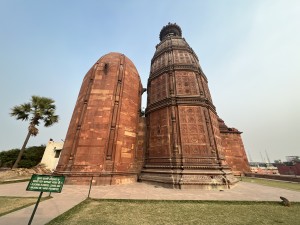
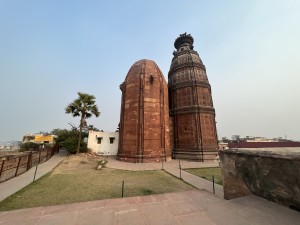
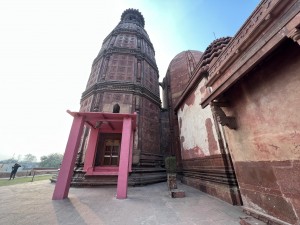
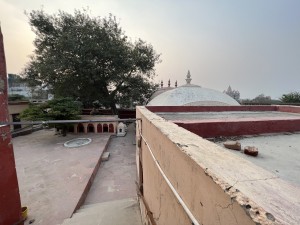
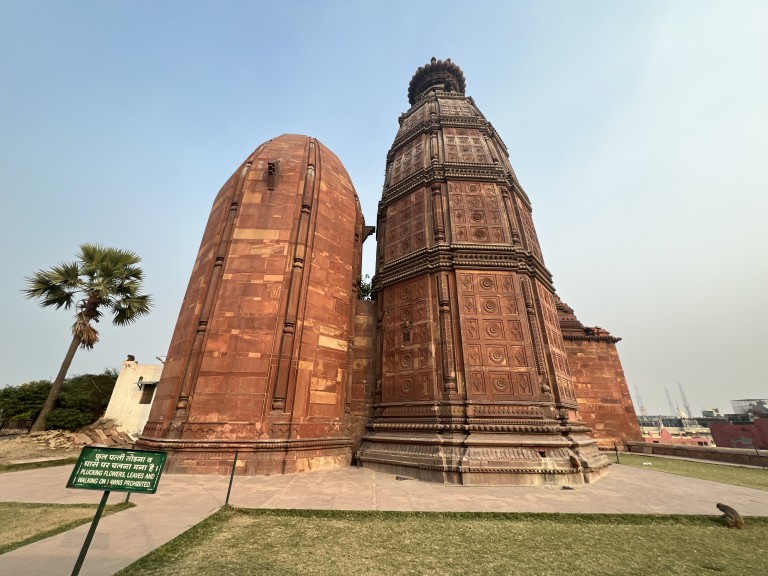
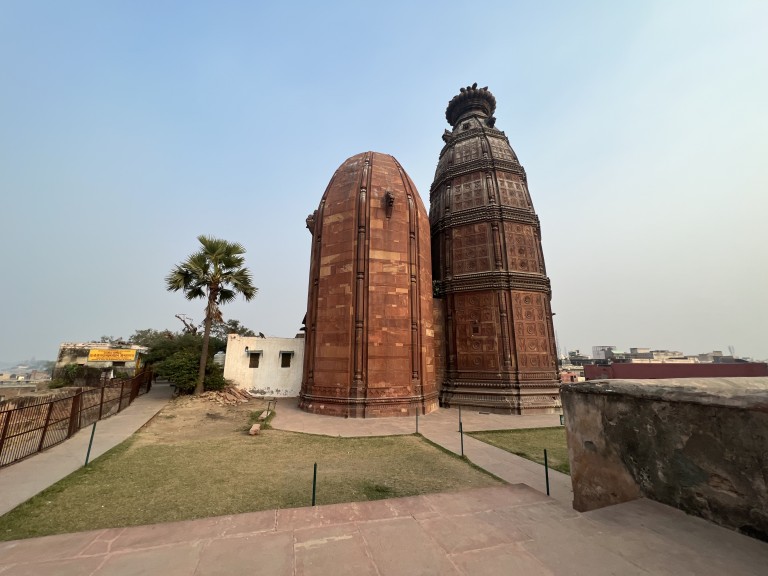
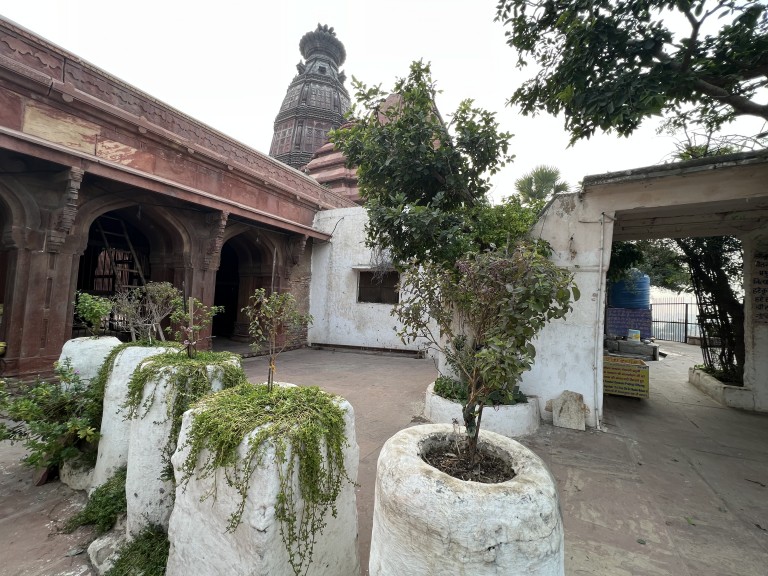
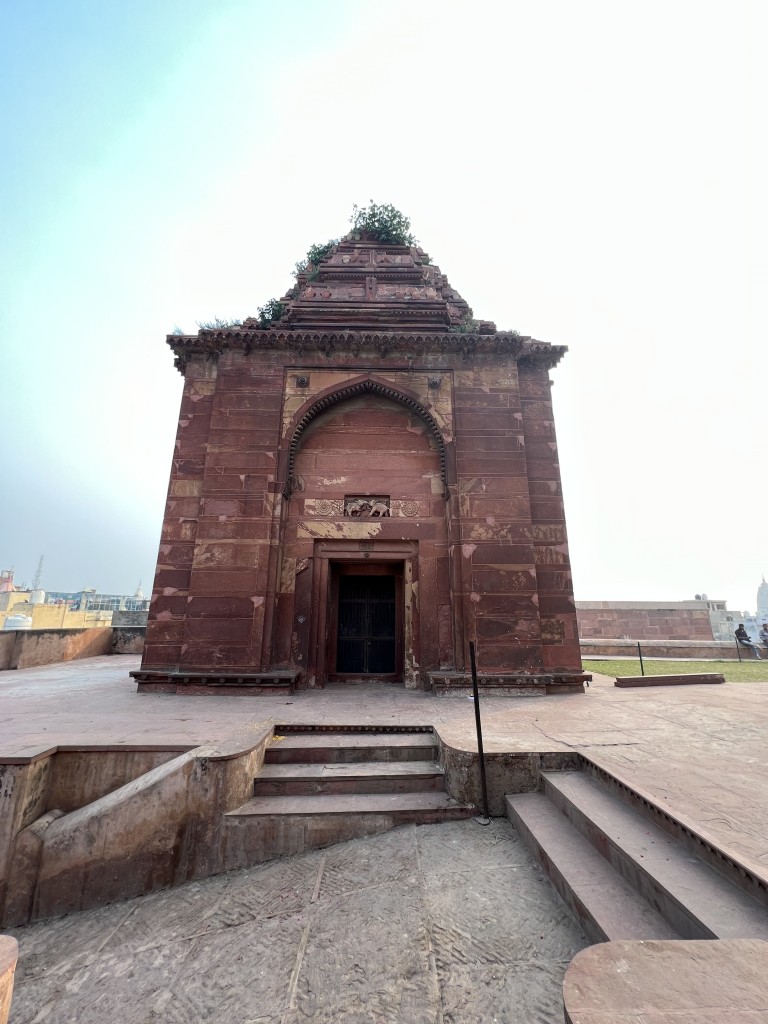
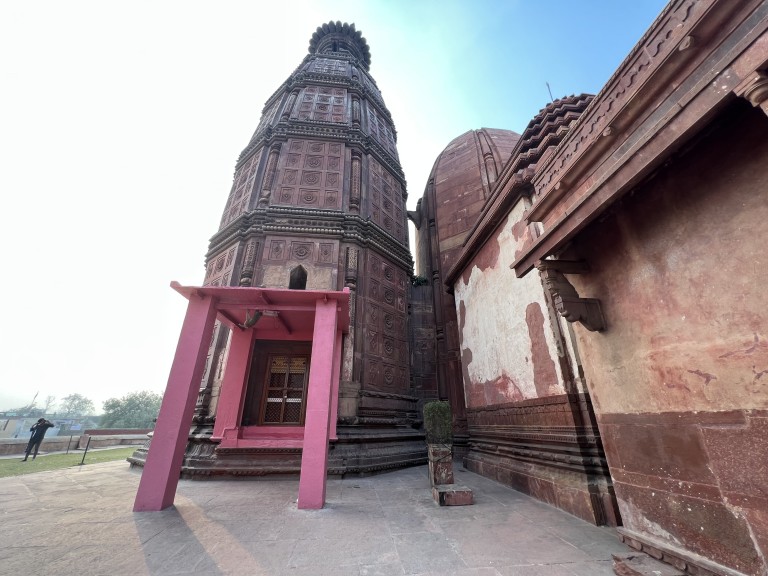
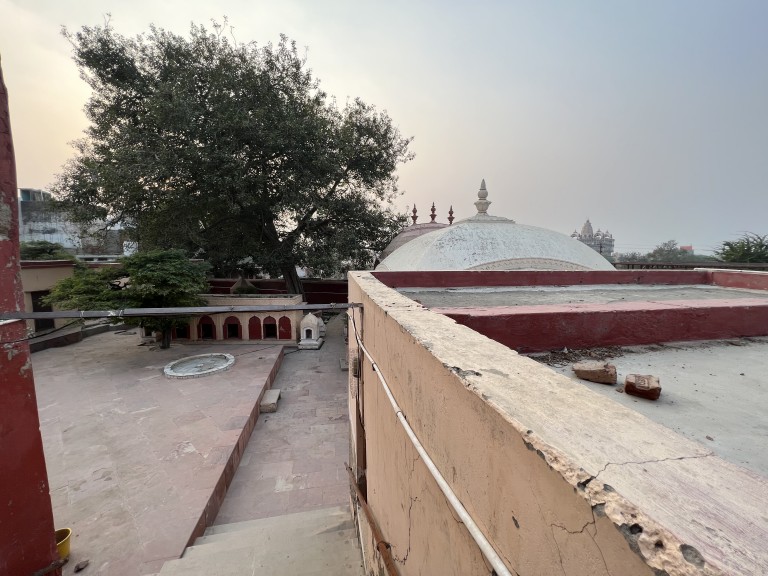
In 1760, when Aurangzeb’s came to this temple they smashed the motifs, frescos and sculptures in and around the temple and according to historical accounts, they dismantled the top of the temple turret, as per the orders of Aurangzeb, who wanted that all the temple turrets be reduced in height. It is important to note that the temple turret situated right next to the temple shows clear signs of desecration and the chakra at the top of the temple turret (shikara) has been dismantled. On the other hand, the second turret on the left (viewed from the west), has absolutely no structural damage whatsoever and in fact appears like a more recent addition. Another point is that the actual architectural design with two temple turrets is quite different, which conveys the idea that the second temple turret was added some years after the desecration of the first temple by Aurangzeb’s soldiers
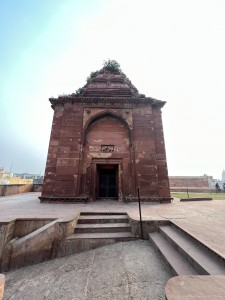
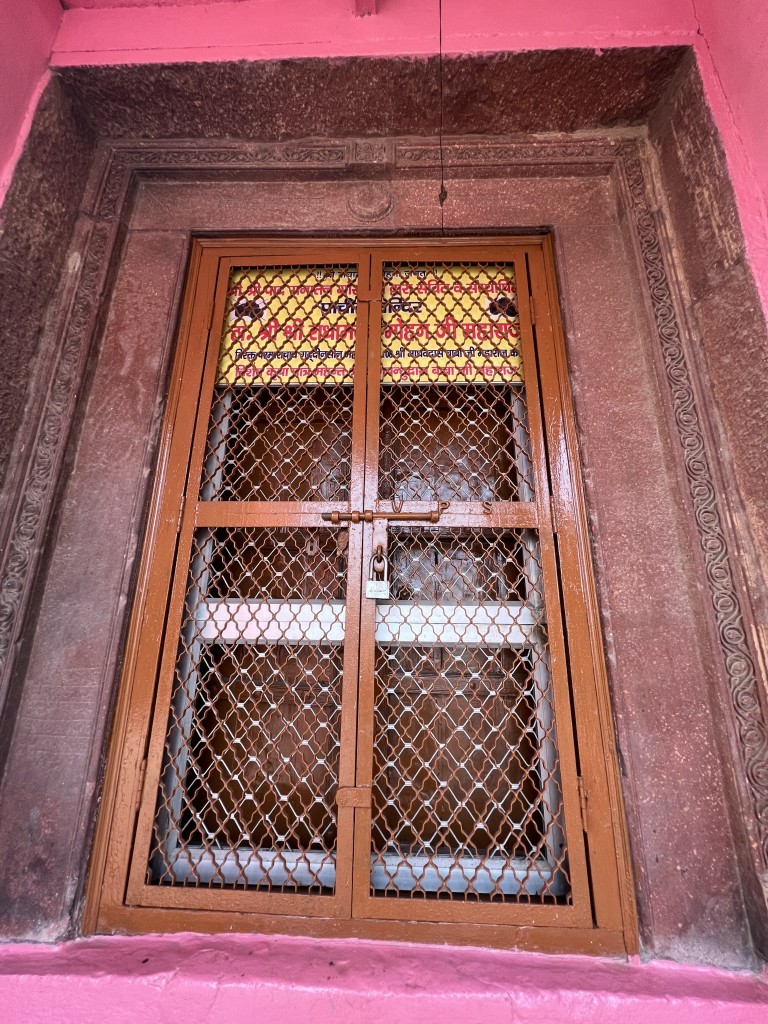
Yet another important observation is that the second turret has no precedent in traditional temple architecture. The fact that the second turret has the Deities doors facing the outer courtyard is another clue to the fact that it was a much later addition once the original temple had been abandoned due to its desecration. It appears certain that the temple tower on the left was built during a different era as the sandstone is of a different quality and the exterior design and motifs are very different from the temple tower on the right. This alludes to the fact it was built by different artisans during another time period altogether, sometime after the year 1760, because there are no signs of desecration at all and it appears intact in every detail.
Bhajana-kutira of Sanatana Goswami
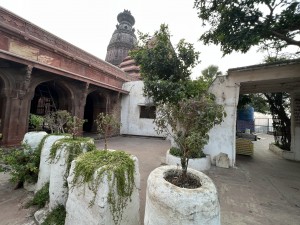
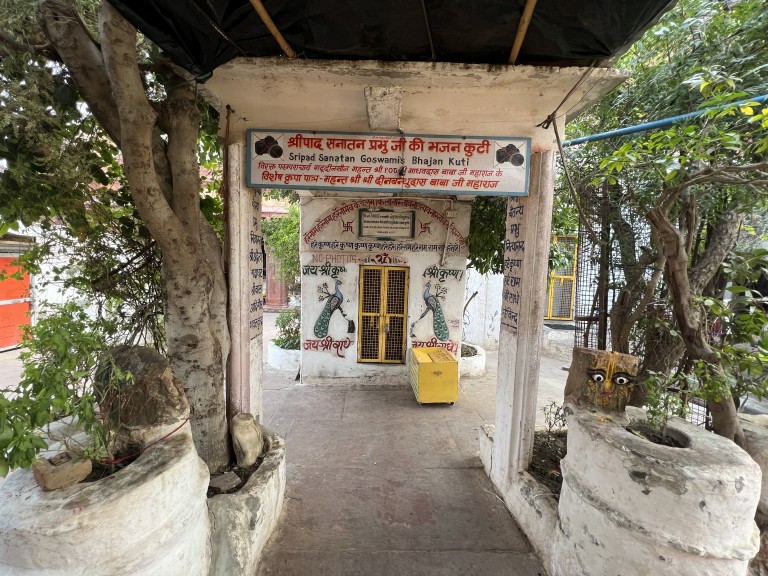
This is the spot on the top of Dwadashaditya-tila where Sanatana Goswami performed his bhajana. The word ‘bhajana’ means ‘to chant or meditate’ and ‘kitira’ or ‘kuti’ means a ‘thatched hut’. When Sanatana Goswami first came to Vrindavana in the year 1516, he lived beneath the trees without caring for any shelter. Even when he began worshiping the Deity of Madana-Mohana, he kept the Deity in the crevice of a tree. It was only at a much later date that he, or any of the other Goswamis, accepted bhajana-kutiras which were made of simple of bamboo canes and thatched leaves.
When Lord Chaitanya first sent Sanatana Goswami to Vrindavana, He gave him a number of specific tasks to fulfill. In the Chaitanya-charitamrita it is said that Lord Chaitanya told Sanatana, “Your body is My principle instrument for executing many necessary functions. By your body I shall carry out so many tasks. You shall have to ascertain the basic principles of being a devotee, love of Godhead, Vaishnava duties, and Vaishnava characteristics. You will have to explain Krishna’s devotional service, establish centers for cultivating love of Krishna, excavate the lost places of pilgrimage, and teach people how to adopt the renounced order. Vrindavana is My very own abode and I want to do many things there to preach Krishna consciousness and I have to do this work through your body”. The essence of Lord Chaitanya’s instructions formed the basis for one of Sanatana Goswami’s most celebrated books known as the Hari-bhakti-vilasa.
Sanatana Goswami’s Early Life
Sanatana Goswami was believed to have been born in the year 1488 at Jessore (now in Bangladesh) on the banks of the Ganges River and was named Amar by his parents. He took birth in a saraswata-brahmana family that originally hailed from Karnataka in South India, where his forefathers were known to have been powerful kings in the region. According to Shrila Jiva Goswami, Sanatana Goswami’s nephew, their family ancestors belonged to the Saraswata Bharadvaja-gotra. Other biographers have said that the family surname was Bhatta and they belonged to the Saraswata-brahmana community from Telangana, who had emigrated to Karnataka. At some point in time, some of their family members eventually moved to Bengal and this is where Amar (Sanatana) and his two younger brothers, Santosh (Rupa) and Anupama (Shri Vallabha), were later born. Amar and his brothers were highly educated having studied under the great Sanskrit scholars Sarvabhauma Bhattacharya and his brother Vidyavachaspati, and were thus highly proficient in Sanskrit, Persian, Arabic, Urdu, Hindi, and Bengali, and acknowledged to be amongst the most learned scholars of the day.
Based on the Gaudiya Vaishnava Abhidhana and other sources, Sanatana’s grandfather Mukundadeva, was engaged in government service as private secretary during the reign of Barbak Shah (1460-1470). After the death of Barbak Shah, his son Yusuf became king, followed by his son Fateh Shah. While in the service of Fateh Shah Mukunda departed from the world. During the reign of Fateh Shah, the Abyssinian generals in the ranks of the army led a coup in which Fateh Shah was assassinated. The Abyssinian generals ruled for five or six years and during this period, the future ruler Hussain Shah, a Pathani army general, became the wazir or prime minister under the last of the Abyssinian rulers, Sultan Shams-ud-Din Muzaffar Shah, who Hussain Shah later conspired to assassinate. After assuming the seat of power, Hussain Shah established the first Sultanate of Bengal in 1493 and his reign over Bengal lasted until 1519.
Mukundadeva’s son Shri Kumaradeva had a number of sons but three gained prominence: Amar (Sanatana Goswami), Santosh (Rupa Goswami) and Anupama (Shri Vallabha). Because of their profound scholarship and reputation as greatly learned men proficient in a number of languages, Hussain Shah, after hearing of their reputations, induced the three brothers to join his government and take up important administrative posts. While in government service it appears that Amar was soon elevated from the position of private secretary to the post of prime minister, while Santosh held another ministerial post and later became the finance minister. The youngest of the three brothers Anupam, was appointed as superintendent of the royal mint. Hussain Shah gave each of the brothers a royal title; Amar received the title of Sakara Mallik, while his brother Santosh was given the title of Dabir Khas and the youngest Anupama was given the title of Anupama Mallik. Hussain Shah also presented the three brothers with a large amount of wealth and land in Ramakeli where the brothers constructed palatial residences befitting their high posts in the government.
As no one from the brahmana community was willing to be associated with the Mohammedans for fear of being ostracized, at first the brothers refused, but when Hussain Shah threatened to persecute and kill innocent Hindus if the brothers did not join his government, they were forced to agree, not wanting to see innocent lives lost on their account. The brothers then moved from their ancestral home in Naihati to Ramakeli, the capital of the Sultanate of Bengal. At that time in history, Bengal had come under the subjugation of the Mohammedans from the year 1203, when Muhammad-bin-Bakhtiyar Khilji, an Afghani-Turkic military commander, owing allegiance to the Delhi Sultanate, overran Bengal defeating in battle the Hindu king Lakshman Sen and captured his capitol city of Gaur. Consequent invasions eventually consolidated the Mohammedan rule over the whole of Bengal.
Hussain Shah’s long reign of more than a quarter of a century was a period of peace and prosperity, which was in striking contrast to the period that preceded it. The liberal attitude of Hussain Shah towards his Hindu subjects is also an important feature of his reign. Hussain Shah was known for his religious tolerance and when he came to know about Lord Chaitanya Mahaprabhu’s huge following amongst his subjects, he ordered his kazis (local magistrates) not to injure him in any way and allow him to go wherever he liked. After the three brothers Amar, Santosh and Anupama, joined the government of Hussain Shah, the rigid and ultra-orthodox smrta-brahmana community immediately ostracized them. However, as they had long been acknowledged to be great Vaishnavas and highly learned Vedic scholars, they continued to have many sincere followers amongst the brahmana community and would also spend long hours engaged in reading the Shrimad-Bhagavatam and other Vedic scriptures with their close associates.
Sanatana Goswami Surrenders to Lord Chaitanya
After hearing from their brahmana friends about the wonderful activities of Lord Chaitanya Mahaprabhu and His sankirtana movement, both Amar and Santosh resolved in their hearts to surrender themselves to Lord Chaitanya and wrote letters to Him begging for His mercy and imploring Him to somehow or other try to save them. Lord Chaitanya, after accepting the sannyasa order in 1510, had moved to Jagannatha Puri in Orissa, but after staying at Puri for some months, He decided to go on a preaching tour of Bengal. After visiting Navadwipa, Lord Chaitanya proceeded to Ramakeli where thousands came to greet Him. Amar and Santosh accompanied by their younger brother Anupama eagerly went to meet the Lord and after placing straw between their teeth, very humbly approached Lord Chaitanya Mahaprabhu and immediately fell on the ground like rods before the Lord’s lotus feet. They then begged the Lord, saying that because of serving the Mohammedan Government, they were the most abominable and fallen persons and therefore they should be saved first. Lord Chaitanya immediately accepted them as His disciples and gave them their spiritual names; Amar became Sanatana, Santosh became Rupa, and Anupama became Shri Vallabha. The three brothers immediately decided to retire from government service in order to join Lord Chaitanya’s sankirtana movement. The Lord told the three brothers to go and live in Vrindavana.
Although Rupa and Shri Vallabha managed to leave the service of the government and proceeded to Vrindavana, Sanatana was not so lucky. When Nawab Hussain Shah came to know that Sanatana was planning to leave his post, he immediately locked him in jail. When Nawab Hussain Shah left on a military campaign to conquer Orissa, Sanatana took the opportunity to bribe the jailer with a large sum of money who then released him. Sanatana immediately went to meet Lord Chaitanya at Benares (Varanasi), where he received the Lord’s personal instructions. Lord Chaitanya ordered Sanatana to immediately proceed to Vrindavana to join Rupa and Shri Vallabha, who had gone to Vrindavana sometime earlier. After his arrival in Vrindavana, Sanatana Goswami set about fulfilling the mandate given to him by Lord Chaitanya. He left Vrindavana only once to meet Lord Chaitanya for the last time at Jagannatha Puri and then immediately returned to Vrindavana. Sanatana Goswami spent the remaining forty two years of his life living in the holy Dhama performing the important tasks personally given to him by Lord Chaitanya Mahaprabhu.
Krishna Kupa
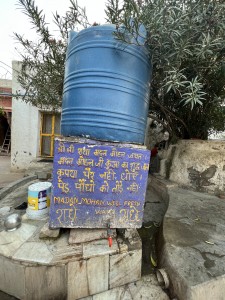
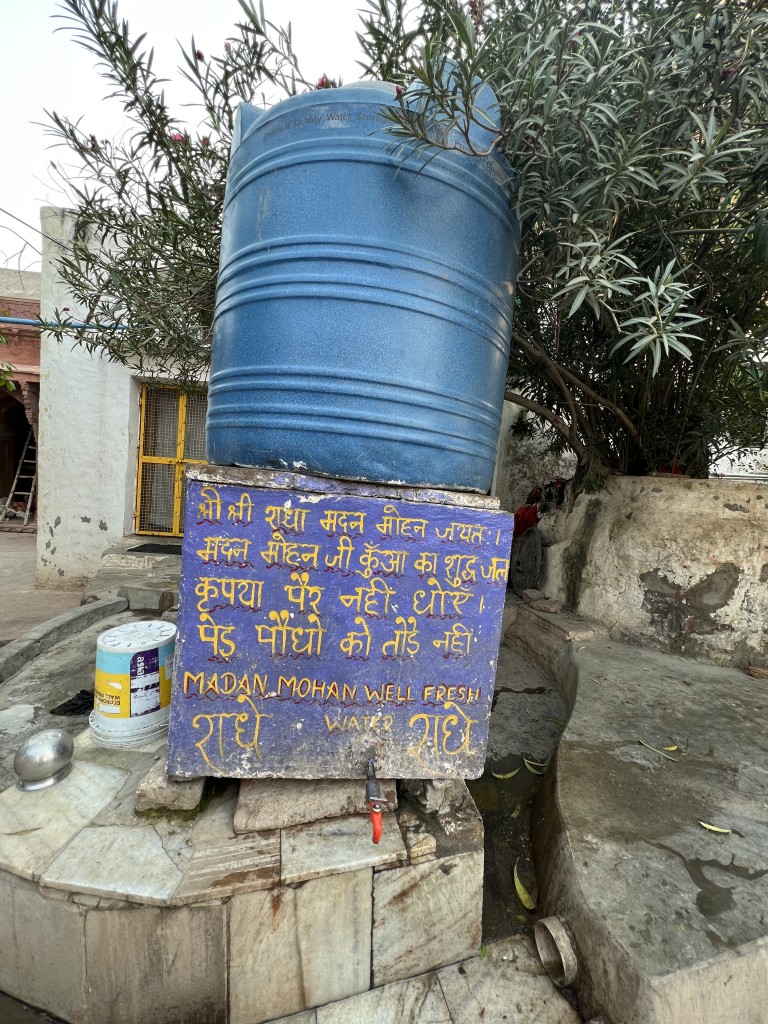
It is said that Lord Madana-Mohana created this well by pushing His flute into the ground so that Sanatana could easily obtain drinking water. The word ‘kupa’ means ‘well’.
Dwadasaditya-tila
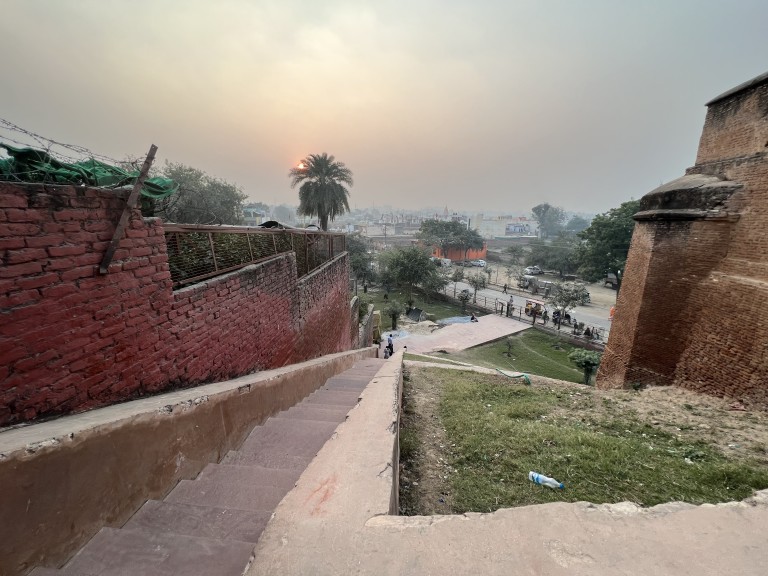
This is the hill which Krishna climbed in order to lay down in the sunshine. He was feeling very cold after having spent time in the chilly waters of Yamuna River while subduing the serpent Kaliya Naga. Shrila Sanatana Goswami chose this sacred spot on top of Dwadasaditya-tila to perform his bhajana and where he worshiped his Deity Lord Madana-mohana. After some time with the help of a wealthy merchant named Ramdas Kapoor, a temple for Madana-mohana was built on top of the same hill.
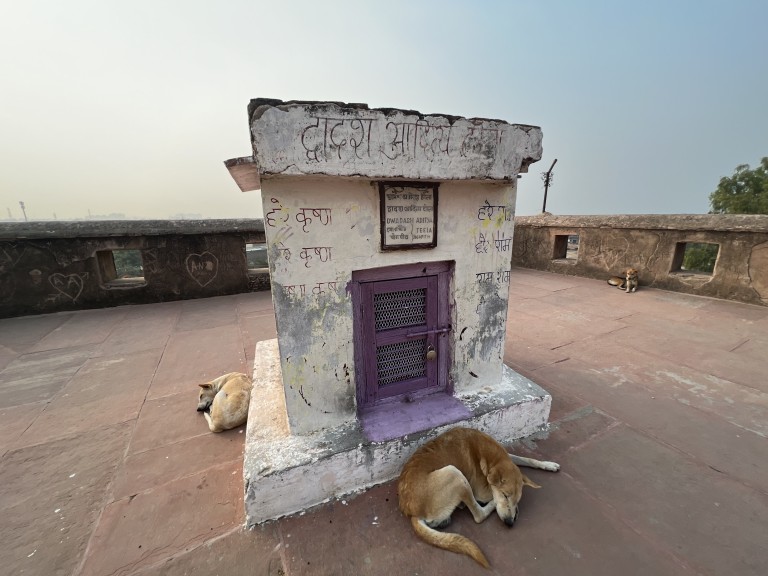
Dwadasaditya Yoga Pitha
There is a shrine here that marks the exact spot where Krishna rested while being warmed by the twelve Adityas, who were the twelve different manifestations of the sun-god. Their names are: Vishnu, Aryama, Indra, Tvashtha, Varuna, Dhata, Bhaga, Parjanya, Vivasvan, Anshuman, Mitra, and Pushya. The twelve Adityas appeared in the sky simultaneously to provide their combined heat in order to stop Krishna from shivering from the cold. Each month there is a different Aditya who takes over as the sun-god and on this occasion all twelve Adityas appeared at one time in order to serve Krishna. The twelve Adityas only appear together at the time of universal devastation but on this occasion, after hearing the prayers of Radharani and the gopis, they combined together to serve Lord Krishna. The heat from the twelve Adityas was so great that Krishna became so warm that He began to perspire, and a small stream formed from the accumulated perspiration ran down the hill-side and created a pool within the Yamuna.
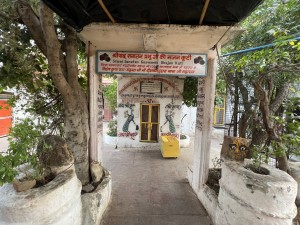
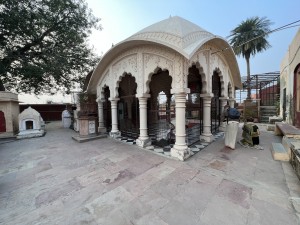
Sanatana Goswami Samadhi
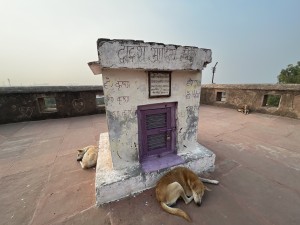
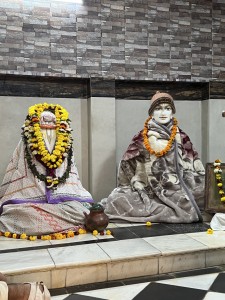
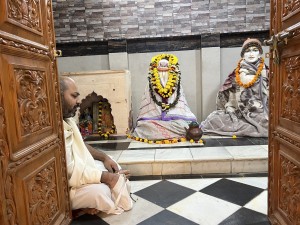
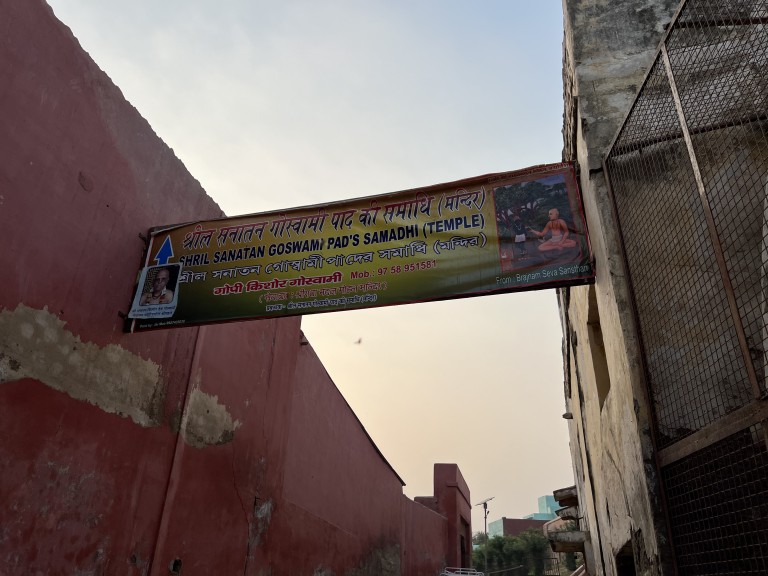
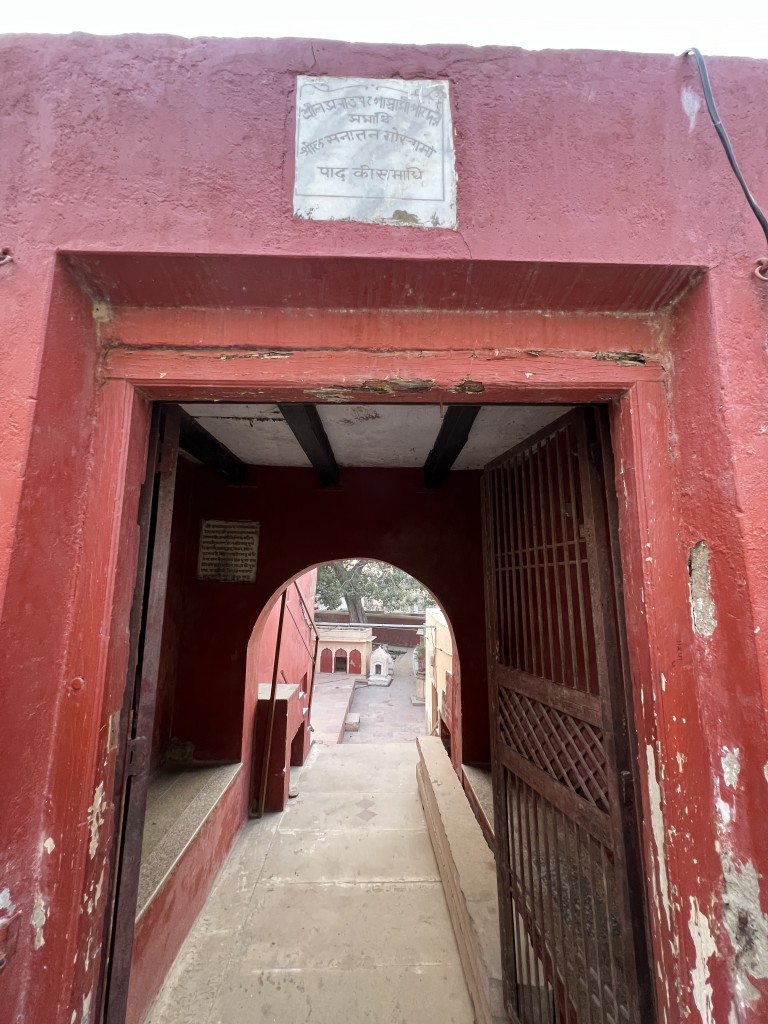
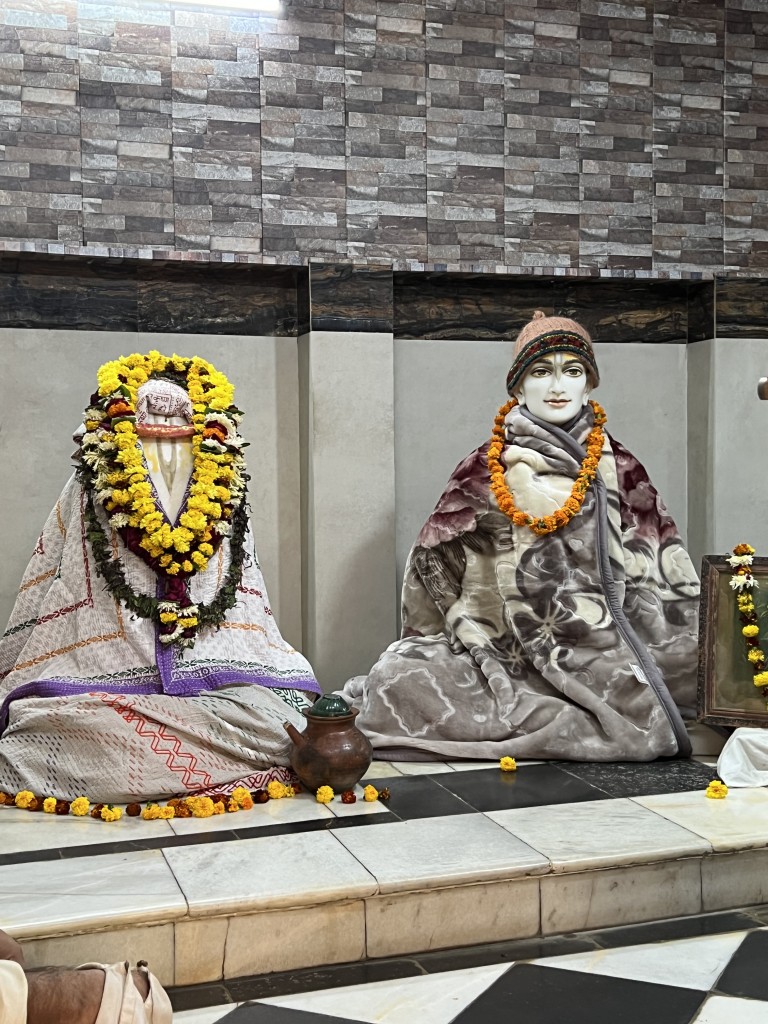
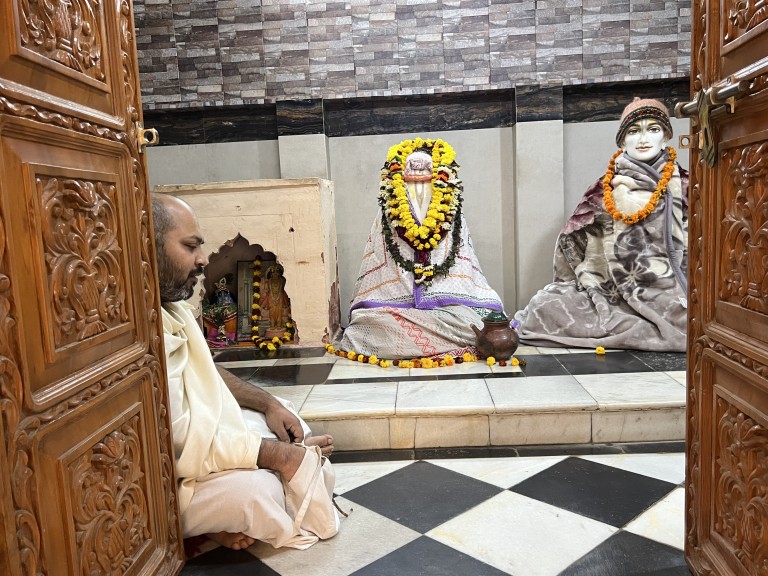
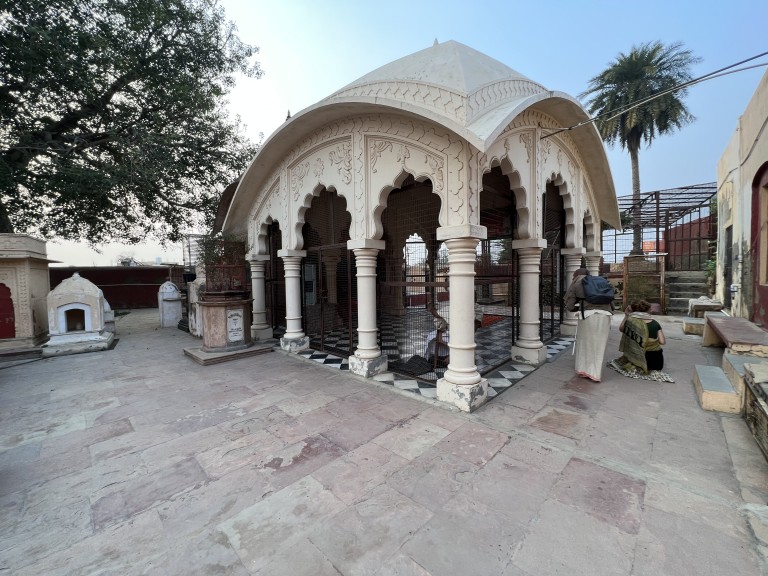
This is the Samadhi Mandira where in the year 1558, Shrila Sanatana Goswami was laid to rest. Sanatana Goswami departed on the occasion of Guru-purnima at Manasi-ganga near Govardhana Hill where he was performing bhajana. His sacred body was then brought in a procession to Dwadashaditya-tila in Vrindavana and entombed next to where his beloved Deity Madana-Mohana was being worshiped. He wrote a large number of books on the science of devotion, the most famous being Brihad-bhagavatamrta and Hari-bhakti-vilasa. According to the Gaura-ganoddesha-dipika, he was known by the name Rati-manjari or sometimes as Lavanga-manjari in Krishna’s Vrindavana pastimes and in the form of Lavanga manjari, he serves Srimati Visakha-sakhi just as Rupa Manjari (Rupa Goswami) serves Lalita-sakhi. The Gaura-ganoddesha-dipika says that Sanatana Goswami is accepted to be an extension of the body of Lord Chaitanya Mahaprabhu, as well as being an incarnation of Sanatana Kumara, one of the four Kumara sons of Lord Brahma.
Tapan Mishra and Chandrasekhara Acharya Pushpa Samadhis
When Lord Chaitanya was on His historic journey from Jagannatha Puri to Vrindavana, He spent around ten days at Benares (Varanasi) and stayed at the house of His old friend Tapan Misra, who was an acquaintance of Lord Chaitanya from Bengal. Tapan Misra was the father of Raghunatha Bhatta Goswami, who while still a child, was able to get the Lord’s personal association when the Lord came to Benares. After the Lord had taken His meal at the house of Tapan Mishra and was resting, Raghunatha used to massage His lotus feet. While staying at Banares, Lord Chaitanya also met Chandrasekhara, who was also a friend of Lord Chaitanya from Navadwipa. While on His return journey from Vrindavana, Lord Chaitanya first went to Prayag where He met Shrila Rupa Goswami, and after instructing him on the science of Krishna consciousness, sent him to Vrindavana. Lord Chaitanya then returned to Benares where He spent a few days staying at the house of Chandrasekhara while taking His meals at the house of Tapan Misra. During His stay at Chandrasekhara’s house, Lord Chaitanya met Shrila Sanatana Goswami, who had just been released from prison. At this time Lord Chaitanya personally instructed Sanatana Goswami in the science of Krishna consciousness and asked him to spend the rest of his life in the service of Vrindavana Dhama.
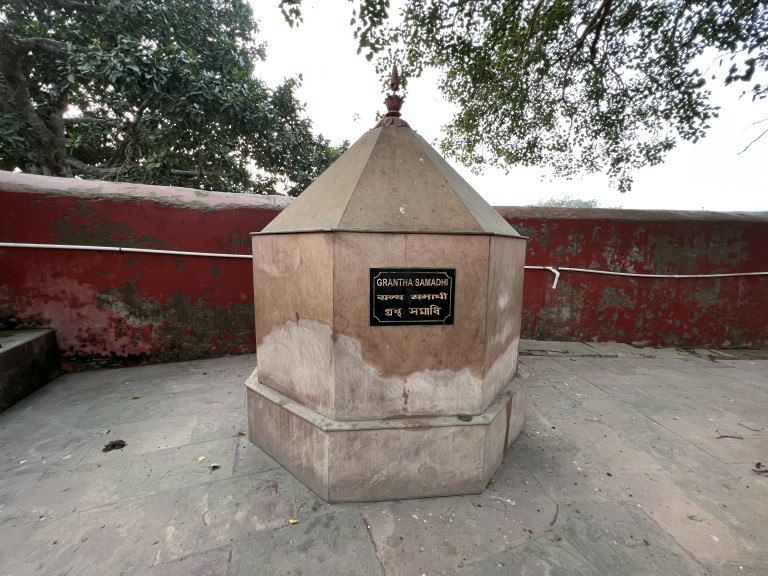
Grantha Samadhi
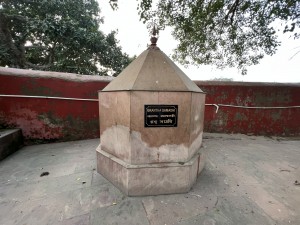
The word ‘grantha’ means ‘sacred books’ and this unusual samadhi contains the sacred books of the Six Goswamis. It is believed that these books were of esoteric subjects concerning the very intimate pastimes of Krishna and the gopis and written on palm leaves. It is said that because the subject of these books was beyond the understanding of ordinary devotees, it was decided to place them in samadhi. This is believed to be the only grantha samadhi in existence anywhere in the world.
Photo (22)