Description

Bhaktivedanta Narayana Gosvami
From the book “Sri Vraja-maṇḍala-parikramā”:
The present name of this temple is Śrī Govindadeva, and its ancient name was Gomā-ṭīlā. Śrī Rūpa Gosvāmī used to perform sādhana-bhajana in a small hut behind the temple of Śrī Rādhā- Dāmodara in Sevā-kuñja. On the order of Śrīman Mahāprabhu, he composed different literatures on bhakti, like Bhakti-rasāmṛta- sindhu and Ujjvala-nīlamaṇi, while living here. Also, following the instruction of Mahāprabhu, he wanted to manifest the deity of Śrī Govinda that had previously been installed by Śrī Vajranābha.
Daily, Śrī Rūpa Gosvāmī would perform the ten miles parikramā of Vṛndāvana. One day, during his parikramā, he became very restless thinking about the deity of Śrī Govinda. He sat down under a tree on the bank of the Yamunā and wept, yearning for His darśana. At that time, a beautiful Vrajavāsī boy who was also doing parikramā walked past. He saw Śrī Rūpa Gosvāmī weeping under the tree, and asked him why he was crying. At first, Rūpa Gosvāmī said nothing, but when the boy persisted, he revealed to Him the pain in his heart. The Vrajavāsī boy brought Rūpa Gosvāmī to Gomā-ṭīlā and said, “Please listen. Every day, just before noon, one cow comes to this mound, and irrigates this place with the milk from her udder. I think that your desire will be fulfilled here.” Saying this, the boy immediately disappeared.
Thinking of the beauty and sweet words of the boy, Śrī Rūpa Gosvāmī fainted. Upon regaining consciousness, he called the neighbouring Vrajavāsīs, who very carefully dug up the earth at that place. There, a little under the ground, was Śrī Govindajī, more beautiful than millions of cupids. They bathed the deity with great ceremony. News of this spread quickly, and crowds of people gathered to take darśana of Śrī Govindajī.
Śrī Govindadeva is Vṛndāvaneśvara – the Lord (īśvara) of Śrī Vṛndāvana. In the Skanda, Padma, Varāha and other Purāṇas, He is said to be Vṛndāvana’s rāja-rājeśvara, King of kings. Śrī Govindadeva is thus the worshipful deity of Vṛndāvana. Śrī Caitanya-caritāmṛta (Ādi-līlā 8.50–1) states:
mahā-yogapīṭha tāhāṅ ratna-siṁhāsana
tāte vasi ’āche sadā vrajendra-nandana
‘śrī-govinda deva’ nāma-sākṣāt madana
Śrī Caitanya-caritāmṛta (Ādi-līlā 1.16) also says:
śrīmad-ratnāgāra-siṁhāsana-sthau
śrī-śrī-rādhā-śrīla-govinda-devau
preṣṭhālibhiḥ sevya-mānau smarāmi
There are many famous statements regarding Śrī Govinda in different scriptures. For instance, Śrīmad-Bhāgavatam (6.8.20) states: “māṁ keśavo gadayā prātar avyād govinda āsaṅgavam ātta- veṇuḥ – May Śrī Keśava protect me with His club in the morning hours, and may Śrī Govinda, who is holding His flute, protect me in the second portion of the day.” A commentary on this verse nicely elucidates its meaning. In the Gopāla-tāpanī Upaniṣad (Pūrva- khaṇḍa text 38) it is said: “tam ekaṁ govindaṁ sac-cid-ānanda- vigraham – You are Govinda and Your form is transcendental, full of knowledge, bliss and eternality.”
The Vedas (Urddhva-āmnāya) glorifies Śrī Govinda in the following verse:
vṛndāvane yogapiṭhe sa eva satataṁ sthitaḥ
asau yuga-catuṣke ’pi śrīmad-vṛndāvanādhipaḥ
pūjito nanda-gopādyaiḥ kṛṣṇenāpi supūjitaḥ
The Atharva Veda says, gokul āraṇye mathurā-maṇḍale vṛndāvana-madhye sahasra-dala-madhye ’ṣṭadala-keśare govindo’pi śyāmaḥ dvibhujo, and so on. Furthermore, the Skanda Purāṇa states:
’cyutaḥ gandharvair apsarobhiśca krīḍa mānaḥ sa modate
Śrī Nārāyaṇa Bhaṭṭa Gosvāmī also mentions Śrī Govinda in the following verse from Vraja-bhakti-vilāsa (10.76):
loka-kalmaṣa-nāśāya paramātma-svarūpiṇe
Before Śrī Rūpa Gosvāmī’s arrival in Śrī Dhāma Vṛndāvana, it was unheard of to place a deity of Śrīmatī Rādhikā beside a deity of Śrī Kṛṣṇa. It so happened that a deity of Śrī Rādhikā, who was present in the temple of Jagannātha in Purī-dhāma at a place named Cakrabeḍa, was being worshipped by everyone as Lakṣmījī. Śrīmatī Rādhikā instructed the father of Mahārāja Pratāparudra, Puruṣottama Jānā, in a dream: “I am not Lakṣmī; I am Rādhā, the beloved of Vrajendra-nandana Śrī Kṛṣṇa. I am waiting for the manifestation of Śrī Govindadeva in Vṛndāvana. When He appears please send Me to Him with great care.” This deity, along with other deities of Śrīmatī Rādhikā, was later sent to Vṛndāvana with Śrī Jāhnavā Ṭhākurānī, and the contemporary gosvāmīs placed this deity of Śrī Rādhā to the left of Śrī Govindadeva. After being united with Śrīmatī Rādhikā, Śrī Govinda became famous by the name of Śrī Rādhā-Govinda.
Śrī Caitanya Mahāprabhu personally sent His own deity form, Śrī Gaura-Govinda, to Vṛndāvana, with His associate Kāśīśvara Brahmacārī. That same deity is nearby, in the southern part of the Govindajī Temple.
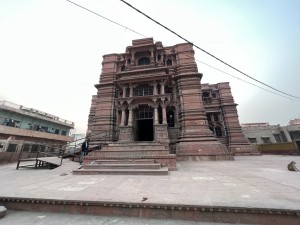
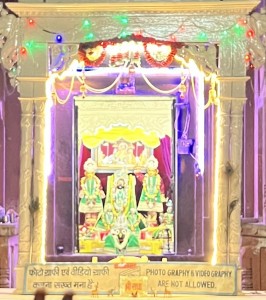
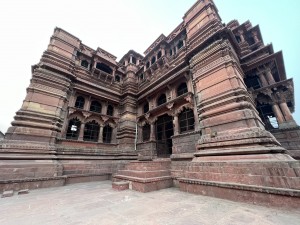
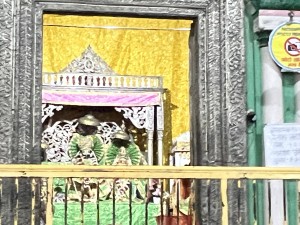
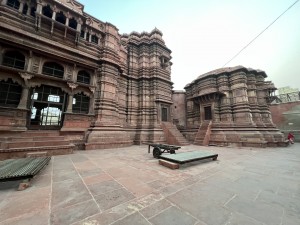
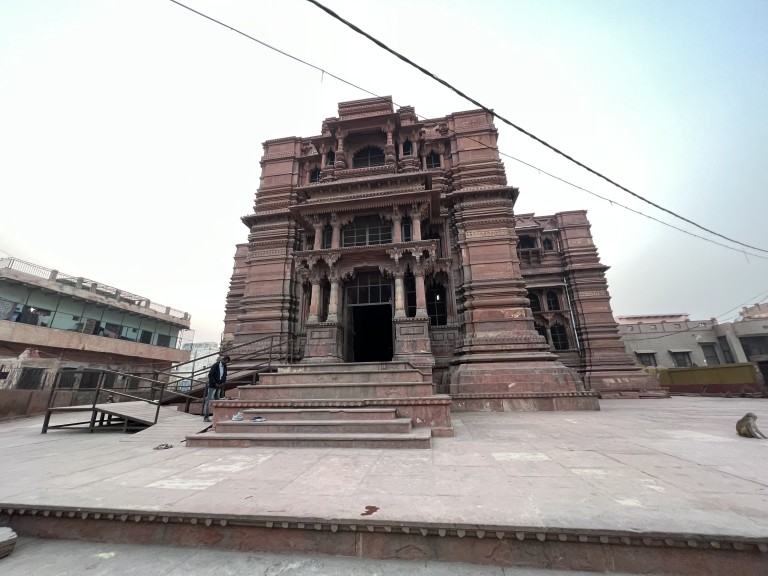
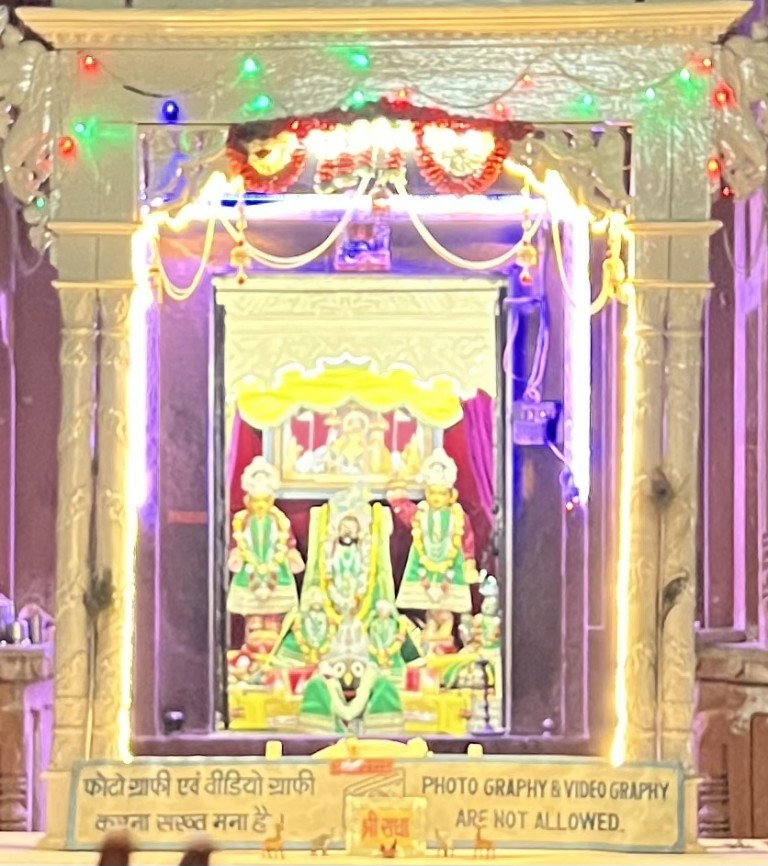
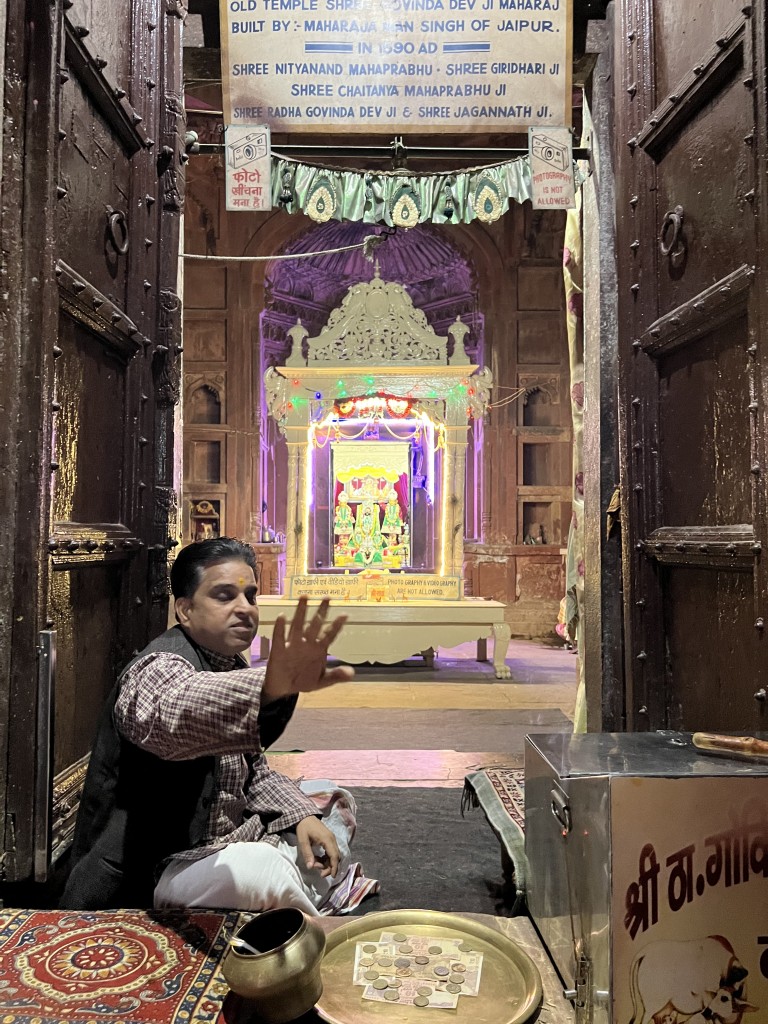
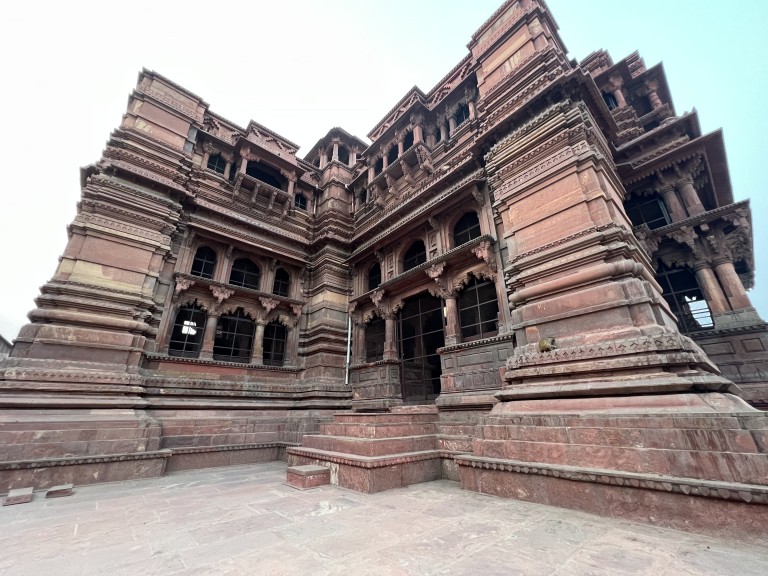
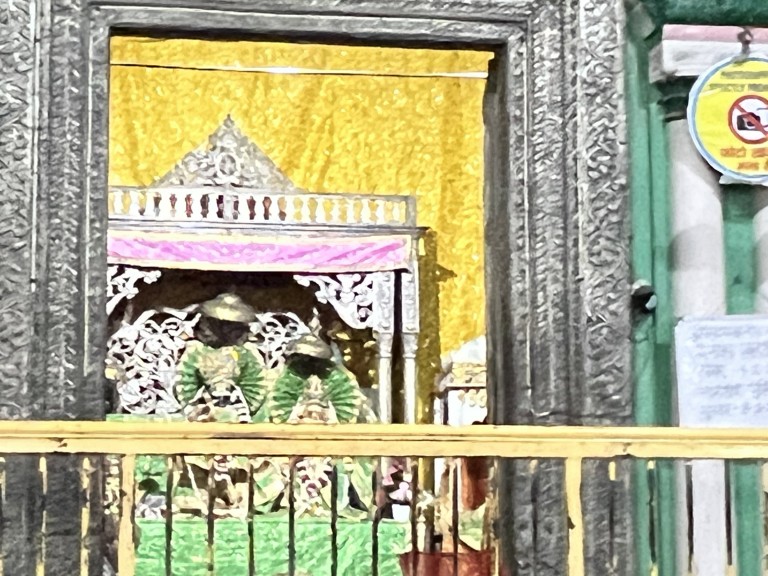
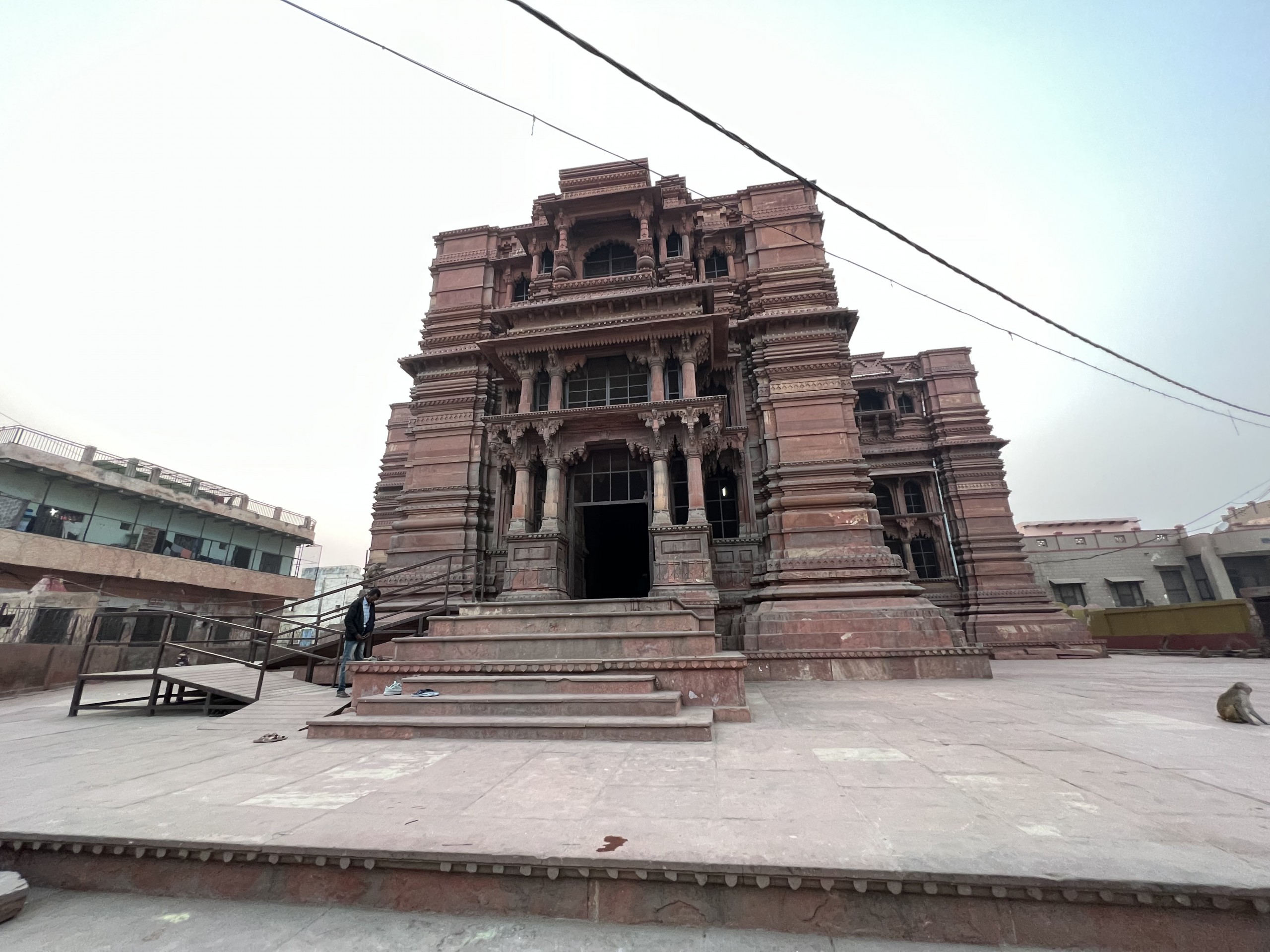
In 1590 AD, a disciple of Śrī Raghunātha Bhaṭṭa Gosvāmī, Mahārāja Māna Singh of Jaipura, built an extensive seven-storey, red-stone temple, as inspired by his holy master. In 1670 AD, the tyrannical Mughal emperor Aurangzeb demolished this temple, destroying the top four floors. When he was in the process of destroying the lower part, he suddenly received some news of some calamity and had to return to Delhi. Thus, the lower portion of the temple was saved. Before the temples of Vṛndāvana were destroyed, Śrī Govindajī and other worshipful deities of the Gauḍīyas were sent to Jaipura. In 1748 AD, the pratibhū-vigraha of Śrī Govindadeva was installed nearby here. Then, in 1819 AD, Śrī Nandakumāra Vasu constructed the present temple. Situated in this temple is Śrī Govindadeva with Śrī Rādhikā to His left. The ancient and original Govindadeva along with His beloved Rādhikā now reside in a temple near the royal palace in Jaipura.
Śrīla Rūpa Gosvāmī jokingly forbids the darśana of Govindadeva with the following words: “If you have even a slight desire to enjoy life with your wife, sons, relatives and friends, then listen to my advice. Never go to Keśi-ghāṭa in Vṛndāvana, even by mistake. There, Śrī Hari as the deity of Govinda is standing in His charming threefold-bending form, smiling. Raising His eyebrows, He looks here and there with slightly crooked eyes. His yellow cloth (pītāmbara) is shimmering on His body, and He is decorated with a heart-stealing garland of forest flowers and bunches of fresh young leaves. Aah, the flute, the root cause of all troubles, is gracefully placed to His lips, and the peacock feather on His head is increasing His beauty. A person who even once beholds this deity of Govinda with his own eyes never returns to his home, and his household life is ruined. Therefore, O wordly jīva, be cautious. Never ever go towards Keśī-ghāṭa; otherwise an unthinkable disaster may occur.”
Rajashekhara Dasa
From the book “Chaurasi-kosa Vraja Mandala Parikrama”:
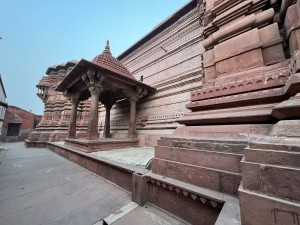
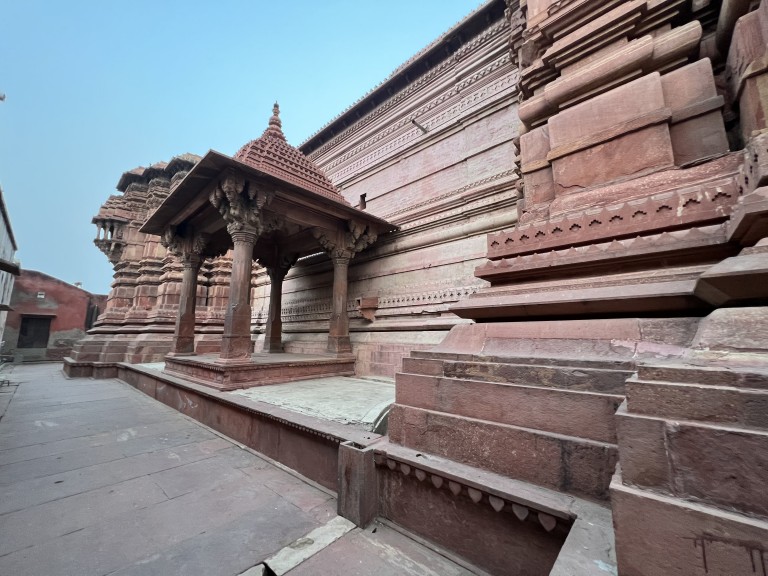
This is one of the famous ‘Seven Goswami Temples’ that was inspired by Shrila Rupa Goswami, who discovered the Deity of Lord Govinda buried in the ground at the site where the majestic temple of Govindaji now stands. The Deity of Govindaji was originally installed five thousand years earlier by Krishna’s great grandson Vajranabha Maharaja, at the place known as the Govindaji yoga-pitha. After the discovery of the Deity, a small shrine was immediately built and the worship of the Deity began. There are no records of the actual date when the first seva-puja of the Deity was performed by Shrila Rupa Goswami, but it was definitely sometime before 1534, the year in which Lord Chaitanya disappeared, because after hearing about the discovery of the Govindaji Deity, Lord Chaitanya had personally sent some of the devotees from Puri to assist Rupa Goswami in serving the Deity. Rupa Goswami also discovered the Deity of Vrinda Devi at Brahma-kunda and she was installed in a separate shrine to the left of the main Deity room. This shrine stands directly above the actual hole within the ground where Govindaji was discovered by Rupa. This shrine which is below ground had its own temple tower and adjoins the southern side of the main temple, is the actual site of the Vrindavana Yoga-pitha.
When Lord Chaitanya Mahaprabhu directed Rupa Goswami to spend the rest of his life in Vrindavana, He asked him to fulfill four important tasks including: excavation of the lost holy places, write books on devotional service, establish the principles of Deity worship, and build temples, He also asked Rupa to specifically find the long-lost Deity of Govindaji, the presiding Deity of the northern petal of the lotus of Vraja Mandala. After arriving in Vrindavana and having searched for many days, Rupa could not find the location where the Deity of Govindaji was lying hidden. It is said that one day, after searching without success, feeling somewhat despondent, Rupa Goswami went to sit near the bank of the Yamuna, probably at nearby Pani Ghata, and was lamenting to himself saying, “Oh Chaitanya, Oh Chaitanya” Suddenly, a charming young cowherd boy came there and asked the cause of Rupa’s dispair. After hearing about Rupa’s search for Govindaji, the boy informed him that a cow was going every day to a nearby tila, or small hill, and was pouring milk from its udder into a hole in the ground. The cowherd boy asked Rupa to see what was in the hole. Realizing that this could be the clue that he had been looking for, Rupa accompanied the cowherd boy to the hill where the hole was located. On reaching the spot, Rupa peered into the hole in the earth and suddenly had the spiritual realization that this was the location where the Deity of Govindaji was buried. Rupa suddenly felt a rush of ecstatic symptoms throughout his being and momentarily fell unconscious. On regaining his senses, the cowherd boy had disappeared. Rupa concluded within his mind that the boy must have been Krishna Himself, disguised as a local cowherd boy, who had guided him to the spot where the Deity was buried. Rupa summoned the help of a few others and very carefully started digging into the hole. A few feet below the surface they suddenly saw the Deity of Govindaji. Loud cries of ‘Jaya Govinda! Jaya Gopala!’ rent the air as they slowly hauled the Deity out of the hole. After performing an abhishekha and instillation ceremony, the worship of the beautiful Deity of Lord Govindaji began once again after a lapse of almost five thousand years. On hearing about the wonderful discovery of the Deity of Govindaji, Lord Chaitanya sent some of His followers from Puri to help Rupa in the Deity worship, so that Rupa might continue with the important work of further excavation of Vrindavana’s holy places and also writing books.
Some years after the discovery of Govindaji, in faraway Orissa, the son of Prataparudra Maharaja whose name was Purushottama Deva, had a dream one night in which a Deity being worshiped in the Jagannatha Temple as Lakshmi Devi, appeared before him and said, “I am not Lakshmi but Radharani, and I have been waiting for my beloved Govinda to again manifest in Vrindavana, so therefore please send Me to Vrindavana.” After receiving the dream, Purushottama consulted with the temple priests, temple authorities, and senior Vaishnavas, and after everyone agreed, the Deity of Lakshmi Devi was sent to Vrindavana. The Deity was then installed on the simhasana as Radharani and placed on the left-hand side of Lord Govinda. This was the first temple installation of a Deity of Radharani anywhere in the world. After this famous episode, gradually other Deities of Radharani were installed in other Goswami temples in Vrindavana and thus the Gaudiya Vaishnava tradition of establishing temples with the Deities of both Radha and Krishna began. The exact date when the instillation of Radharani at the Govindaji Mandira took place is unknown, but it occurred sometime between 1534 and 1541, because after this date Purushottama Deva was assassinated by the army general Govinda Vidyadhara.
Previous to the time it was accepted that Radharani was automatically present along with Krishna, in Her un-manifested form as hladini-shakti, the internal pleasure potency of Krishna. This is because Radha and Krishna can never be separated and are eternally one and the same. It has also been said that Prataparudra’s son Purushottama Deva, also sent another Deity of Radharani to be installed in the Madana-Mohana Mandira.
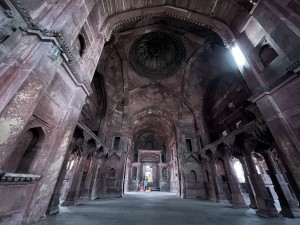
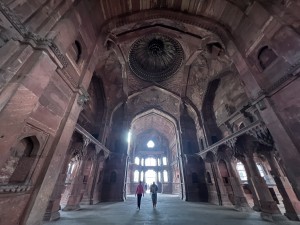
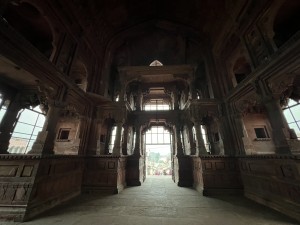
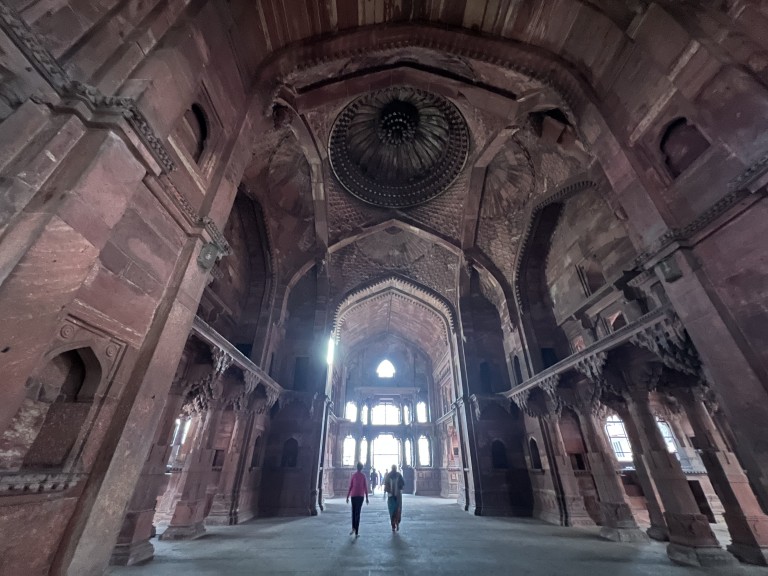
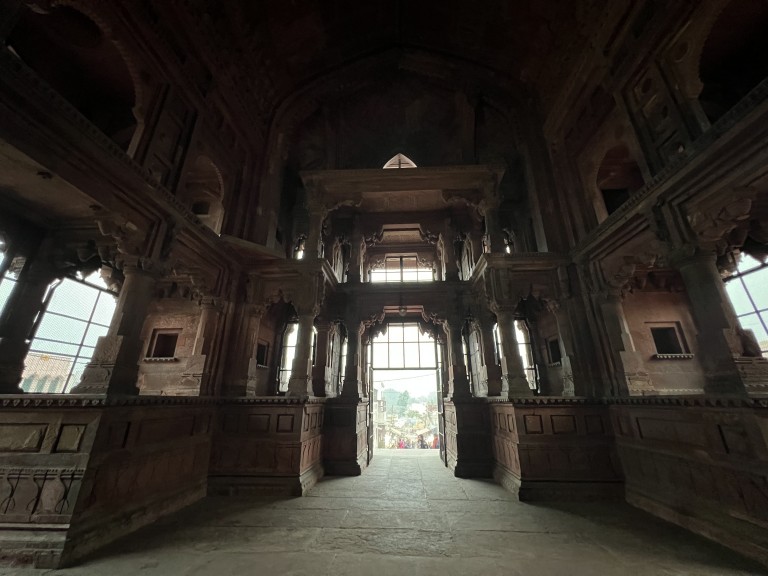
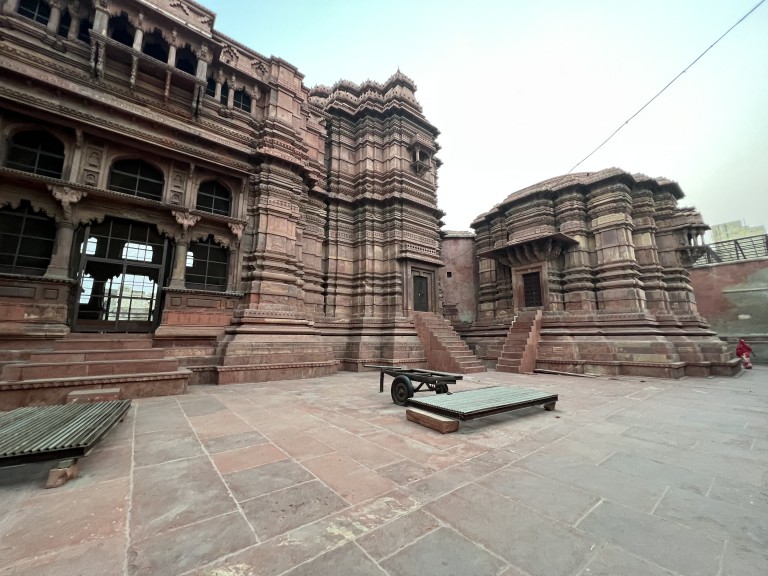
After the historic visit of Emperor Akbar to Vrindavana in 1570, the king of Jaipura and commander-in-chief of Akbar’s army, Raja Man Singh, an ardent follower of the Goswamis and a disciple of Raghunatha Bhatta Goswami, requested permission from Akbar to construct the Govindaji Mandira and other Goswami temples in Vrindavana. Akbar gave his approval and also offered to provide high quality red sandstone from which the Govindaji Mandira was built. This rare sandstone had previously been reserved exclusively for Mughal palaces and forts. Although Rupa Goswami had by this time already entered samadhi, the construction began under the guidance of Raghunatha Bhatta Goswami. The temple construction was supervised by the king of Jaipura, Raja Man Singh, and all the best architects, engineers, and stone masons, were employed by the king in constructing this temple, which was recognized at that time as one of the greatest temples in India. This temple combined elements of Hindu, Christian, and Islamic architecture, and therefore, besides looking like a traditional Hindu temple, its unique design bears striking resemblance to both a mosque and a cathedral. The Govindaji Mandira, which opened in 1590, became the most impressive edifice that ‘Hindu art’ had ever produced in the whole of Northern India. The intricate carving of the sandstone and the series of balconies and archways that can be seen around the entire structure is unique. A separate shrine was also constructed at the actual site of the Govindaji Yoga-pitha where the Deities of Vrinda Devi and Yogamaya Devi were installed.
Raghava Pandita, Narottama and Shrinivasa Acarya also had darshana of Lord Govindaji some years before the construction of the Govindaji temple. The Bhakti-ratnakara says. “Then they all went to see Shri Govindadeva whose beauty and sweetness are described by the learned. After taking darshana of Shri Govinda, the three devotees became filled with ecstasy and their eyes and minds were fully satiated. On seeing the three devotees, Shri Krishna Dasa Pandita (Govindaji’s pujari) became jubilant. He gave them garlands and prasada and inquired about their well-being. In ecstasy, Shri Raghava Pandita gradually explained everything about their darshana of the holy places of Vraja.” The Deity of Lord Govindaji, along with the Deities of Madana-Mohana and Gopinathaji, originally established by Vajranabha in Vrindavana, represent the three eternal duties or in other words the constitutional position of all living entities trapped in the material world under the shackles of maya which are: sambandha, abhdeya, and prayojana. The word abhideya means acting according to that constitutional relationship with the Supreme Personality of Godhead. Lord Govindaji is the Deity who helps us to establish this relationship (abhideya) and the siksha-guru or instructing spiritual master acts as the representation of Lord Govinda Deva.
The Tyrant Aurangzeb Attacks the Govindaji Mandira
It is often said that the temple towered seven stories into the sky, but this referred only to the temple turret, not the entire structure. By observing the architecture of the temple, and other temples of the same design, there would not have been any more than the three floors that are seen today, otherwise the entire architectural beauty of the building would have been lost. In temple architecture, the ratio between the height of the main structure, and the height of the temple turret, must be in conformity with standard temple design mentioned in the Vedas. To calculate the height of the temple turret, which is called the shikara, one must calculate the size of its foundations, therefore, from this measurement one can understand that the height of the temple turret would have been about seven stories, and from this one can also calculate the exact height of the main structure, called the kirtana mandapa, which according to the standard ratio between shikara and mandap, could not have be more than three floors.
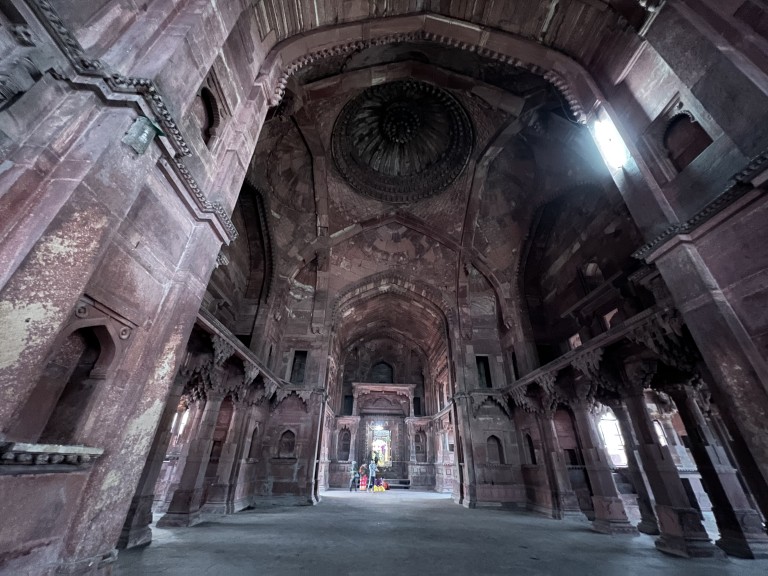
More importantly, from the engineering stand-point, there is no superstructure to support any further floors above the three floors that exist today. Another fact is that because the Govindaji Mandira was built during the Mughal era, it combines Hindu, Christian and Islamic architectural traditions. Therefore in Christian traditions a dome is always placed on top of a building to signify its highest point or pinnacle. The kirtana mandapa of the temple is finished with a dome which rises above the height of the third floor, creating in a sense, a forth level, which is surrounded by decorative arches. Similar decorative arches and chattris would also have also run around the roof-top of the third floor, but merely as a decorative embellishment. The large dome above the kirtana mandapa also signifies the sacredness of the Hare-nama kirtana being performed below. It would have been totally against ‘Hindu’ tradition to build any further floors above the kirtana mandapa, as no one was allowed to place their feet or walk above the kirtana mandapa, where the kirtana was being performed below.
The Govindaji Mandira was built with three turrets; one was the central turret (shikara), which is said to have been seven stories high, with the two smaller turrets on either side. The ground floor contains a number of large and small halls where discourses could be held, or where pilgrims could sit and relax as they do today. The second and third floors were meant as viewing galleries and a place where ladies could have darshana of the Deity and enjoy the kirtanas, without having to mingle with the public on the ground floor where large crowds of men would have normally congregated; where the kirtana exclusively performed by men, would be taking place. Situated on top of the seven story central shikara was a very large oil lamp, which was lit in the evening and fueled with either ghee or oil.
This large oil lamp ultimately led to the destruction of the central shikara when it was spotted by Aurangzeb in far-away Agra, a distance of sixty kilometers south of Vrindavana. Late one evening in the year 1670, the Mughal Emperor, while standing on the ramparts of his fort at Agra, suddenly noticed a bright light in the far distance. After being told it was the light from a Hindu temple in Vrindavana, he became infuriated that the shikara of a temple belonging to Hindu idolaters was far higher than the minaret of a Muslim mosque. In anger Aurangzeb ordered its immediate destruction. Hearing the rumors of an impending attack on Vrindavana by the soldiers of Aurangzeb, the Hindu princes, who had their spies at the Mughal court, sent word to the temple priests in Vrindavana about an imminent attack. Therefore, the priests were able to secretly smuggle the temple Deities out of Vrindavana and take Them to the safety of Rajasthana, which was still ruled by Hindu kings. It was decided to move all the Deities because as soon as Aurangzeb’s soldiers would have arrived in Vrindavana, their first target would have been the destruction of these Deities. Thus when the soldiers eventually arrived in Vrindavana they found no Deities.
Aurangzeb’s actual order to his soldiers was to dismantle the shikara of the Govindaji Mandira. His soldiers did not actually dismantle any floors of the temple itself accept the easily removable decorative chattris and arches running around the roof-top of the mandap.
Soldiers merely desecrated the temple interior by smashing all the intricate frescos and sculptures they could find, and also defiled the garbha-griha or Deity room, which was sufficient under ancient temple laws for the temple to be abandoned. Aurangzeb’s soldiers only dismantled the top four floors of the shikara and then stopped, as Aurangzeb’s order had been fulfilled. After dismantling the turrets of the four main temples in Vrindavana the soldiers returned to Agra. This dismantling of the temple turrets has also been confirmed by historical records of the actual episode. The other temples that were desecrated by Aurangzeb’s soldiers besides Govindaji were: Madana-Mohana, Radha Gopinath, Jugala Kishore and Radha Vallabha. Since the time of the desecration of Vrindavana’s temples, the Deities of the Goswamis have continued to be worshiped in Jaipur. The Deity of Lord Govindaji is presently being worshiped in the grounds of the Jaipura royal palace.
Photo (10)