Description

Rajashekhara Dasa
From the book “Chaurasi-kosa Vraja Mandala Parikrama”:
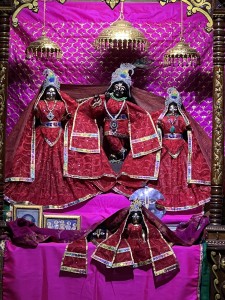
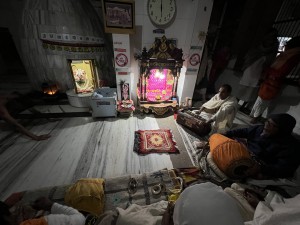
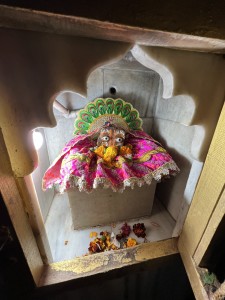
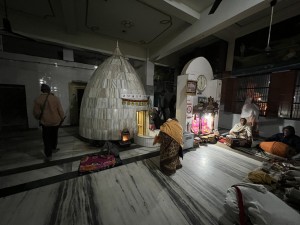
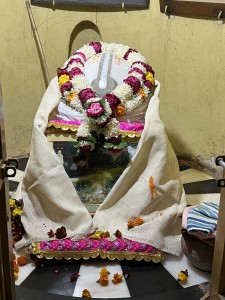
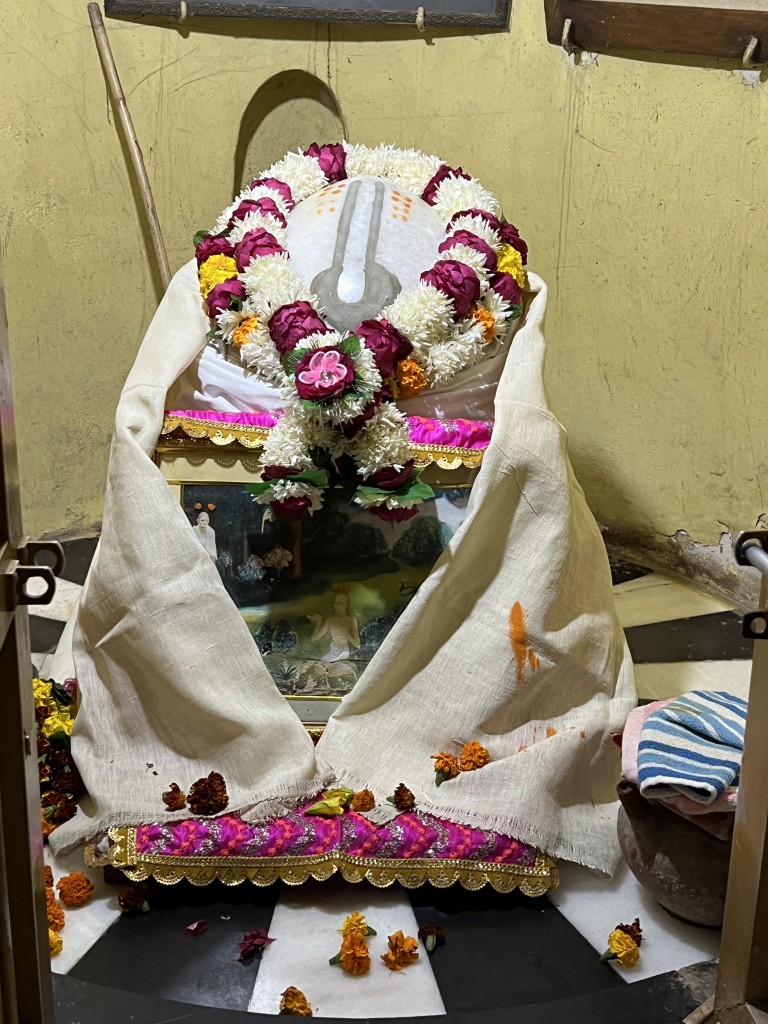
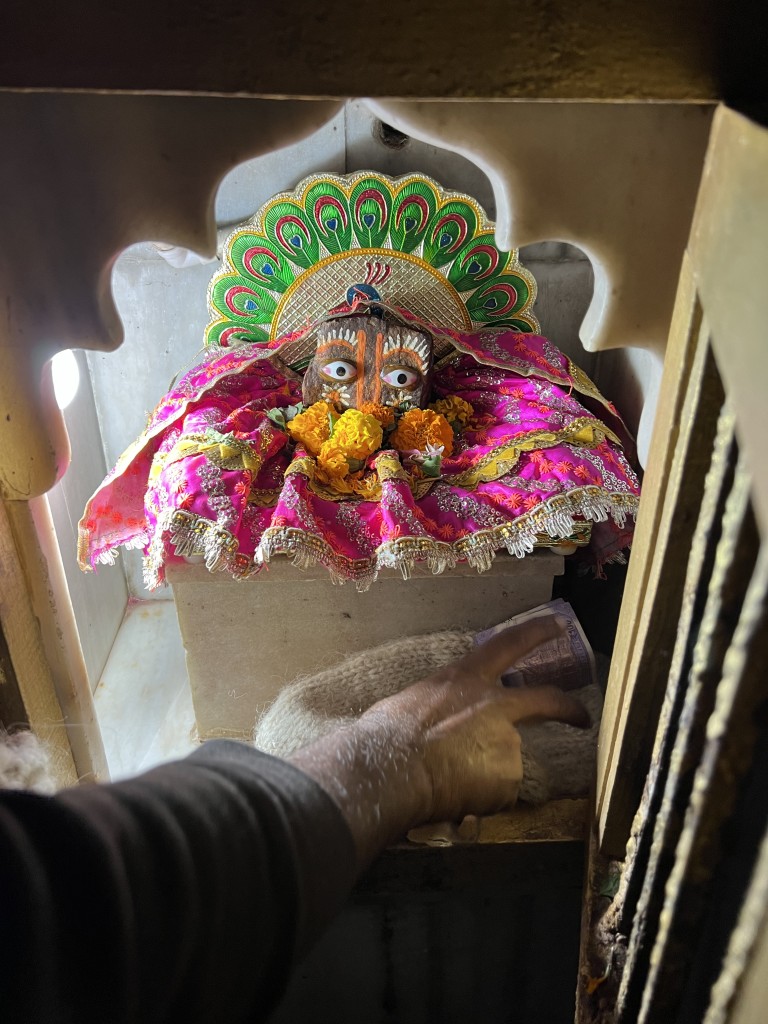
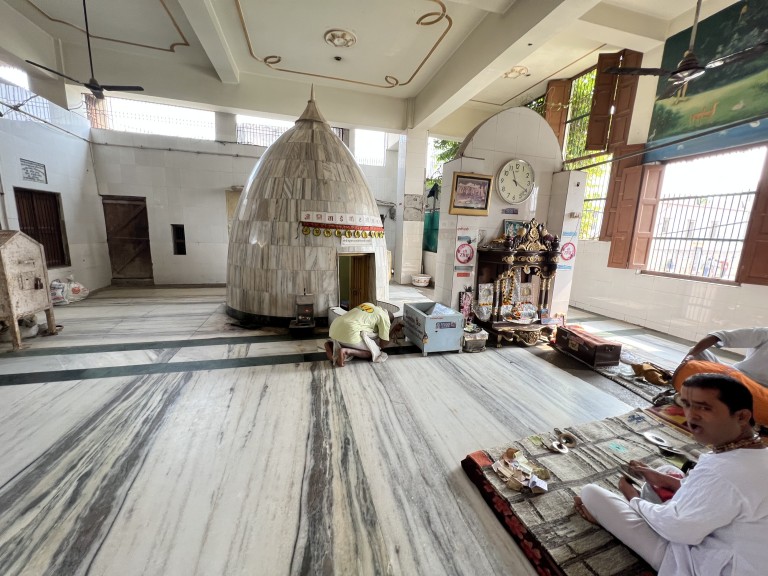
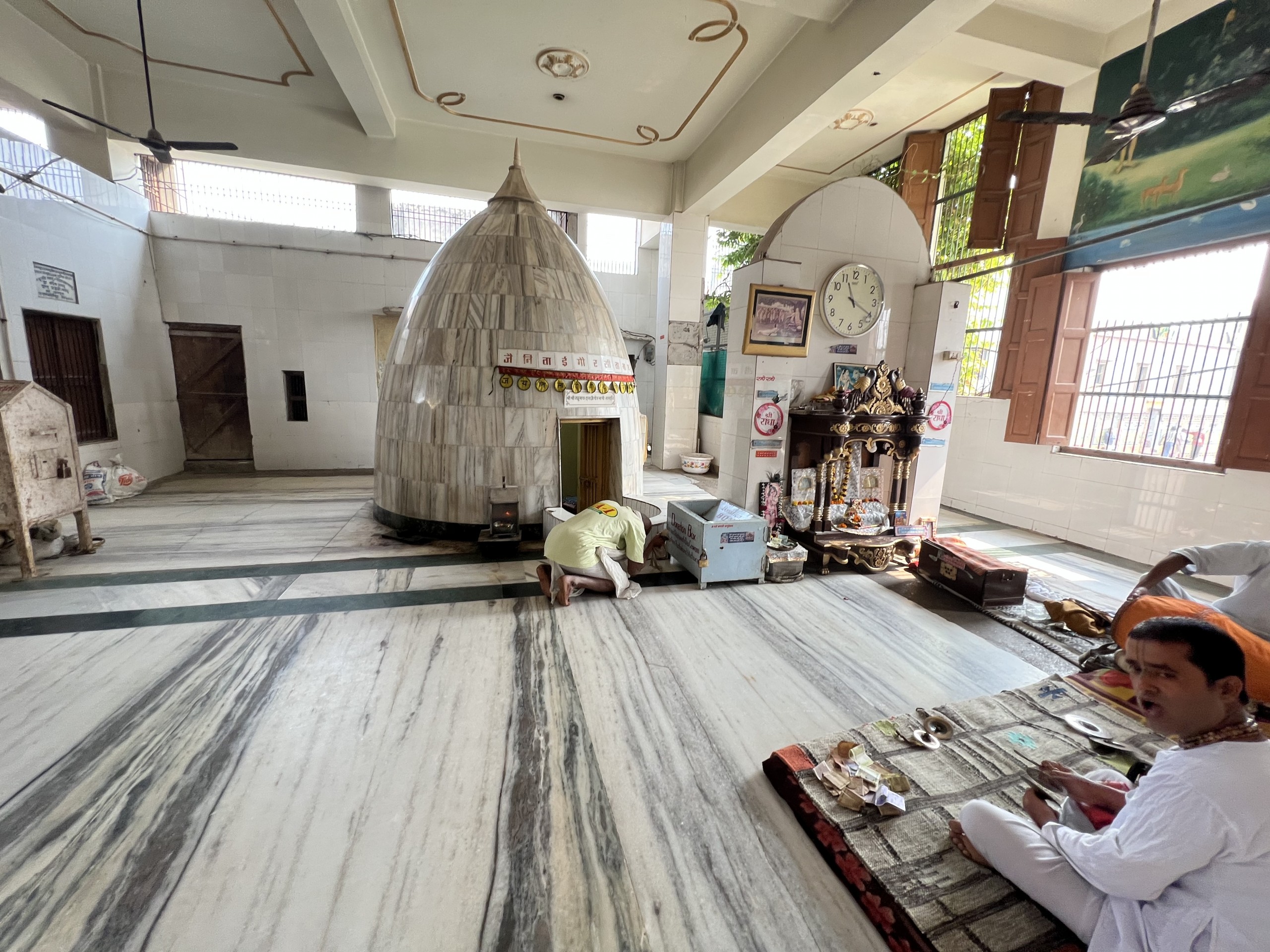
This is the samadhi of Raghunatha Dasa Goswami, one of the most intimate followers of Lord Chaitanya Mahaprabhu, who was affectionately known to all the Gaudiya Vaishnavas as Dasa Goswami. He was born in Bengal in 1494, as the son of a very wealthy landowner, but after hearing about the glories of Lord Chaitanya Mahaprabhu, his only desire was to surrender before Lord Chaitanya and serve His lotus feet. In order to keep him at home, his father got him married at an early age and also arranged for guards to watch over him. Nevertheless, Raghunatha had absolutely no interest in worldly affairs and made a number of abortive attempts to run away from home in the hope of joining Lord Chaitanya in Jagannatha Puri. While still living at his father’s house, he had the great fortune to meet Lord Nityananda, who ordered him to utilize his father’s wealth and organize a great public feast at Panihati, where he was asked by the Lord to distribute many different varieties of chira-dahi, a preparation of yogurt, sugar, and flat-rice, mixed with various fruits, which was one of Lord Nityananda’s favorite dishes. Thousands attended the feast and Lord Nityananda was so happy that he placed His lotus feet on Raghunatha’s head and blessed him that he would soon achieve the association of Lord Chaitanya. The famous ‘Chira-dahi Mahotsava’ of Raghunatha Dasa is still being celebrated every year at Panihati in West Bengal. At the age of nineteen, Raghunatha finally managed to escape after eluding his guards and was able to reach Jagannatha Puri where he surrendered before Lord Chaitanya. The Lord placed him under the care of His personal secretary Swarupa Damodara Goswami, who expertly trained Raghunatha in all aspects of Gaudiya Vaishnava philosophy, culture and tradition.
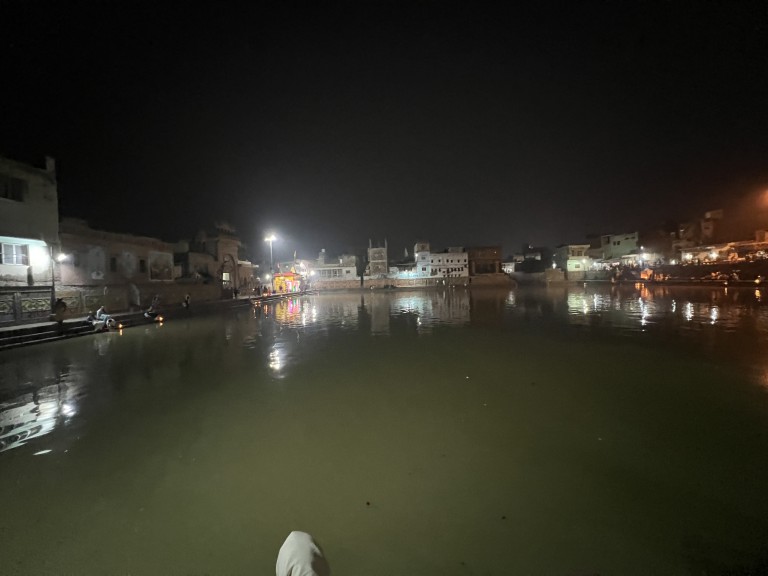
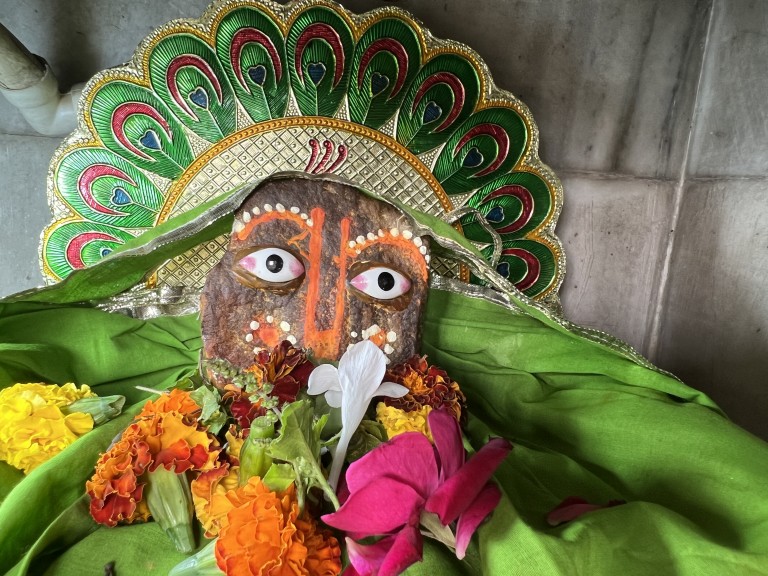
Raghunatha Dasa remained at Jagannatha Puri serving Lord Chaitanya until the Lord’s disappearance in 1534. After the Lord’s departure from the world, Raghunatha Dasa went to Vrindavana to take shelter of Rupa and Sanatana Goswami, who immediately accepted him as their younger brother. Raghunatha was in such a distraught condition due to the loss of Lord Chaitanya’s association, he was even contemplating suicide, by throwing himself from the top of Govardhana Hill. Rupa and Sanatana tried to console him, and because he had received a small Govardhana-shila and a set of beads known as gunja-mala, especially favored by Radharani, as a gift from Lord Chaitanya, Rupa and Sanatana suggested that he should take shelter of Govardhana Hill by performing parikrama every day and live at Radha-kunda, where he could render service to the sacred kunda so dear to Radha’s heart.
Raghunatha Dasa remained at Radha-kunda for the rest of his life and became renowned amongst Lord Chaitanya’s followers as the embodiment of renunciation. Raghunatha would chant at least one-hundred thousand holy names of Krishna on his japa beads every day and would not sleep more than one or two hours. Raghunatha ate only enough to keep body and mind together and it is said that his observance of the regulative principles was so strict and unwavering, that it appeared that his regulative principles were etched in stone; as such lines can never be erased. It is said that after the disappearance of Lord Chaitanya, Raghunatha, experienced such acute separation that he stopped eating solid food, taking only fruit and milk. After the disappearance of Sanatana Goswami, his mood of separation increased and he took only a leaf-cup of buttermilk daily. But after the disappearance of Rupa Goswami, he gave up eating altogether.
Practically speaking Raghunatha Dasa, towards the end of his life, was so absorbed in pure Krishna consciousness, that he lost awareness of the material world and his external physical covering. He remained completely absorbed in the consciousness of being a manjari serving at the lotus feet of Radharani. To illustrate his total absorption in gopi-bhava, there is a very well-known story about his rejecting a gift of buttermilk because it was connected to Chandravali, Radharani’s main rival for the love and affection of Krishna.
The Bhakti-ratnakara says, “Raghunatha dasa Gosvami had special affection for one Vrajavasi named Dasa. One day this Dasa went to Sakhisthali village and got a large leaf of a palsha tree. He was thinking how Dasa Gosvami would not eat grains due to intense feelings of separation. Because Raghunatha’s practice was to take only one leaf cup of buttermilk in a day, Dasa thought that with a bigger cup he would then have a little more. Considering this, Dasa went to his home, made a cup from this leaf, and brought the buttermilk to Raghunatha.”
The Vrajavasi named Dasa arrived at Radha-kunda and presented a leaf-cup of fresh buttermilk to Raghunatha Dasa Goswami. As Raghunatha held the leaf-cup in his hand, he suddenly noticed it was much larger than any of the regular leaf-cups he had seen. Feeling somewhat suspicious about the gift-bearing devotee, he asked from where this very large leafcup had come. When the devotee replied that the leaf-cup was from a village named Sakhisthali, which was the village of Chandravali, in a sudden fit of jealous anger, Raghunath threw the leafcup far away, saying that he would have nothing to do with Chandravali, her village, or any of her sakhis. The devotee Dasa immediately went away in great awe of Raghunatha, feeling extremely blessed to have witnessed Raghunatha’s intense mood of love and pure unadulterated devotion towards Radharani.
Another wonderful story is revealed in the Bhakti-ratnakara. “One time Rupa Gosvami had given his book Lalita-Madhava to Raghunatha. This book describes the intense feelings of love in separation. After reading the book, Raghunatha cried day and night in agitation and became mad in distress. Sometimes he went far off to stay, leaving the book, and sometimes he fell to the ground keeping the book to his chest. People who saw the various states of Raghunatha’s ecstasy as he lost consciousness became worried and struck with wonder. Thinking of a cure for Raghunatha’s condition, Rupa Gosvami quickly finished writing Dana-keli-kaumudi. Shri Rupa then gave Raghunatha the new book and requested him to taste its Contents and return Lalita-Madhava for editing. Although Raghunatha was reluctant to give up Lalita-Madhava, when he heard that Rupa wanted to edit it, he relented. Taking and reading Dana-keli-kaumudi, he tasted different ecstasies and thus merged in an ocean of happiness. Oh Shrinivasa, what can I say about the activities of Sanatana, Rupa and Raghunatha.”
The book Lalita-madhava describes the various mellows, ecstasies and emotions of devotional service and the pastimes of Radha and Krishna. It was written as a drama by Srila Rupa Gosvami which was completed in the year 1459. The subject matter deals in part with the maddened ecstasies of Srimati Radharani, with Radharani’s proceeding toward Krsna, the achievement of Candravali and Lalita and the meeting between Krishna and the gopis in Nava-Vrindavana near Dwaraka. On the other hand the book Dana-keli-kaumudi, also written in the form of a drama describes the ecstatic tax-collection pastimes between Krishna and the gopis, which is full of playful intrigue and transcendental humor.
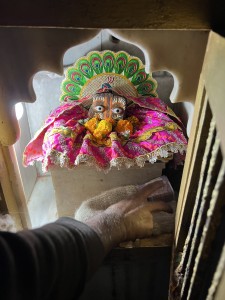
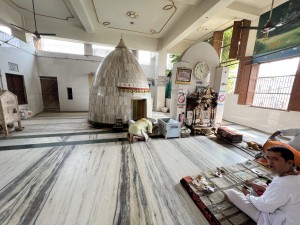
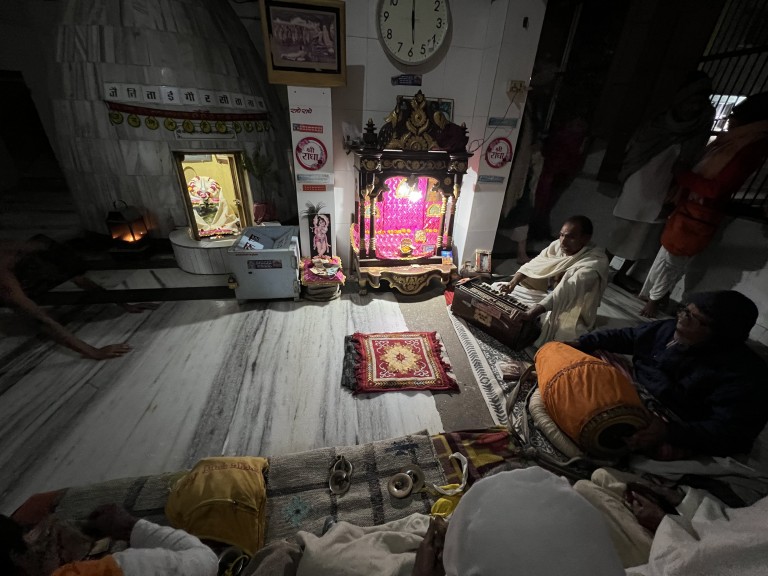
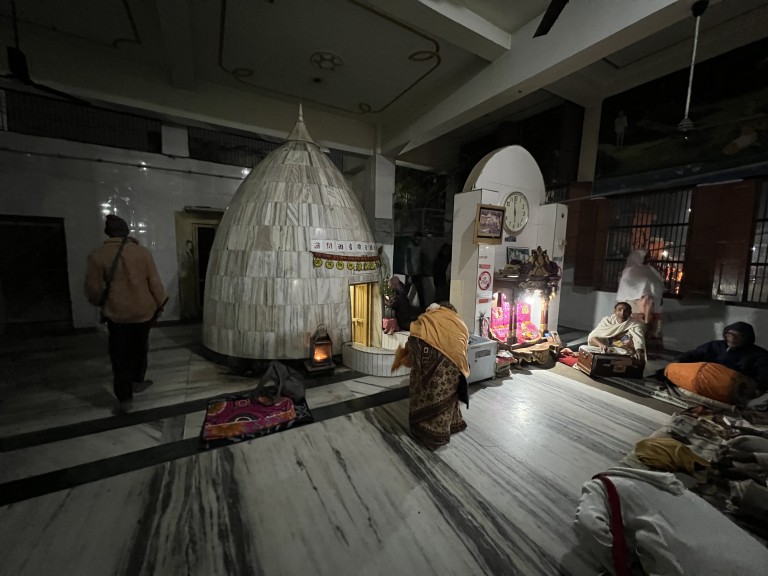
After having spent more than forty years performing bhajana at Radha-kunda, in the year 1583, Raghunatha Dasa Goswami finally disappeared from the vision of the world. His samadhi was erected at the place on the banks of Radha-kunda where he would sit every day to chant the holy names of the Lord on his japa beads. According to the Gaura-ganoddesha-dipika, Raghunatha Dasa Goswami is Rati Manjari in Krishna’s Vrindavana pastimes. (Some say he was Rasa Manjari).
Photo (12)