Description

Bhaktivedanta Narayana Gosvami
From the book “Sri Vraja-maṇḍala-parikramā”:
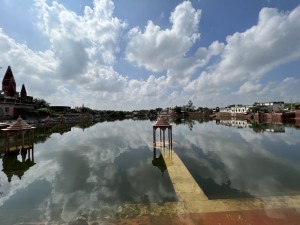
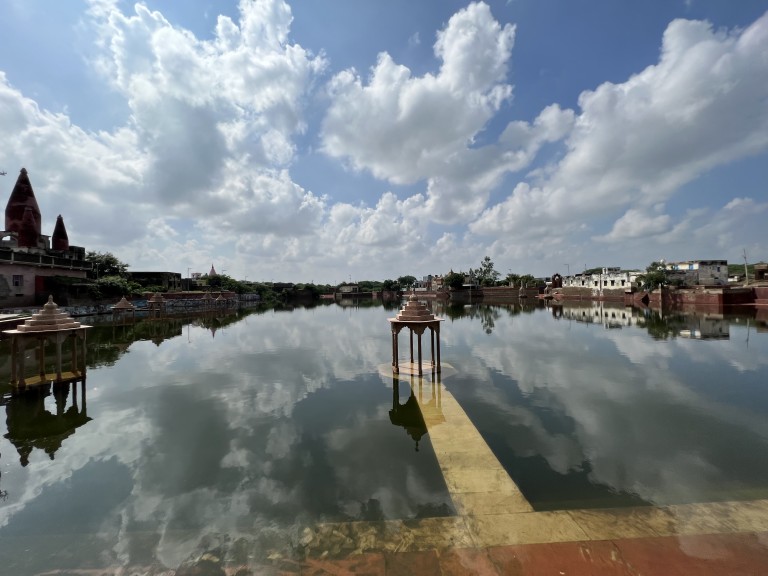
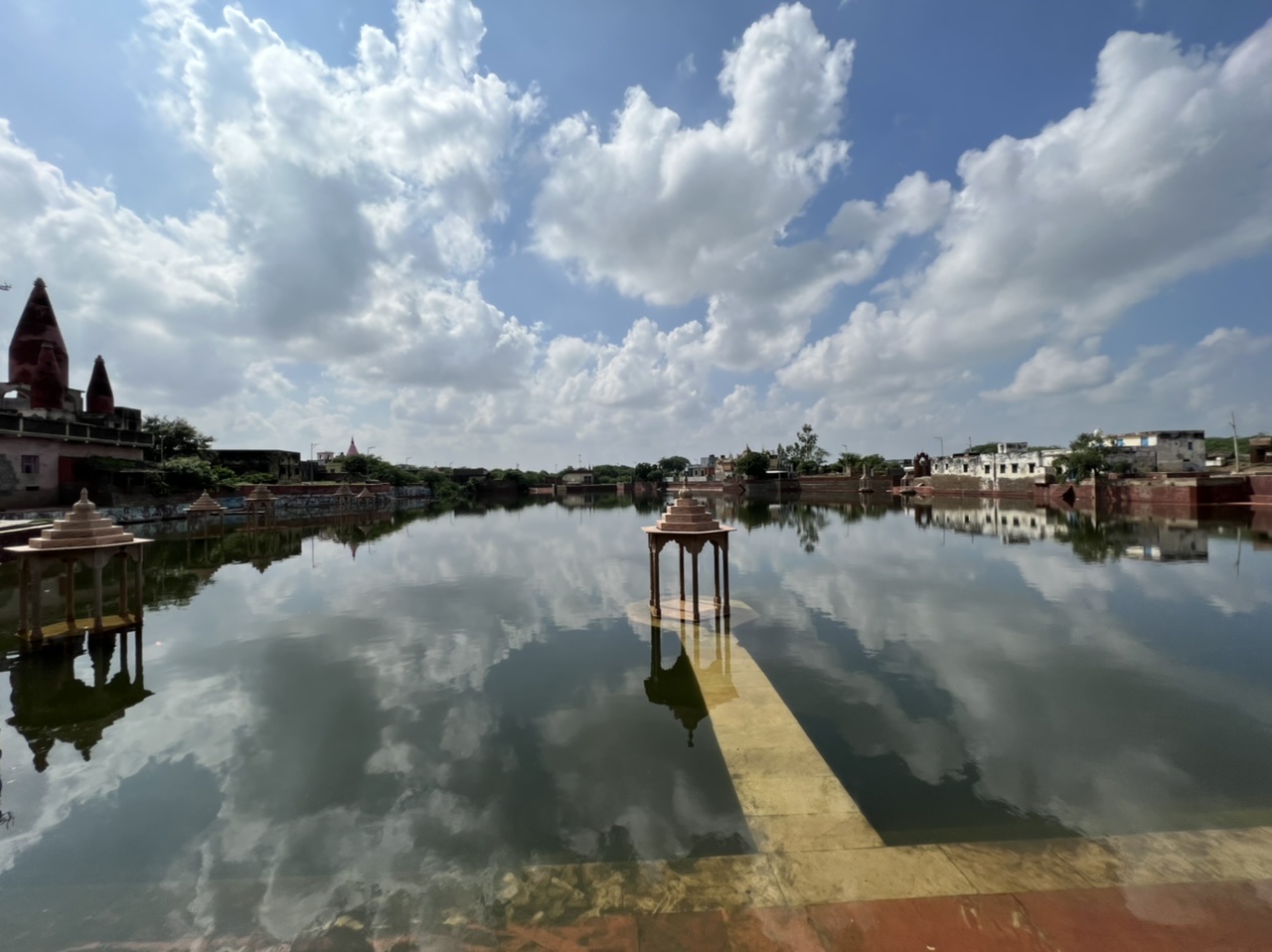
This sarovara, or lake, lies north of Nandagaon when coming down from Nandīśvara Hill, and is situated on the side of the highway that leads towards Kāmyavana. The custom is to bathe in this lake before taking darśana of Nanda, Yaśodā and the others on the crest of the hill. It is said that Pāvana Gopa, the father of Viśākhā Sakhī, constructed this sarovara, thereby giving it its name. When Kṛṣṇa and His friends would return from cow grazing, they would bring the cows here to drink. At that time, Kṛṣṇa would call out “Nīrī-nīrī” and signal to the cows to enter the sarovara. He would then call out “Cūṅ-cūṅ” to induce the cows to drink water, and “Tīrī-tīrī” to call them back to the bank. The boys would satisfy the cows by having them drink water in this way before returning them to their resting place in the cowshed. The boys would then go back to their respective homes.
The Vrajavāsīs would also bathe in the fragrant and pure water of Pāvana-sarovara. Kṛṣṇa used to bathe here and frolic in the water with His friends. On the far bank, Śrīmatī Rādhikā used to bathe and play in the water with Her sakhīs. Sometimes Kṛṣṇa would dive in from His bank like a crocodile, make His way unseen to the bank of the sakhīs, and catch their feet. In this way, He played with them. Mahārāja Vṛṣabhānu had a beautiful palace built for his daughter Śrīmatī Rādhikā on the northern bank of Pāvana-sarovara. She played many games with Her sakhīs in this palace, from which She could very easily have darśana of Her beloved Śrī Kṛṣṇa.
Rajashekhara Dasa
From the book “Chaurasi-kosa Vraja Mandala Parikrama”:
This is the most celebrated lake in Nandagrama and it is customary to first bathe here before going to have darshana of Krishna and Balarama at Nanda Bhavana. Lord Chaitanya also bathed here before He climbed the Nandishwara Parvata to search for the Deities of Nanda, Yashoda Mayi and Krishna, that were laying hidden inside a cave on the hill-top. In the Bhakti-ratnakara it says, “O Shrinivasa, anyone who bathes in Pavana-sarovara and sees the Deities of Krishna, Balarama, Nanda and Yasoda, on Nandishwara Hill attains all his desires at that very moment.”
When Krishna returns in the evening with all the cows from the pasturing grounds, He first brings them to Pavana-sarovara so they can drink the cool and refreshing water of this lake. In the Vraja-vilasa-stava it says, “On the pretext of fetching clear water, the lotus eyed gopis repeatedly go there to meet with King Nanda’s son on the shores of Pavana-sarovara, which is surrounded by many kadamba trees accompanied by the pleasant humming sound of intoxicated bees. May that lake known as Pavana-sarovara protect us.” This lake is one of Krishna’s favorite places and He enjoys many wonderful water sports here known as ‘jala-krida’ as well as other pastimes with the sakhis and sakas. The word ‘jala’ means ‘water’ and ‘krida’ means to ‘play’ or to ‘sport’.
Yashoda Mayi would often bathe Krishna at Pavana Sarovara in the morning and Radharani would also come from Yavata and cook Krishna’s breakfast on the banks of the sarovara. Mother Yashoda always asked Radharani to cook because of the benediction She received from Durvasa Muni, that anyone who ate Her cooking would never get sick and would also achieve a long life. Therefore, Yasoda Mayi engaged Radharani in cooking for Krishna every morning along with Balarama’s mother Rohini. Radharani also cooked for Krishna at Her own home in Yavata and would send this home-cooked food with Her maidservants to Nanda Bhavana. On the banks of Pavana-sarovara there was a beautiful grove of kadamba trees known as Kadamba-kanana or kadamba-khandi where Krishna and Balarama and Their friends used to rest under in the shade of the sweet smelling kadamba trees. On one occasion, taking the opportunity to offer service to His elder brother, Krishna began gently massaging Balarama’s lotus feet as He relaxed beneath in the shade while some of the cowherd began to fan Him with leaves from the trees.
The word ‘pavana’ means ‘purifying’ as well as ‘merciful’, and Pavana-sarovara, due to its supreme sanctity, does all of these things. One day, Nanda Maharaja was planning a pilgrimage to Prayag for bathing in the confluence of the Ganga, Yamuna, and Saraswati, known as the Triveni Sangama. Not wanting His father to leave Vrindavana, Krishna requested him to spend one more day in Vrindavana and instead go the next day as it would be akshaya-tritiya, and an auspicious day for pilgrimage. Waking early the next morning, Nanda came to Pavana-sarovara to take his bath after which he was planning to leave for Prayag. When he reached the lake he saw a very black complexioned stranger of large build taking a ritual bath in Pavana-sarovara. Not having seen the dark complexioned stranger at Nandagrama before, Nanda Baba enquired from him his name, to which the stranger replied that his name was Prayag Raja. Still confused about the stranger and not knowing anyone from Nandagrama by that name, Nanda asked him from which place he had come. Prayag Raja explained that he was the king of ‘tirthas’ and was from Prayag, which was situated at the confluences of the Ganga, Yamuna, and Saraswati. He further explained that because all the pilgrims went to Prayag to wash off their sins, he himself was forced to come to Pavana-sarovara to bathe and cleanse himself of all those sins that had been left behind by the pilgrims.
Astonished at what he had just heard, Nanda Baba was completely taken-aback. Prayag Raja then informed Nanda, that because this day was akshaya-tritiya, all the holy places of Bharata-varsha would assemble at Pavana-sarovara to wash of the sins left behind by pilgrims at their respective tirthas. Looking around the banks of Pavana-sarovara, Nanda suddenly noticed so many beautiful looking ladies with blackish complexions coming down to the banks of the lake to take a ritual bath. He then realized that they were the holy rivers like the Ganga, Yamuna, Saraswati, Gandaki, Gomati, Godavari, Tapti and Kaveri, who were also accompanied by so many other tirthas. Nanda Maharaja was struck with wonder at what he had just seen and heard. Nanda thus decided that there was little value in going to Prayag to take a holy bath, as Prayag Tirtharaja himself was coming to Pavana-sarovara to take his own purifying bath. Nanda Maharaja very humbly returned to his palace full of praise for Pavana-sarovara.
Although Pavana-sarovara eternally exists in Goloka Vrindavana, some say that after this incident the sarovara received the name ‘Pavana’ or purifying. Some commentators say that this sarovara was created for Krishna’s pleasure by Vishakha’s father whose name was Pavana Gopa and was thus named after him. Others say that Pavana-sarovara, which is born from a natural spring, was enlarged by Pavana Gopa for the benefit of the Vrajavasis and also a place where large herds of cows could drink water.
Photo (1)