Description

Bhaktivedanta Narayana Gosvami
From the book “Sri Vraja-maṇḍala-parikramā”:
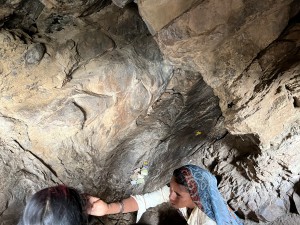
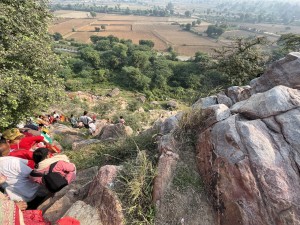
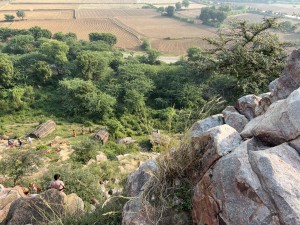
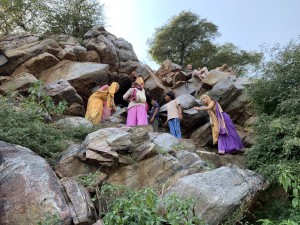
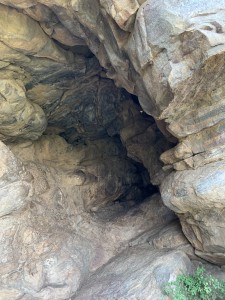
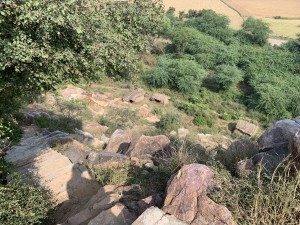
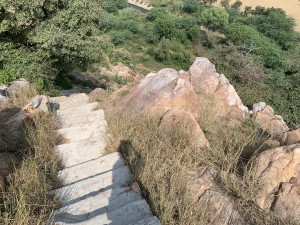
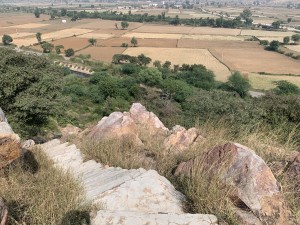
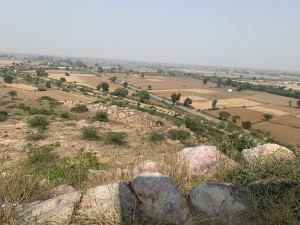
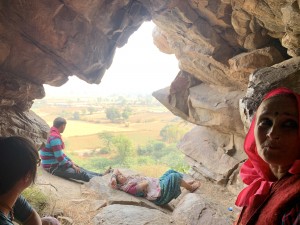
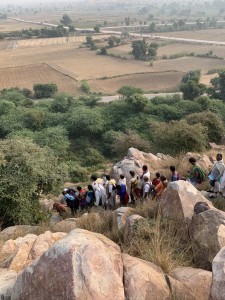
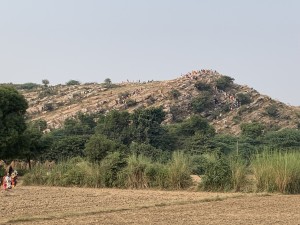
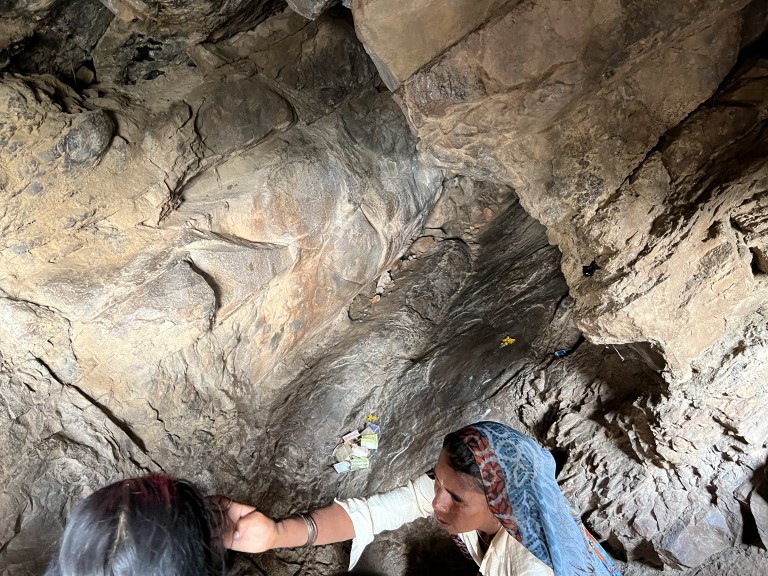
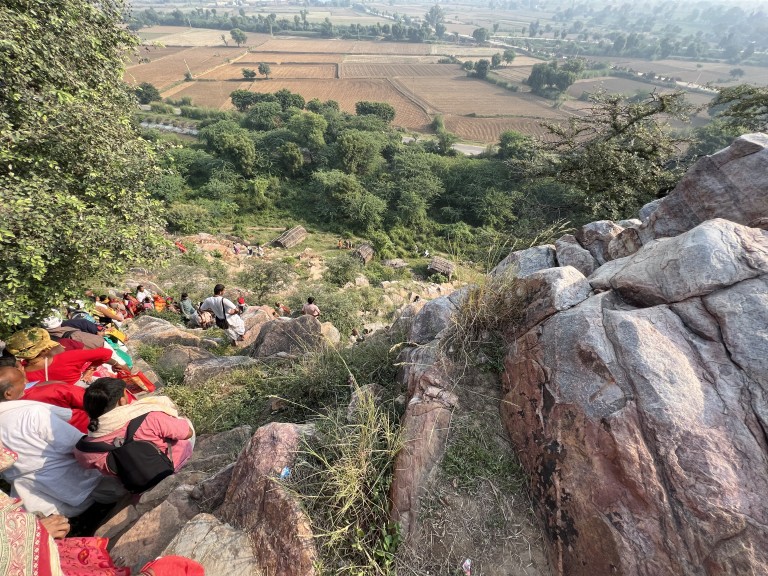
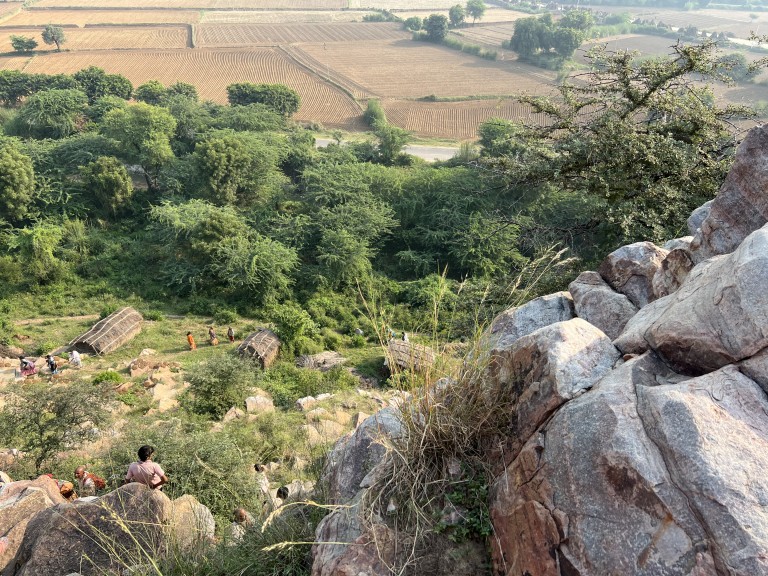
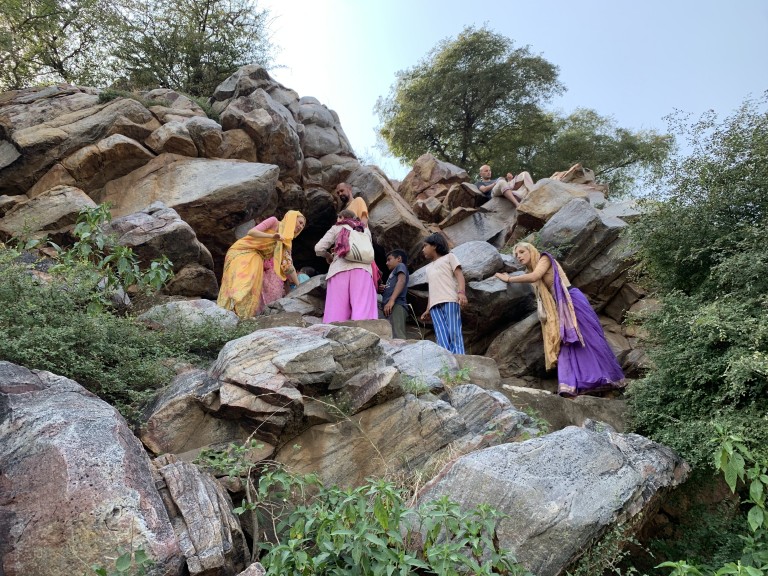
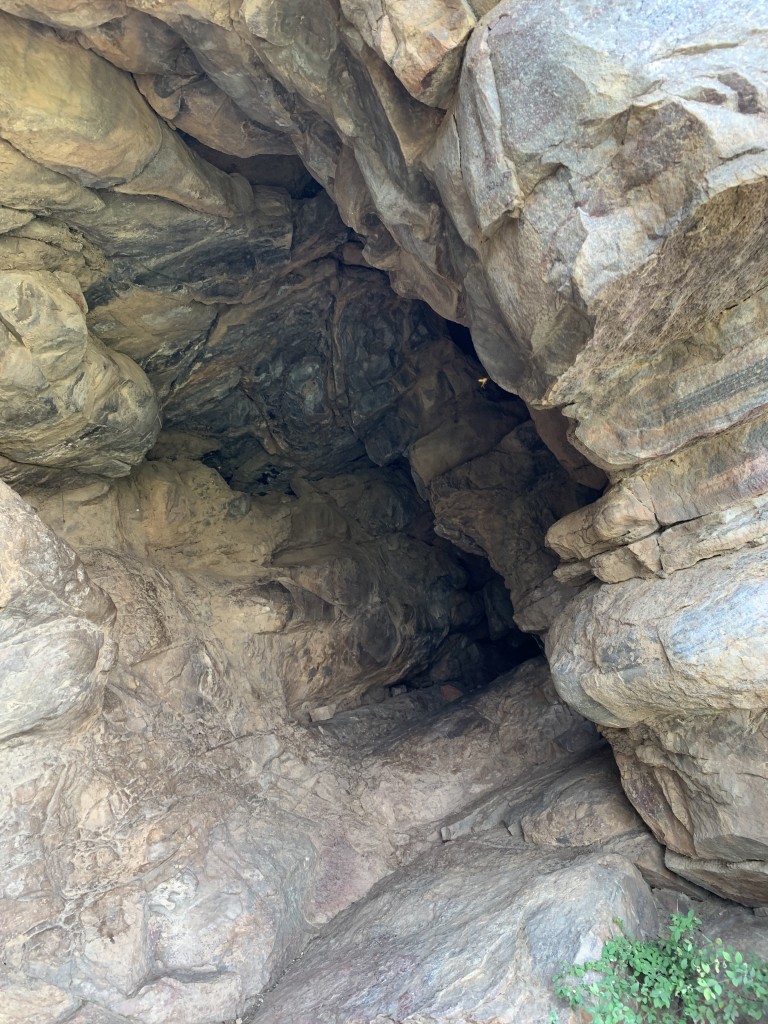
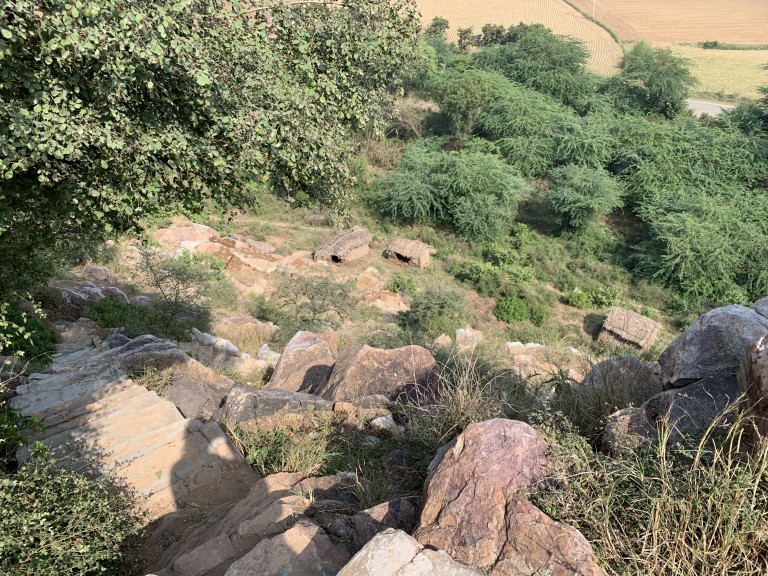
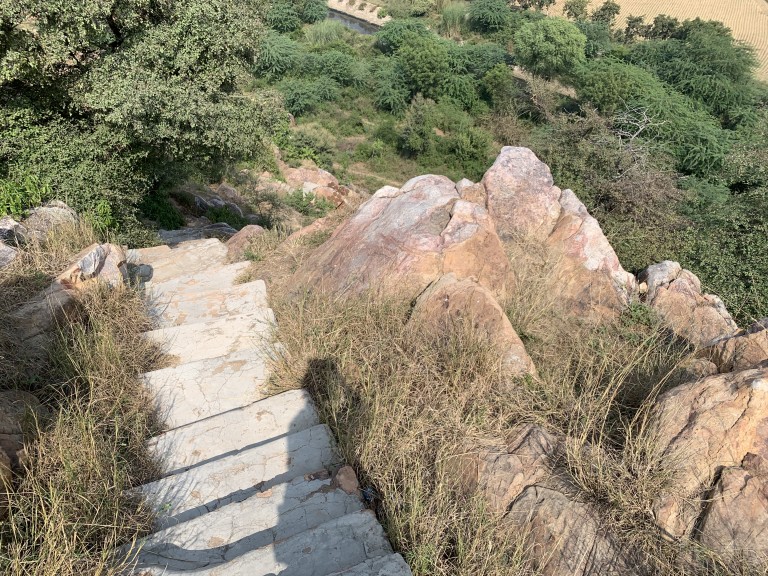
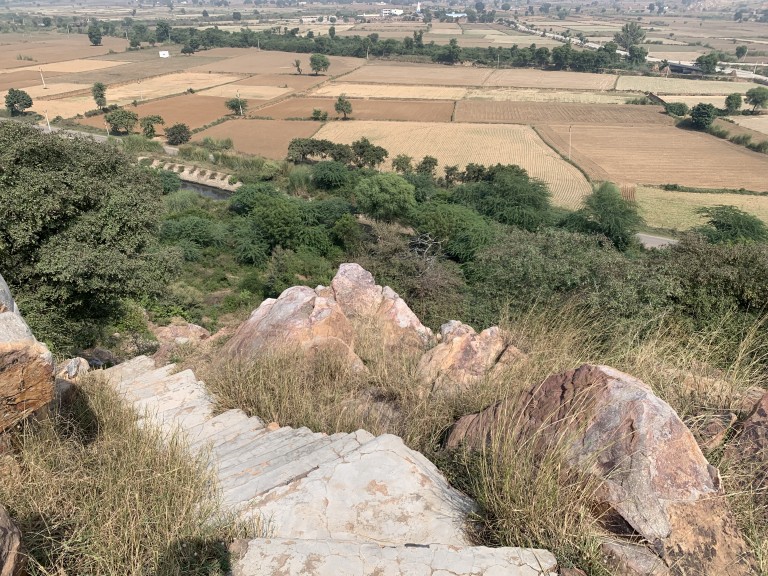
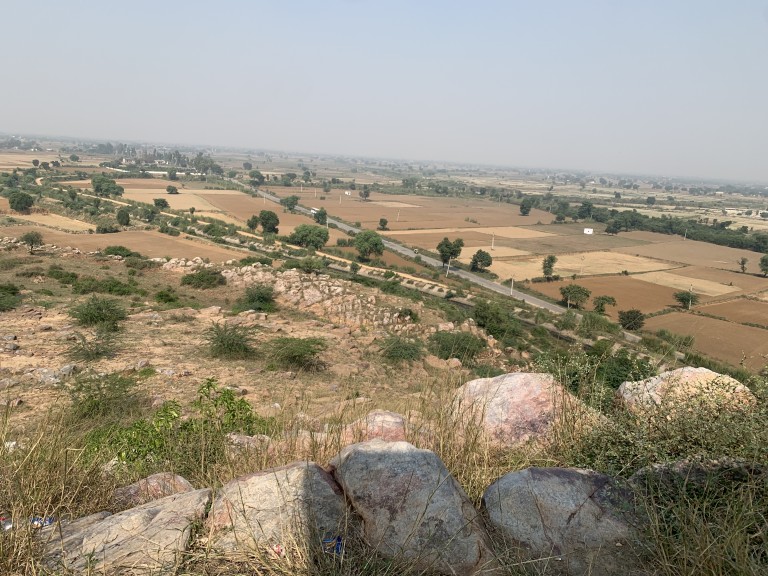
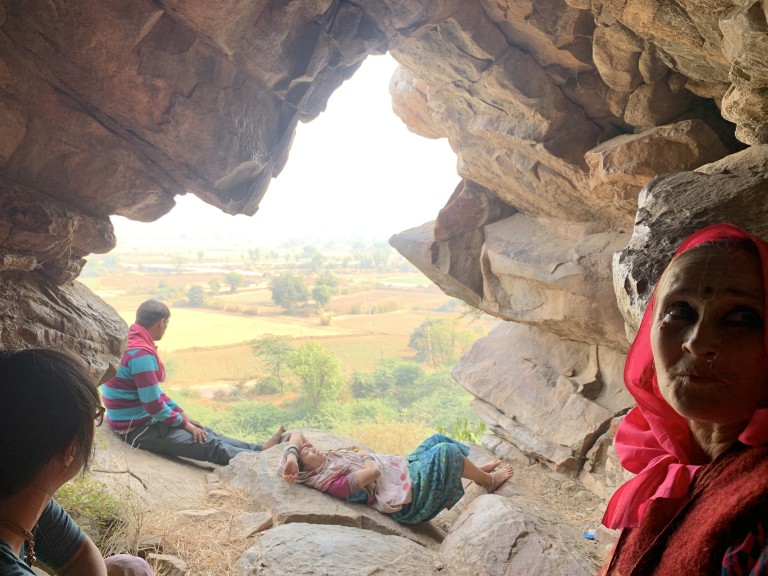
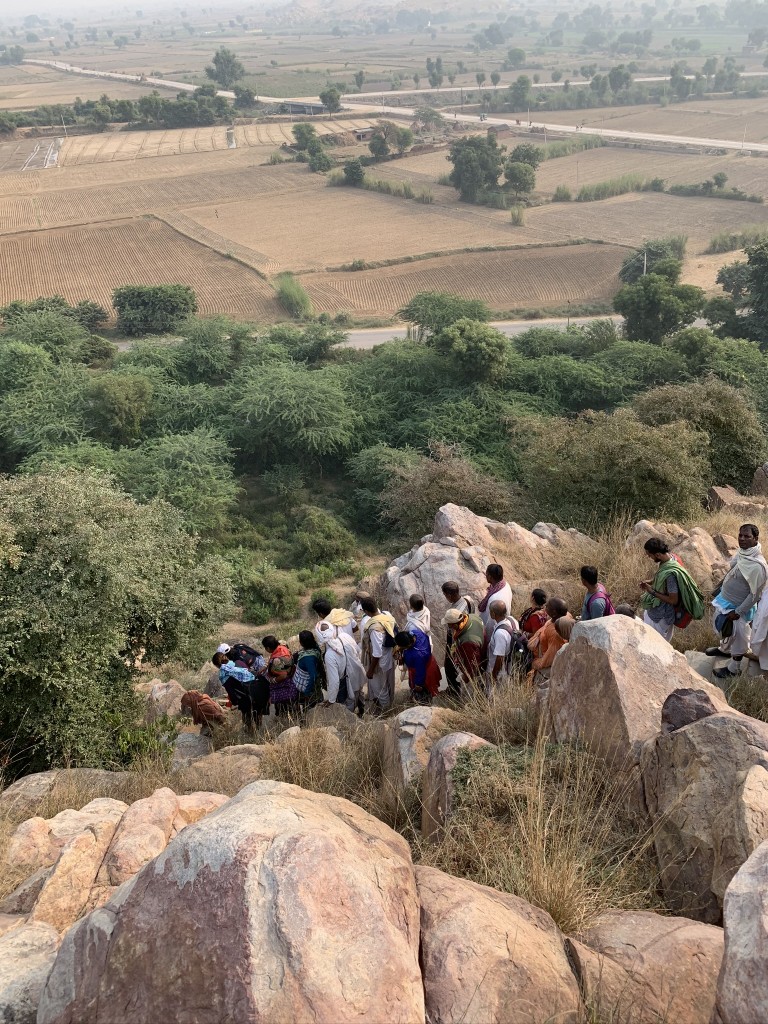
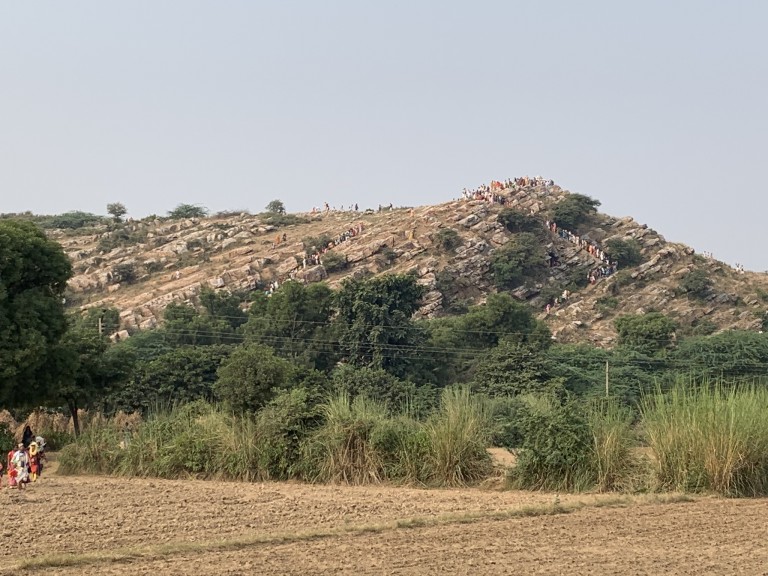
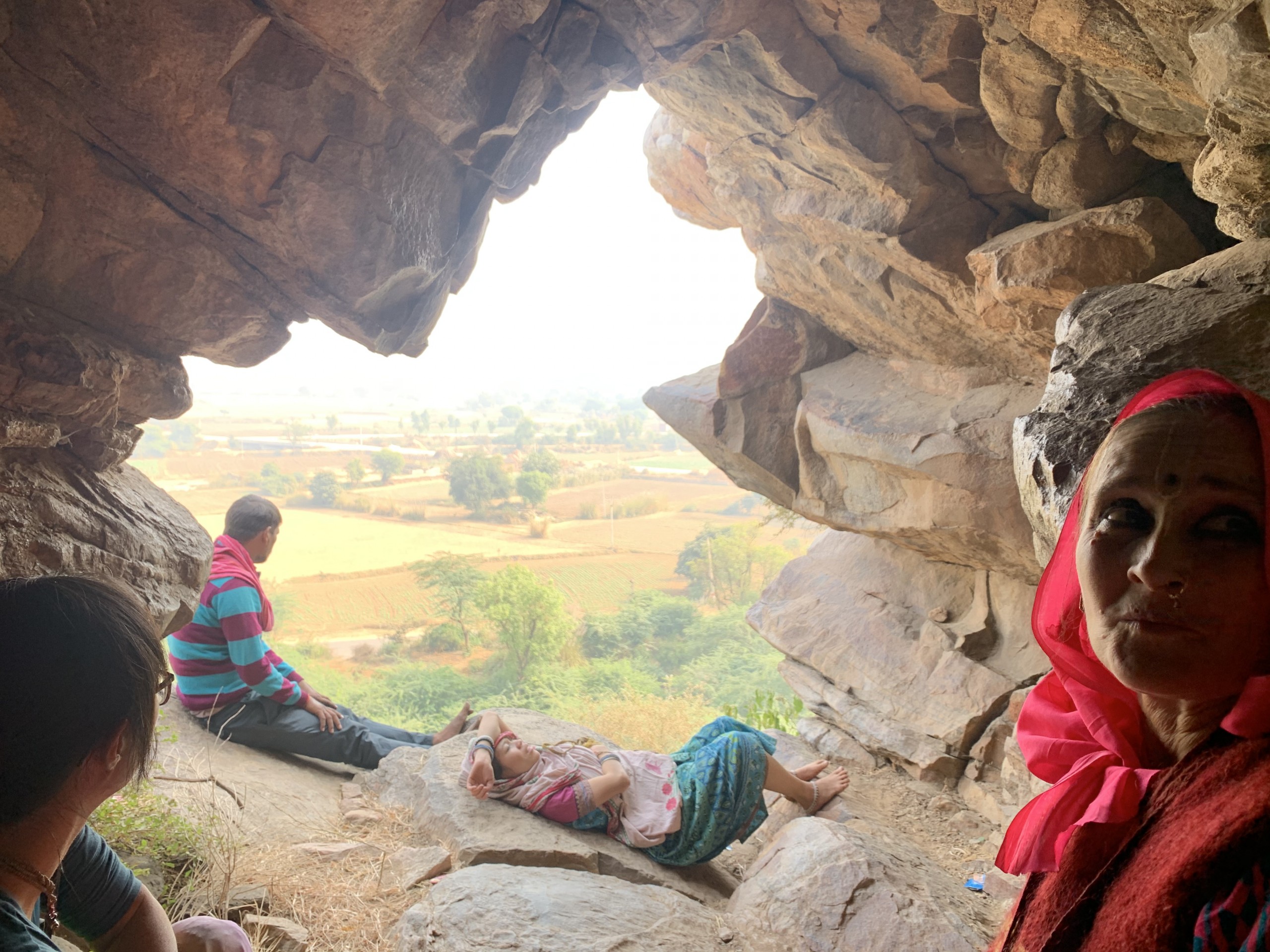
Nearby the slide, in the middle of the hill is the cave of Vyomāsura. Kṛṣṇa killed Vyomāsura here. This cave is also referred to as Medhāvī Muni’s cave because Medhāvī Muni worshipped Kṛṣṇa here.
The footprint of Śrī Baladeva Prabhu lies nearby, at the foot of the hill. When Śrī Kṛṣṇa was killing Vyomāsura, the earth began to tremble. Baladeva pressed down on the earth with His foot and thus stabilised it. His footprint can still be seen today.
Once, Kṛṣṇa came to this place while grazing His cows. The forest was filled with green grass, which the cows happily ate. Without any care, Śrī Kṛṣṇa and the sakhās began to play a game of “cops and robbers”. Many of the sakhās pretended to be sheep while others pretended to be their keepers. Still others took on the role of thieves and stole the sheep. Kṛṣṇa played the judge. The owners of the sheep filed a lawsuit with the judge against the thieves. Śrī Kṛṣṇa called both parties before Him and proceeded to consider the case. All the cowherd boys were thus deeply absorbed in their play.
Intending to kill Kṛṣṇa, Vyomāsura, one of Kaṁsa’s spies, entered the group disguised as a sakhā and became one of the thieves. He stole all the sakhās who were playing the part of sheep and hid them in this cave. Śrī Kṛṣṇa looked around and wondered, “Where have all our sakhās gone?” Recognising Vyomāsura as a demon in disguise, He understood that this was his work. He therefore caught him and killed him. Kṛṣṇa and the sakhās who were playing the sheep’s owners then released the other sakhās from the cave in the hill. This pastime has been described in the Tenth Canto of Śrīmad-Bhāgavatam.
Rajashekhara Dasa
From the book “Chaurasi-kosa Vraja Mandala Parikrama”:
The Bhakti-ratnakara says, “Chaursyakhela is the mountain where Vyomasura hid the cowherd boys and was then killed by Krishna.” Situated on the side of a mountain is the cave or gufa of the demon Vyomasura. Located nearby are Krishna’s lotus handprints and the imprints of His flower garland and Kaustuba necklace. On the opposite side of the road are the lotus footprints of Lord Balarama. The Bhakti-ratnakara mentions that this is the site where Shri Krishna killed the demon Vyomasura. This particular part of the mountain is known as Chaursya-khela Parvata because Krishna and the cowherd boys were playing a game (khela) of cops and robbers and the word ‘chaursya’, or ‘chaur’ means ‘ thief’. Thus the game named ‘chaursya-khela’ means ‘cops and robbers’.
The term ‘vyoma’ refers to a type of demon or asura that by dint of mystic powers can fly in the sky at will. The word ‘vyoma’ means ‘sky’. The demon Vyomasura, in his previous life, had been a king named Bhimaratha who ruled the kingdom of Kashi. He was a devotee of Lord Vishnu and was always performing sacrifices. Eventually he left the kingdom to his son and retired to perform penance on the Malaya Mountain in Southern India. One day the great sage and son of Lord Brahma, Pulastya Muni, arrived at Bhimaratha’s ashrama, but due to his false pride in being a great personality and performer of severe penances, Bhimaratha failed to receive the great sage in the proper manner and neglected to either rise from his seat or offer any respects to such an exalted visitor. Infuriated at the insulting behavior of Bhimaratha, the great sage Pulastya cursed him by saying. “O great rascal, immediately become a demon.”
Within a short time, Bhimaratha left his body and in his next life took birth as Vyomasura, the son of the asura Maya Danava. During the despotic rule of King Kamsa, many great demons were engaged in helping him in consolidating his hold on power and expanding his dominance over other kings. The demon Vyomasura was also one of Kamsa’s supporters and one day he was asked by Kamsa to go to Vrindavana and kill the cowherd boy named Krishna. The Bhagavatam says that on that particular day, Krishna was at Govardhana Hill with His cowherd boyfriends playing a game of ‘cops and robbers’. However, the Gopala-campu of Shrila Jiva Goswami says that Krishna was playing near Kamyavana and not Govardhana. Some boys played the part of police constables, some played the part of thieves, and others played the part of lambs. The game involved the police trying to catch the thieves who were stealing the lambs. Arriving on the scene, Vyomasura, by dint his mystic power, assumed the form of a cowherd boy and played the part of a thief. One by one he began stealing the cowherd boys that were playing the part of lambs, and after carrying them away, hid them in a cave and rolled a big rock in front of the cave entrance to close it. Gradually the demon stole almost all of the cowherd boys playing with Krishna.
Krishna was wondering where all the cowherd boys have gone, as only four or five boys remained playing the game. Contemplating the situation, Krishna then noticed that a very cunning demon was masquerading as one of the cowherd boys. Without any warning Krishna suddenly caught hold of the demon in the same way that a lion catches a lamb. Feeling the strong grip of Krishna and fearing for his life, the demon Vyomasura began to expand his body into a gigantic size and attempted to escape by flying high into the sky. Nevertheless, he could not free himself from Krishna’s powerful grip. A fierce battle then ensued between the demon Vyomasura and Krishna, sometimes they fought on the land and sometimes in the sky. The whole earth began to shake as if an earthquake was about to strike and Balarama had to press His foot down firmly on the ground to keep the earth steady. As the demon flew in the sky, all of a sudden Krishna lost His grip and fell to the earth on all fours, leaving behind the imprints of His hands on the rocks along with His flower garland that fell off. Krishna’s Kaustuba necklace also fell off and landed nearby. In an angry mood, Krishna suddenly reached up into the sky and catching the demon Vyomasura by the arm Krishna pulled him down and slammed him into the ground with such force, that the demon died on the spot. Krishna then released all the cowherd boys from within the cave where they had been hidden.
Regarding the Shrimad-Bhagavatam saying that the cowherd boys were playing at Govardhana Hill, Shrila Jiva Goswami has clarified this point by saying they were playing at Chaursyakhela Parvata. The Vaishnava acharyas are empowered representatives of Vyasadeva and his son Sukadeva Goswami and therefore have the authority and vision to clarify any apparent contradictions. Factually all the mountains in the west of Vraja belong to the mountain range known as the Aravallis, and Govardhana Parvata is recognized as one its major peaks. It could be that at some time in history the entire mountain range was known as Govardhana. The Aravallis are considered amongst the world’s oldest mountains dating from the pre-Cambrian period more than five hundred million years ago. It is also a geological fact that the entire Aravalli mountain range, including Govardhana Hill, is slowly disappearing. Therefore, it can be said that modern science confirms the statements found in the ancient Vedic literatures that Govardhana Hill is slowly sinking into the earth due to the curse of Pulastya Muni.
Photo (12)