Description

Bhaktivedanta Narayana Gosvami
From the book “Sri Vraja-maṇḍala-parikramā”:
This kuṇḍa lies in the eastern part of Kāmyavana. Śrī Nārāyaṇa is present here as dharma. Nearby is a platform (vedī) named Viśākhā-vedī. There is a special rule that one should bathe in this pond on Kṛṣṇāṣṭamī (the eighth day of the dark moon) on a Wednesday in the month of Bhadra during the constellation named Śravaṇā. Within the area of Dharma-kuṇḍa, there are many places one may visit for darśana, such as Nara-Nārāyaṇa-kuṇḍa, Nīla-varāha, Pañca Pāṇḍava, Hanumānjī, Pañca Pāṇḍava-kuṇḍa (Pañca-tīrtha), Maṇikarṇikā and Viśveśvara Mahādeva.
The five Pāṇḍavas resided in this attractive Kāmyavana for a long time during their exile to the forest. Once, Mahārānī Draupadī and the Pāṇḍavas felt very thirsty. It was summer and the nearby ponds and other sources of water had dried up. Water was not available anywhere, not even from distant places. Mahārāja Yudhiṣṭhira gave one empty pot to his valiant brother Bhīmasena and told him to fill it with clean water. The intelligent Bhīma saw that birds were flying to and from a particular place, so he headed in that direction. After some time, he came to a beautiful lake full of clean, fragrant water. Being very thirsty, he thought to quench his own thirst first before carrying water back to his brothers. However, as soon as he stepped in the lake, a Yakṣa appeared before him and said, “Answer my questions before daring to drink water, otherwise you will die.” Ignoring the order of the Yakṣa, the great and valiant Bhīmasena filled his palms with some water, but upon doing so he immediately fainted to the ground.
Noting Bhīmasena’s delay in returning, Mahārāja Yudhiṣṭhira sent his brothers one by one to go and fetch water – first Arjuna, then Nakula and then Sahadeva. Upon reaching the lake, however, they all met the same fate as Bhīma, having attempted to drink water without following the Yakṣa’s command. Finally, Mahārāja Yudhiṣṭhira went himself and found his brothers all lying on the ground unconscious. He became very worried. He decided to quench his thirst before trying to revive them, but as soon as he went to do so, the Yakṣa appeared and told Mahārāja Yudhiṣṭhira that he had to correctly answer his questions before he could drink any water. Mahārāja Yudhiṣṭhira patiently requested the Yakṣa to ask his questions.
Yakṣa: Who causes the sun to rise?
Yudhiṣṭhira: The Supreme Lord causes the sun to rise.
Yakṣa: What is weightier than the earth itself? What is higher than even the sky? What travels faster than the wind? And what is greater in number than blades of grass?
Yudhiṣṭhira: One’s mother is heavier than the earth. One’s father is higher than the sky. The mind is swifter than air, and the thoughts that spring from the mind are more numerous than blades of grass.
Yakṣa: Which is the best dharma in the world? What is the best kind of forbearance?
Yudhiṣṭhira: The best dharma in the world is mercy. To tolerate the dualities of this world – like pleasure and sorrow, profit and loss, and birth and death – is the best kind of forbearance.
Yakṣa: Who is the invincible enemy of human beings? What is their endless disease? Who is a saintly person, and who is not a saintly person?
Yudhiṣṭhira: Anger is the invincible enemy of human beings. Greed is their endless disease. One who does good to all living entities is a saintly person, and a cruel person who has no control over his senses is not a saintly person.
Yakṣa: Who is happy? What is the greatest wonder? What is life’s real path? What is newsworthy?
Yudhiṣṭhira: He who has no debt, he who is not in a foreign land, and he who is able to eat simply is happy. Every day, living beings make their way to the abode of Yamārāja, the god of death, but those who are left behind think they will live forever. There is no greater wonder than this. Argument has no place in determining the correct path. The Śrutis are diverse, and the opinions of the sages divided. The truth of dharma is thus very deep. Therefore, the path that is followed by great personalities is the real path. Time is cooking all living beings in the frying pan of illusion and allurement, which represents this material world. It shuffles them with the ladle of months and seasons, and cooks them in the fire of the sun, which burns up the fuel of day and night. This is the only news in this world.
Yakṣa: O King, you have answered all my questions correctly. You may therefore select any one of your brothers and he will return to life.
Yudhiṣṭhira: Among all my brothers, let dark-complexioned and very powerful Nakula return to life.
Yakṣa: King, why do you want Nakula to be brought back to life? Why not Bhīma, who has the strength of ten thousand elephants, or the invincible archer Arjuna?
Yudhiṣṭhira: I cannot give up virtue. I am of the opinion that the supreme virtue is to have equal feelings for everyone. My father had two wives, Kuntī and Mādrī. In my opinion, both of them should have sons. Kuntī and Mādrī mean the same to me. I want to preserve this equality; therefore, Nakula should return to life.
Yakṣa: O topmost devotee, you have more respect for virtue than for time and wealth. Therefore, all your brothers should live again.
That Yakṣa was none other than Dharmarāja (Śrī Nārāyaṇa) Himself, who had desired to test the dharma of his son Yudhiṣṭhira. Mahārāja Yudhiṣṭhira passed the examination.
One day, when the Pāṇḍavas and Draupadī were living here during their exile, Mahārānī Draupadī went alone to take bath in Vimala-kuṇḍa. Meanwhile, the Pāṇḍavas were at their residence, free of anxieties and deeply absorbed in narrations about the Supreme Lord. Jayadratha, the brother-in-law of both Duryodhana and the Pāṇḍavas, was attracted to Draupadī. He was waiting for an opportunity to find Draupadī alone so he could kidnap her easily. In this way, he would dishonour the Pāṇḍavas. On this day, fate had it that he found Draupadī alone bathing in Vimala-kuṇḍa away from her residence. Jayadratha tried to take Draupadī with him to his kingdom by threat and guile, but Draupadī, the crest jewel of chaste ladies, firmly refused. This made Jayadratha furious, and he forcefully pulled her up on to his chariot and drove the horses very fast.
Draupadī started loudly calling out to Arjuna, Bhīma and Kṛṣṇa for protection. Somehow, her loud cries reached the ears of Arjuna and Bhīma, and the two mighty warriors immediately ran after the chariot with great speed. The great warrior Arjuna, who single-handedly could face up to ten thousand opponents at one time, stopped Jayadratha’s chariot by shooting arrows of fire at it. Jayadratha jumped from the chariot and fled for his life, but Bhīma outran him and caught him. Both brothers submitted Jayadratha before Draupadī and then the three of them went before Mahārāja Yudhiṣṭhira. Bhīma was furious, “This criminal should be killed immediately.” Arjuna supported Bhīma. However, Dharmarāja Yudhiṣṭhira pacified them both. “This degraded person has committed an offence at the feet of Draupadī,” he said. “Therefore, she should choose a suitable punishment for him.”
Draupadī then gravely spoke, “Needless to say, he has committed a horrible crime, yet he is your sister’s husband. I do not want to see my sister-in-law cry for the rest of her life as a widow. It is therefore best to release him.” Bhīma, however, was intent on having him killed. They finally concluded that for a respectable person dishonour is equal to death, and therefore Jayadratha should have his head shaven clean, but in such a way as to give him five tufts of hair. Similarly, before releasing him, they would shave his face leaving only a beard. Bhīma shaved Jayadratha’s head and face as planned, thereby dishonouring him. He then released him. Jayadratha went away greatly insulted and performed severe austerities with the aim of being able to kill the Pāṇḍavas. However, Arjuna killed him in the Mahābhārata War, by following the instructions of Śrī Kṛṣṇa.
The wicked Duryodhana was always anxious to destroy the Pāṇḍavas completely. Once, while the Pāṇḍavas and Draupadī were living here during their exile, he invited Maharṣi Durvāsā and fed him a sumptuous, delicious meal with great honour. Durvāsā was satisfied and requested Duryodhana to ask for a boon. With folded hands, Duryodhana said, “Mahārāja Yudhiṣṭhira is my elder brother. Please accept his hospitality and go to his residence with your sixty thousand disciples, but go in the afternoon. The Pāṇḍavas are currently living in Kāmyavana.”
Duryodhana knew well that the Pāṇḍavas served their guests with extreme care. Draupadī had a pot that had been given to her by Sūryadeva. The cooking done in that one pot could feed innumerable persons to their satisfaction, but as soon as Draupadī had eaten and cleaned the pot, it could provide no more food until she cooked again. Draupadī would feed any guests as well as the Pāṇḍavas, and then clean the pot without fail before the afternoon. Durvāsā and his sixty thousand disciples were to arrive there in the afternoon, so the Pāṇḍavas would not be able to feed them. Duryodhana hoped that the very hot-tempered Durvāsā Ṛṣi would curse the Pāṇḍavas and thus burn them to ashes.
Maharṣi Durvāsā was fully aware of the glories of the Pāṇḍavas, who were devotees of Śrī Kṛṣṇa. However, it is difficult for even the demigods to understand his contrary activities. Only he knows what, when and why he does what he does. Thus, he and sixty thousand sages reached the residence of the Pāṇḍavas in Kāmyavana in the afternoon. Upon seeing him, the Pāṇḍavas became very happy. Mahārāja Yudhiṣṭhira worshipped him and requested him to accept his hospitality. Maharṣi said, “We are now going to bathe in Vimala-kuṇḍa and will come back very soon. You should arrange for our meals. We will eat here.” Saying this, Durvāsā left to bathe together with his whole entourage.
The Pāṇḍavas now became very concerned. What arrangement could be made to feed these sages? They called Draupadī and asked her if she could arrange to feed a gathering of sixty thousand, but her pot had already been cleaned and turned upside down. She considered hard what to do to save the Pāṇḍavas but could not think of a plan. At last, she began calling out to her dear friend Śrī Kṛṣṇa in a voice filled with distress. How could Dvārakānātha not come upon hearing her call? He immediately appeared in front of Draupadī and said, “Sakhī, I am very hungry. Give Me something to eat.” Draupadī answered, “You are hungry and I have nothing at home. My pot has been cleaned and is lying upside down. The extremely hot-tempered Maharṣi Durvāsā together with his sixty thousand disciples are about to come to take their meal. When he finds that there is nothing to eat, he will definitely annihilate the Pāṇḍavas. Therefore, first please arrange for them to be fed.”
Śrī Kṛṣṇa said, “I cannot do anything without eating and drinking, so please bring your pot.”
In a sad voice Draupadī said, “There is nothing in the pot. I have cleaned it very thoroughly.” “Still, you please bring it. I want to see.”
Draupadī brought the pot and put it in Kṛṣṇa’s hands. Kṛṣṇa looked into it and became joyful. A very tiny piece of leafy vegetable was stuck to the side of the pot. Śrī Kṛṣṇa scraped it off with His nail and put in His mouth. He then filled His stomach with water poured by Draupadī’s hands. “Tṛpto ’smi, tṛpto ’smi! – I am satisfied, I am satisfied!” he exclaimed, and he began to pat His stomach with His hand. He even belched in satisfaction. Śrī Kṛṣṇa then sent Bhīmasena to quickly go and call the sages. The great warrior Bhīma, club in hand, started towards Vimala-kuṇḍa.
Maharṣi Durvāsā and his disciples had been bathing in Vimala- kuṇḍa when suddenly their stomachs felt completely full. They all started belching as if they had eaten a meal. When Durvāsā saw Bhīma coming towards them, the memory of the incident with Ambarīṣa Mahārāja entered his mind and he became frightened. He and his sixty thousand disciples quickly fled to Maharṣi-loka through the celestial pathways. Upon arriving at Vimala-kuṇḍa, Bhīma could not find the sages anywhere. He returned and told Mahārāja Yudhiṣṭhira and Śrī Kṛṣṇa, “I searched everywhere but could not find them.”
After learning what had happened from Śrī Kṛṣṇa, Draupadī and the Pāṇḍavas became free from anxiety. If Śrī Kṛṣṇa is satisfied, then the whole universe is satisfied. This is indeed this episode’s message to the world. This pastime of Śrī Kṛṣṇa took place here at Kāmyavana.
Another time, while the Pāṇḍavas were residing here, the wicked Duryodhana discovered their whereabouts and descended upon Kāmyavana with all his brothers, associates like Karṇa and Śakuni, relatives, friends, and an army of four divisions. For some days, he set up a very festive camp on the bank of Vimala-kuṇḍa just to humiliate the Pāṇḍavas.
When Indra came to know of this, he ordered his general Citrasena to arrest Duryodhana. Citrasena defeated Duryodhana’s entire army, arrested him and took him to Indra by the aerial pathways, Duryodhana loudly shouting and screaming all the while. Yudhiṣṭhira Mahārāja heard his crying and ordered Bhīmasena to rescue him. But Bhīmasena objected, “Mahārāja, Duryodhana wanted to harm us, which is why our best well-wisher Citrasena has caught him and is taking him away. It is best if we remain quiet.” Mahārāja Yudhiṣṭhira could not tolerate this. He looked at Arjuna and said, “Brother Arjuna, our brother Suyodhana [a name of Duryodhana used by Mahārāja Yudhiṣṭhira] is in danger, and it is our duty to rescue him. We can quarrel and fight among ourselves over some issue, but when it comes to others we one hundred five brothers are one. Quickly rescue Suyodhana.” The mighty warrior Arjuna easily released Duryodhana from the hands of Citrasena, the general of the demigods, and with his arrows brought him down to stand before Mahārāja Yudhiṣṭhira. He met Duryodhana very affectionately and respectfully sent him back to his place of residence. But the blackness of coal does not go away even if the coal is washed millions of times with soap. The affectionate behaviour of Mahārāja Yudhiṣṭhira pierced Duryodhana’s heart like a sharp iron rod. He considered himself dishonoured, and returned to Hastinapura highly agitated. Whoever God protects, no one can harm. Indeed, no one can so much as twist a single hair of someone who is under Śrī Kṛṣṇa’s shelter.
Nearby, at Pañca Tīrtha-sarovara, were some amazing deities of the Pāṇḍavas and Draupadī. This place is uninhabited, and therefore a thief was able to steal a few of the deities here some time ago, while others were broken. Since then, the remaining deities have been kept in the nearby temple of Kāmeśvara Mahādeva, where they are neglected.
Dharma-kūpa, Dharma-kuṇḍa and many other places that seem to be connected with the Pāṇḍavas lie close by.
Rajashekhara Dasa
From the book “Chaurasi-kosa Vraja Mandala Parikrama”:
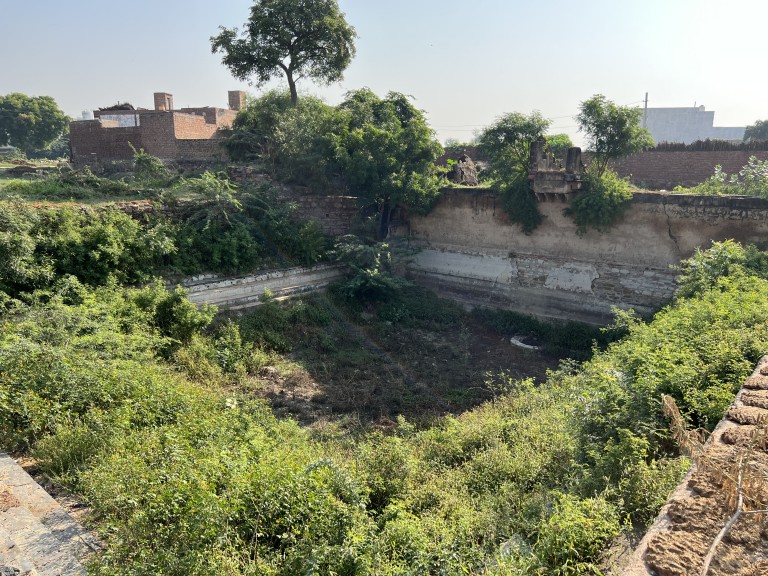
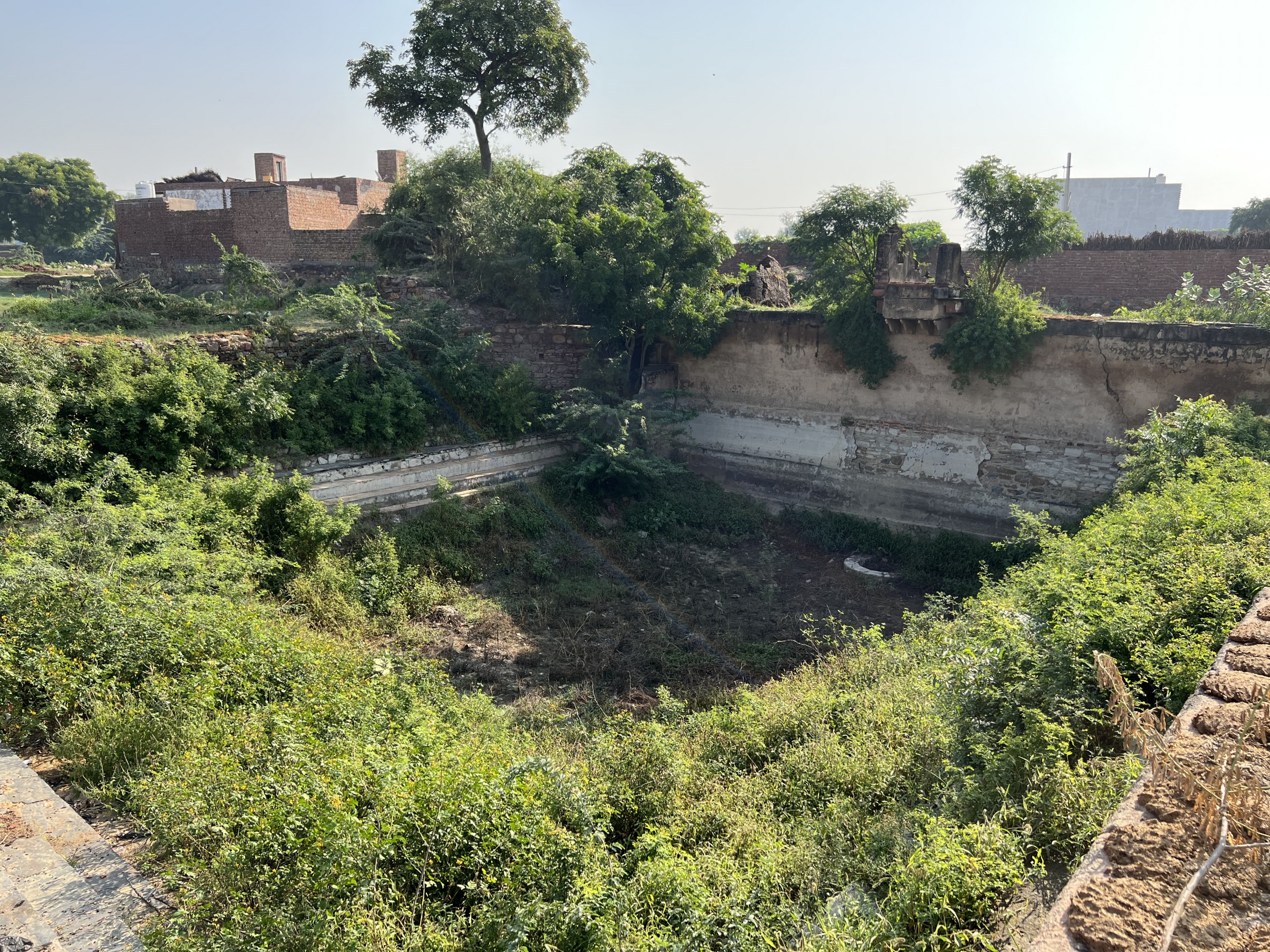
Dharma-kunda is a small kunda situated in an isolated area surrounded by open fields. The Bhakti-ratnakara says, “This is Dharma-kunda where Narayana in the form of Dharma performs indescribable pastimes.” The sacred Dharma-kunda is also known as Pancha Pandava-kunda. The word ‘dharma’ means ‘religion’ as well as ‘religious duties’ and the name ‘Pancha Pandava’ refers to Yudhisthira, Arjuna, Bhima, Nakula, and Sahadeva, the five (pancha) sons of Maharaja Pandu, who were collectively known as the Pandava brothers. When the Vedas speak of Dharma or Dharmaraja it usually refers to Lord Yamaraja, who passes judgment on the departed souls and who is one of the great Mahajanas, or those who perfectly understand the import of the Vedas.
Photo (1)