Description

Bhaktivedanta Narayana Gosvami
From the book “Sri Vraja-mandala-parikrama”:
“Once, when Śrīmatī Rādhikā was in Her sulky mood (māna), She hid Herself in a kuñja here. In separation from Her, Kṛṣṇa became completely distressed. With the help of the sakhīs He was able to find Śrīmatī Rādhikā, and with great dif ficult y He pacified Her māna.”
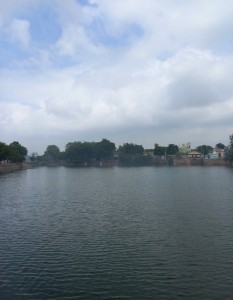
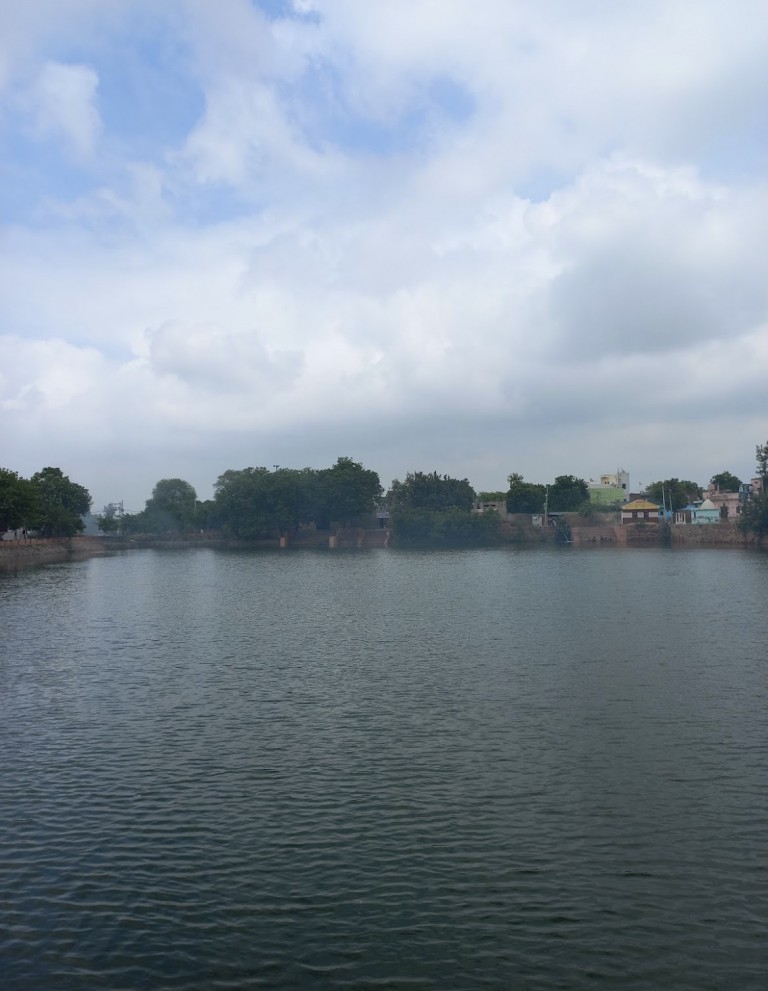
The charming forest of Bahulāvana is full of beauty. According to the Skanda Purāṇa (Mathurā-khaṇḍa), Śrī Hari’s sakhī Bahulā resides here – bahulā śrīhareḥ patnī tatra tiṣṭhati sarvadā. This place is now called Bāṭī. It lies seven miles west of Mathurā, between Rādhā- kuṇḍa and Vṛndāvana. Saṅkarṣaṇa-kuṇḍa and Māna-sarovara are two kuṇḍas in Bahulāvana.
Once, when Śrīmatī Rādhikā was in Her sulky mood (māna), She hid Herself in a kuñja here. In separation from Her, Kṛṣṇa became completely distressed. With the help of the sakhīs He was able to find Śrīmatī Rādhikā, and with great difficulty He pacified Her māna.
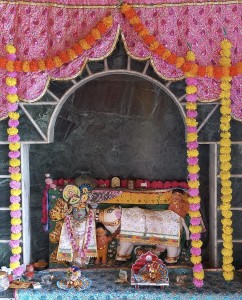
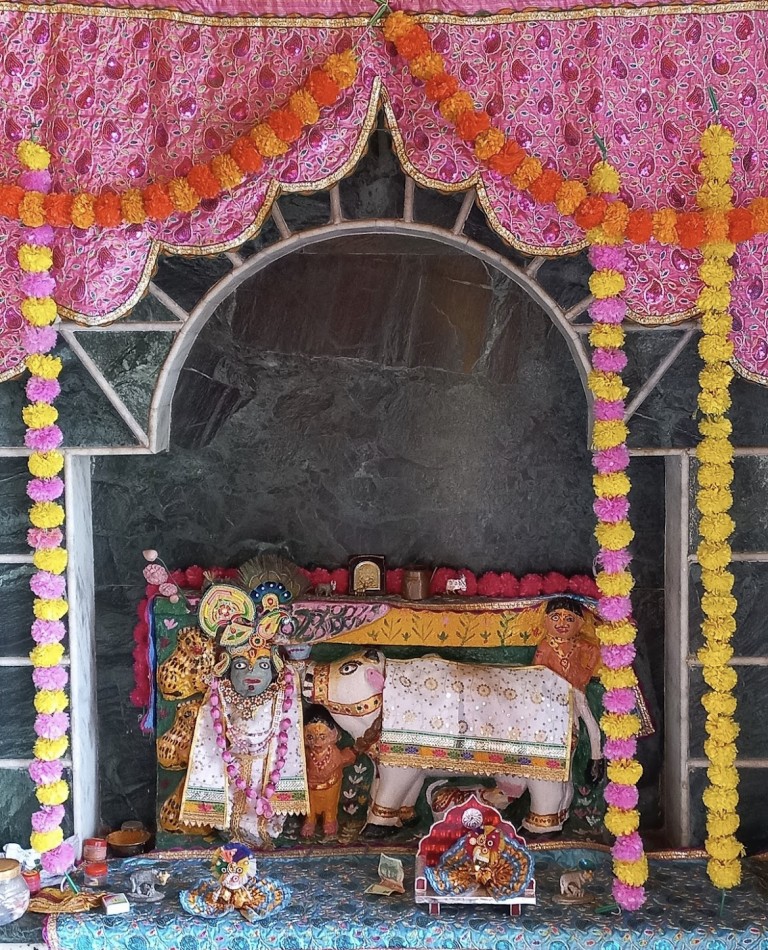
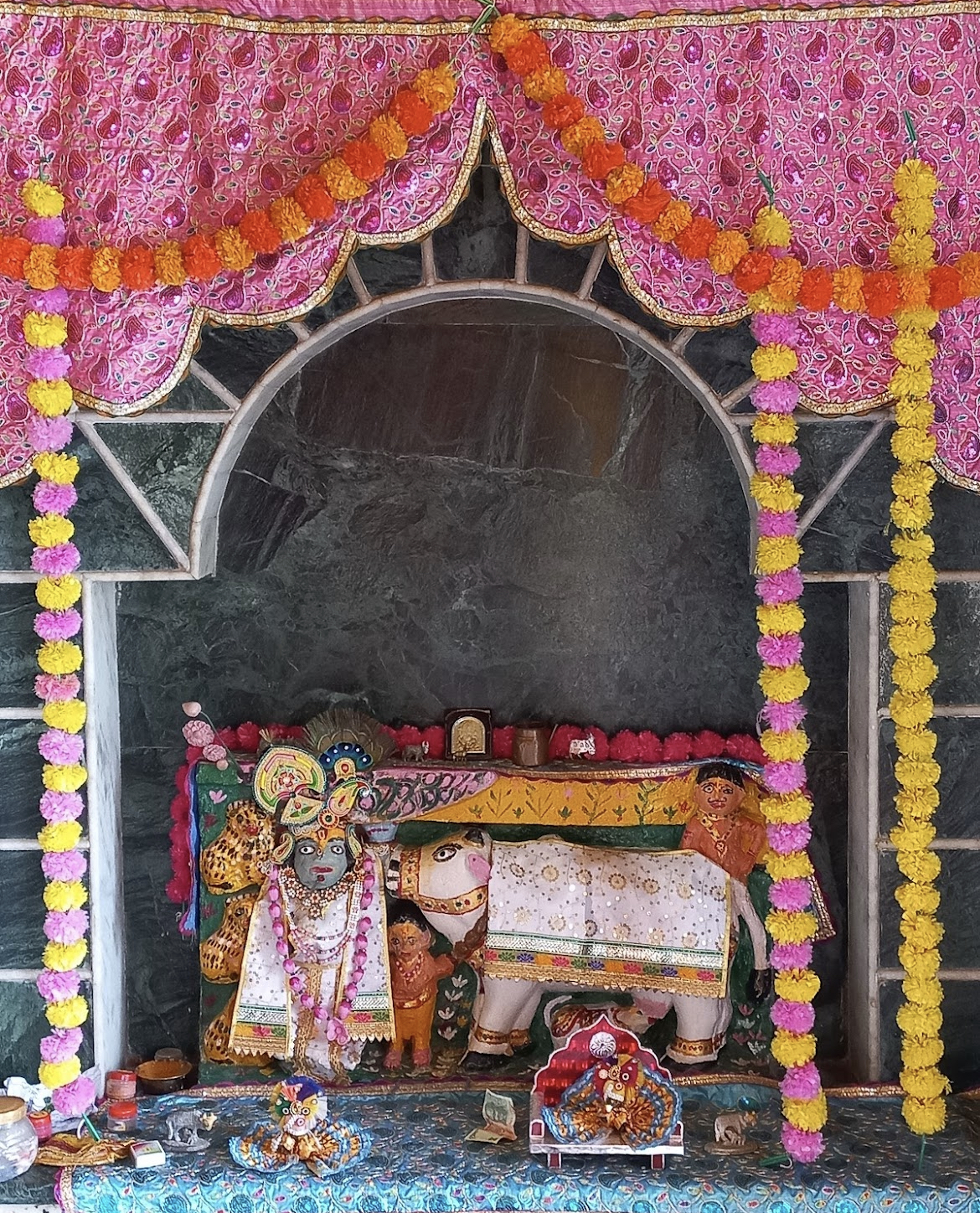
It is popularly believed that any desire of a person who takes bath here will be fulfilled. In the temple on the bank of Saṅkarṣaṇa-kuṇḍa are deities of Śrī Kṛṣṇa, a tiger, a cow, its calf and a brāhmaṇa. According to local lore, a cow named Bahulā was once drinking water from this pond when a fierce tiger attacked and caught her. She assured the tiger that she would return to be eaten after she had first gone to the house of her master, a brāhmaṇa, and fed milk to her hungry calf. When she got home, she told her calf to drink milk to his full satisfaction, and told him about her promise to the tiger. However, the calf insisted on going with her without drinking any milk. The brāhmaṇa also prepared himself to go alone. He planned to leave the cow and calf at home and give himself to the tiger as food. In the end, all three approached the tiger, each willing to sacrifice himself. At that moment, Śrī Kṛṣṇa Himself appeared there, and the tiger underwent a change of heart. By the mercy of Śrī Kṛṣṇa, the brāhmaṇa returned home safely with his cow and calf.
Śrī Rādhā-kuṇḍa lies within Bahulāvana. On Bahulāṣṭamī it is customary to take bath in Śrī Rādhā-kuṇḍa. Large numbers of people assemble to bathe here on that day.
When Śrī Caitanya Mahāprabhu wandered through the different forests, He became overwhelmed by the natural beauty of this place. A charming and heart-rending description of this is given in Śrī Caitanya-caritāmṛta (Madhya-līlā, Chapter 17) as follows: When Śrī Caitanya Mahāprabhu entered Bahulāvana, the beautiful cows grazing there surrounded Him. They stopped eating the grass and, overflowing with prema, began to bellow and lick His body. Seeing the affectionate motherly mood of the cows, Mahāprabhu became completely absorbed in ecstatic waves of prema. When He regained some external consciousness, He began caressing the cows and they did not want to leave Him. It was with great difficulty that the cowherd folk forced them onwards.
Again Śrī Mahāprabhu became absorbed in transcendental emotions. Weeping He called out, “Kothāya kṛṣṇa, kothāya kṛṣṇa? – Where is Kṛṣṇa? Where is Kṛṣṇa?” Herds of deer and does gathered and fearlessly licked Mahāprabhu’s limbs with affection. Parrots, cuckoos and bees began singing in the fifth note, and peacocks danced before Him. Completely jubilant, the trees and creepers covered themselves in buds, new leaves and flowers. With their arm-like branches and twigs, they lovingly offered their flowers and fruits at the lotus feet of Śrīman Mahāprabhu.
Seeing the ecstatic emotions of the moving and non-moving entities of Vṛndāvana, Śrīman Mahāprabhu’s absorption in transcendental ecstasy intensified. He loudly cried, “Chant ‘Kṛṣṇa’, chant ‘Kṛṣṇa’!” and all of those moving and non-moving entities echoed His words. Sometimes Mahāprabhu, crying piteously, clasped hold of the necks of the deer and does who gazed at His lotus face with love-filled glances and tear-filled eyes.
A little further on, Śrīman Mahāprabhu saw a female and male parrot (sārī and śuka) sitting opposite each other on two branches of a tree, lovingly quarrelling about the glories of the Divine Couple, Śrī Rādhā-Kṛṣṇa.
Śuka: My Kṛṣṇa is Madana-mohana, the enchanter of Cupid’s mind.
Sārī: Yes, He is – as long as my Rādhā is at His left side. Other- wise, He is only Madana (Cupid).
Śuka: My Kṛṣṇa lifted Girirāja on His finger.
Sārī: Because my Rādhā transmitted power into Him; other- wise, how could He have done so?
Śuka: My Kṛṣṇa is the life of the whole universe.
Sārī: My Rādhā is the life of that life.
Śuka: My Kṛṣṇa’s head is beautifully decorated with a peacock- feather.
Sārī: Only because my Rādhā’s name is marked on that feather.
Śuka: The peacock-feather on my Kṛṣṇa’s head leans to the left.
Sārī: Because it wants to bow down to my Rādhā’s feet.
Śuka: My Kṛṣṇa is the moon.
Sārī: My Rādhā is the trap that captures that moon.
Śuka: There is no need to quarrel uselessly. Let us glorify the Youthful Couple together.
Sārī: I happily agree to this.
This loving quarrel between the śuka and sārī is also described in Govinda-līlāmṛta. Here, the male parrot says (13.29):
“May our Lord Jagamohana, whose unparalleled beauty plunders the wealth of patience of an innumerable multitude of women, whose world-famous glory astounds even Lakṣmī- devī, whose strength turns the majestic Govardhana mountain into a child’s toy, who has unlimited qualities, whose simple disposition entertains everyone, and whose glory substantiates the welfare of the entire universe, protect the entire world.”
Hearing this, the female parrot replies (Govinda-līlāmṛta 13.30):
“Śuka, Śrī Rādhikā’s divine love, beauty, dancing, excellent calmness, expertise in music, wealth of good qualities, and poetic compositions, or in other words, Her erudition, are all so attractive that She steals away the heart of Śrī Kṛṣṇa, who enchants the mind of the entire universe.”
The male parrot then says (Śrī Caitanya-caritāmṛta, Madhya- līlā 17.214):
“Dear sārī, all glories to Śrī Madana-mohana, the enchanter of Cupid, who carries a flute. He steals the heart of all the women in the entire universe, and enjoys with the gopīs.”
After hearing the parrots’ loving quarrel, Śrīman Mahāprabhu watched the dance of the peacocks. Seeing their bluish necks He remembered Kṛṣṇa and became so overwhelmed in ecstatic love that He fell down on the earth in a faint. His companions somehow brought Him back to consciousness, and He continued His parikramā of Vraja.
Rajashekhara Dasa
From the book “Chaurasi-kosa Vraja Mandala Parikrama”:
The forest of Bahulavana gains mention in a number of ancient Puranas and is particularly associated with Bahula Devi, after whom the forest has been named, and who appeared in this forest in the form of a cow. The Skanda Purana says that Bahula Devi is the consort of Lord Shri Hari (Vishnu), but it does not reveal any further information about her.
Therefore, comparisons have been made between Bahula Devi and Bhumi Devi (mother earth), who is also referred to as being the consort of Lord Shri Hari, and who also appears in the form of a cow. To give further support that Bahula Devi, Bhumi Devi, and also Lakshmi Devi, are one and the same personality, we find the following shloka in the Skanda Purana: “Bahula, the wife of Shri Hari always lives in this forest. Oh king, this place is always auspicious because Lakshmi resides here, always enjoying pleasure pastimes with Her husband. In Bahulavana there is Sankarshana-kunda and Mana-sarovara. Whoever takes bath here in the month of Chaitra is able to have darshana of Shri Hari with His consort Lakshmi.” This verse refers to Bahula as being non-different from Lakshmi Devi. The Adi-Varaha Purana also say that Bhumi Devi resides with Her husband Lord Varaha on the southern petal of the lotus of Vraja, at the sacred place known as Saukara-puri, which also called Saukara-Vateshwara (Batesar). Thus the Puranas equate Bhumi Devi as well as Bahula Devi, to being non-different from Lakshmi Devi, the wife and eternal consort of Lord Vishnu. The Adi-Varaha Purana says, “Bahula is the best of all forests. Whoever enters this forest attains Agniloka after death.”
Photo (2)