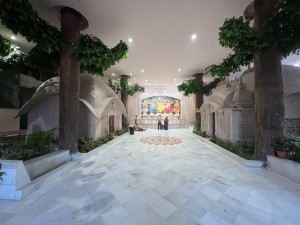
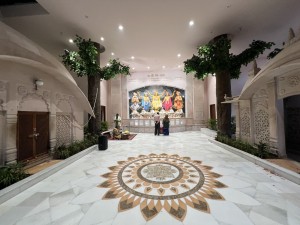
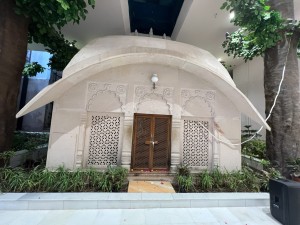
Description

Bhaktivedanta Narayana Gosvami
From the book “Sri Vraja-maṇḍala-parikramā”:
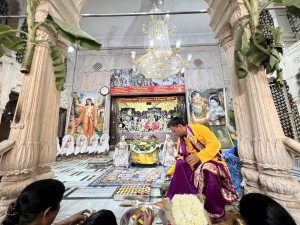
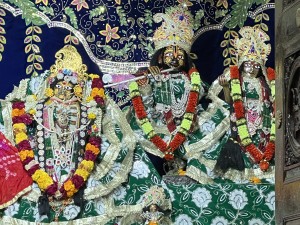
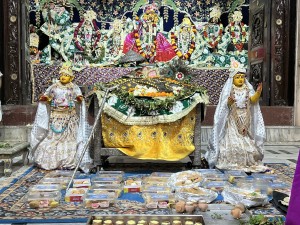
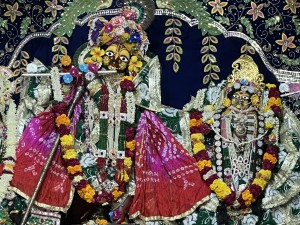
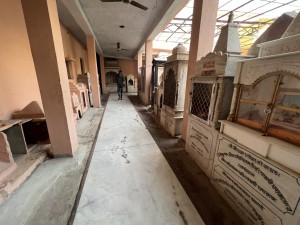
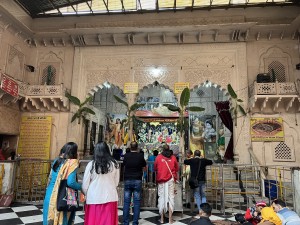
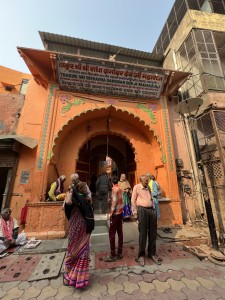
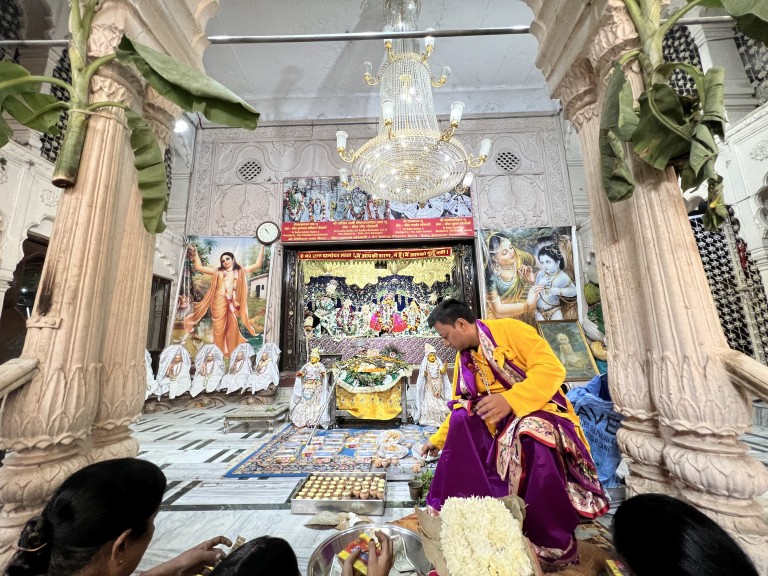
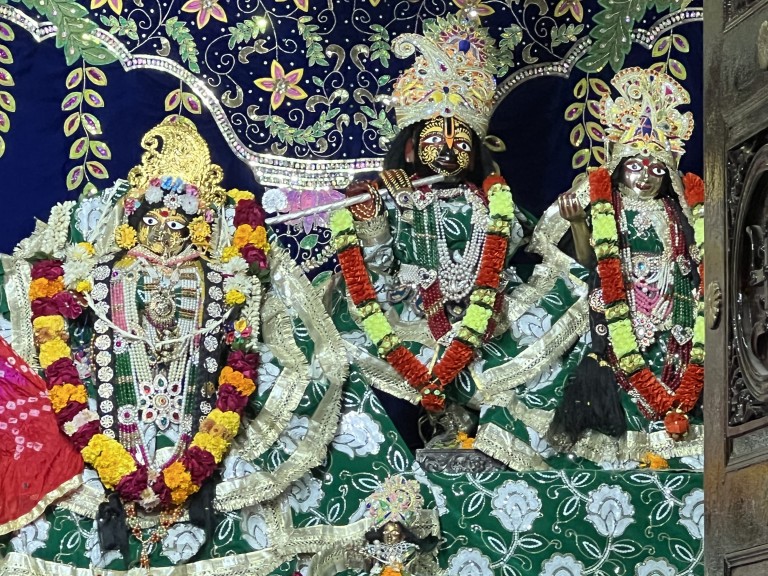
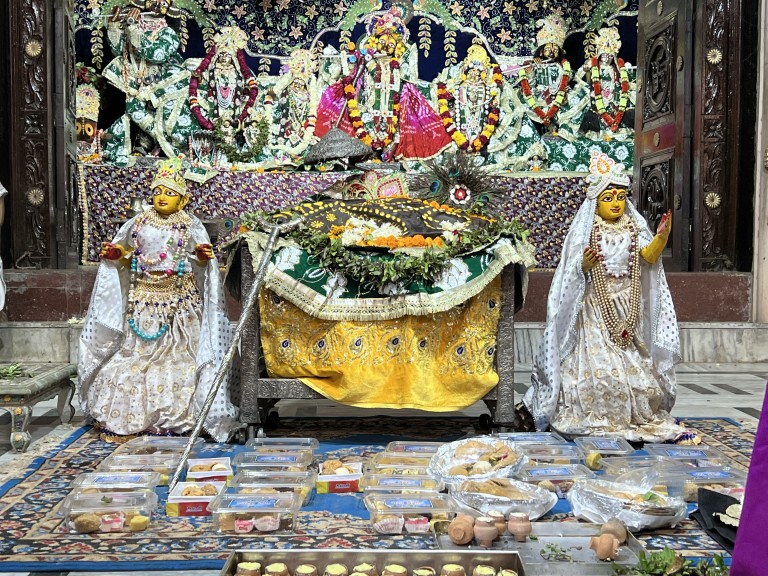
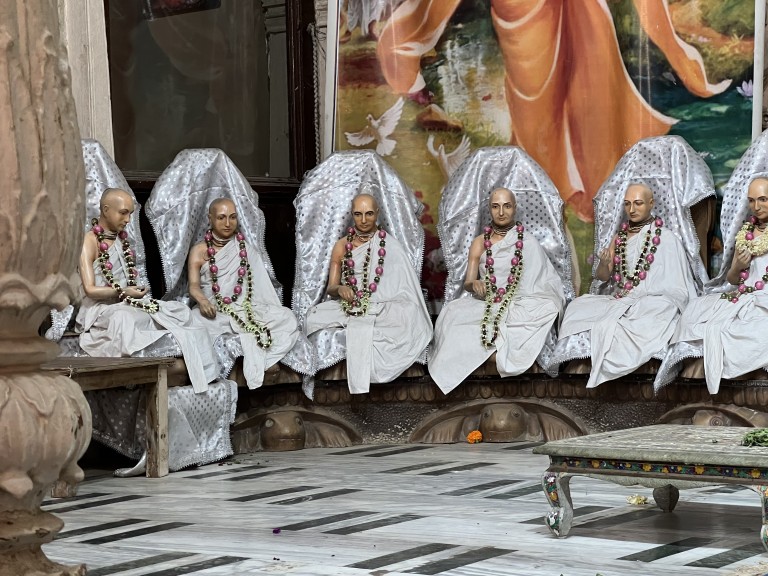
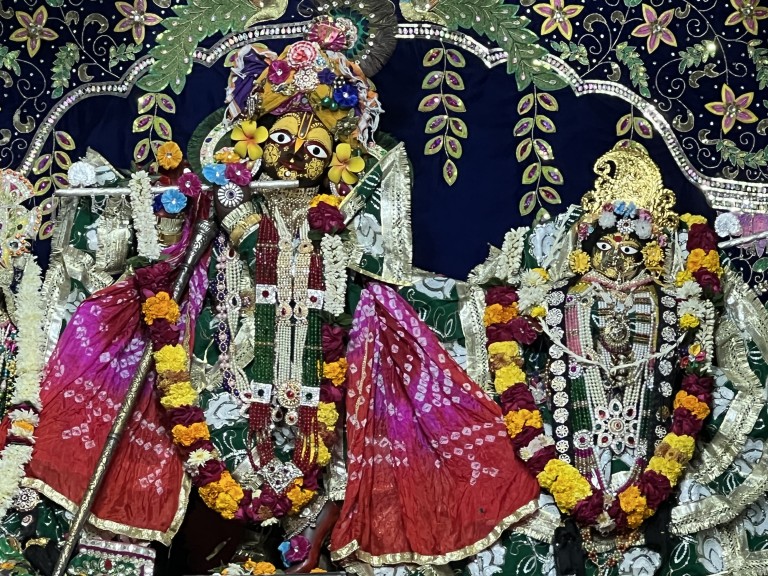
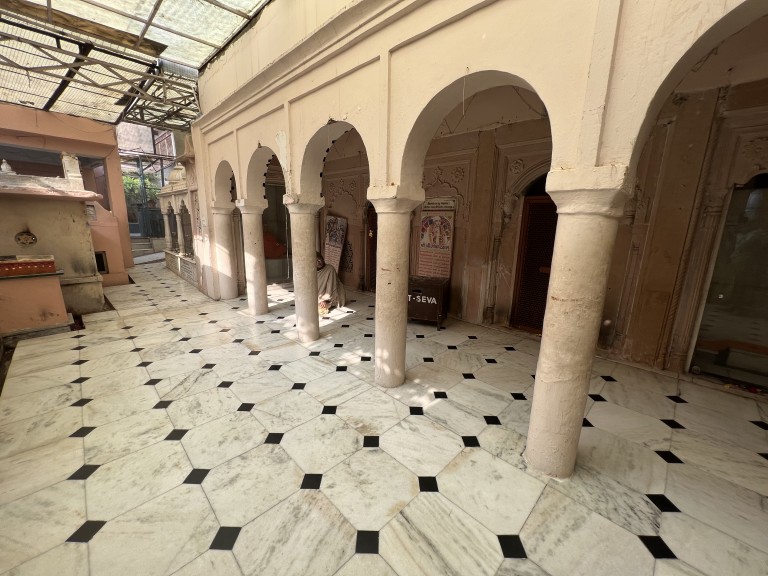
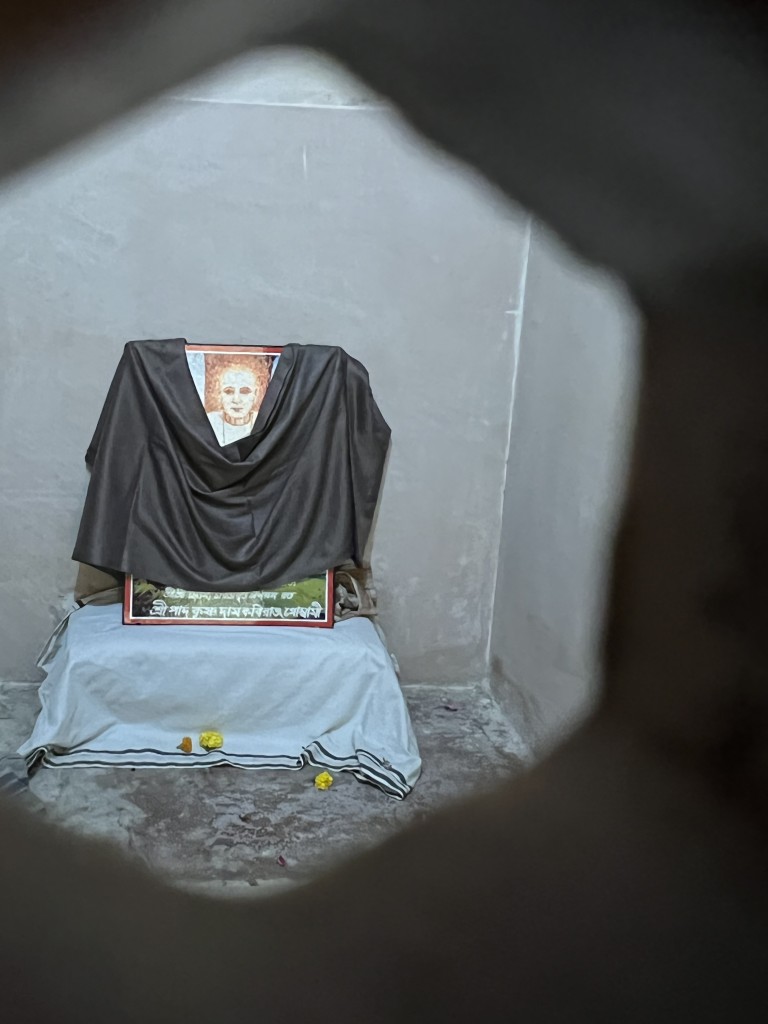
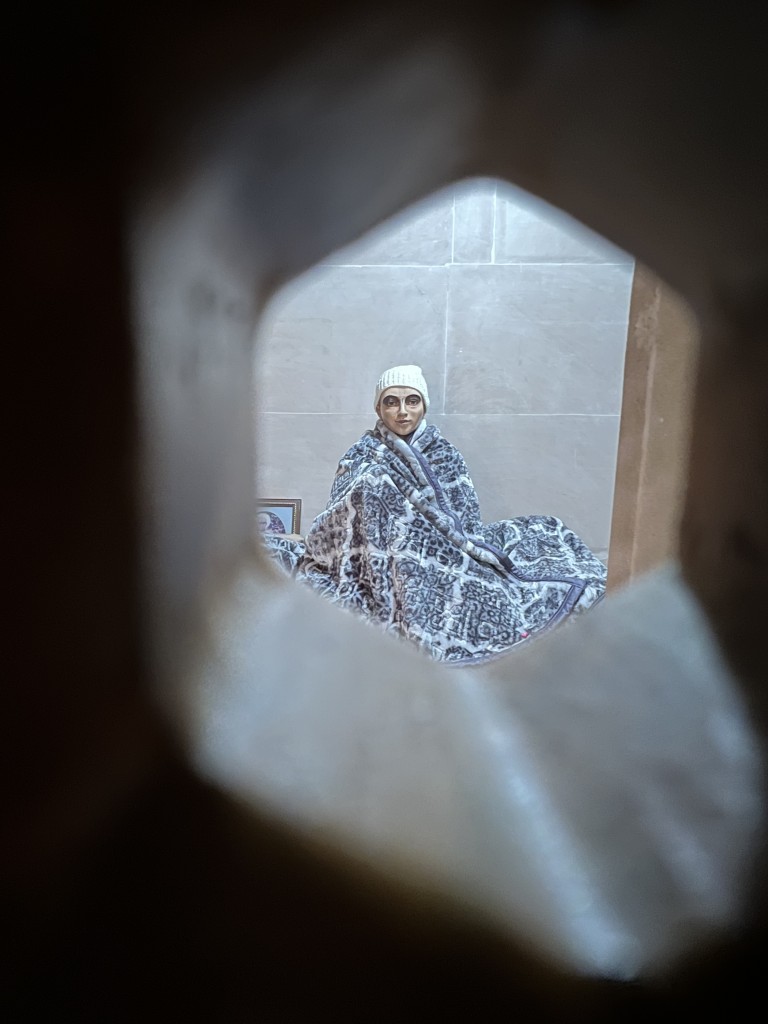
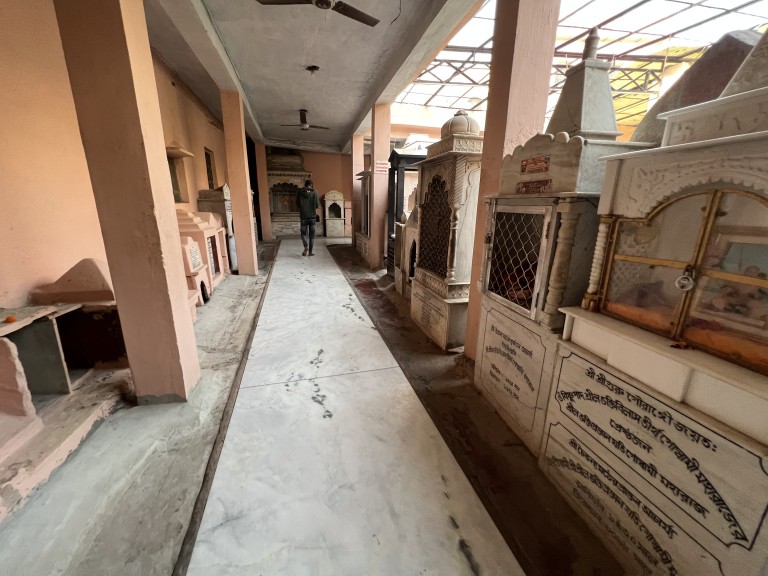
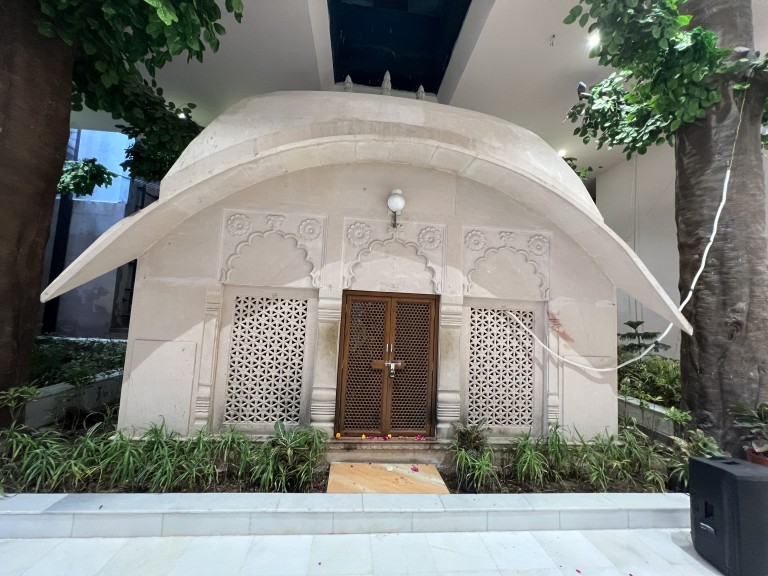
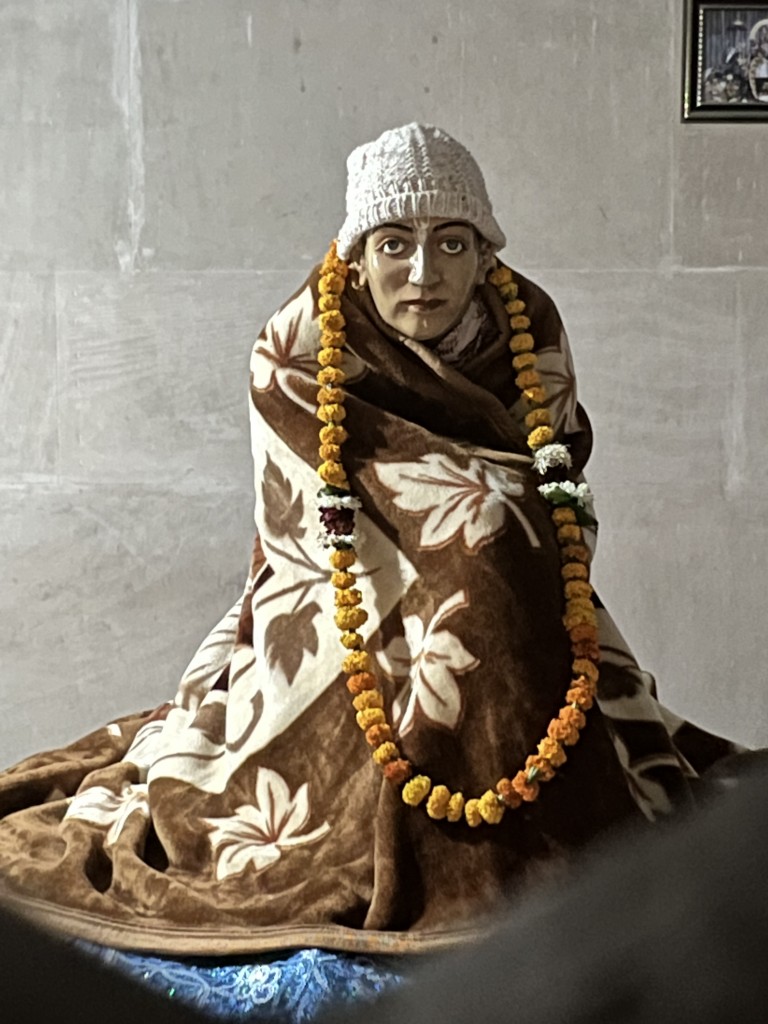
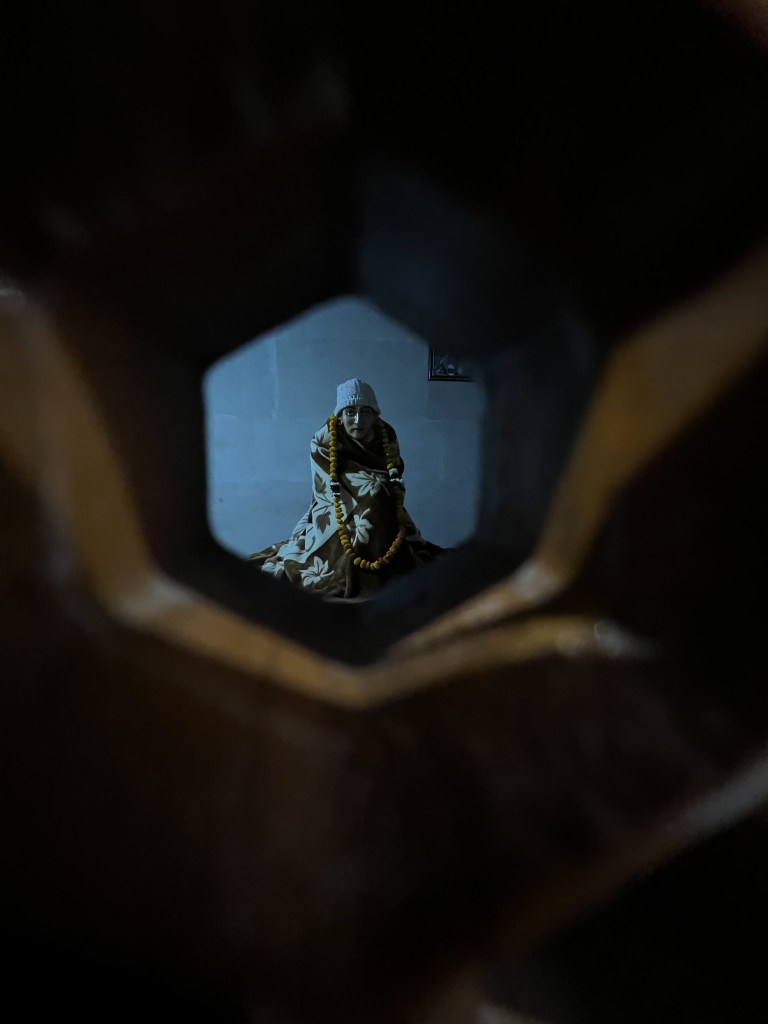
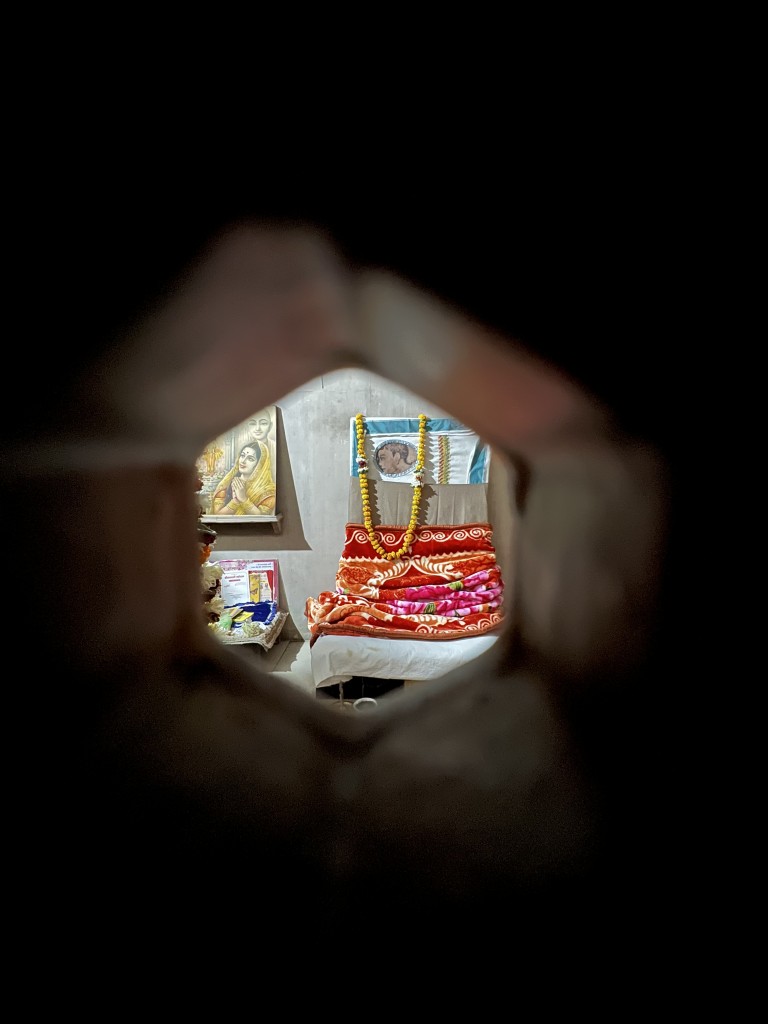
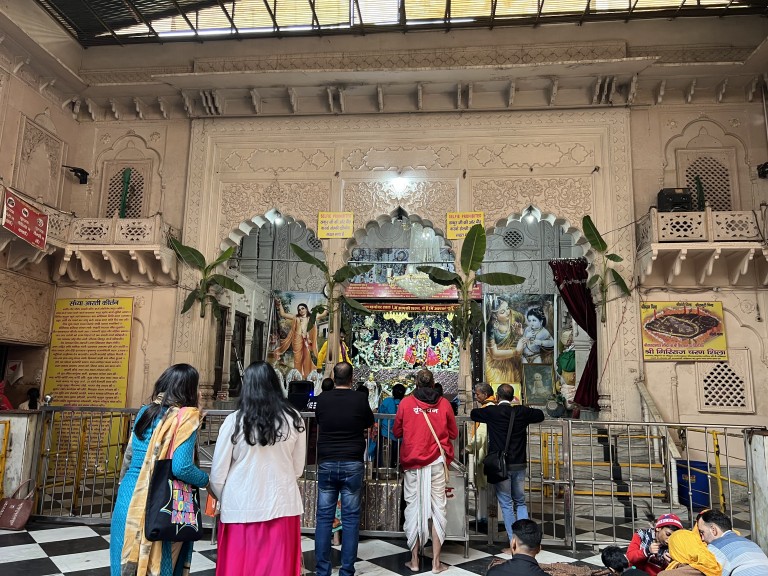
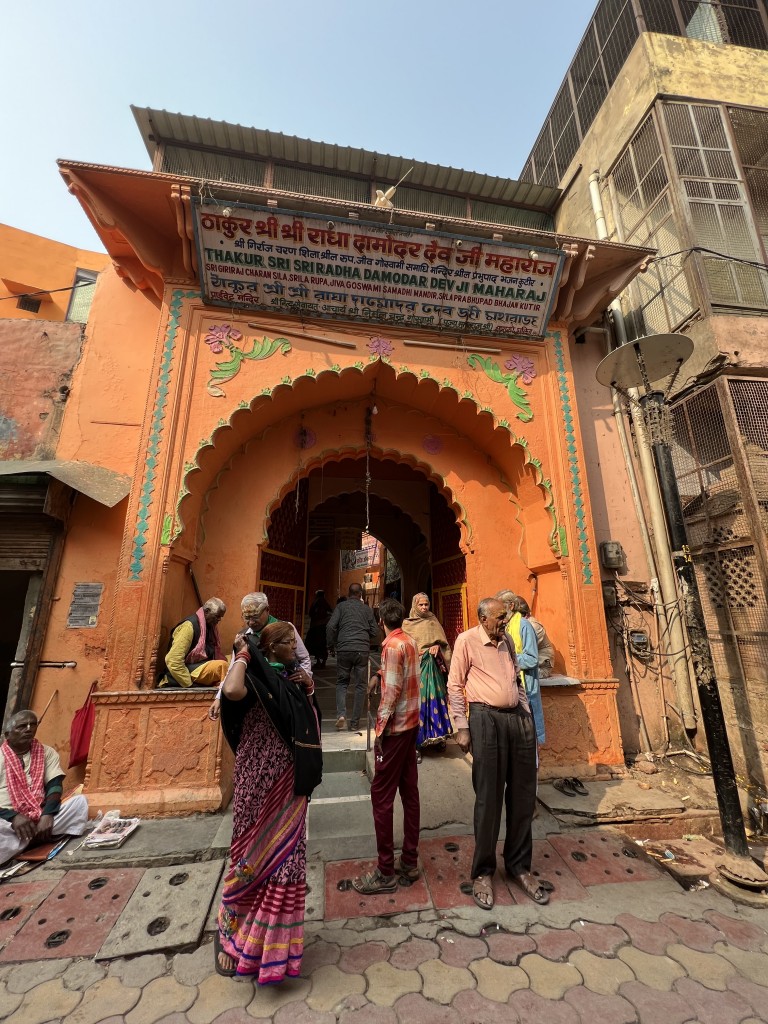
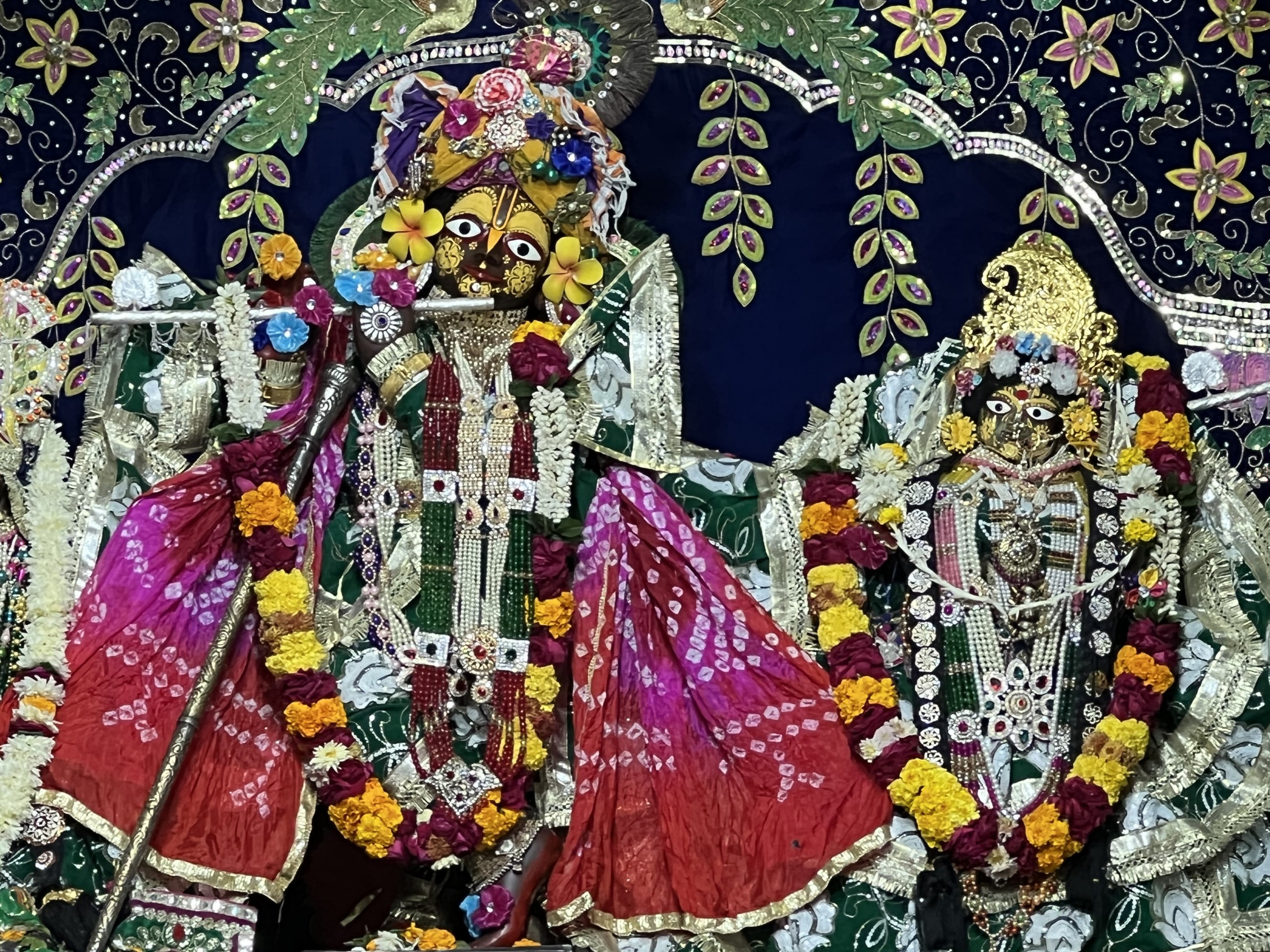
This temple is situated within the area of Sevā-kuñja. Śrī Rūpa Gosvāmī used to live here in his bhajana-kuṭī. The contemporary Gosvāmīs and devotees assembled here for iṣṭagoṣṭhīs and, in those gatherings of Vaiṣṇavas, Śrī Raghunātha Bhaṭṭa would elucidate on Śrīmad-Bhāgavatam in his melodious voice. Śrī Rūpa Gosvāmī compiled Śrī Bhakti-rasāmṛta-sindhu, Ujjvala-nīlamaṇi and other sacred texts on bhakti at this place. The young Śrī Jīva Gosvāmī was engaged in all kinds of service to Śrī Rūpa Gosvāmī, who personally manifested the deity of Śrī Rādhā-Dāmodara with his own hands and offered the service and worship to Śrī Jīva. According to the book Sevā-prākaṭya, Śrī Rādhā-Dāmodara were installed in saṁvat 1599 (1543 AD) in the month of Māgha (January–February) on Śuklā-daśamī (the tenth day of the bright half of the month). The original Śrī Rādhā-Dāmodara are now in Jaipura, and Their pratibhū-vigrahas, which are as potent as the original deities, are in Vṛndāvana. On the altar with Them are Śrī Vṛndāvana-candra, Śrī Chailacikaniyā, Śrī Rādhā-Mādhava and a few others. The samādhis of Śrī Jīva Gosvāmī and Śrī Kṛṣṇadāsa Kavirāja Gosvāmī lie behind the temple, and in the northern area of the temple are the samādhi and bhajana-kuṭī of Śrī Rūpa Gosvāmī. Adjacent to this is the samādhi of Śrī Būgarbha Gosvāmī.
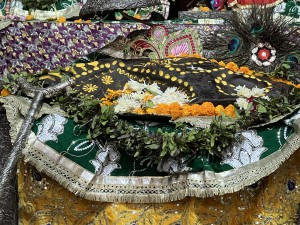
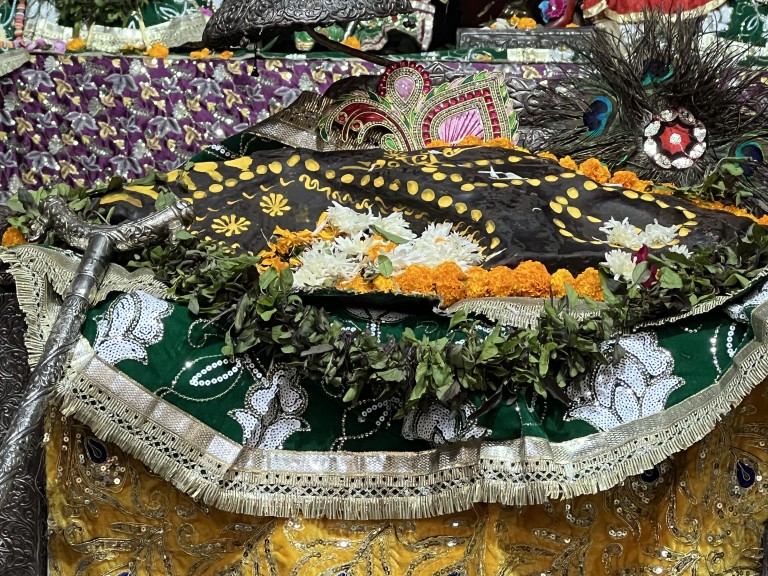
Sanātana Gosvāmī used to perform parikramā of Govardhana daily. In his old age, when he became incapable of performing parikramā, Kṛṣṇa came to him as a boy and gave him a govardhana- śilā, which was one-and-a-half cubits long and shaped like a banyan leaf. He instructed Sanātana Gosvāmī to perform parikramā of this śilā instead. On this śilā are imprints of Kṛṣṇa’s foot, His flute and a cow’s hoof. Sanātana Gosvāmī brought that śilā to Vṛndāvana and would circumambulate it daily. After his disappearance, Śrī Jīva Gosvāmī installed the śilā in the temple of Śrī Rādhā-Dāmodara and began to worship it. Darśana of this śilā is available on special request.
Rajashekhara Dasa
From the book “Chaurasi-kosa Vraja Mandala Parikrama”:
This is one of the most important of the ‘Seven Goswami Temples’ and was established by Shrila Jiva Goswami, who was both the nephew and the disciple of Shrila Rupa Goswami. The original Deity of Radha Damodara was personally hand carved by Rupa Goswami and given to Jiva as a gift. According to old temple records, Krishna appeared to Rupa Goswami in a dream and asked him to carve a Deity out of stone. Although Rupa Goswami had no experience of carving, by the grace of Krishna he was able to carve a very beautiful Deity from a stone that he found in the Yamuna. Rupa Goswami named the Deity as Damodara and presented it to Srila Jiva Goswami who had been longing to worship a Deity. This Deity is now being worshiped in Jaipura, where most of the Deities of the Gaudiya Goswamis were taken for safety due to the fear they would be desecrated during the attack on Vrindavana by the Mughal tyrant Aurangzeb’s soldiers in the year 1670. The replica Deity known as the pratibhu-murti, which has exactly the same potency as the original, is presently being worshiped here at the Radha Damodara Mandira, although recently the pujaris have claimed otherwise. According to old records of the period, the Deity of Radha Damodara was installed on the simhasana in 1542, when the first seva-puja was performed. In the same year Gopala Bhatta Goswami performed the first seva-puja of Radharamana. Then in the year 1558, Jiva Gosvami eventually acquired the land at Seva Kunja where the Deity of Radha Damodara was being worshiped, during the same year he also acquired the land at Radha-kunda.
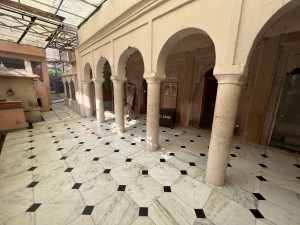
There are no records pertaining to the construction of the temple, but as few temples were built during this period of the Mughal rule, the first temple would have been a very simple structure. The magnificent Goswami temples of Govindaji, Madana-Mohana, and Gopinathaji, were built in the years after Emperor Akbar’s historic visit to Vrindavana in 1570. Emperor Akbar was escorted to Vrindavana by Raja Man Singh, the king of Jaipur, who was a general in Akbar’s army. While visiting Vrindavana Akbar was introduced to Shrila Jiva Goswami, who was at that time known as one of the greatest philosophers and Sanskrit scholars in all of India. During Akbar’s visit, Raja Man Singh, a disciple of Raghunatha Bhatta Goswami, received permission from the emperor to construct the temples of Govindaji, Madana-Mohana, and Gopinathaji, the Deities originally carved by Vajranabha. Akbar also agreed to provide the finest red sandstone for their construction. Akbar also donated funds for constructing a library at Radha Damodara for keeping all the Goswami literatures, which can still be seen and is located in a room to the left of the altar and known as the ghanta-garh, or book-room. The present temple of Radha Damodara dates from the mediaeval period and the temple was built in such a way, similar to the Radharamana Mandira, so that it appeared more like a regular haveli or residential quarters rather than a temple, so as not to attract the attention of the despotic Mughal rulers.
On the alter (simhasan) of the Radha Damodara Mandira, besides the Deities of Radha Damodara and the gopi Lalita Devi, one can also see the pratibhu-murtis of other Gaudiya Goswami Deities including: Radha Vrindavana-candra (Krishnadasa Kaviraja Goswami) and Radha Madhava (Jayadeva Goswami). The Deity of Radha Chalchikan (Bhurgarbha Goswami) is believed to be the original Deity worshiped by him. One can also see the famous govardhana-shila that was given to Sanatana Goswami by Lord Krishna for the purpose of Sanatana’s circumambulation of Govardhana Hill during his old age. This shila is also believed to be the pratibhu-murti, with the original shila being in Jaipura, although the pujaris claim otherwise.
The Radha Damodara Mandira was formerly situated in a corner of the sacred Seva Kunja not far from the banks of the Yamuna River. This was the place where Rupa Goswami established his bhajana-kutira and where he wrote many of his books. Rupa Goswami was assisted at that time by his nephew and disciple Jiva Goswami, who personally made the parchment leaves for Rupa to write upon and also edited all of Rupa’s books. It was once said by Shrila Prabhupada, that the Radha Damodara Mandira is situated at the center of the spiritual world, because of the divine activities performed there by the Six Goswamis of Vrindavana, who used this place for their daily meetings and from where they made their plans to inundate the world with Krishna consciousness. Shrila Prabhupada also stayed here at the Radha Damodara Mandira for a number of years where he translated the first two cantos of the Vedic classic Shrimad-Bhagavatam into the English language. After completing his translation of Srimad-Bhagavatam, Shrila Prabhupada left for America in 1965 in order to fulfill the order given to him by his spiritual master, which was to spread the teachings of the Six Goswamis and the glories of Lord Chaitanya Mahaprabhu’s sankirtana movement all over the world.
Unfortunately, with the advance of urban development, the area of Seva Kunja has now been reduced in size and surrounded by a perimeter wall and the Radha Damodara Mandira is presently located around 100 meters away, although the area (Mohalla) is still known by the name of Seva Kunja.
Jiva Goswami Samadhi
Shrila Jiva Goswami was born in 1513 at Ramakeli in the district of Maldah, West Bengal, as the son of Shri Vallabha, who died just after Jiva’s birth. Shri Vallabha was the younger brother of Rupa and Sanatana Goswamis and thus Jiva was the nephew of the two Goswamis and also the youngest amongst the Six Goswamis of Vrindavana. With his father already dead, the sudden demise of his mother prompted Jiva to renounce the world. Jiva first made his way to Navadwipa where he met Lord Nityananda, who took the young Jiva on parikrama around the nine islands of Navadwipa Dhama. Nityananda Prabhu personally advised Jiva to go to Benares (Varanasi) and study Vedanta philosophy and Sanskrit grammar under the guidance of the renowned scholar Madhusudana Vachaspati, and under his tutelage, Jiva soon gained the reputation as a brilliant student and protege.
On completing his studies Jiva immediately left for Vrindavana where arrived in 1535, to join his two uncles in propagating the message of Lord Chaitanya Mahaprabhu, whom he had met in his childhood. Jiva took shelter under Rupa Goswami, who accepted him as his disciple and trained him in all the finer points of Gaudiya Vaishnava philosophy. With the help of both Rupa and Sanatana, Jiva soon became acknowledged as the greatest philosopher in Indian history. He is simultaneously credited to have been the foremost Sanskrit scholar that has ever lived. Even today, there is a department at the Benares Hindu University under Jiva Goswami’s name dedicated to the study of his works. He was also the most prolific writer amongst the Gaudiya Goswamis of Vrindavana, having produced over twenty five important books, including the celebrated Sat Sandharbas, as well as Sankalpa Kalpadruma, Gopala-champu, Madhava-mahotsava, Sukha-Bodhini, Dig-Darshini Tika, Laghu Vaishnava Toshani. Jiva Goswami also composed his own Sanskrit grammar known as Harinama-vyakarana, in which all the technical terms in the sutras are names of Krishna, or His associates. Jiva Goswami’s inspiration for composing this book originated in Lord Chaitanya Mahaprabhu’s own explanation of grammar in terms of Krishna’s holy names, in His early life as a famous pandit of Navadwipa.
Shrila Jiva Goswami was such a brilliant scholar that it was difficult for him to restrain his youthful enthusiasm when confronted by those who wanted to proudly present themselves as greatly learned scholars. On one occasion, he was actually banished from Vrindavana by his spiritual master Rupa Goswami, when he audaciously took to task the famous scholar Vallabha Bhatta, after hearing what he thought was the Bhatta’s unwarranted critique of Rupa’s wonderful invocation to Bhakti-rasamrita-sindhu (Nectar of Devotion). The most humble Rupa was so embarrassed by his nephew’s direct challenge and grammatical demolition of the senior Bhatta, that he asked him to leave his association until he could develop what Rupa considered to be ‘proper Vaishnava humility’.
On another occasion some years later, a famous all-conquering (digvijayi) scholar from Kashmir arrived in Vrindavana wanting to debate the highly renowned Gaudiya Goswamis. Having traveled the length and breadth of India defeating everyone, his ambition was to cover himself in glory as India’s greatest living scholar by defeating Rupa and Sanatana, the famous Goswamis of Vrindavana. The digvijayi pandita began pestering both Rupa and Sanatana to engage in a debate, but the Goswamis had no time for such trivialities, as they were fully occupied with their own writings. Ultimately, just to get rid of the digvijayi, they agreed to sign a patra (affidavit) signifying their defeat at the hands of the pandita, if that would satisfy him and he would stop disturbing them and go away. Having got the victory patras from both Rupa and Sanatana, the Kashmiri panditas attention then fell on Jiva, who everyone said was an even greater scholar than his two uncles. Puffed-up by his own false prestige and his cheap successes over the two Goswamis, he approached Jiva to challenge him in a debate. When Jiva saw the two patras signed by his uncles, he became filled with indignation after realizing the circumstances surrounding his uncles’, so-called defeat by this worthless Kashmiri pandita. Jiva Goswami immediately engaged in a furious debate with the digvijayi that is said to have lasted a full seven days, culminating in the utter defeat and humiliation of the so-called digvijaya pandita. Jiva immediately took back the patras signed by his uncles and destroyed them while the so-called digvijayi pandita beat a hasty retreat from Vrindavana, never to be seen again.
Lord Chaitanya Mahaprabhu, in His youth, had also confronted a famous digvijaya pandita from Kashmir named Keshava, and soundly defeated him by His superior knowledge of Sanskrit grammar. In those days, Mahaprabhu was a renowned scholar in His own right and was known locally as Nimai Pandita. The brahmana panditas’ from Navadwipa were famous for their learning, especially in the various branches of Sanskrit grammar, or vyakarana, like Panini, Kalapa, and Kaumudi. In His youth Nimai Pandita became a teacher of kalapa-vyakarana. The brahmanas’ from Kashmir were undoubtedly superior to most other brahmana panditas’ in India at that time, due to their vast knowledge of the Vedas, and they traveled widely defeating all those who came before them. The word ‘digvijayi’ means ‘one who is victorious in all directions’ and ‘pandita’ means a ‘learned, wise, and erudite scholar’. According to the Krishna Samhita, Kashmir is a part of bhauma-svarga, or the ‘heavenly realm’ situated on the earthly plain and considered to be the original birthplace of all brahmanas.
Jiva Goswami’s fame as the greatest living philosopher and Sanskrit scholar spread so far and wide that even the Mughal Emperor Akbar desired to meet him. In 1570, Raja Man Singh the king of Jaipura, a disciple of Raghunatha Bhatta Goswami, brought Akbar to meet Jiva at the Radha Damodara Mandira in Vrindavana. The Emperor was so impressed with Jiva Gosvami, that he provided funds to build a library where the works of Jiva and the other Goswamis could be safely kept. According to the records of his last will and testament, Srila Jiva Goswami entered samadhi in the year 1608, at the Radha Damodara Mandira in Vrindavana, where his sacred body was entombed. The Gaura-ganoddesha-dipika says that Shrila Jiva Goswami is Vilasa-manjari in Krishna’s Vrindavana pastimes.
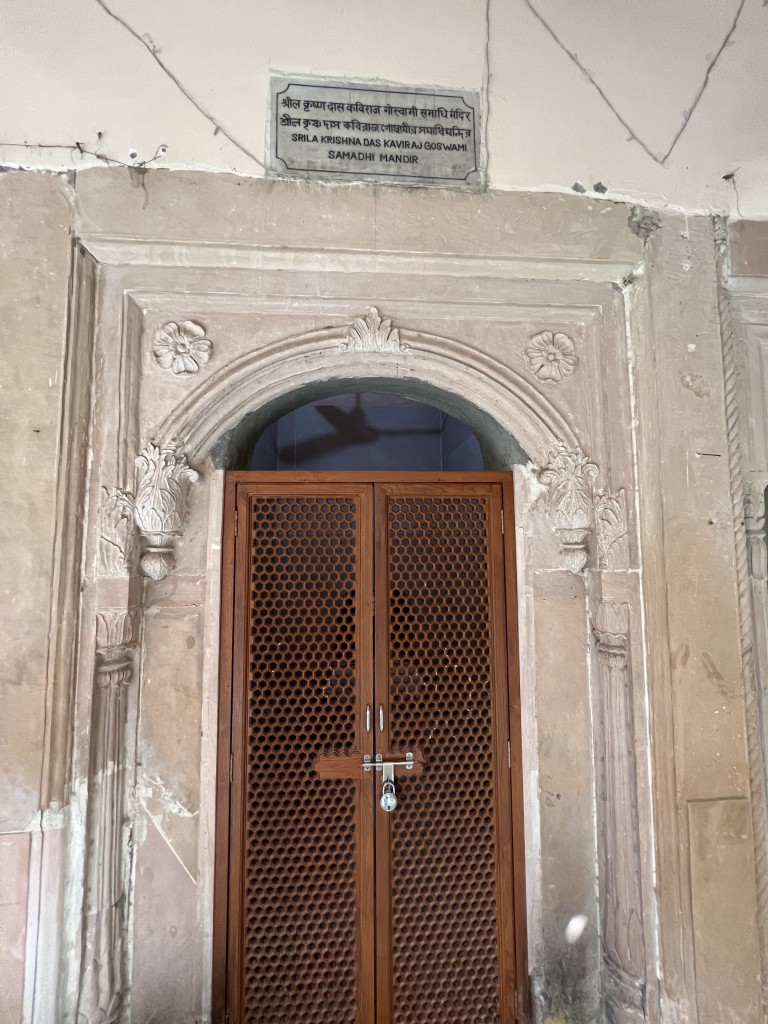
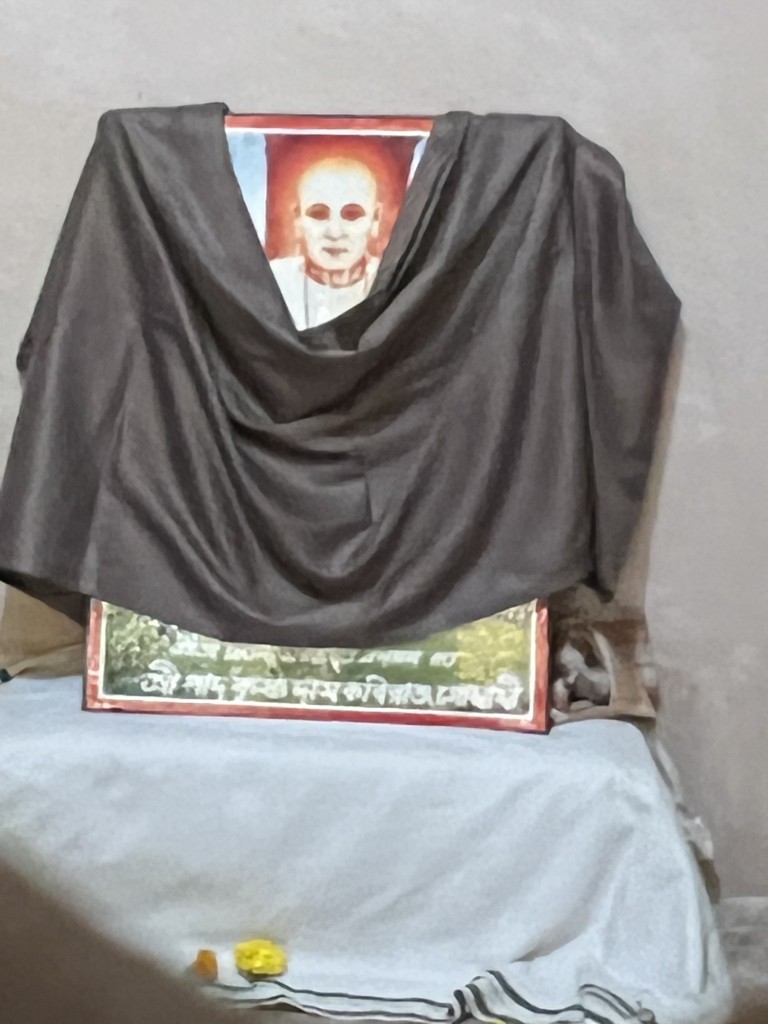
Krishnadasa Kaviraja Goswami Samadhi
It is believed that a portion of the ashes from the funeral pyre of Shrila Krishnadasa Kaviraja Goswami are entombed here, while another portion of his ashes are entombed at Radha-kunda where the actual cremation ceremony took place. At that time, some of the great Vaishnava saints were cremated so that in the future, the Muslim zealots could not attempt to desecrate their sacred remains. The other Goswamis that were cremated were Raghunatha Dasa Goswami and Raghunatha Bhatta Goswami, whose samadhis are at Radha-kunda. Krishnadasa Kaviraja was renowned as a great scholar having studied all the branches of Vedic knowledge. He came to Vrindavana after Lord Nityananda appeared in his dream and told him to go to Vrindavana. He took initiation from Raghunatha Dasa Goswami and lived at Radha-kunda with his beloved guru and each day he would hear about the pastimes of Lord Chaitanya from Raghunatha Dasa. By the grace of his guru, he became celebrated as the author of Chaitanya-charitamrita, one of the greatest classics amongst Gaudiya Vaishnava literature, which he completed in 1581, while was staying at Radha-kunda. The Chaitanya-charitamrita was based mostly on what he heard directly from Raghunatha Dasa Goswami, as well as from the personal diaries of Swarupa Damodara and Murari Gupta. In 1582, one year after completing the Chaitanya-charitamrita, Krishnadasa Kaviraja Goswami entered Samadhi. According to the Gaura-ganaddesha-dipika, he is Kasturi-manjari in Krishna’s Vrindavana pastimes.
Some researchers believe that this samadhi at Radha Damodara is actually the samadhi of Krishna Dasa Brahmachari, the famous disciple of Gadadhara Pandita, who was appointed by Sanatana Goswami as the first pujari of Lord Madana-Mohana. Krishna Dasa Brahmachari was the diksha-guru of Narayana Bhatta, the author of the celebrated book Vraja-bhakti-vilasa. Some others venture to say that this may be a dual samadhi of both the saints. Others have said that it is the samadhi of another Krishna Dasa, who was the disciple of Jiva, and after both Raghunatha Dasa and Jiva Goswami’s disappearance, he became the next custodian (mahant) of Radha-kunda. As far as most Gaudiya Vaishnavas are concerned, this tomb is accepted as the samadhi of Krishnadasa Kaviraja, either as his vibhuti-samadhi containing ashes, or his smriti-samadhi honoring his memory. During his stay at Radha Damodara, Shrila Prabhupada came here for darshana every day while circumambulating the Radha Damodara temple. Shrila Prabhupada respected this samadhi as that of Kaviraja Goswami, as well as that of Krishna Dasa Brahmachari, whom he said is the ashtha-sakhi Indulekha in Krishna’s Vrindavana pastimes, and that either of the Vaishnava saints can be honored, as during their lifetime they both delivered love of Godhead to the fallen masses.
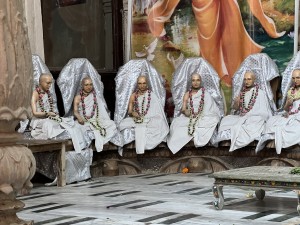
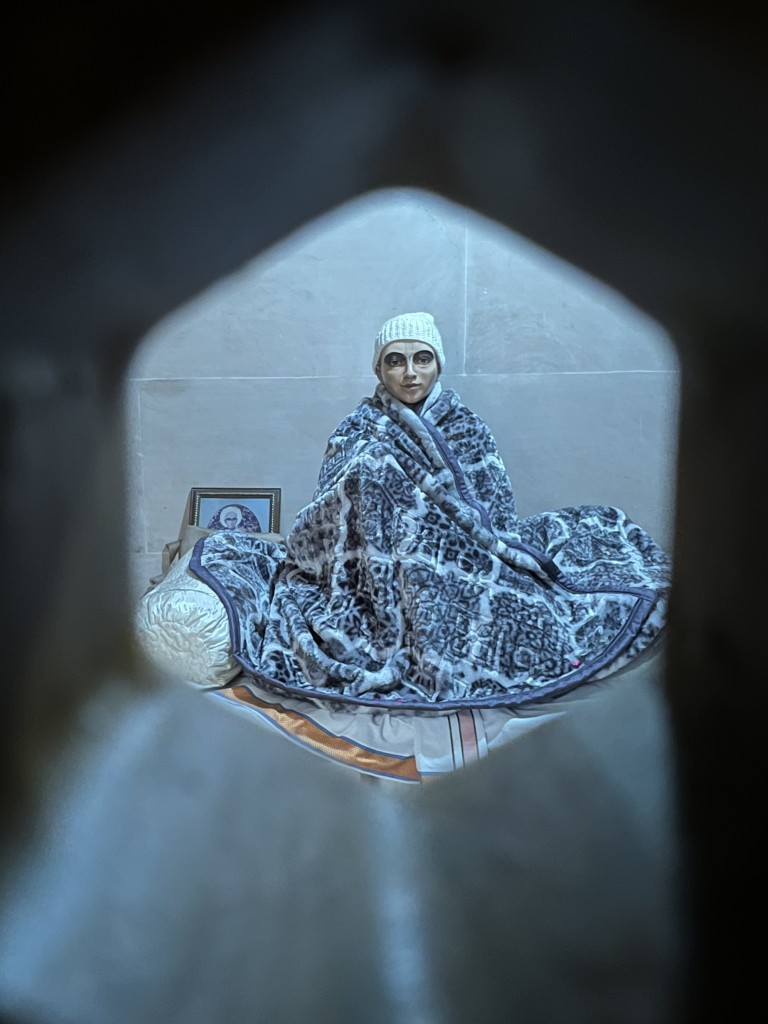
Bhaktisiddhanta Saraswati Goswami Prabhupada Pushpa Samadhi
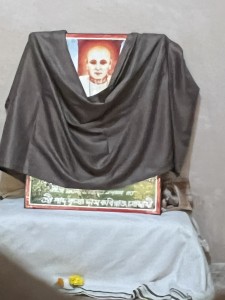
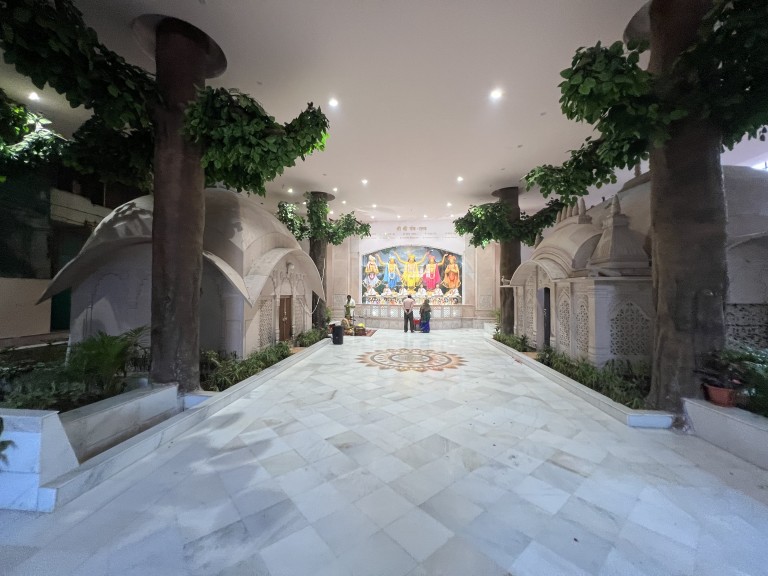
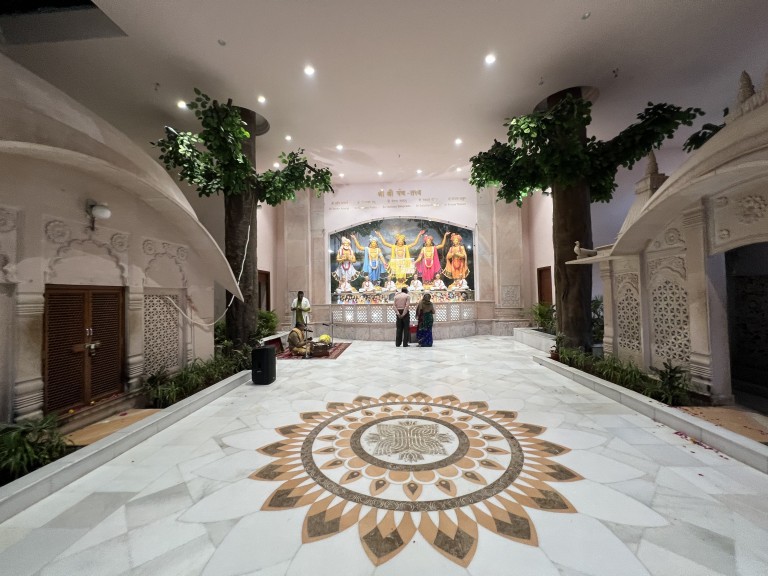
Shrila Bhaktisiddhanta Saraswati Goswami entered into samadhi in the year 1936, although some give the date of the following year, 1937, as he left his body during the night of December 31st. He was the only disciple of the renowned Gaudiya Vaishnava saint Gaura Kishore Dasa Babaji. Shrila Bhaktisiddhanta Saraswati later became the spiritual master of His Divine Grace A.C. Bhaktivedanta Swami Prabhupada, the founder-acharya of ISKCON. The word ‘pushpa samadhi’ means that flowers (pushpa) were taken from the actual samadhi of Srila Bhaktisiddhanta Saraswati at Sridhama Mayapura during the original samadhi ceremony and then placed in the samadhi here at the Radha Damodara Mandira. A pushpa samadhi is considered to be non-different from the original samadhi.
Shrila Bhaktisiddhanta Saraswati was born into a Gaudiya Vaishnava family at Puri as the son of Shrila Bhaktivinoda Thakura in the year 1874. At the time of his birth, everyone was surprised to see that his umbilical cord was wrapped around his body just like a brahmana’s sacred thread. When his father took him to see Lord Jagannatha during the annual Rathayatra procession, a flower garland fell down from Lord Jagannatha’s neck onto the child. All these things were seen as auspicious omens that this was no ordinary child. Bhaktivinoda Thakura, who at the time was the most prominent preacher of Mahaprabhu’s message and became the acharya of the Gaudiya Vaishnava sampradaya, after the disappearance of Jagannatha Dasa Babaji. Bhaktivinoda Thakura had prayed to Lord Krishna to send someone to help him in his mission of pushing forward Lord Chaitanya’s teachings to the world at large. In response to the Thakur’s sincere prayers, Krishna sent him a most brilliant son who later single-handedly revolutionized the method of preaching through organizing the printing and mass distribution of books on Krishna consciousness. He also reorganized the Gaudiya Vaishnava sampradaya in accordance with the ancient Vedic system of Varnashrama-dharma, by introducing the brahmachary and sannyasa ashramas.
In his own lifetime, Shrila Bhaktisiddhanta Saraswati established sixty-four temples of Radha-Krishna in all the major cities of India and also opened a number of branches in countries like Burma and Bangladesh. His long cherished dream; which was also the desire of his father Thakura Bhaktivinoda, was to see the teachings of Lord Chaitanya translated into the English language and spread to the people of Western world. Their ardent desire was eventually fulfilled by Shrila Bhaktisiddhanta’s most brilliant disciple, His Divine Grace A. C. Bhaktivedanta Swami Prabhupada, who single-handedly translated all the important Vedic literatures into English, and spread the message of Lord Chaitanya and the chanting of Krishna’s holy names, to every town and village across the face of the earth. For the first time in the history of the world, the Englishmen, the Americans, Russians, Chinese, as well as Africans, were converting in their thousands to Krishna consciousness while adopting all the principles of pure Vaishnava Dharma.
The great success of the world-wide Krishna consciousness movement under Shrila Prabhupada was due to the solid foundation laid down by Shrila Bhaktisiddhanta Saraswati Goswami, who became known as the ‘Lion Guru’ because of his fearless preaching of Lord Chaitanya’s philosophy, combined with his stiff opposition to the ‘caste-brahmanas’ and ‘castegoswamis’, who claimed that those not born in brahmana families, could never become Vaishnavas or brahmanas. Those arrogant bigots known as smarta-brahmanas, vehemently propagated the idea that only caste-brahmanas and caste-goswamis could study the Vedas and become preachers of Vaishnava Dharma. One particular group of caste-goswamis known as the Nityananda-vamsa, outrageously claims that only they are authorized to become initiating gurus in the line of Lord Chaitanya Mahaprabhu. These caste-conscious bigots also strongly objected to Shrila Bhaktisiddhanta’s awarding the sacred thread to those not born in brahmana families, even though it is fully approved under the pancharatrika-smriti regulations. However, with the rapid spread of the Hare Krishna Movement around the world and with millions of people having been converted to pure Vaishnava Dharma, and with highly qualified Vaishnavas-brahmanas now hailing from every caste, creed, color and nationality on the face of the earth, one can very easily understand how blatantly foolish and totally misguided are the caste-brahmanas and castegoswamis, who, in the face of the phenomenal success of the Krishna consciousness movement world-wide, have now been so rightly consigned to the garbage-bin of history.
King Bhirambhir Pushpa Samadhi
King Bhirambhir (also pronounced as Bir Hambir or Veer Hamveer), was the 49th king of the Malla dynasty and ruled over the Mallabhum kingdom in the present Bankura district of West Bengal, from 1565 to 1620 CE. King Bhirambhir was formerly known as ‘daku-raja’ or the ‘dacoit-king’ because to enhance his treasury, he employed gangs of dacoits and highway robbers to loot travelers and merchants who happened to pass through his kingdom. In the year 1582, Jiva Goswami sent his three celebrated shiksha disciples, Shrinivasa Acharya, Narottama Dasa, and Shyamananda Pandita, by bullock cart from Vrindavana to Navadwipa, with a large box containing copies of the Six Goswamis books that were to be distributed amongst Lord Chaitanya’s followers in Bengal and Orissa. One day during the long and arduous journey, as it was late and they were weary from traveling, they found a place to camp and take rest for the night, not knowing that they were within the territory of the notorious ‘daku-raja’ King Bhirambhir.
Meanwhile, the king’s astrologer informed him that a very great and unparalleled treasure was now passing through his kingdom. The king immediately dispatched a gang of dacoits to the spot and seeing that everyone was asleep, the royal robber’s quietly made off with the box which they believed was full of gold and jewels. Once they returned to the King’s palace and opened the box, the King was surprised to find only books. Meanwhile, when Shrinivasa, Narottama, and Shyamananda, awoke early the next morning, they were horrified to find that the box of books had been stolen. Each book had been copied by hand, as was the practice in the days before the invention of the printing press, and to replace them was impossible. It was decided that Shrinivasa would remain behind and try to locate the stolen books, while the others would carry on with their journey.
While moving here and there in search of the books, Shrinivasa gave lectures at various places about the glories of Lord Chaitanya and the Six Goswamis. The local people were enthralled by the discourses of Shrinivasa, who, having studied under Jiva Goswami, was both an erudite scholar and learned philosopher. Shrinivasa was invited to attend a discourse on Shrimad-Bhagavatam at the palace of King Bhirambhir that was to be given by the pandita of the royal court. The lecture was disturbing to Shrinivasa, due to its unauthorized and impersonal conclusions and Shrinivasa challenged the court pandita on a number of points. In response, the court pandita also challenged Shrinivasa, sarcastically saying that if Shrinivasa thought he could give a better discourse, then he should go ahead and try. Srinivasa immediately took up the challenge and gave a resounding discourse based on everything he had learned from Jiva Goswami and from the books of the Six Goswamis. The audience was completely astounded and King Bhirambhir, who attended the discourse, was greatly moved by what he had heard.
King Bhirambhir was very eager to meet Shrinivasa and when the King asked Shrinivasa if there was anything that he could do to serve him, Shrinivasa mentioned about the box of stolen books. The King immediately broke down and tearfully admitted his dastardly and sinful activities of robbing travelers, while at the same time begging forgiveness from Shrinivasa, whom he recognized as a great saint. The King then led Shrinivasa to the boxes of books lying in the royal storeroom. When Shrinivasa saw the boxes containing the Goswami’s literatures, he was overjoyed. After this incidence, King Bhirambhir took shelter of Shrinivasa Acharya and accepted him as his guru. He completely reformed himself and gradually became a sincere Vaishnava. He was later given initiation by Shrinivasa and received the name Chaitanya Dasa. The king gave as a guru-dakshina a rich endowment of land and money to Shrinivasa. He renamed his kingdom as Vana Vishnupura and introduced the worship of Radha Madan-Mohan and also encouraged all the citizens of the state to adopt Vaishnava Dharma. Very soon his kingdom became famous as a purely Vaishnava state.
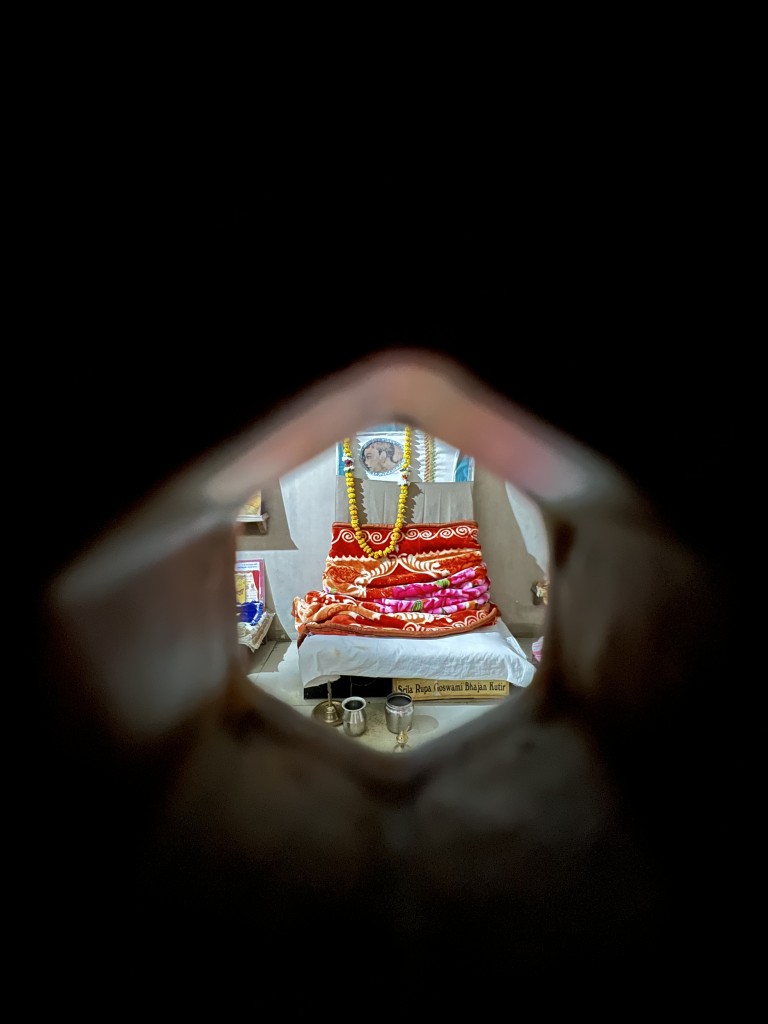
Rupa Goswami Bhajana-kutira
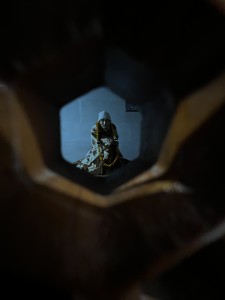
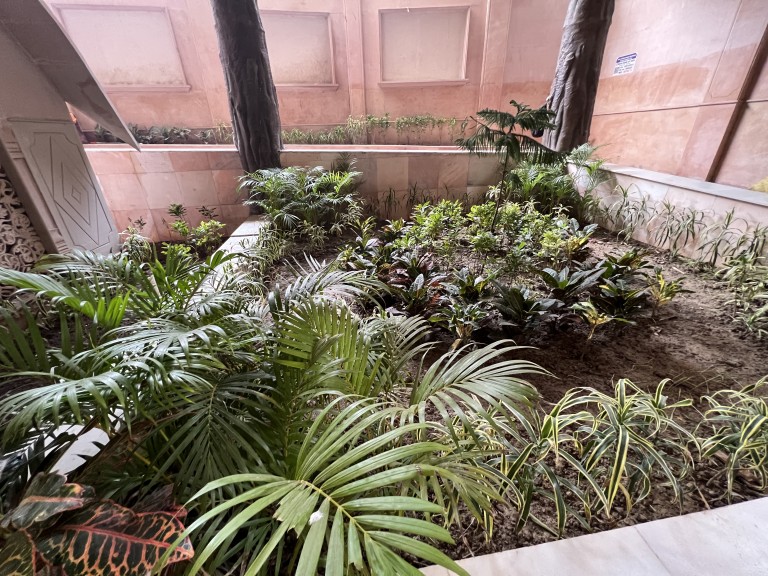
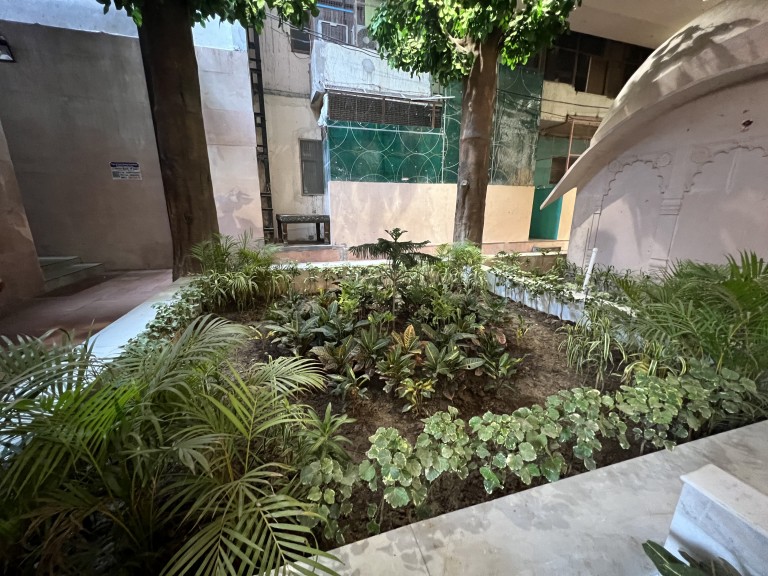
On his arrival in Vrindavana, Shrila Rupa Goswami chose this spot in the sacred garden of Seva Kunja near the banks of the Yamuna to perform his bhajana and rest beneath the trees at night. This spot in Seva Kunja eventually became his headquarters, where he would meet with the other Goswamis and where he held discourses on Shrimad-Bhagavatam and other Vaishnava literatures. It was also here where he wrote many of his important books including the great Vaishnava classic Bhakti-rasamrita-sindhu, the Nectar of Devotion, which he completed in 1541. Within time, a simple thatched cottage was built for Rupa Goswami where he could keep his parchment leaves and other items used for writing books.
After personally instructing Shrila Rupa Goswami at Prayag (Allahabad) on the philosophy and practices of pure devotional service to Krishna, Lord Chaitanya Mahaprabhu directly ordered him to go to Vrindavana as His personal representative, for the purpose of excavating the lost holy places of Lord Krishna’s pastimes, to write books on the science of devotion, and to construct temples dedicated to Radha and Krishna, as well as establish the rules and regulations pertaining to Deity worship. Lord Chaitanya’s vision was that Vrindavana would be the center from where His sankirtana movement would spread out across the face of the earth.
Shrila Rupa Goswami arrived in Vrindavana from Prayag, along with his youngest brother Shri Vallabha (Anupama), in the year 1516. At the time his elder brother Sanatana, had been imprisoned by Hussain Shah, the Nawab of Bengal, and could only join Rupa sometime later after gaining his release from jail. The three brothers Rupa, Sanatana, and Shri Vallabha, belonged to the aristocratic saraswata-brahmana community, but had been forcibly coerced under threat of dire consequences to accept important ministerial posts in the government of Hussain Shah. This happened because the brothers were the most highly educated and erudite scholars of the day, and were proficient in a number of languages including Sanskrit, Arabic, Persian, Hindi, Urdu and Bengali. By the mercy bestowed upon them by Lord Chaitanya Mahaprabhu, the three brothers eventually gained release from the clutches of the Nawab and were able to surrender their lives to the Lord Chaitanya’s sankirtana mission.
Although Rupa’s youngest brother Shri Vallabha died untimely, his son Jiva eventually joined Rupa in Vrindavana in the year 1535, and became an important assistant who knew the art of making parchment leaves for writing books. Because of his high level of education, especially in Sanskrit grammar, Jiva was able to edit all the books written by Rupa Goswami. Eventually, Jiva, who was already a brilliant scholar of Sanskrit and Vedic philosophy, even in his youth, became the initiated disciple of Rupa Goswami and under his expert guidance, Jiva went on to become the greatest scholar of Sanskrit literature that has ever lived.
Lord Chaitanya had specifically asked Rupa to find the important Deities of Vrindavana that were previously established five thousand years earlier by Vajranabha Maharaja, Lord Krishna’s great grandson. Unfortunately, during the course of time these important Deities had been lost, including the famous Deity of Govindaji, the presiding Deity of Vrindavana. Rupa Goswami discovered the Deity of Lord Govindaji buried in the ground near the site known as the Yoga-pitha, where some years later the monumental temple of Govindaji was eventually constructed. Rupa also discovered the Deity of Vrinda Devi at Brahma-kunda, after she appeared in a dream and told him exactly where she was hidden.
Rupa Goswami Samadhi
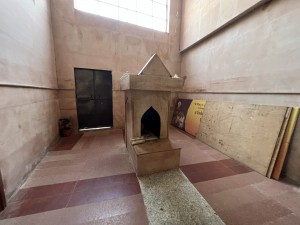
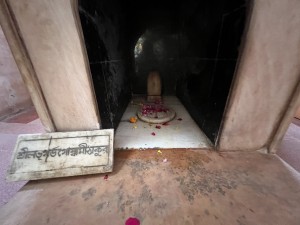
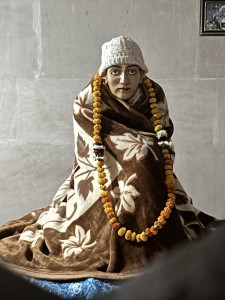
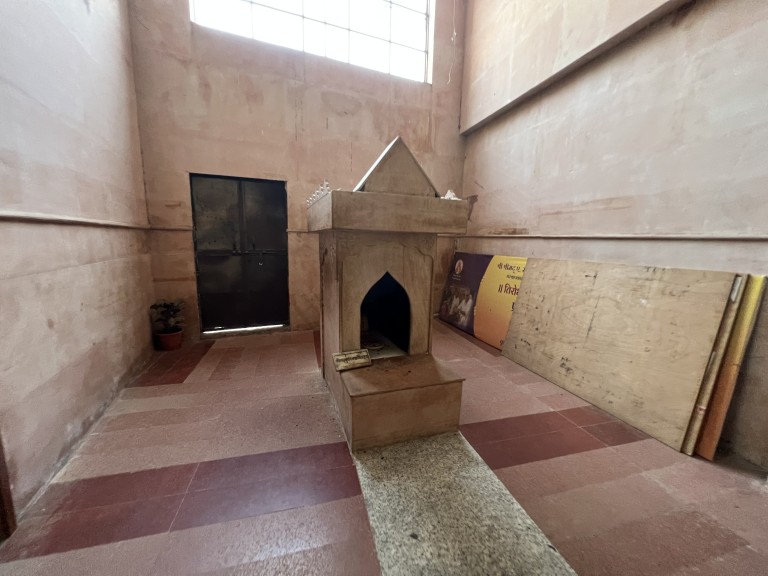
Srila Rupa Goswami entered samadhi in the year 1564, and his sacred body was entombed here next to his bhajana-kutira by his beloved disciple and nephew Jiva. Srila Rupa Goswami was born in the year 1489 and first met Lord Chaitanya along with his two brothers at Ramakeli, West Bengal, in 1514, at this first meeting, the three brothers resolved in their hearts to renounce the world and devote their lives to the service of Lord Chaitanya Mahaprabhu. In the year 1516, Rupa Goswami arrived in Vrindavana and spent the rest of his life in propagating the mission of Lord Chaitanya and by the time he left the world, he had accomplished enough to establish Vrindavana, the place where Lord Krishna performed His transcendental pastimes five thousand years earlier, as the most important place of pilgrimage, not only in India, but on the entire face of the earth.
Even though Rupa Goswami accepted his elder brother Sanatana as his guru, Rupa is recognized as the most prominent amongst the Six Goswamis and was undoubtedly the main driving force in pushing forward Lord Chaitanya’s sankirtana mission. Even though all Gaudiya Vaishnavas accepted Sanatana Goswami as their guru, being the senior-most disciple of Lord Chaitanya, they simultaneously acknowledged Rupa Goswami as the spiritual leader of all Gaudiya Vaishnavas in the world. In the year 1534, with the sudden disappearance of Lord Chaitanya, it was Shrila Rupa Goswami who kept Lord Chaitanya’s fledgling mission united and carefully steered it to become a dominant force within the Vaishnava community of India. Shrila Rupa Goswami became the undisputed leader and first great acharya of the newly formed Gaudiya Vaishnava sampradaya founded exclusively on the precepts and teachings of Lord Chaitanya Mahaprabhu. In the Gaudiya Vaishnava tradition, all the followers of Lord Chaitanya Mahaprabhu are known as Rupanugas, or those who follow in the footsteps of Shrila Rupa Goswami.
According to the Gaura-ganaddesha-dipika, Rupa Goswami is the highly celebrated Rupa-manjari in Krishna’s Vrindavana pastimes. Rupa-manjari is one of Radha’s most confidential maidservants and in the transcendental hierarchy of gopi maidservants, she is considered second only to Lalita-sakhi. It is therefore said in the Vaishnava tantras, that before one can approach Radha and Krishna, one must first take shelter of Lalita-sakhi and receive her blessings, then only can one dare to approach Radha and Krishna. Concomitantly, it is also said that before one can take shelter of Lalita, one should first surrender to her assistant, the all-merciful Rupa-manjari, and be blessed by her, and then only one can approach Lalita-sakhi.
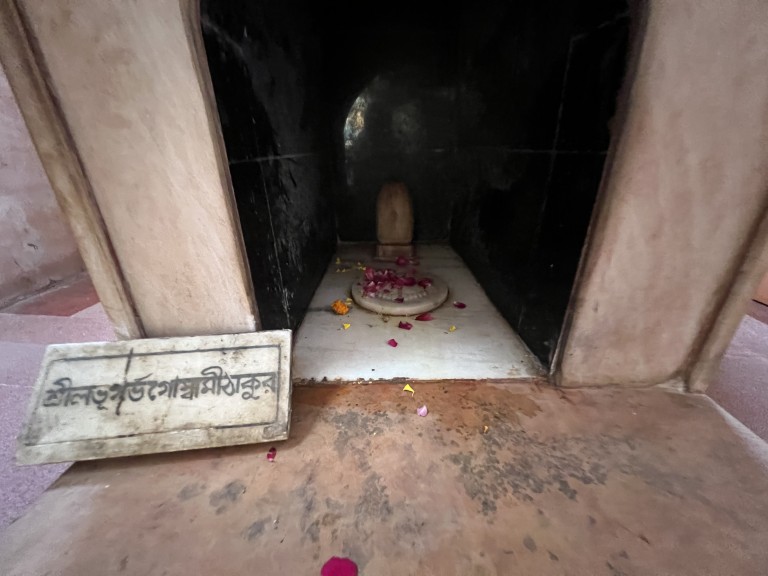
Bhugarbha Goswami Samadhi
Bhugarbha Goswami is one of the least known amongst the Vrindavana Goswamis because he lived a very reclusive life. He became known as Bhugarbha because he would generally find a small cavern or hole in the ground in which he would perform his bhajana, the word ‘bhu’ means ‘earth’, or ‘ground’, and ‘garbha’ means in this regard a ‘hole in the ground’ and refers to any interior chamber. A number of other Gaudiya Goswamis also utilized small holes or caverns within the earth as places to perform bhajana, including Lokanatha Goswami, Raghava Pandita Goswami, Jiva Goswami and Shyamananda Pandita Goswami. Performing bhajana in a hole or cave helped avoid any distraction and the temperature inside the earth always remains constant and therefore it is cool in summer and warm in winter.
Bhugarbha Goswami was one of the most prominent disciples of Gadadhara Pandita and a very close friend of Lokanatha Goswami. These two Goswamis travelled all over Vraja Mandala in search of the dwadashavanas, the twelve sacred forests of Vrindavana Dhama. In the Bhakti-ratnakara it says, “Bhugarbha Goswami and Lokanatha Goswami were so close and affectionate to one another that they were like one body.” Once in a dream, Lord Chaitanya appeared before Bhugarbha Goswami and ordered him to go to Vrindavana and locate all the sacred forests. His friend Lokanatha Goswami also had a similar dream, in which Lord Chaitanya gave him a same order, that he should go to Vrindavana and locate the sacred forests and places of Krishna’s pastimes. The two friends immediately left for Vrindavana where they arrived in the year 1509. The two Goswamis simply wandered around Vraja calling out the names of her twelve forests and it is said that Vrinda Devi revealed the exact location of each forest. Lokanatha Goswami also discovered the celebrated Deity of Radha Vinoda hidden within Kishori-kunda near Umraya. Bhugarbha Goswami used to worship the Deities named Radha-Chalchikan that were being worshiped in a temple nearby but due to closure of that temple They were installed on the altar of the Radha Damodara Mandira. Bhugarbha Goswami entered samadhi on chatudasi during Kartika (Krishna-paksha). According to the Gaura-ganoddesa-dipika, it says that Bhugarbha Goswami is the gopi named Prema Manjari in Krishna’s Vrindavana pastimes.
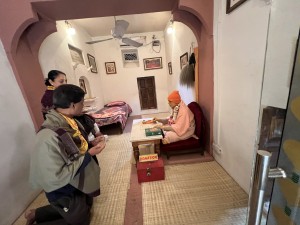
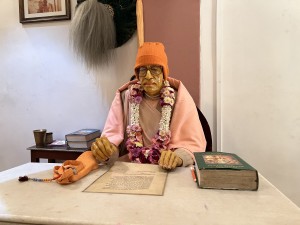
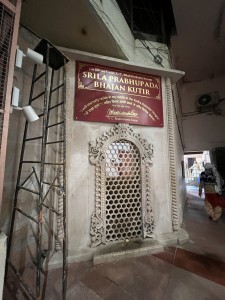
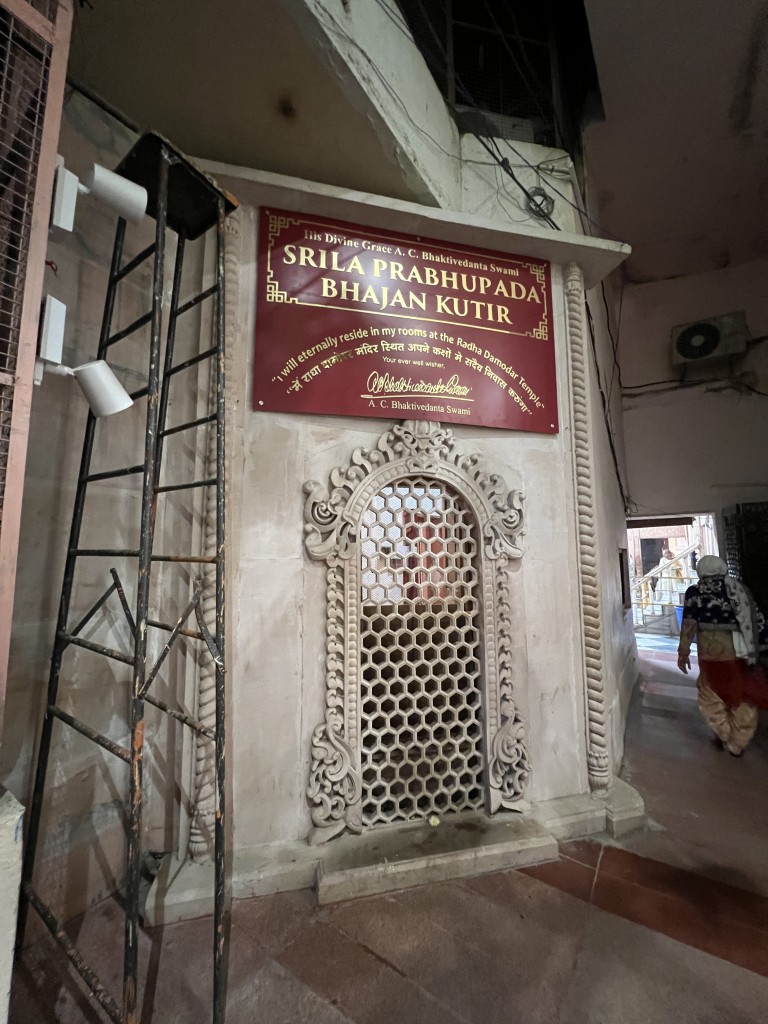
Bhaktivedanta Swami Prabhupada Bhajana-kutira
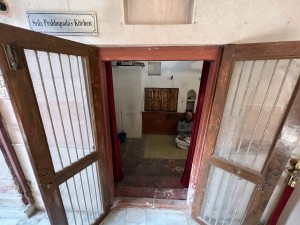
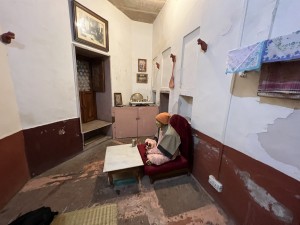
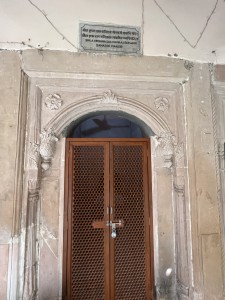
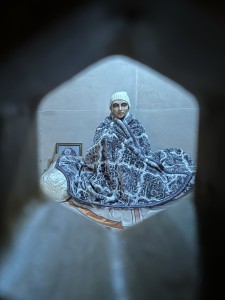
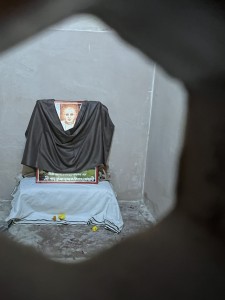
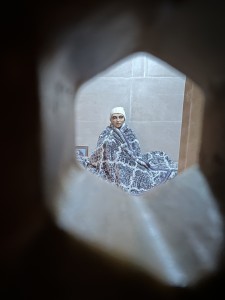
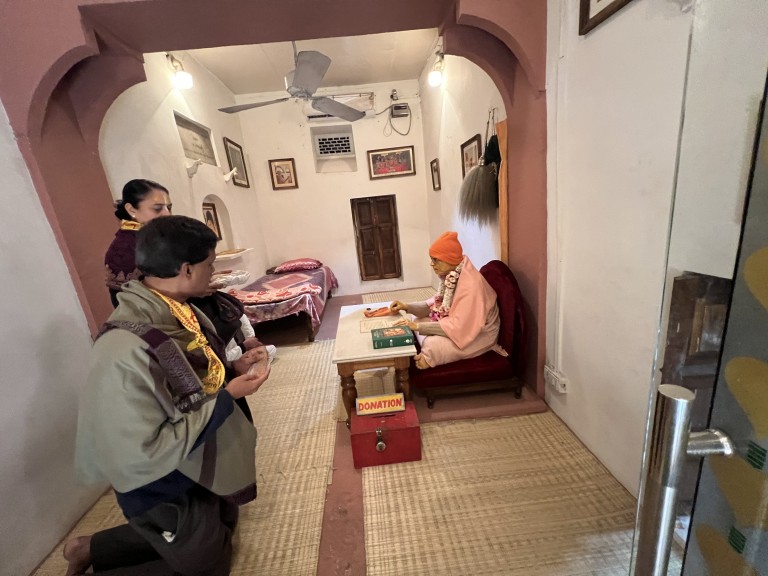
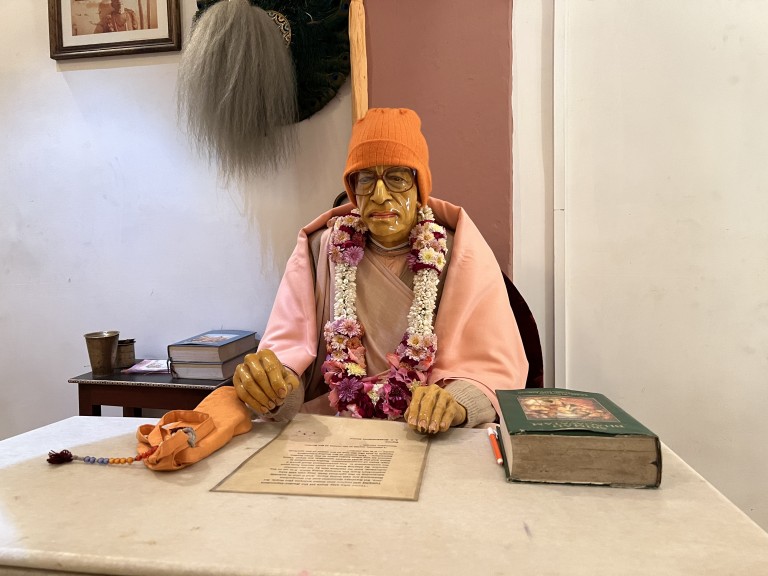
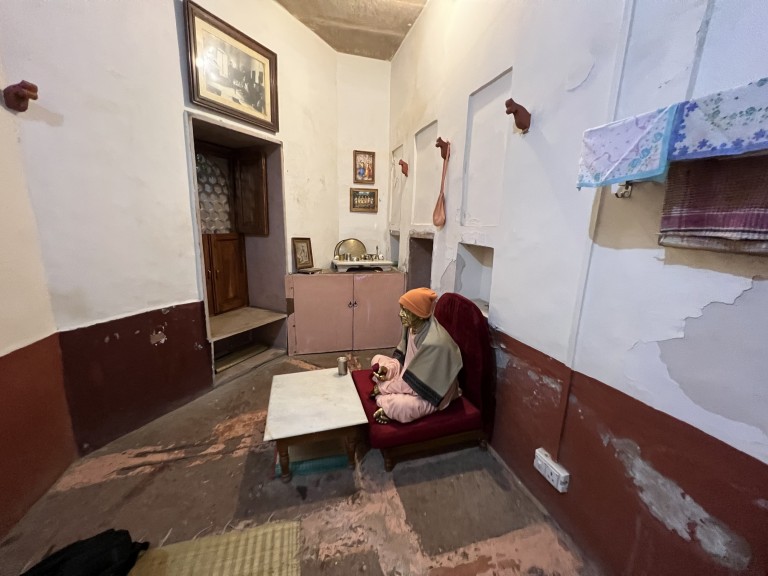
These are the famous rooms at the Radha Damodara Mandira where His Divine Grace A. C. Bhaktivedanta Swami Prabhupada, the founder-acharya of Iskcon, stayed for six years before leaving on his historic journey to the U.S.A. in the year 1965, where he established the International Society for Krishna Consciousness, popularly known as the Hare Krishna Movement. Having been born into an aristocratic Vaishnava family in Calcutta in 1896, Shrila Prabhupada, as he was known amongst his followers, first met his spiritual master Shrila Bhaktisiddhanta Saraswati Goswami in 1922; some years later in 1933 he became his formally initiated disciple receiving the name Abhaya Charanaravinda. After running a successful pharmaceutical business in Allahabad, Shrila Prabhupada retired in 1954 and adopted the vanaprasta-ashrama. At this time he started the iconic monthly magazine ‘Back To Godhead’ and eventually moved to Jhansi in Madhya Pradesh, where he opened a preaching centre for propagating the teachings of Lord Chaitanya Mahaprabhu.
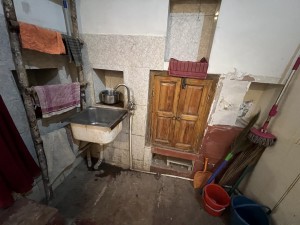
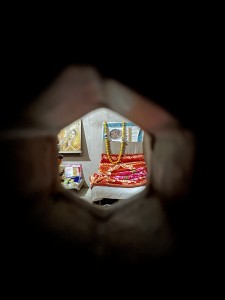
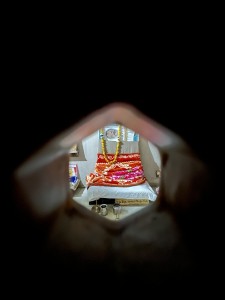
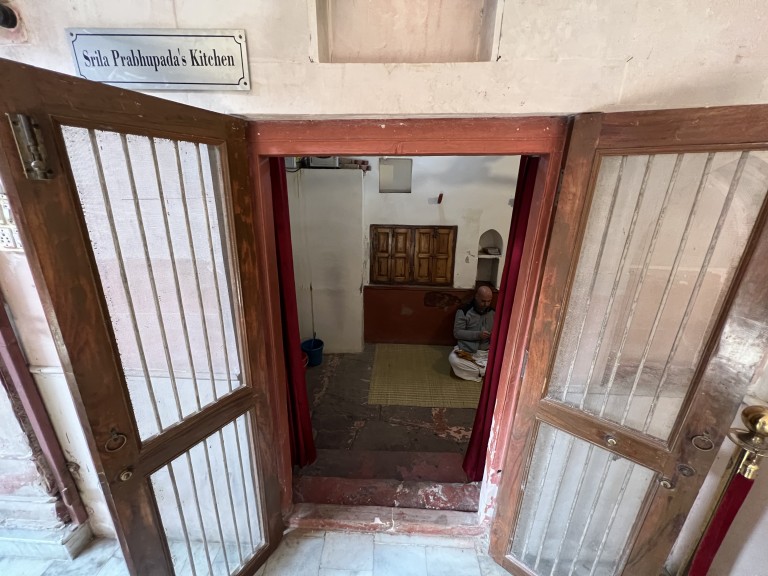
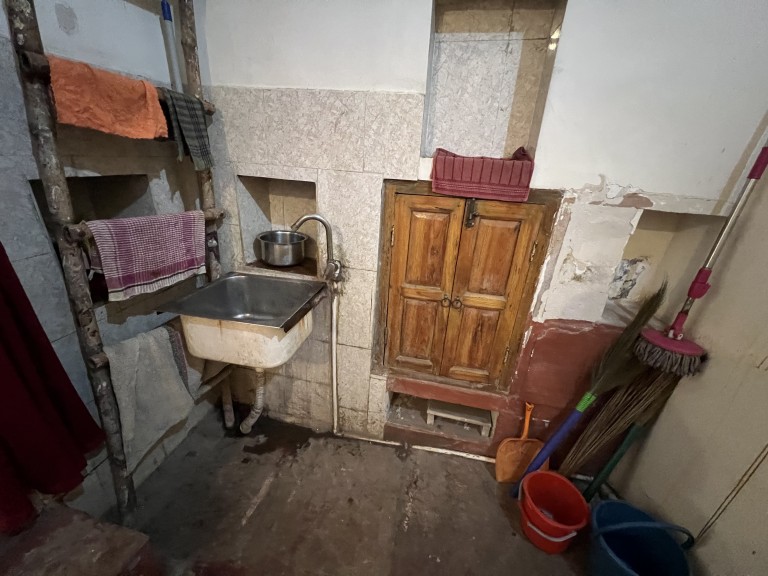
In 1956, Shrila Prabhupada moved to the holy city of Vrindavana where he initially stayed in a room at the Vamsi Gopala Mandira near Keshi Ghata. Then in July 1959, after having begun his now famous English translation of the Vedic classic Shrimad-Bhagavatam, Shrila Prabhupada relocated to the Radha Damodara Mandira and occupied two rooms on the upper floor. Then in 1962, Shrila Prabhupada moved downstairs into two rooms on the ground floor, adjacent to the temple courtyard. One of the rooms became his kitchen, and this is where he also honored prashadam while looking through the latticed window at Rupa’s Goswami’s samadhi and bhajana-kutira. The other room he used as his bhajana-kutira where he chanted japa and spent much of his time translating the Shrimad-Bhagavatam. Moving to the Radha Damodara Mandira was a major turning point in Shrila Prabhupada’s life and it was here where he began in earnest his life’s mission of fulfilling his spiritual master’s order, which was to spread the teachings of Lord Chaitanya to the Western world. On September 17th 1959, Shrila Prabhupada accepted the renounced order of life known as tridandi-sannyasa, from his dear god-brother Keshava Maharaja at the Gaudiya Matha temple in Mathura. After moving to Radha Damodara and now having taken sannyasa, Shrila Prabhupada began formulating his plans of traveling to America and establishing a world-wide society of devotees dedicated to the devotional service of Radha and Krishna.
Shrila Prabhupada said that the Radha Damodara Mandira was the most important temples in Vrindavana, because it was here that Shrila Rupa Goswami resided and where he established his headquarters for preaching the mission of Lord Chaitanya’s sankirtana movement. Lord Chaitanya had personally sent Rupa Goswami to Vrindavana to accomplish the task of establishing the Krishna consciousness movement for the spiritual benefit of the whole world. Shrila Prabhupada has said that this corner at the Radha Damodara Mandira was like the hub of the spiritual world, due to the activities performed there by the Six Goswamis in propagating the sankirtana movement, which began here under Rupa Goswami leadership, and then gradually spread out around the world, just as the spokes of a wheel start from the hub, and then spread out in every direction. Shrila Rupa Goswami created the solid foundation of Lord Chaitanya’s mission here at Radha Damodara, but it was Shrila Prabhupada who single-handedly took that mission from there, to every part of the globe.
With just a crate of his English translations of the Shrimad-Bhagavatam and only forty rupees in his pocket, Shrila Prabhupada left the Radha Damodara Mandira in Vrindavana on a journey that would ultimately change the course of religion in both America and the world forever. On the 13th of August 1965, Shrila Prabhupada set sail from the Indian port of Calcutta, having obtained free passage on the Scindia Steamship Lines cargo ship named the Jaladutta, bound for the United States of America, where he landed at Boston Harbor on the 17th September. The arrival of Shrila Prabhupada in America gave birth to the Hare Krishna revolution which has now become an important watershed in modern history.
Looking back on his days in Vrindavana, Shrila Prabhupada said that living at Vrindavana’s Radha Damodara Mandira as a sannyasi and performing madhukari in order to sustain his existence, was one of the most blissful periods of his life. While staying there, besides the ecstasy of translating the Shrimad-Bhagavatam into English, he would go on parikrama every morning and evening to have darshana of all the famous Deities of Vrindavana. While residing in his rooms at Radha Damodara, Shrila Prabhupada once revealed that both Rupa and Jiva Goswami had appeared to him in dreams, encouraging him to accomplish the greatest task ever expected of a pure devotee – to deliver the sublime teachings of Lord Chaitanya Mahaprabhu to a most inhospitable and hostile alien world. Shrila Prabhupada’s stay at Radha Damodara, not only transformed his own life, but ultimately it transformed the lives of millions of people around the world. He once confidentially informed his senior disciples, that he is eternally present in his rooms at the Radha Damodara Mandira. At 7.30pm on November 14th, 1977, Shrila Prabhupada entered into maha-samadhi at the Krishna Balarama Mandira in Vrindavana, and his sacred body was entombed in a beautiful white marble Samadhi Mandira located in the temple grounds.
Photo (37)