

Description

Bhaktivedanta Narayana Gosvami
From the book “Sri Vraja-maṇḍala-parikramā”:
Kusuma-sarovara is on the right of the parikramā path, about one-and-a-half miles south-west of Śrī Rādhā-kuṇḍa. A forest of flowers (kusuma) was here full of varieties of trees, creepers and flowers like belī, camelī, jūhī, yūthī, mallikā and campaka. Śrīmatī Rādhikā used to come here on the pretext of picking flowers with Her girlfriends, but Her real intent was to meet rasika Śrī Kṛṣṇa, with whom She would have love-quarrels and sarcastic exchanges full of rasa.
Kṛṣṇa-bhāvanāmṛta describes how one day Śrīmatī Rādhikā was picking flowers here with Her girlfriends when Kṛṣṇa arrived, and the following exchange took place:
Kṛṣṇa: Who is there? Rādhā: Nobody.
Kṛṣṇa: Tell Me honestly, who are You? Rādhā: Nobody.
Kṛṣṇa: You are speaking in a very crooked way.
Rādhā: And You speak in a very straight way, don’t You? Kṛṣṇa: I am asking You who You are.
Rādhā: Don’t You know? Kṛṣṇa: What are You doing?
Rādhā: Picking flowers to worship the Sungod.
Kṛṣṇa: Have You received permission from anyone to do so?
Rādhā: There is no need of anyone’s permission.
Kṛṣṇa: Aha, I have caught a thief today. I wondered who was stealing flowers every day and ruining this garden. Now I have caught You, and will punish You straight away.
Rādhā: Since when have You become the master of this flower garden? Have You ever planted a single flower here? Have You ever even watered one? On the contrary, You ruin this flower garden with Your hundreds and thousands of cows and Your boisterous, brazen friends. Indeed, since when have You become the protector of this garden?
Kṛṣṇa: Do not defame a pious, righteous person like Me. Now I shall teach You a good lesson.
Rādhā (smiling): Aha-ha, You are a highly pious and righteous person, are You? You killed a woman right after Your birth; You lied to Your mother even in childhood; You stole butter from the houses of the neighbouring gopīs; and when You became a little older, You stole the clothes of the young gopīs. Only a few days ago You killed a calf. This is the extent of Your pious, saintly conduct.
Hearing the retort, Kṛṣṇa scratched His head and looked towards clever Madhumaṅgala, who advised Him, “One’s wellbeing lies in remaining quiet.” At this point, all the sakhīs surrounded Śyāmasundara and began to clap.
The following pastime also took place here. One morning, Śrīmatī Rādhikā and Her sakhīs came to the bank of Kusuma- sarovara to pick belī, camelī, jūhī, kanera, campaka and other flowers that bloomed here. Śrīmatī Rādhikā saw a tree with a branch full of flowers. Knowing that She was coming to Kusuma- sarovara to pick flowers, playful Kṛṣṇa had climbed that very tree. Using all His weight, He pushed the branch down and remained hidden in the foliage so that Śrīmatījī could not see Him. Rādhikā pulled down that branch with one hand, and was absorbed in picking its flowers with the other when suddenly Kṛṣṇa shifted to another branch. The branch sprung up, lifting up Rādhikā with it and She cried out for help. Śrī Kṛṣṇa leapt out from the tree and caught hanging Śrīmatījī in His arms. The sakhīs began clapping and laughing loudly, but Śrīmatī Rādhikā, released Herself from Śrī Kṛṣṇa’s embrace and scolded Him harshly.
Now the flower garden at Kusuma-sarovara has completely disappeared.
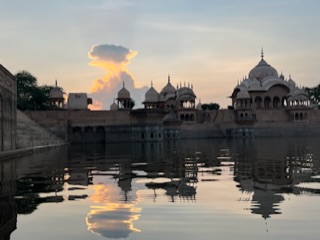
In 1767 AD, Mahārāja Javāhara Singh of Bharatapura looted the royal treasury of Delhi, and with that money built ornate stone ghāṭas with steps down to the water’s edge. To the west of the sarovara is the cenotaph of Rājā Sūrajamala flanked by the cenotaphs of his two queens. There is a temple of Uddhavajī here.
Rajashekhara Dasa
From the book “Chaurasi-kosa Vraja Mandala Parikrama”:
This is one of the most beautiful and scenic places in the whole of Vraja. This lake is also known as Sumanah-sarovara and is one of the places where Radharani and the gopis would bathe and also pick lotus flowers to make garlands for Krishna. The word ‘kusuma’ means ‘lotus flowers’ and ‘sarovara’ means a ‘lake’. The word sumanah also refers to the particular type of rare lotus flower that grew in this lake. Lord Chaitanya Mahaprabhu also came to Kusuma Sarovara during His parikrama of Vraja in the year 1515 and took His bath in the sacred lake. It is said that one who bathes in Kusuma-sarovara becomes eligible to witness the ashta-kaliya-lila or eight-fold daily pastimes of Radha and Krishna. It is said that once Narada Muni informed Vrinda Devi that he had the ardent desire to witness the rasa-lila in Vrindavana, therefore Vrinda Devi told him to bathe in Kusuma-sarovara, and after doing so, he achieved the body of a gopi and was able to enter the rasa-mandala to see the rasa dance. In the Vraja-riti-chintamani it says,
“Simply by once bathing in this Kusuma-sarovara, Narada Muni attained a gopi form. This fact is directly confirmed in the words of the enchanting Supreme Personality of Godhead.”
The palatial monuments on the northern bank of the lake were built by Jawahir Singh, the king of Bharatapura in 1764, as a tribute to his great father Raja Suraj Mal, the most famous Jat warrior in Indian history. The main building is actually the samadhi of Suraja Mal and contains his ashes; the two buildings on either side are the samadhis of his two queens whose ashes are also entombed there. The ceilings are decorated with paintings from Krishna-lila as well as the heroic exploits of Suraj Mal. On the western bank of the lake near the old Shiva temple is the samadhi of Ashtavakra Muni. It is said that Ashtavakra Muni did penance here at Kusuma-sarovara for many years while waiting for the appearance of Radha and Krishna. One day he had the darshana of the ‘divine couple’ enjoying pastimes on the banks of the lake and immediately gave up his body.
