Description

Bhaktivedanta Narayana Gosvami
From the book “Sri Vraja-maṇḍala-parikramā”:
“Mathurā-dhāma is blessed, being superior even to Vaikuṇṭha, the holy abode of Śrī Nārāyaṇa. By residing in Mathurā for only one day a person attains devotion to Lord Hari, and by residing here three nights, one attains that the rarest love of God, which is difficult to obtain even for great liberated souls.”
The Glories of Śrī Mathurā
There are seven holy cities on the Earth that award liberation – Ayodhyā, Mathurā, Māyāpurī (Haridvāra), Kāśī, Kāñcī, Avantīkā (Ujjain), and Dvārāvatī (Dvārakā). Of these, Mathurā, the birthplace of the Supreme Lord Śrī Kṛṣṇa– Chandra, is the topmost. This abode not only awards liberation but also bestows the love of God (Bhagavad-Prema). Mathurā is the Supreme Lord’s abode consisting of eternity, knowledge, and bliss and it is completely beyond the illusory energy. It is protected by the Sudarśana chakra and is therefore not affected by the universal dissolution or other disruptions. What to speak of Vaikuṇṭha, it is even more praiseworthy than Dvārakā, which is ornamented by Śrī Kṛṣṇa’s queens6.
This city of Mathurā is never annihilated. At the beginning of Satya–yuga, the child Dhruva met Devarṣi Nārada here. Dhruva took bath in the Yamunā at Dhruva–ghāṭa (in Mathurā) and accepted the nāma-mantra of the Lord from Nārada Muni. Nearby at Madhuvana–Maholī, he attained perfection by worshipping Bhagavān.
Also in Satya–yuga, Durvāsā Ṛṣi arrived here while the devotee Mahārāja Ambarīṣa was in the course of breaking his vow of observing Ekādaśī and Dvādaśī, and it was here that Durvāsā realised Ambarīṣa Mahārāja’s glory. Even today, Cakra–tīrtha and Ambarīṣa–ṭīlā stand as witnesses to how Ambarīṣa Mahārāja was protected by the Sudarśana chakra.
In Tretā–yuga, on the order of Śrī Rāmacandra, Śrī Śatrughna killed the son of the demon Madhu, Lavaṇāsura, here. This pastime is well–known. In Dvāpara–yuga, Mathurā became famous as the place of Śrī Kṛṣṇa’s appearance and the site of His many pastimes. It is also well known that Śrī Kṛṣṇa–dvaipāyana Vedavyāsa took birth here on an island in the Yamunā.
In Kali–yuga the Supreme Lord Śacīnandana Śrī Gaurahari, resplendent with the luster and inner sentiments of Śrī Rādhā, came to take darśana of Vraja–dhāma. First He reached Mathurā, where He took bath at Viśrāma–ghāṭa, and then visited the pastime places within the eighty–four koshas of Vraja–maṇḍala. Gauḍīya literature describes that Śrī Advaita Ācārya, Śrī Nityānanda Prabhu, Śrī Lokanātha Gosvāmī and Śrī Bhūgarbha Gosvāmī arrived in Mathurā before Śrī Caitanya Mahāprabhu. Śrī Caitanya Mahāprabhu’s intimate associates, such as Śrī Rūpa, Śrī Sanātana, and other gosvāmīs, came to Mathurā and Vraja after Him and roamed throughout the land. Śrī Caitanya-caritāmṛta and Bhakti- ratnākara further describe that later all our Gauḍīya ācāryas came to Mathurā Vraja–maṇḍala.
The abundant glories of Mathurā are described in the Purāṇas. Bhagavān Śrī Keśavadeva is present in the heart of this abode, which is likened to the whorl of a lotus. On the northern petal, in Vṛndāvana, is Śrī Govindadeva by whose darśana a person is forever liberated from the cycle of birth and death. On the eastern petal, at Viśrāma–ghāṭa, is the form of the Lord named Viśrānti, and on the southern petal is Ādi–varāhadeva, who bestows all–perfection7.
Bathing in any of Mathurā’s sacred waters destroys all the sins of any living entity, and each and every step taken in Mathurā gives the same result as performing a horse sacrifice (aśvamedha-yajña). The Supreme Lord Himself says in the Ādi-varāha Purāṇa: “O Vasundharā, certainly, in all the three worlds – the hellish planets, the world of humans and the celestial realm – nowhere is as dear to Me as Mathurā8.” He further states in the same Purāṇa: “O Vasundharā, during Cāturmāsya, My time of sleep, all the oceans, lakes and places of pilgrimage dwell in Mathurā9.”
Skanda Purāṇa mentions that the result attained by residing in any other part of Bhāratavarṣa (India) for hundreds and thousands of years is attained simply by remembering the city of Mathurā10.
Whoever chants and fasts in Mathurā becomes free from sin by taking darśana of Śrī Kṛṣṇa’s birthplace11. A sinful person who has killed a brāhmaṇa, who is a drunkard, who kills cows, or who has violated celibacy, becomes free of these sins merely by circumambulating Mathurā. All those who come from other far–off places to perform Mathurā parikramā and to have darśana of the pastime places here become free from all kinds of sins. Not only that, if one simply takes a vow to reside in Mathurā, he becomes free from all kinds of material entanglements.
It is written in the Padma Purāṇa that one who desires to have darśana of Mathurā but leaves his body before getting this opportunity, will surely take birth in Mathurā in a future life12.
There is not the slightest doubt about this. Only those with firm, unshakeable devotion for Śrī Kṛṣṇa, and who are the objects of His abundant mercy, can have an attachment to this Mathurāpurī, which is beyond the material world13.
In Vāyu Purāṇa it is written that Mathurā–maṇḍala is within the eighty–four koshas of Vraja–maṇḍala, and that the Supreme Lord Śrī Hari Himself eternally resides here14. The Vāyu Purāṇa further states that “Mathurā–dhāma is blessed, being superior even to Vaikuṇṭha, the holy abode of Śrī Nārāyaṇa. By residing in Mathurā for only one day a person attains devotion to Lord Hari, and by residing here three nights, one attains that the rarest love of God, which is difficult to obtain even for great liberated souls15.”
Śrīla Rūpa Gosvāmī has written in Śrī Mathurā-māhātmya: “O Avanti, become ready with a spittoon in your hands. O Māyāpurī (Haridvāra), become ready to fan with a cāmara. O Kāñci, take an umbrella in your hand. O Kāśi, hold wooden sandals in your hands and be ready. O Ayodhyā, do not be afraid anymore. O Dvārakā, do not chant any prayers today. This Mathurā–devī, who today has become the chief queen of Śrī Kṛṣṇa, the great King of kings, is pleased with all of you maidservants16.”
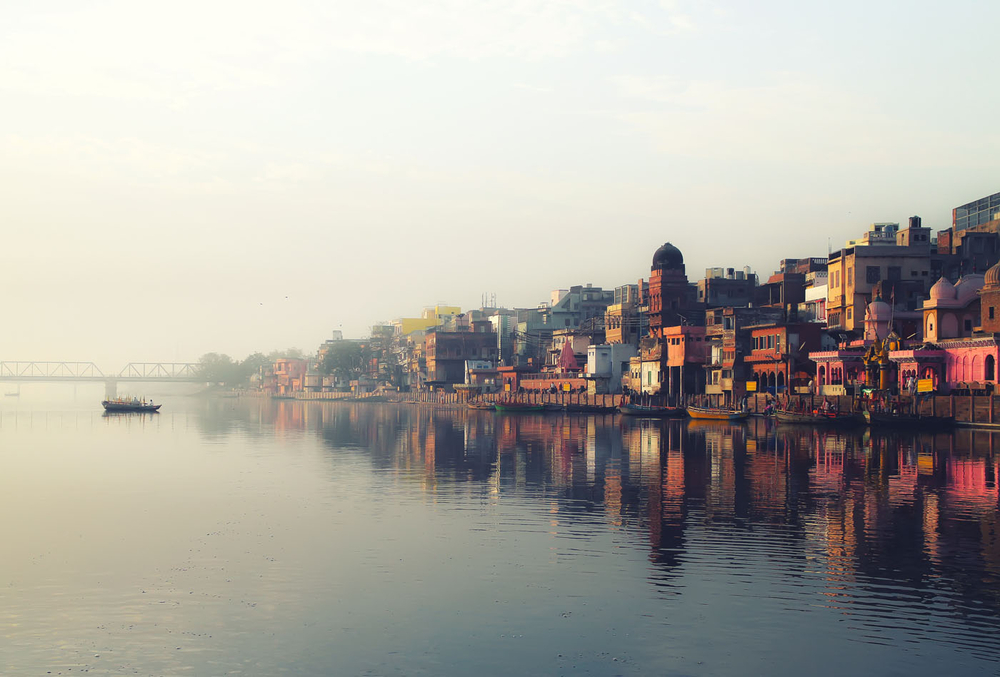
Photo (1)